Veracity upscaled revised

Medicare Novitas: Navigating the Enrollment Landscape

7 lvXGxmx6B

Handling your medicare novitas enrollment isn't just a box to check; it is the fundamental access point for your practice’s revenue cycle. Whether you are a new solo practitioner or managing a large multi-specialty group, understanding the specific nuances of this Medicare Administrative Contractor (MAC) is vital for successful medicare provider enrollment. If you miss a single beat in the application process, you aren't just looking at a minor delay: you are looking at a complete halt in reimbursements that can cripple your cash flow. Navigating the landscape of medicare novitas requires a blend of technical precision and strategic patience. As the MAC for Jurisdiction H and Jurisdiction L, Novitas Solutions oversees a massive territory, including states like Texas, Pennsylvania, and Maryland. Because they handle such a high volume of providers, their review process is rigorous, and their tolerance for errors is zero. When you submit an application, you are entering a system that demands absolute accuracy. Vintage watercolor illustration of a classical compass resting on an aged medical ledger, symbolizing direction and precision in healthcare administration. The Role of Novitas Solutions in Your Practice Novitas Solutions serves as the bridge between your healthcare services and the federal funds that sustain them. They are responsible for processing claims, but more importantly for your growth, they manage the provider enrollment gateway for thousands of clinicians. This means they are the ones who decide if your documentation meets the federal standards set by the Centers for Medicare & Medicaid Services (CMS). When you deal with medicare novitas, you aren't just dealing with a generic government entity. You are dealing with a specific set of regional rules and submission platforms that differ slightly from other MACs like Palmetto or NGS. Understanding these "Novitas-isms" is the difference between an approval letter and a rejection notice. Choosing Your Submission Channel One of the most critical decisions you will make is how to submit your enrollment data. While the end goal is the same, the path you take significantly impacts your timeline. You generally have three choices: PECOS (Provider Enrollment, Chain, and Ownership System): This is the national, internet-based system. It is comprehensive but can be notoriously clunky for those who don't use it daily. The Novitas Provider Enrollment Gateway: This is a specific tool designed by Novitas to allow for the digital upload of paper applications. It functions as a middle ground for those who prefer the layout of paper forms but want the speed of digital delivery. Traditional Mail: Sending hardcopy applications is still an option, though it is the slowest and carries the highest risk of documents being lost or delayed. For most modern practices, the medicare novitas Gateway or PECOS is the way to go. You can find more details on how these systems interact in our guide on navigating the maze of Medicare enrollment. The 8-Step Gateway Workflow If you choose to use the Novitas Provider Enrollment Gateway, you must follow a very specific technical dance. Deviation from these steps often leads to a "Submission Failure" message that can set you back weeks. Step 1: Accept the terms and conditions. Step 2: Provide your NPI and state of enrollment to request a one-time access code. Step 3: Enter the code immediately (it expires in 30 minutes). Step 4: Select your specific application type and the state where you will practice. Step 5: Upload the CMS-855 application as a PDF. Step 6: Attach all supporting documentation (licenses, certifications, voided checks). Step 7: Finalize the submission. Step 8: Save your Submission ID. This ID is your only lifeline for tracking the status of your file. Vintage watercolor medical illustration showing an ornate set of keys hanging next to a digital-style gateway, representing the access granted through proper enrollment. Essential Forms: The CMS-855 Series Every medicare novitas journey begins with the CMS-855 forms. Depending on your provider type, you will need to master one of the following: CMS-855I: For individual physicians and non-physician practitioners. CMS-855B: For clinics, group practices, and certain other suppliers. CMS-855A: For institutional providers like hospitals or skilled nursing facilities. CMS-855R: For the reassignment of Medicare benefits (crucial if you are joining an existing group). Errors on these forms are the primary reason for application "development": the dreaded process where a Novitas analyst sends your application back for corrections. Each time an application is developed, your "clock" resets, often adding 30 to 60 days to the total processing time. Novitasphere: The Power of the Portal For providers operating within the medicare novitas jurisdictions, Novitasphere is an indispensable tool. It is a free, secure web portal that provides access to eligibility, claim status, and: most importantly: enrollment tracking. Setting up a Novitasphere account requires an initial enrollment for the office or group, followed by individual user setups. Once active, it allows you to see exactly where your application sits in the queue. You no longer have to wait on hold for hours with a call center; the data is at your fingertips. This level of transparency is vital when managing the enrollment of surgery centers or other high-complexity facilities. The High Cost of Enrollment Delays In the world of medicare novitas, time is literally money. Medicare does not typically allow for back-billing for services rendered before your "effective date" of enrollment. If your provider starts seeing patients on June 1st, but your enrollment isn't approved until July 15th, those six weeks of revenue may be lost forever. The consequences of a botched enrollment include: Zero Reimbursement: You are providing free care until the paperwork clears. Patient Dissatisfaction: Medicare patients may be forced to seek care elsewhere if you aren't an "active" provider. Compliance Risks: Operating outside of active enrollment windows can trigger audits or "overpayment" demands from CMS. Vintage watercolor illustration of an hourglass filled with gold coins instead of sand, emphasizing the financial impact of time in the enrollment process. Why The Veracity Group is Your Strategic Partner At The Veracity Group, we don't just "fill out forms." We provide

Mastering PECOS Medicare for Faster Approvals

Pbaq5 aQwQo

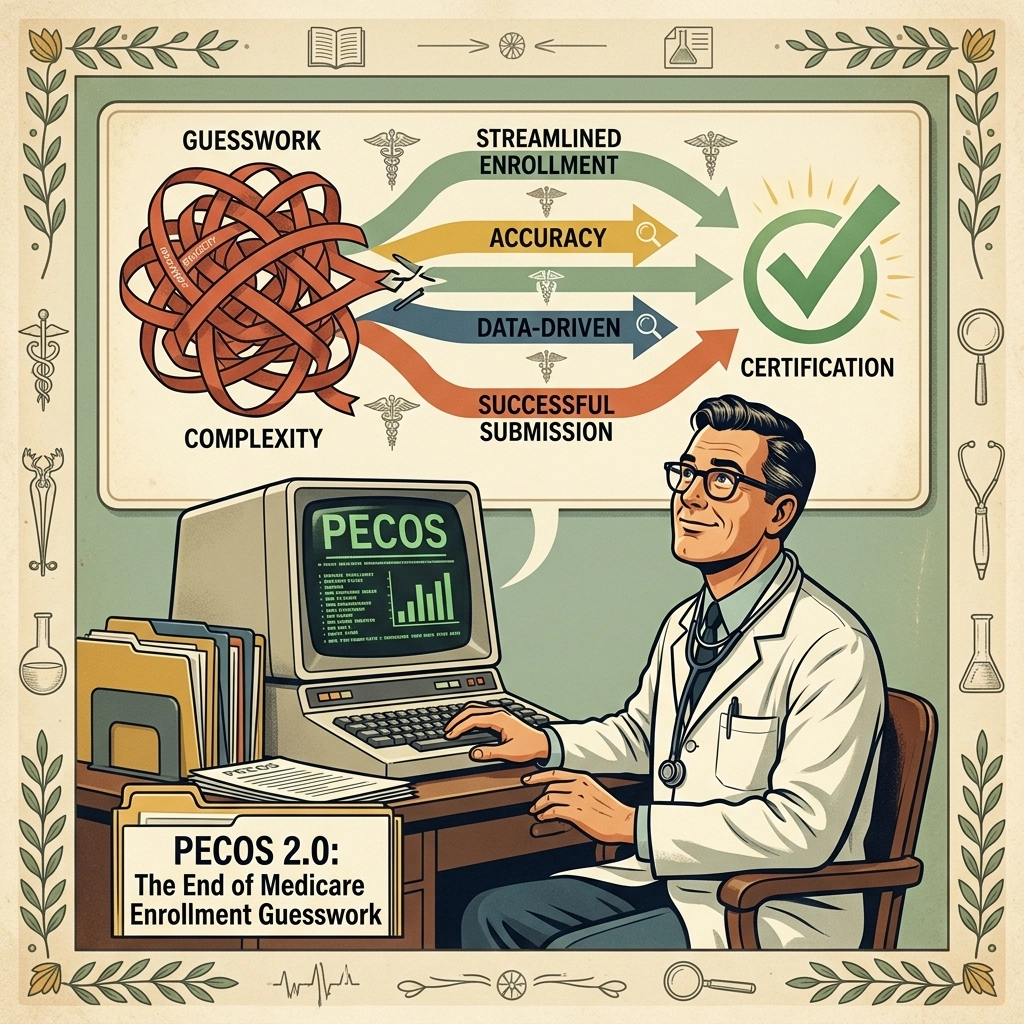
Navigating the complexities of federal healthcare programs can feel like a full-time job, but mastering pecos medicare is the only way to ensure your practice actually gets paid for the work you do. Whether you are dealing with initial setup or handling your medicaid provider enrollment, the digital landscape of the Centers for Medicare & Medicaid Services (CMS) requires precision and patience. The Provider Enrollment, Chain, and Ownership System (PECOS) is the engine behind your Medicare participation, and if that engine stalls, your revenue stream dries up immediately. Looking for professional provider credentialing services in the USA? 👉 Check our main service page here: veracityeg.com The Backbone of Professional Credibility In the healthcare world, PECOS Medicare is the backbone of professional credibility. It is the national electronic portal where providers submit, view, and update their enrollment information with Medicare. Think of it as your practice’s digital passport; without it, you aren't crossing the border into the Medicare reimbursement territory. While the system was designed to streamline the paper-heavy processes of the past, it remains a common source of frustration for many administrators. The high cost of delays is not just a theoretical risk: it is a reality that can make or break your practice's monthly cash flow. A single typo or a missing document can lead to a "Returned for Corrections" status that pushes your approval date back by weeks or even months. Why Accuracy Trumps Speed When you begin your PECOS Medicare journey, the temptation is to rush through the screens to get the application off your desk. This is a critical mistake. Accuracy must be your priority. Medicare Administrative Contractors (MACs) are notoriously strict. They aren't looking for reasons to approve you; they are looking for data mismatches that allow them to flag your file for further review. Before you even log in, you must have your "ducks in a row." This includes: National Provider Identifier (NPI) details that match your state license exactly. IRS documentation (CP-575 or 147C letters) that confirms your Legal Business Name and Tax ID. Electronic Funds Transfer (EFT) information to ensure payments actually reach your bank account. Ownership and Control information, which requires disclosing anyone with 5% or more ownership in the entity. For a deeper look at how this fits into the broader enrollment landscape, check out our guide on navigating the maze of CAQH and Medicare enrollment. Registering for Access: The I&A System Before you can touch pecos medicare, you have to navigate the Identity & Access (I&A) Management System. This is the gatekeeper. You will need to establish a user account that connects your individual identity to your organizational NPI. Setting up these roles correctly is a foundational step that typically takes a day or two, but it is where many providers stumble. If you assign the wrong user roles: such as an "Authorized Official" vs. an "Access Manager": you might find yourself unable to sign the final application legally. This configuration bottleneck is a silent driver of enrollment delays that most people don't see coming until they are halfway through the process. Completing the Enrollment Application Once you are inside the PECOS Medicare system, the real work begins. The application will ask for your practice locations, your "specialty," and your reassignment of benefits. If you are a physician joining a group, you must ensure that the group’s NPI is linked correctly to your individual application. If the group hasn't updated their own file recently, your application could be stalled by their outdated records. This is why proactive management of your entire organization's profile is essential. The Importance of Disclosure Transparency is not optional. If a provider has had a license suspension, a criminal conviction, or an exclusion from any federal program in the last ten years, it must be disclosed upfront. Attempting to hide these facts is a guaranteed way to trigger an immediate denial and potentially a long-term ban from the program. According to the official CMS PECOS resources, failure to provide complete and accurate information is the leading cause of application rejection. Monitoring Communications with Your MAC After you hit "submit," the ball is in the MAC’s court. However, you cannot simply walk away. Most pecos medicare approvals take between 60 and 90 days, but that timeline only holds if you respond to "development requests" within the tight windows provided (usually 30 days). MACs will communicate via email or through the PECOS message center. If they ask for a copy of a diploma or a specific clarification on a practice address, you must provide it immediately. Every day you wait to respond is another day your claims sit in "unbillable" limbo. Revalidation: The Silent Deadline Mastering your enrollment isn't a one-and-done event. Every few years, Medicare requires you to revalidate your information. If you miss the revalidation notice: often sent to the "correspondence address" listed in your file: CMS will deactivate your Medicare billing privileges. Deactivation is a nightmare scenario. It doesn't just stop future payments; it can lead to a gap in coverage where you cannot bill for services provided during the deactivation period. Keeping your contact information current within pecos medicare is the only way to ensure you receive these critical notices. If you change your office suite number or your phone number, update it in the system within 30 days. Strategies for a Frictionless Approval To achieve faster approvals, you should adopt a "ready-fire-aim" approach in reverse: aim with extreme precision before you fire off the application. Audit Your Data: Cross-reference your state licensing board data with your NPI registry and your PECOS profile. If one says "Street" and the other says "St.", align them. Digital Signatures: Use the e-signature functionality within PECOS whenever possible. It is significantly faster than mailing a paper certification statement. Save Frequently: The PECOS portal is notorious for timing out. Save your progress every few minutes to avoid losing complex data entries. Verify Bank Info: Ensure the name on your bank account matches the name on your IRS