
Administrative bottlenecks, missing logins, and unexpected payer rejections should not stand between your providers and your revenue. At The Veracity Group, we manage your credentialing, primary enrollment, and commercial payer contract negotiations nationwide.
Unlike automated, disconnected software platforms that leave you to guess your application status, we combine rigorous, hands-on administrative follow-up with real-time transparency. We handle the complex compliance landscape of state Medicaid systems, commercial payer panels, and CAQH maintenance so your internal team can focus on patient care.



In the US healthcare system, therapy organizations generally operate within two distinct clinical categories: Behavioral Health Therapy and Rehabilitative Therapy. While provider licensing requirements, payer enrollment pathways, and reimbursement rules differ, both specialties require credentialing to participate in commercial insurance networks, Medicare programs, Medicaid organizations, and specialty therapy panels.
Mental health organizations credential independently licensed clinicians who diagnose, evaluate, and provide behavioral healthcare services.
Rehabilitation clinics credential therapists responsible for evaluations, treatment planning, therapy delivery, and patient recovery programs.
Credentialing requirements vary based on provider type, clinical responsibilities, payer participation rules, and supervision requirements. In most therapy organizations, both individual providers and the practice entity participate in the enrollment process.
Independently licensed mental health clinicians generally require full credentialing before participating in insurance networks.
Primary therapists responsible for evaluations and treatment plans generally require direct credentialing.
Credentialing requirements vary based on payer policies, supervision standards, and provider classifications.
The therapy organization itself must maintain enrollment records, contracts, and billing infrastructure.
In addition to credentialing individual providers, insurance carriers require the therapy organization itself to be enrolled as a participating healthcare entity. This enrollment connects the practice's Tax ID, organizational NPI, payer contracts, reimbursement records, and billing infrastructure.
The organization serves as the central credentialed entity linking providers, insurance contracts, reimbursement workflows, and payer participation records.
Identifies the organization as a healthcare entity separate from individual therapists.
Connects payer contracts, enrollment records, and reimbursement processing.
Establishes participation with commercial insurance, Medicare, and Medicaid programs.
Approved claims are reimbursed to the therapy practice rather than individual clinicians, supporting centralized revenue management, accounting oversight, and payer reporting requirements.
Successful credentialing depends on maintaining complete, accurate, and current provider records. Most insurance carriers, Medicare programs, Medicaid organizations, and therapy networks require a standard collection of professional, organizational, and enrollment documentation before participation can be approved.
Individual therapists must maintain professional records used during credentialing reviews and network enrollment.
Therapy organizations maintain entity-level records supporting enrollment and reimbursement activities.
Enrollment frequently requires participation in payer and government credentialing databases.
Credentialing timelines vary by payer type, provider specialty, application completeness, and state-specific processing requirements. While some enrollments can be approved within a few weeks, most therapy organizations should plan for a multi-month onboarding process before participating as an in-network provider.
PECOS processing, provider verification, and enrollment review requirements.
Network participation reviews, credentialing committees, and contract approvals.
State-specific verification, background reviews, and enrollment processing timelines.
Interstate compact registrations, licensure verification, and cross-state enrollment activities.
Because providers generally cannot bill as in-network clinicians until credentialing and enrollment are complete, therapy organizations should begin gathering documentation and submitting applications at least 90 days before a new provider begins seeing patients.
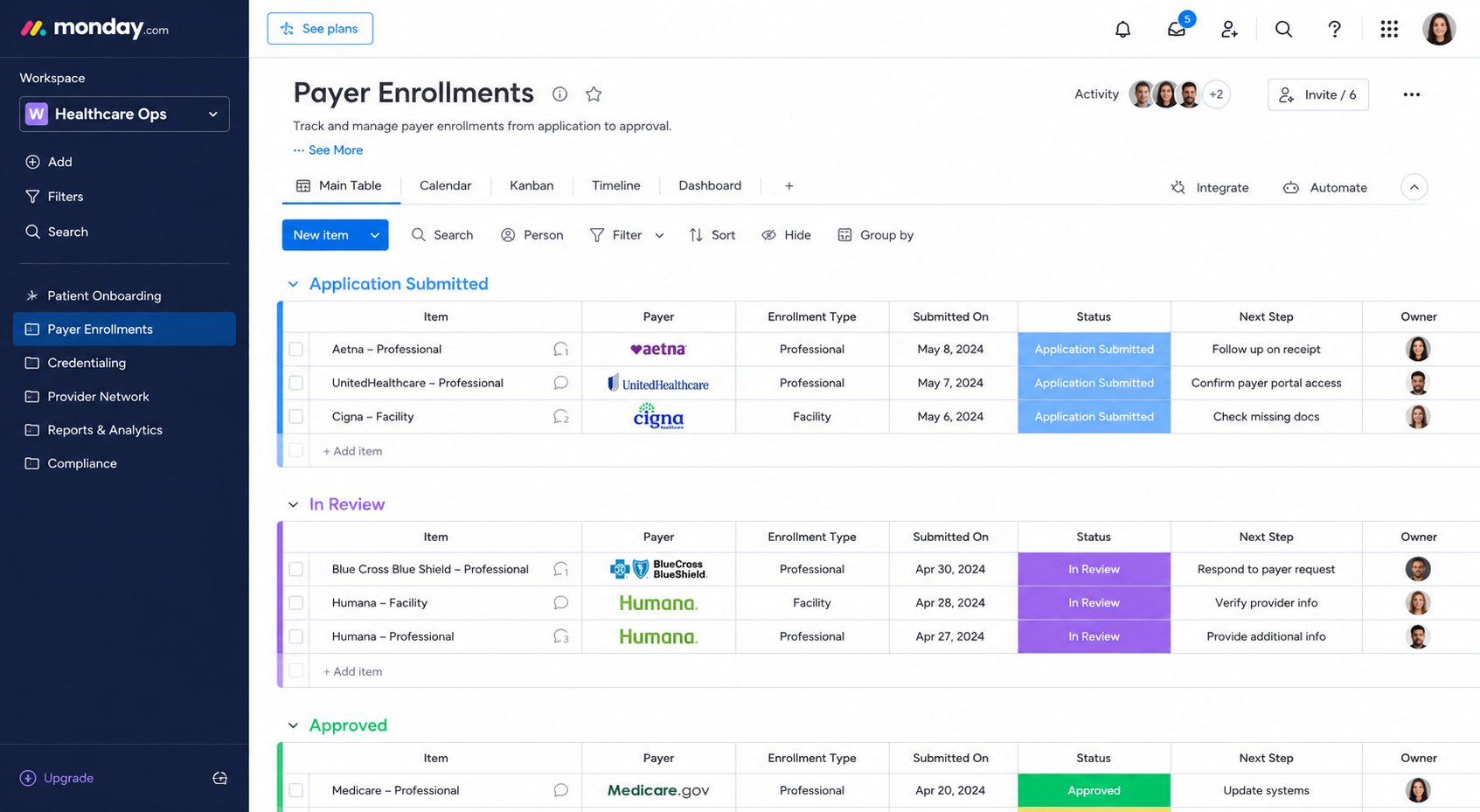
 MONDAY.COM POWERED WORKFLOW
Every provider enrollment, payer follow-up, document request, approval milestone, and communication history is tracked through our centralized workflow system—giving your administrators and leadership team complete visibility throughout the credentialing process.
Insurance participation is not simply an administrative formality. Commercial insurance carriers, Medicare programs, Medicaid organizations, and specialty therapy networks maintain extensive verification standards designed to protect patients, validate provider qualifications, and preserve program integrity.
Federal and state agencies routinely verify professional licenses, disciplinary history, educational credentials, and provider eligibility before enrollment approvals are issued.
Credentialing is not a one-time event. Providers must maintain current licenses, insurance coverage, demographic records, and periodic re-attestations to remain in good standing.
Every insurance carrier maintains unique enrollment standards, application requirements, review processes, and credentialing timelines that must be carefully managed.
Incomplete documentation, expired credentials, or missing disclosures can delay approvals, interrupt reimbursement, and create unnecessary compliance risks.
The Veracity Group helps therapy organizations navigate the credentialing process through structured workflows, document management, payer enrollment coordination, status monitoring, and compliance-focused record maintenance. Our objective is to reduce administrative burden while helping providers maintain participation across commercial insurance carriers, Medicare programs, Medicaid organizations, and specialty therapy networks.
Whether you’re opening a new practice, expanding locations, renewing provider credentials, or enrolling with Medicare, Medicaid, and commercial payers, The Veracity Group provides reliable nationwide credentialing support.

Simplifying provider credentialing, payer enrollment, and compliance management through transparent processes, dedicated support, and industry expertise.
Schedule Consultation© 2026 The Veracity Group. All Rights Reserved.