Telehealth Credentialing for Psychologists: The PSYPACT Revolution and Evolving Payer Rules

The demand for behavioral health services is at an all-time high, creating a critical need for streamlined provider enrollment and robust medical credentialing systems that allow psychologists to reach patients across state lines. As the mental health crisis intensifies, the traditional barriers to care: primarily state-specific licensure: are being dismantled by the Psychology Interjurisdictional Compact (PSYPACT). For practice owners and healthcare administrators, understanding this revolution is no longer optional; it is the backbone of professional credibility and a mandatory requirement for maintaining a competitive, revenue-generating practice in 2026. The PSYPACT Revolution: A New Era of Mobility The Psychology Interjurisdictional Compact (PSYPACT) is a multi-state agreement designed to facilitate the practice of telepsychology and the temporary in-person, face-to-face practice of psychology across state boundaries. Before the widespread adoption of this compact, a psychologist wishing to treat a patient in another state was forced to navigate a labyrinth of individual state board applications, paying multiple fees and waiting months for approval. Today, PSYPACT provides a passport to success for clinicians. By obtaining the proper credentials through the Association of State and Provincial Psychology Boards (ASPPB), a psychologist licensed in one compact state can legally provide services to patients in any other participating state. This is not a "free pass"; it is a rigorous, standardized verification process that ensures high-level care while eliminating the redundant administrative burden of multiple full state licenses. Looking for professional provider credentialing services in the USA? 👉 Check our main service page here: veracityeg.com The Two-Credential Requirement To leverage the power of PSYPACT, psychologists must secure two specific credentials. Failure to maintain both results in an immediate loss of interjurisdictional authority, which can lead to serious legal and financial consequences for your practice. The E.Passport: Issued by the ASPPB, this certificate confirms your educational background, active licensure status, and adherence to strict conduct standards. You must hold a doctoral degree in psychology from an APA/CPA-accredited program and have passed the EPPP (Examination for Professional Practice in Psychology) with a score that meets the compact's standards. Authority to Practice Interjurisdictional Telepsychology (APIT): Once the E.Passport is secured, the PSYPACT Commission issues the APIT. This is your official authorization to deliver services. Alt Text: Infographic showing the two-step PSYPACT authorization process: E.Passport and APIT certificates. Maintaining these credentials requires more than just a one-time application. You are required to complete three hours of continuing education annually specifically related to the use of technology in psychology. Without these credits, your authorization expires, and any services provided across state lines constitutes practice outside PSYPACT authority and may violate state law: a risk no medical group can afford. The Evolving Payer Landscape Since COVID-19 While PSYPACT simplifies the legal right to practice, the payer rules for psychologists have undergone a massive, often confusing transformation since the COVID-19 pandemic. During the public health emergency, payers relaxed many restrictions on telehealth. However, we are now in a post-emergency era where "temporary" rules have either become permanent or have been replaced by stricter, more complex requirements. Many commercial payers and Medicaid programs require specific modifiers (such as 95 or GT) and place of service (POS) codes (like 02 for telehealth provided outside the home or 10 for telehealth provided in the patient’s home) to process claims correctly. For psychologists, utilizing codes such as 90834 (Psychotherapy, 45 minutes) or 90837 (Psychotherapy, 60 minutes) via telehealth requires precise alignment with the payer’s current policy. The high cost of delays in updating your enrollment files with payers is staggering. If a psychologist is authorized by PSYPACT to treat a patient in a neighboring state but has not updated their provider enrollment profile with that patient's specific insurance plan for that specific jurisdiction, the claim is likely to be denied or underpaid. This is the silent driver of revenue leakage in modern behavioral health practices. Why Enrollment is More Than Just Licensure A common misconception among practice owners is that PSYPACT authorization automatically grants "in-network" status in other states. This is a dangerous assumption. Credentialing and enrollment are two different beasts. While PSYPACT handles the regulatory side, you must still navigate the individual requirements of insurance panels. Alt Text: A psychologist working from a home office using a secure telehealth platform on a laptop. Payer networks are often restricted by geography. Just because you are in-network with Blue Cross Blue Shield in Texas does not mean you are automatically in-network for a patient in Illinois, even if you have PSYPACT authorization. You must often complete additional multi-state Medicaid enrollment or commercial contracting updates to ensure you are reimbursed at the appropriate rate. The behavioral health provider enrollment process is notoriously difficult because of the high volume of providers and the specialized nature of the services. Payers frequently "close" panels to new behavioral health providers, but having a PSYPACT-authorized clinician can sometimes serve as leverage to enter these closed markets, provided the enrollment paperwork is handled with surgical precision. The Strain on Behavioral Health Systems The current strain on our healthcare system is undeniable. Patients are waiting weeks or months for appointments. Telehealth is the primary solution to this bottleneck, but it only works if the providers are properly enrolled. When a practice fails to manage its CAQH profiles or neglects demographic updates, it creates a barrier to care that is just as physical as a locked clinic door. For healthcare administrators, the mission is clear: you must treat your enrollment data as a live, breathing asset. This involves: Regularly auditing CAQH for accuracy. Ensuring the NPI (National Provider Identifier) registry reflects the correct taxonomy and address data for telehealth services. Monitoring the expiration dates of the E.Passport and APIT with the same intensity as a primary state license. The Veracity Group specializes in navigating these complexities. We understand that for a psychologist, the goal is patient care, not paperwork. By leveraging our services, practices can ensure that their clinicians remain compliant across all jurisdictions without the administrative headache. Strategies for Multi-State Success To thrive in the PSYPACT era, your
DEA Registration for Telehealth: Navigating Post-COVID Enforcement in 2026

In today’s landscape, managing provider enrollment and the intricacies of medical group enrollment requires more than just filling out forms; it demands a strategic roadmap for regulatory compliance. For telehealth practitioners, the "new normal" is defined by the DEA’s fourth temporary extension of COVID-19 telehealth flexibilities, which remains in effect through December 31, 2026. There is no official transition to a high-stakes enforcement era tied to April 6, 2026. Instead, providers should recognize that DEA and DOJ scrutiny of telehealth prescribing has been ongoing for years, even as the current temporary framework remains active. This extension is not a permanent hall pass: it is additional time for clinics to align their operations with the Ryan Haight Online Pharmacy Consumer Protection Act of 2008. Looking for professional provider credentialing services in the USA? 👉 Check our main service page here: veracityeg.com The 2026 DEA Deadline: The Clock is Ticking for Telehealth The current regulatory environment is a pressure cooker for telehealth platforms and independent practitioners alike. While the DEA has allowed for the remote prescription of Schedule II-V controlled substances without a prior in-person evaluation through the end of 2026 under its fourth temporary extension, this flexibility is a bridge to permanent regulations, not a permanent state of being. There is no DEA-designated enforcement switch flipping on April 6, 2026. If your practice is still operating under the assumption that these "temporary" rules will be renewed indefinitely, you are playing a dangerous game with your professional standing and financial stability. The Ryan Haight Act fundamentally requires at least one in-person medical evaluation before a practitioner can issue a prescription for a controlled substance. During the public health emergency, this requirement was waived. Now, the DEA is aggressively drafting permanent "Special Registrations for Telemedicine" that will require online platforms to obtain specific registrations to continue dispensing controlled medications. Failure to prepare for this transition will disrupt your patient care and trigger catastrophic revenue losses. Understanding the Ryan Haight Act in a Post-COVID World The Ryan Haight Act was designed to prevent the illegal distribution of controlled substances via the internet. In a 2026 context, the DEA is focusing on how to maintain patient access to critical medications: like those for opioid use disorder (OUD) or ADHD: without opening the floodgates to prescription drug abuse. The Special Registrations for Telemedicine rule is expected to create three new categories of provider registrations. These registrations are the backbone of professional credibility for any modern telehealth clinic. What many providers overlook is that these federal flexibilities do not override state-level mandates. Even if the DEA says you can prescribe remotely, your state medical board might have different ideas. This creates a patchwork of compliance requirements that can make or break a growing practice. Navigating this maze is why provider enrollment at the state and federal levels must be handled with surgical precision. Veracity ensures that your practice isn't just following the broad federal strokes, but is compliant with the granular details of every state in which you operate. The High Cost of Non-Compliance The consequences of failing to update your DEA registration or neglecting your medical group enrollment data are severe. Enforcement pressure did not suddenly begin on April 6, 2026; federal scrutiny of telehealth prescribing, including DOJ takedowns and related investigations, has been building for years. We are seeing an increase in OIG audits and DEA inspections targeting telehealth-heavy practices. If a provider is found to be prescribing controlled substances across state lines without the proper state-specific DEA registration or a valid special registration, the penalties include: Immediate Suspension of DEA Registration: This effectively shuts down your ability to practice medicine as a telehealth provider. Exclusion from Federal Healthcare Programs: Once you are on the OIG exclusion list, your provider enrollment with Medicare and Medicaid is terminated, often permanently. Hefty Civil Monetary Penalties: Fines for Ryan Haight Act violations can reach tens of thousands of dollars per prescription. Reputational Damage: In the age of digital transparency, a DEA enforcement action is a permanent stain that will cause patients and insurers to flee. As we discuss in our guide on mastering multi-state Medicaid provider enrollment, the complexity only increases when you add state-specific prescribing rules to the mix. Compliance Minefields: State vs. Federal Mismatch One of the most significant challenges in 2026 is the discrepancy between federal DEA guidance and state-specific regulations. For example, while the DEA currently allows audio-only telemedicine for certain OUD medications, some states strictly require synchronous audio-video technology. If your clinic’s provider enrollment records do not accurately reflect the physical locations of your practitioners or the states where your patients reside, you are inviting a compliance disaster. Ensuring that your DEA registration matches your actual practice patterns is the "silent driver" of clinical success. You must maintain updated demographic updates with all payers and regulatory bodies. A provider who is registered in Texas but is seeing patients in Florida without a Florida-specific DEA registration (where required) is a liability waiting to happen. The Veracity Take: How We Manage the Transition At The Veracity Group, we don't just watch the news; we anticipate the regulatory shifts that impact your bottom line. Our approach to our services is rooted in the reality of 2026 enforcement. We act as your compliance shield, ensuring that every provider in your group has the necessary registrations to operate legally across all jurisdictions. When the DEA finalizes the Special Registrations for Telemedicine, the influx of applications will likely cause massive bottlenecks. Those who wait until December 2026 to apply will find themselves at the back of a very long line, potentially facing months where they cannot legally prescribe. We help our clients stay ahead of the curve by: Audit-Proofing Enrollment Files: We verify that every provider’s DEA registration is correctly linked to the group’s tax ID and physical or virtual locations. State-by-State Analysis: We track the shifting landscape of state prescribing laws to ensure your multi-state telehealth operations remain bulletproof. Streamlined Group Management: For large clinics, managing medical
CMS ACCESS Model Puts Digital Health in the Spotlight

The CMS ACCESS Model just changed everything for healthcare practices willing to embrace digital transformation. Starting July 2026, this groundbreaking 10-year payment model will reward clinics for measurable patient outcomes rather than traditional fee-for-service visits: and digital health tools are the backbone of this revolution. Your clinic’s digital readiness will determine whether you thrive or get left behind in Medicare’s new value-based landscape. What Makes the ACCESS Model a Digital Health Game-Changer The ACCESS (Accountable Care in Coordinated, Evidence-based, Sustainable Services) Model represents Medicare’s boldest shift toward technology-supported care in decades. Unlike traditional reimbursement that pays for individual services, ACCESS provides recurring, outcomes-tied payments based on your ability to improve patient health metrics using any combination of digital tools. This isn’t just policy change: it’s a fundamental rewiring of healthcare economics that puts innovative practices at a massive competitive advantage. CMS explicitly designed ACCESS to support flexible care delivery methods including telehealth, remote patient monitoring, wearable device integration, digital coaching platforms, and asynchronous communication tools. The message is crystal clear: digital innovation is no longer optional for Medicare success. Four Clinical Tracks Where Digital Health Wins Big The ACCESS Model targets four high-impact areas that affect approximately two-thirds of Medicare beneficiaries: 1. Early Chronic Kidney Disease Risk Factors Remote monitoring and digital lifestyle interventions can track blood pressure, medication adherence, and dietary compliance in real-time: exactly the kind of continuous care coordination that traditional office visits can’t provide. 2. Diabetes, Chronic Kidney Disease, and Atherosclerotic Cardiovascular Disease Digital glucose monitoring, medication management apps, and telehealth check-ins create the comprehensive care ecosystem needed to hit ACCESS Model outcome targets. 3. Chronic Musculoskeletal Pain Digital physical therapy platforms, pain tracking apps, and virtual consultations offer scalable pain management that reduces opioid dependence while improving patient satisfaction scores. 4. Behavioral Health Conditions Mental health apps, teletherapy platforms, and digital wellness programs address the behavioral health crisis with accessible, evidence-based interventions that traditional practices struggle to deliver consistently. The Revenue Reality: Digital Health Pays Different: and Better Here’s where ACCESS Model mathematics get interesting for forward-thinking practices. Instead of billing individual CPT codes, you receive shared savings payments based on your patient population’s health improvements. This means your digital health investments directly correlate to revenue potential. Practices using comprehensive digital health workflows can: Reduce unnecessary office visits while maintaining care quality Scale patient monitoring without proportional staffing increases Track outcome metrics with precision that manual processes can’t match Demonstrate measurable ROI on technology investments through improved reimbursement The financial incentives finally align with modern care delivery methods. Why Over 350 Organizations Are Already Positioning for ACCESS The response has been unprecedented: more than 350 technology-enabled care organizations have submitted intent to participate in ACCESS Model pilot programs. Smart practices recognize that early adoption advantages in value-based care are nearly impossible to replicate later. Consider the competitive landscape shift: While traditional practices debate digital health ROI, ACCESS Model participants will be building patient outcomes databases and refining care protocols that become increasingly difficult for competitors to match. Critical Digital Infrastructure Your Practice Needs Now The ACCESS Model isn’t waiting for your practice to catch up. Successful participation requires specific technological capabilities that take months to implement and optimize: Patient Data Integration Platforms Your EHR must seamlessly connect with remote monitoring devices, patient-reported outcome tools, and communication platforms to create unified care management workflows. Remote Monitoring Capabilities Whether it’s blood pressure cuffs, glucometers, or mental health screening tools, your practice needs reliable data collection and automated alert systems for patients trending off-target. Telehealth Infrastructure Beyond Basic Video Calls ACCESS Model success requires comprehensive virtual care platforms that support care planning, medication management, and coordination between multiple providers. Analytics and Reporting Tools You’ll need sophisticated data analysis capabilities to track patient progress, identify intervention opportunities, and demonstrate outcome improvements to CMS. The High Cost of Digital Health Delays Waiting until 2026 to modernize your digital workflows is a recipe for ACCESS Model failure. Practices that delay digital transformation face three critical disadvantages: Steep Learning Curves During Revenue-Critical Periods Implementing new technologies while simultaneously trying to achieve outcome targets creates operational chaos that damages both patient experience and financial performance. Limited Technology Partner Options The best digital health platforms are already partnering with early-adopting practices. Late-moving clinics often get stuck with second-tier solutions or unfavorable contract terms. Competitive Disadvantage in Patient Acquisition Patients increasingly expect seamless digital health experiences. Practices without robust digital capabilities will struggle to attract and retain the engaged patient populations that drive ACCESS Model success. Building Your Digital Health Strategy for ACCESS Model Success Your ACCESS Model preparation starts with honest assessment of current digital capabilities and strategic gap identification. Most successful practices focus on three core areas: Care Coordination Platforms Invest in technology that connects all aspects of patient care: from appointment scheduling to medication management to outcome tracking. Fragmented digital tools create data silos that undermine ACCESS Model performance. Patient Engagement Tools ACCESS Model outcomes depend heavily on patient behavior change and adherence. Digital platforms that make it easy for patients to participate in their care are essential for sustainable success. Provider Workflow Integration Your clinical team must love using the technology or adoption will fail regardless of technical capabilities. Choose platforms that simplify rather than complicate daily workflows. Ready to Build Your Digital Health Advantage? The CMS ACCESS Model represents the biggest opportunity for innovative practices to gain sustainable competitive advantage in decades. Digital health isn’t just about staying current: it’s about positioning your practice as the preferred destination for outcome-focused Medicare patients. Your digital transformation journey determines whether ACCESS Model participation becomes a revenue driver or an operational burden. The practices making strategic technology investments now will own the value-based care landscape for years to come. The question isn’t whether digital health will dominate Medicare reimbursement: it’s whether your practice will be ready to capitalize on the transformation. To operationalize your ACCESS strategy, finish with our digital health policy update on telehealth provider enrollment requirements for 2026—what payers expect,
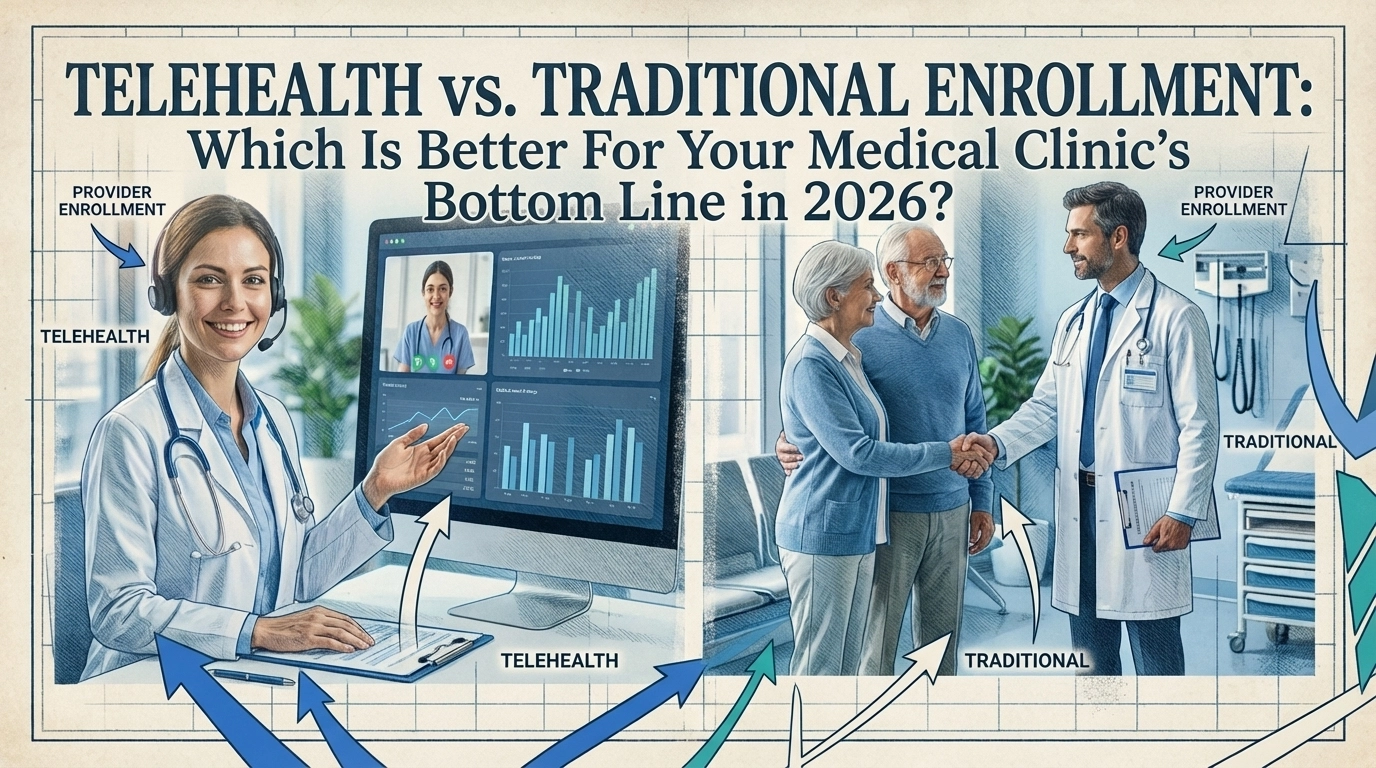
Telehealth vs Traditional Provider Enrollment: Which Is Better For Your Medical Clinic's Bottom Line in 2026?

The healthcare landscape is shifting faster than ever, and your provider enrollment strategy will make or break your clinic's financial success in 2026. If you're still debating between telehealth and traditional provider enrollment approaches, you're asking the wrong question entirely. Here's the reality: The most profitable medical clinics in 2026 aren't choosing between telehealth and traditional provider enrollment, they're strategically combining both to maximize their revenue potential while minimizing operational headaches. The False Choice That's Costing You Money Most practice managers get trapped thinking they need to pick a side. Traditional provider enrollment focuses on getting your providers credentialed with insurance networks for in-person services, while telehealth provider enrollment involves the additional complexity of multi-state licensing and virtual care network participation. But here's what the data reveals: Hybrid care models that blend telehealth and in-person services are generating 23% higher revenue per provider compared to single-modality practices. The clinics winning in 2026 understand that your provider enrollment strategy needs to support both service delivery methods. Why Pure Telehealth Provider Enrollment Falls Short Don't get me wrong, telehealth provider enrollment has massive advantages. Virtual care capacity can increase your patient volume by 40% without expanding physical space. But relying exclusively on telehealth provider enrollment creates three critical vulnerabilities: Reimbursement Uncertainty: Telehealth reimbursement policies vary wildly across insurance networks. Some payers maintain pandemic-era rates, while others have scaled back significantly. This inconsistency makes revenue forecasting nearly impossible for telehealth-only practices. Limited Service Scope: Complex procedures, physical examinations, and certain diagnostic services still require in-person care. Practices enrolled only for telehealth services leave high-value revenue on the table. Network Participation Gaps: Many insurance networks still treat telehealth as supplementary rather than primary care. Your provider enrollment options may be limited if you're not also offering traditional services. The Traditional Provider Enrollment Trap On the flip side, sticking with traditional-only provider enrollment is like driving with the parking brake on. Sure, you'll get predictable reimbursement rates and established payment structures. But you're missing massive opportunities. Capacity Limitations: Your physical space constrains how many patients you can see. No-show rates directly hit your bottom line when you can't pivot to virtual alternatives. Geographic Restrictions: Traditional provider enrollment typically limits you to your immediate geographic area. Telehealth provider enrollment opens multi-state revenue opportunities that can double your patient base. Operational Inefficiencies: Managing only in-person appointments means higher overhead costs per patient interaction. Smart clinics use telehealth for routine follow-ups, freeing up premium appointment slots for complex cases. The 2026 Revenue Reality Check By the end of 2026, up to 30% of all medical appointments will be conducted via telehealth. The global telehealth market is exploding from $140.7 billion in 2025 to a projected $403.2 billion by 2034. Here's what this means for your provider enrollment strategy: Practices that aren't enrolled for both service modalities will lose competitive positioning fast. Your patients expect flexibility, and your competitors are already providing it. The Hybrid Provider Enrollment Advantage The clinics dominating in 2026 have cracked the code on strategic provider enrollment that maximizes both telehealth and traditional revenue streams. Here's how they're doing it: Multi-State Licensing Strategy: Smart practices are getting their providers enrolled in 3-5 key states where telehealth demand is highest. This geographic expansion can increase patient volume by 200% without additional physical infrastructure. Network Optimization: Rather than enrolling with every possible insurance network, winning clinics focus on high-reimbursement networks that support both telehealth and traditional services. This reduces administrative burden while maximizing payment rates. Service Line Specialization: Hybrid practices strategically align their provider enrollment with service lines that benefit from both modalities. Primary care chronic disease management, behavioral health, and cardiology follow-ups show the strongest ROI when supported by comprehensive enrollment strategies. Operational Metrics That Matter Your provider enrollment decisions should be driven by hard financial data, not gut feelings. Track these metrics to determine which approach optimizes your bottom line: Contribution margin per visit type: Virtual visits often have higher margins once you factor in reduced overhead No-show rates by modality: Telehealth appointments typically have 60% lower no-show rates Revenue per provider per day: Hybrid models can increase this by 35% through optimized scheduling Patient retention rates: Practices offering both modalities see 25% higher patient lifetime value The Provider Enrollment Process: What You Need to Know Getting enrolled for hybrid care delivery requires strategic planning. The provider enrollment process for telehealth includes additional complexity around: Multi-state medical licensing requirements Technology platform credentialing with insurance networks Compliance documentation for virtual care delivery Cross-state insurance network participation This is where many practices get overwhelmed and make costly mistakes. If you're dealing with provider enrollment delays that are already impacting your revenue, you might want to check out these proven enrollment hacks that actually work to get back on track faster. The Technology Integration Factor Your provider enrollment strategy must align with your technology capabilities. The most profitable hybrid practices invest in integrated platforms that support: Unified scheduling for virtual and in-person appointments Seamless EHR workflows across modalities Integrated billing and claims management Cross-platform patient communication tools Practices using fragmented systems lose an average of $47,000 annually through workflow inefficiencies and billing errors. Quality Metrics Drive Profitability Here's something most practice managers miss: Value-based care contracts increasingly reward quality outcomes over visit volume. Hybrid practices excel at quality metrics because: Telehealth enables more frequent patient touchpoints for chronic disease management Virtual follow-ups reduce readmission rates by 18% on average Combined modalities support better medication adherence and care plan compliance These quality improvements directly translate to higher reimbursement rates in Medicare Shared Savings Program, Medicare Advantage, and ACO arrangements. Your 2026 Action Plan Stop thinking about telehealth versus traditional provider enrollment. Start planning your hybrid enrollment strategy now. Here's your roadmap: Phase 1: Audit your current provider enrollment status and identify gaps in telehealth network participation. Phase 2: Prioritize multi-state licensing for your highest-performing providers in markets with strong telehealth demand. Phase 3: Optimize your technology platform to support seamless hybrid care delivery before expanding your telehealth provider
Telehealth Credentialing Vs Traditional Enrollment: Which Is Better For Your Medical Clinic in 2025?

The healthcare credentialing landscape has fundamentally shifted. Your choice between telehealth credentialing and traditional enrollment will determine whether your clinic thrives or struggles in the increasingly competitive medical marketplace of 2025. The stark reality? Traditional enrollment works best for single-location practices focused on in-person care, while telehealth credentialing is essential for clinics pursuing virtual or hybrid models: but it comes with serious complexity that can make or break your expansion plans. Traditional Credentialing: The Established Foundation Traditional credentialing remains the backbone of in-person medical practices, focusing on single-location provider verification through well-established processes. This approach has powered healthcare delivery for decades, and for good reason. The Core Strengths Traditional enrollment delivers predictable timelines of 1-3 months in standard cases, making it the clear winner for straightforward practice operations. Your administrative team faces fewer moving parts, cleaner documentation requirements, and consistent processes that don't require extensive specialized training. The key advantages include: Simplified payer relationships with fewer networks to manage initially Clear compliance pathways without complex multi-state regulatory variations Faster staff onboarding since credentialing processes remain consistent Lower resource allocation compared to multi-state telehealth requirements The Critical Limitations Here's where traditional credentialing shows its age. This approach restricts your clinic's growth potential and limits patient access to your specialized services. You're essentially building walls around your practice when the healthcare industry demands geographic flexibility. Traditional credentialing cannot accommodate providers serving multiple locations, making it incompatible with modern hybrid care models that patients increasingly expect. Telehealth Credentialing: The Complex Growth Engine Telehealth credentialing manages providers delivering virtual care across multiple states and insurance networks. This approach enables rapid geographic expansion but demands significantly more resources and expertise. The Expansion Advantage Telehealth credentialing positions your clinic for explosive geographic growth by allowing single providers to serve broader patient populations across state lines. You gain access to untapped markets without physical office investments. The strategic benefits include: Multi-state licensing leverage through interstate compacts that reduce redundant requirements Delegated credentialing options via proxy arrangements that streamline complex processes Technology integration capabilities with advanced EHR systems and monitoring devices Hybrid care model support that blends virtual and in-person patient interactions The Resource Reality Organizations dedicate 1.7 times more resources to telehealth credentialing versus traditional credentialing: a fact that catches many clinic administrators off guard. Each insurance payer maintains unique enrollment requirements with timelines stretching 90-180 days. The complexity intensifies because payer requirements vary dramatically. Some insurers require separate telemedicine enrollment forms while others accept traditional credentials. This fragmentation between practice privileges and billing credentials can delay patient access for months. The Head-to-Head Comparison Credentialing Factor Traditional Enrollment Telehealth Credentialing Timeline to Completion 1-3 months 3-6+ months Geographic Reach Single location only Unlimited multi-state potential Payer Complexity Single or few networks Multiple payers per state Administrative Burden Standard staffing needs 1.7x higher resource requirements Licensing Requirements One state license Multiple state licenses required Compliance Monitoring Moderate oversight High: ongoing multi-state tracking Scalability Potential Limited to physical locations Exponential geographic growth Technology Integration Basic EHR connections Advanced API and device integration Strategic Solutions for Telehealth Complexity Smart clinic administrators implement specific strategies to cut telehealth credentialing time by 30-50% while reducing administrative burden. Automation Technology Credentialing software platforms eliminate the manual document chaos that bogs down multi-state enrollment. These systems automate document storage, expiration tracking, license management, and primary source verification across multiple jurisdictions simultaneously. Your staff stops drowning in paperwork and starts focusing on what matters: getting providers credentialed faster. Credentialing by Proxy Under CMS guidelines, hospitals can credential telehealth providers remotely through the distant site rather than requiring complex originating site credentialing. This approach requires a formal written agreement but can slash credentialing timelines significantly. Interstate Compact Utilization Fully leverage interstate licensing compacts to eliminate redundant state-by-state credentialing requirements. These compacts allow qualified providers to practice across multiple states with streamlined licensing processes. Your 2025 Decision Framework Choose Traditional Credentialing When: Your clinic operates primarily in-person at a single location and you're not planning geographic expansion. Traditional enrollment makes perfect sense if you have minimal provider turnover and limited administrative staffing. This approach works best for: Established single-location practices with stable patient bases Specialty clinics serving local communities without expansion plans Small practices with limited administrative resources Rural clinics where telehealth infrastructure remains underdeveloped Choose Telehealth Credentialing When: You're building a virtual-first or hybrid practice model that serves patients across multiple states. This path requires substantial upfront investment but delivers exponential growth potential. Telehealth credentialing becomes essential for: Multi-state provider networks seeking rapid geographic expansion Specialty practices with unique services that benefit remote patients Growing clinics ready to invest in advanced credentialing technology Forward-thinking practices positioning for telemedicine-first healthcare delivery The Hybrid Approach Strategy Start with traditional credentialing for in-person operations, then layer telehealth credentialing for virtual providers as your practice evolves. This staged approach minimizes risk while building toward comprehensive service delivery. Use delegated credentialing by proxy arrangements to avoid duplicating credentialing work across multiple facilities. Adopt credentialing software that manages both traditional and telehealth modalities seamlessly. The 2025 Competitive Reality The healthcare landscape demands modern credentialing technology combined with streamlined process management. Clinics that invest in the right credentialing infrastructure gain massive competitive advantages through faster provider onboarding, reduced staff burnout, and quicker patient access to care. Your credentialing choice directly impacts your clinic's growth trajectory. Traditional enrollment keeps you competitive in local markets, while telehealth credentialing unlocks unlimited geographic potential: but only if you're prepared for the complexity and resource requirements. The winning strategy? Align your credentialing approach with your practice's growth ambitions, then execute flawlessly with the right technology and expertise supporting your expansion plans.
Telehealth Provider Enrollment: What Mental Health Clinics Need to Know

Mental health clinics embracing telehealth face a complex web of provider enrollment requirements that can make or break their expansion plans. While telehealth has revolutionized patient access to mental healthcare, the provider enrollment process requires careful navigation of federal regulations, state licensing requirements, and payer-specific rules that vary dramatically across jurisdictions. Provider enrollment for telehealth is not the same as credentialing: and understanding this distinction is critical for clinic administrators managing telehealth programs. Provider enrollment specifically addresses where and how your providers can deliver care, while ensuring compliance with location-based regulations that directly impact reimbursement. The Multi-State Licensing Challenge State licensing requirements create the biggest enrollment hurdle for telehealth mental health providers. Your providers must be licensed in the state where they are physically located and delivering services: not necessarily where the patient is located. This fundamental rule shapes every aspect of your enrollment strategy. For mental health clinics serving patients across state lines, this means each provider needs separate state licenses for every state where they provide care. A psychiatrist practicing in Pennsylvania treating a patient located in Pennsylvania must hold an active Pennsylvania license; when treating a patient located outside Pennsylvania, the provider must meet that state's licensure and enrollment requirements as well. The financial stakes are significant. Providers delivering care without proper state enrollment face claim denials, regulatory penalties, and potential legal exposure. State licensing boards take unauthorized practice seriously, and violations can result in sanctions that affect a provider's ability to practice anywhere. Medicare's October 2025 Game-Changer Starting October 1, 2025, Medicare's new telehealth mental health requirements fundamentally alter the provider enrollment landscape. These changes require immediate attention from clinic administrators planning telehealth programs. The in-person visit requirement becomes mandatory: patients must receive a Medicare-covered mental health service in-person from the telehealth provider within six months prior to the first telehealth session, then at least once every 12 months thereafter. This isn't just a clinical guideline: it's a reimbursement requirement that directly impacts your revenue cycle. Your enrollment strategy must account for physical office locations where these in-person visits occur. Medicare requires that these locations be properly documented in your provider enrollment files. Valid locations include clinic offices or provider home offices that are documented as practice locations. Hotels, cars, and temporary locations don't qualify. Key exemptions provide strategic opportunities: patients in rural areas at eligible originating sites and those receiving substance use disorder treatment are exempt from in-person visit requirements. Mental health clinics serving these populations can maintain purely telehealth-based enrollment strategies. Identity Verification and Compliance Requirements Patient identity verification becomes a formal enrollment consideration under the new Medicare rules. Providers must verify patient identity by requiring government-issued photo identification through video during telehealth encounters. The first encounter requires capturing photographic records of the patient presenting identification. This requirement affects your technology infrastructure and staff training: considerations that impact your provider enrollment planning. Your enrollment applications must demonstrate that your practice locations and technology systems support compliant identity verification processes. Eligible Provider Categories for Mental Health Telehealth Not every mental health professional qualifies for telehealth provider enrollment. Medicare recognizes specific provider categories for telehealth mental health services: Physicians and nurse practitioners Physician assistants and clinical nurse specialists Clinical psychologists and clinical social workers Licensed marriage and family therapists Licensed mental health counselors Qualified occupational therapists, physical therapists, and speech-language pathologists Certain services face enrollment restrictions. Providers delivering psychiatric diagnostic interview exams under specific CPT codes (90792, 90833, 90836, 90838) may not receive payment for these services depending on payer policies. Your enrollment strategy must account for these service-specific limitations. FQHC and RHC Special Enrollment Considerations Federally Qualified Health Centers and Rural Health Centers enjoy expanded telehealth enrollment opportunities that other clinics don't have. These organizations can permanently serve as Medicare distant site providers for behavioral health telehealth services, and their patients can receive telehealth services at home without geographic restrictions. However, effective January 1, 2026 (potentially accelerated to October 1, 2025), FQHCs and RHCs must meet the same in-person visit requirements unless providers document that risks outweigh benefits. This creates a temporary enrollment advantage that these organizations should leverage immediately. State-Specific Enrollment Variations Every state creates unique provider enrollment requirements for telehealth. In Pennsylvania, mental health providers delivering telehealth services to patients located in the Commonwealth must hold an active Pennsylvania license and ensure their practice locations are listed and maintained in PROMISe, the state's Medical Assistance provider enrollment system. Pennsylvania recognizes home offices as practice locations when properly documented for privacy, security, and record retention and requires accurate service location information in enrollment files. Pennsylvania does not require a separate telehealth certification. Providers billing Pennsylvania Medical Assistance enroll with DHS/OMAP, comply with OMHSAS telebehavioral health guidance, and follow payer contracting requirements under HealthChoices Behavioral Health managed care plans. Out-of-state providers serving Pennsylvania patients must meet Pennsylvania licensure and enrollment requirements before delivering care via telehealth. Your enrollment strategy must account for each state's specific requirements. What works in one state may be inadequate or non-compliant in another. This reality makes multi-state telehealth enrollment particularly challenging for mental health clinics. Technology and Location Documentation Requirements Provider enrollment applications must demonstrate compliant technology infrastructure. Your enrollment documentation needs to show that your telehealth platforms support required identity verification, secure communications, and proper record-keeping capabilities. Physical location documentation remains critical even for telehealth-focused providers. Medicare and state agencies require accurate documentation of where providers are physically located when delivering care. Home offices qualify as practice locations if properly documented, but temporary or mobile locations create enrollment complications. Practical Enrollment Steps for Mental Health Clinics Start with a comprehensive state analysis of where your providers are located and where you plan to serve patients. This geographic mapping drives your entire enrollment strategy and helps identify licensing and enrollment requirements. Coordinate state licensing with Medicare enrollment to ensure consistent location information across all applications. Discrepancies between state licensing addresses and Medicare enrollment locations create processing delays and compliance issues. Implement systems for tracking in-person visit requirements before October