Veracity upscaled revised

The 7.5% New York Squeeze and the CMS “USB” Scandal: What Every Clinic Needs to Know

Adw2Ne2mgev

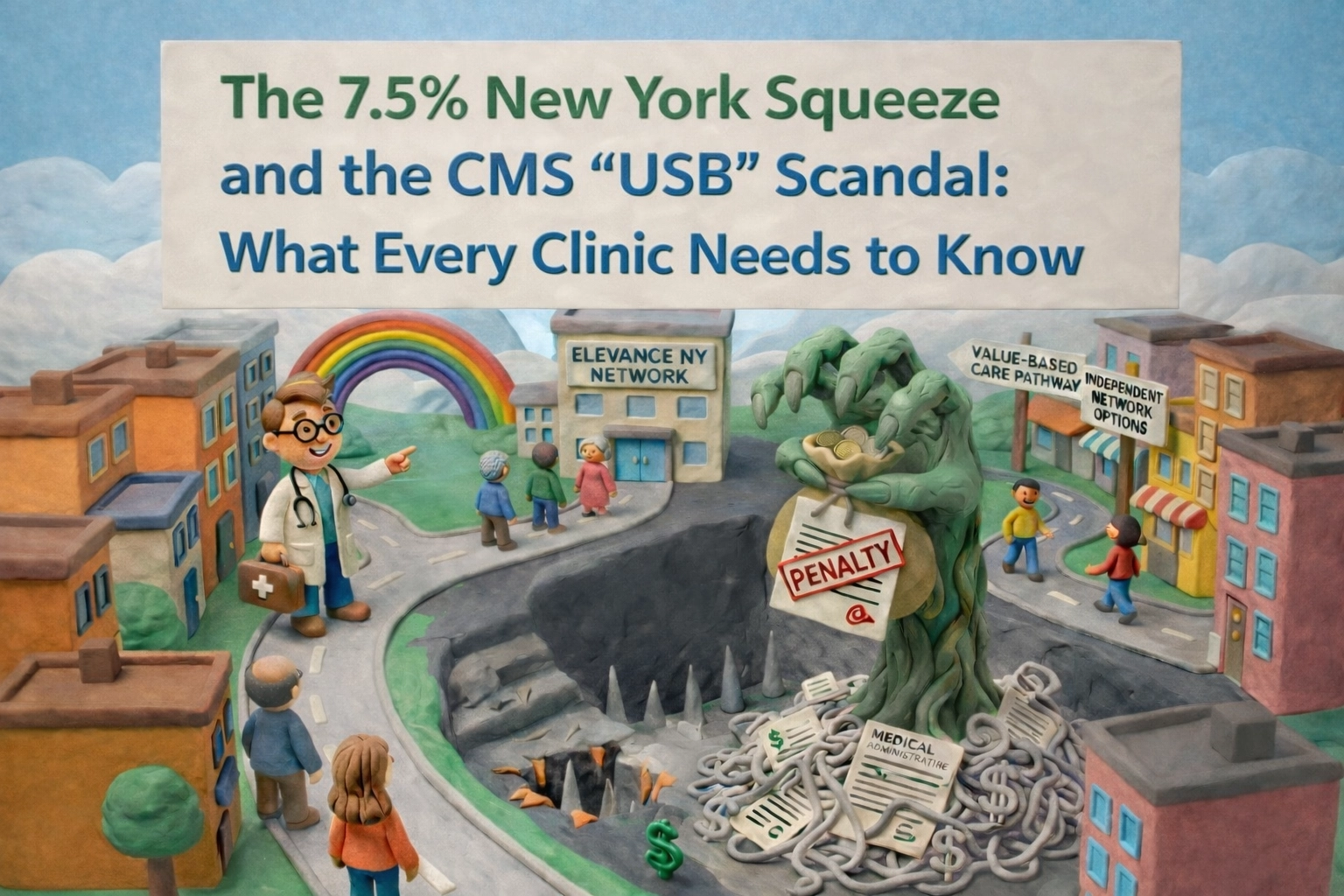
In the high-stakes world of New York healthcare, your provider enrollment services and consistent payer enrollment are the only things standing between a profitable quarter and a massive financial sinkhole. Imagine a world sculpted from clay: pliable, colorful, and seemingly simple, only to have a giant thumb come down and flatten your revenue. That is exactly what is happening as Elevance Health tightens the screws in the Empire State. Starting July 1, Anthem Blue Cross Blue Shield in New York may reduce hospital reimbursements by 7.5% for using out-of-network providers, while separate commercial and federal pressures are building outside New York. These are different clay traps, and for New York clinics and hospitals, the July 1 reimbursement squeeze is the major upcoming financial hurdle. Looking for professional provider credentialing services in the USA? 👉 Check our main service page here: veracityeg.com The 7.5% New York Squeeze, the 10% Multi-State Policy, and the CMS Deadline New York regulators are not playing games. As reported by Modern Healthcare, Elevance has already faced major scrutiny over network integrity issues, but the often-cited $12.9 million settlement was not for provider directory inaccuracies. That settlement addressed allegations that Elevance improperly denied coverage for residential mental health and substance use treatment. Separate "ghost network" lawsuits in New York involving Elevance and its subsidiary Carelon focus on allegedly inaccurate provider directories, and those cases have not produced a $13 million settlement. In New York, the more relevant recent benchmark for ghost-network enforcement is the $2.5 million EmblemHealth settlement. That backdrop now intersects with a New York-specific commercial policy that matters directly to hospitals and affiliated groups: starting July 1, Anthem Blue Cross Blue Shield in New York may reduce hospital reimbursements by 7.5% when out-of-network providers are used. That is not the same as the broader 10% Facility Administrative Policy already active in 11 other states, with California starting June 1. The New York issue is a 7.5% state-specific squeeze. The broader commercial issue is the 10% multi-state penalty. Both target provider-network mismatches inside facility claims, but New York organizations need to keep their eyes on the July 1 date because that is the next major financial trigger in the Empire State. The CMS matter is different again, and it is not active yet. According to the latest CMS notice, intermediate sanctions are set to begin March 31, 2026, only if Elevance fails to correct the risk adjustment data by March 30, 2026. CMS says Elevance persistently used encrypted USB flash drives for risk adjustment data corrections instead of the required electronic systems, including RAPS, EDPS, and RAOR. You can review the agency material directly through CMS. Elevance has pushed back on that narrative. The company’s defense is that the disputed data issues relate only to claims before April 3, 2023, and that it is now in compliance. That distinction matters. The 7.5% New York policy and the 10% multi-state commercial penalty affect facility claims involving out-of-network providers, while the CMS sanctions issue is a Medicare Advantage compliance matter tied to risk adjustment data submission methods. For providers and facilities, the message is blunt: when payer operations are under regulatory pressure, administrative policies and claim edits become more aggressive, not less. In New York, the biggest near-term issue is the July 1 reimbursement risk. Why These Policies are "Clay Traps" In a Claymation world, everything looks solid until the heat is turned up. Your facility roster, servicing provider list, and payer records look solid on the surface, but underneath, they often hide outdated affiliations, missing effective dates, incorrect service locations, and providers who are not fully aligned with the facility’s participation status. The Veracity Group sees this daily: an organization assumes its enrollment is "set it and forget it," only to learn the payer has identified a mismatch between the facility’s network status and the rendering provider’s network status. The trap works like this: The In-Network Setting: A patient receives care at an in-network hospital or facility. The Out-of-Network Mismatch: One of the providers tied to that encounter is treated as out-of-network because enrollment, affiliation, or maintenance data is incomplete or misaligned. The Administrative Penalty: Anthem in New York may apply a 7.5% reimbursement reduction starting July 1, while the broader multi-state policy applies a 10% penalty in other affected markets. That matters for a second reason too. These policies are framed as administrative deductions against hospitals using out-of-network providers in in-network settings, and they effectively sidestep the No Surprises Act IDR process by shifting money off the claim before the usual payment dispute pathway even begins. In plain English: the squeeze happens first, and the operational scramble comes second. This creates a domino effect. The facility is underpaid, the provider relationship gets strained, and your revenue cycle team is left cleaning up a mess that should have been prevented upstream. In a state like New York, where the cost of doing business is already sky-high, you must treat professional provider enrollment and directory accuracy as core financial assets. You can read more about how demographic updates are the backbone of that control. The High Cost of "Good Enough" In the current regulatory environment, "good enough" enrollment is a recipe for disaster. According to KFF, provider directory accuracy remains a stubborn industry problem, and that matters because payer edits are only as reliable as the data feeding them. When Elevance identifies a mismatch tied to facility participation and provider network status, they do not send a friendly reminder. In New York, that mismatch may trigger a 7.5% reimbursement reduction starting July 1. In other affected states, it can trigger a 10% administrative penalty. This is a classic problem-solution scenario. The problem is a rigid, unforgiving insurance system that penalizes clerical gaps, roster drift, and affiliation errors. The solution is an aggressive, proactive approach to provider enrollment. You cannot wait for the payer to tell you your data is wrong. By the time the notice lands, the deduction is already sitting on the remittance. The Veracity Take:

Provider Enrollment in New York: PNDS + Dual Eligible Unwind

Dvs1cCTAPmF

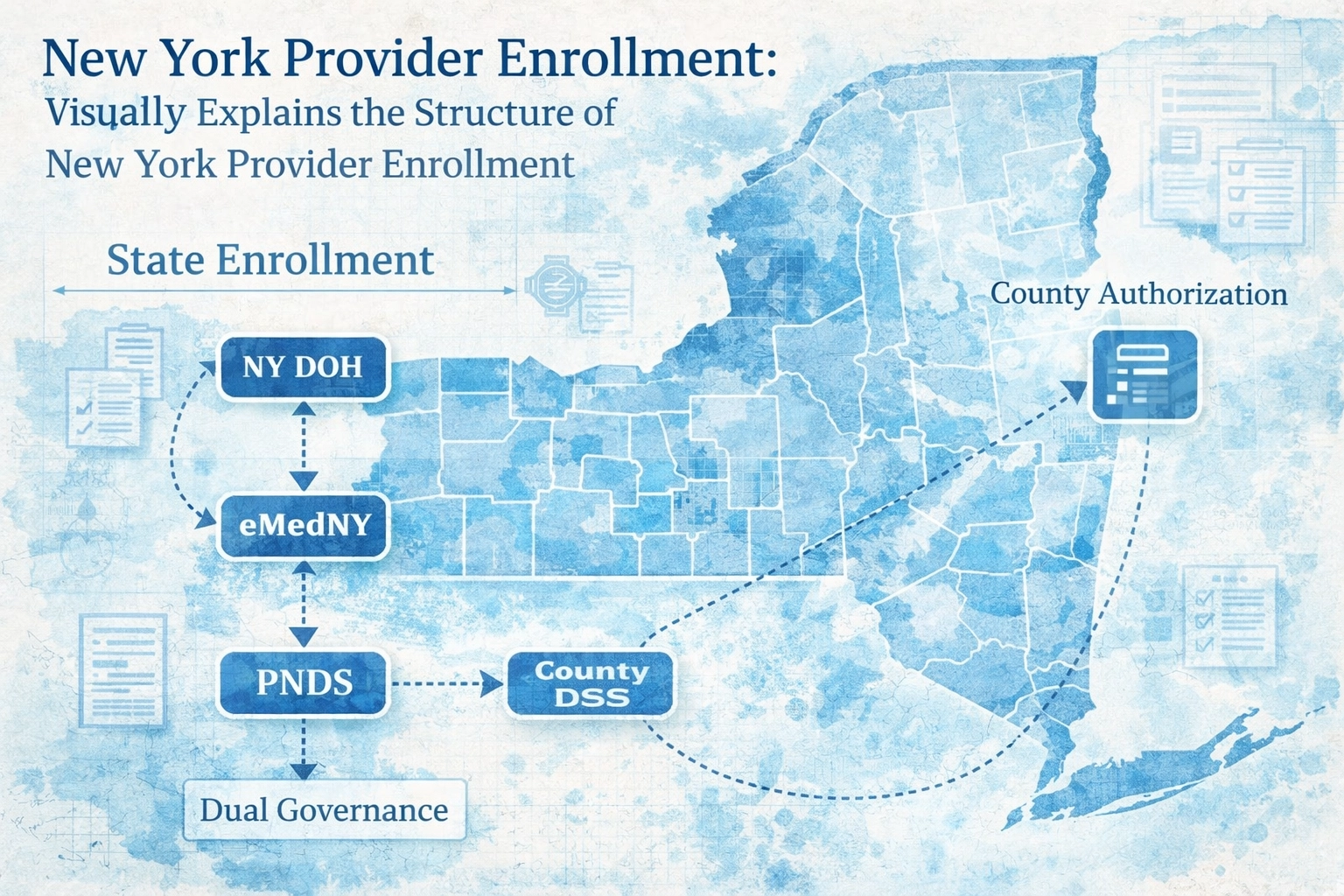
New York provider enrollment isn’t just complicated: it’s layered with administrative tripwires that derail even experienced practice managers. While most administrators focus on state-level Department of Health requirements, they miss how managed care network reporting, ongoing Provider Network Data System (PNDS) expectations, and NPI linking failures create a perfect storm of delays that cost your practice thousands in lost revenue. If you’re managing a multi-location clinic or expanding into New York for the first time, you’re walking into one of the most complex enrollment landscapes in the country. New York is uniquely challenging, but every state brings its own set of hurdles. See how it compares to other regions in our guide on Three States, Three Realities: Medicaid Enrollment in Texas, Indiana, and California. Here’s what most practice managers don’t know: and what will cost you if you don’t address it. 1) The Real New York Trap: Enrollment + Network Participation Drift New York Medicaid enrollment succeeds or fails based on clean, consistent provider data and plan-facing participation rules. Your eMedNY enrollment, your NPPES record, and the way Managed Care Organizations (MCOs) list you in their networks must align under the broader managed care oversight framework described on Medicaid.gov. This creates the operational trap: your practice can be enrolled but still not paid when your network participation data, provider directory listing, or plan configuration does not match what the MCO reports. What “Participation Drift” Looks Like in Real Life When your practice expands locations, adds providers, or changes tax details, you must keep every system synchronized. Drift shows up as: Rendering providers missing from a plan’s active roster even though your clinic treats members Incorrect service locations in plan directories that block referrals and generate grievances Tax ID / pay-to mismatches that trigger claim denials or payment holds Role configuration errors (billing vs. rendering vs. servicing) that reject claims at intake For high‑Medicaid specialties (behavioral health, pediatrics, family medicine, urgent care), these gaps create immediate revenue disruption because volume is high and denials compound fast. 2) eMedNY Enrollment vs. PNDS: Know What Each System Actually Does New York’s eMedNY remains the backbone of Medicaid claims processing and provider enrollment workflow. PNDS is different. PNDS is a managed care provider network reporting tool used for oversight of MCO networks—plans submit provider network data and the state evaluates network adequacy. New York DOH describes PNDS as a managed care provider network data system (see NYSDOH PNDS overview). In federal context, Medicaid managed care oversight relies on accurate network reporting as part of monitoring and access expectations (see Medicaid.gov managed care monitoring tools guidance). Why PNDS Accuracy Still Impacts Your Payments Because MCOs use provider network data to build rosters and directories, bad data turns into operational denial triggers. When your information is wrong in a plan’s network file, you see: Claims pended or denied due to provider/location not recognized for the member’s plan Referral leakage because patients can’t find you in directories Credentialing/contracting rework inside the plan (even when you already treat members) Network participation gaps that stall new site launches The Data Fields That Trip Up Most Practices During PNDS transition, these specific data elements cause the most enrollment failures: Service location addresses that don’t exactly match IRS tax documents Taxonomy codes that don’t align with actually rendered services Group NPI versus individual NPI designation errors Doing Business As (DBA) names that differ from legal entity names Supervising provider relationships for behavioral health services Even a minor discrepancy: like using “Street” instead of “St.” in your address: can trigger a validation failure that delays your enrollment by 45-60 days. NPI Linking: The Silent Enrollment Killer NPI linking failures represent the single most common reason for New York provider enrollment delays. The state requires precise relationships between individual provider NPIs, group NPIs, and service location NPIs: and if these relationships aren’t established correctly in both NPPES and eMedNY, your entire enrollment grinds to a halt. How NPI Linking Actually Works (And Where It Breaks) When you enroll in New York Medicaid, you must establish clear hierarchical relationships: Individual providers must be linked to the group NPI under which they practice Service locations must be associated with the correct group NPI Rendering providers must have active individual NPIs properly linked to billing entities Supervising providers must be explicitly linked to supervised staff for behavioral health services The problem? These relationships must be established in NPPES first, then replicated exactly in eMedNY, and now again in PNDS. Any mismatch creates a validation error that prevents enrollment completion. For practices offering medical provider enrollment services across multiple specialties, NPI linking becomes exponentially more complex. You’re managing multiple provider types, various supervision structures, and different taxonomy codes: all of which must align perfectly across three separate systems. The 30-Day NPPES Update Window Here’s a trap most practice managers fall into: they update NPI information in NPPES but immediately attempt to complete their eMedNY enrollment. NPPES changes take 7-10 business days to propagate to state Medicaid systems. If you submit your New York enrollment before NPPES updates are visible to eMedNY, your application will be rejected for data inconsistencies: even though your NPPES data is technically correct. You must wait for full NPPES propagation before proceeding with state enrollment. 4) The Real Consequences of eMedNY + Network Reporting Failures These aren’t theoretical problems: they create immediate revenue disruptions for practices that underestimate New York’s enrollment and managed care participation requirements: 1) Lost Revenue During Delays: Every week of enrollment delay costs practices an average of $8,000-$15,000 in unbillable Medicaid services, depending on patient volume. For behavioral health practices with high Medicaid patient populations, a 90-day delay means $50,000+ in lost revenue. 2) Directory and Roster Breakage: When your practice location, taxonomy, or provider affiliation is wrong in an MCO’s network data, patients search directories and never find you—even while your front desk schedules them. 3) Retroactive Billing Limits: New York allows limited retroactive billing (typically 60-90 days from enrollment approval), but services delivered during prolonged enrollment