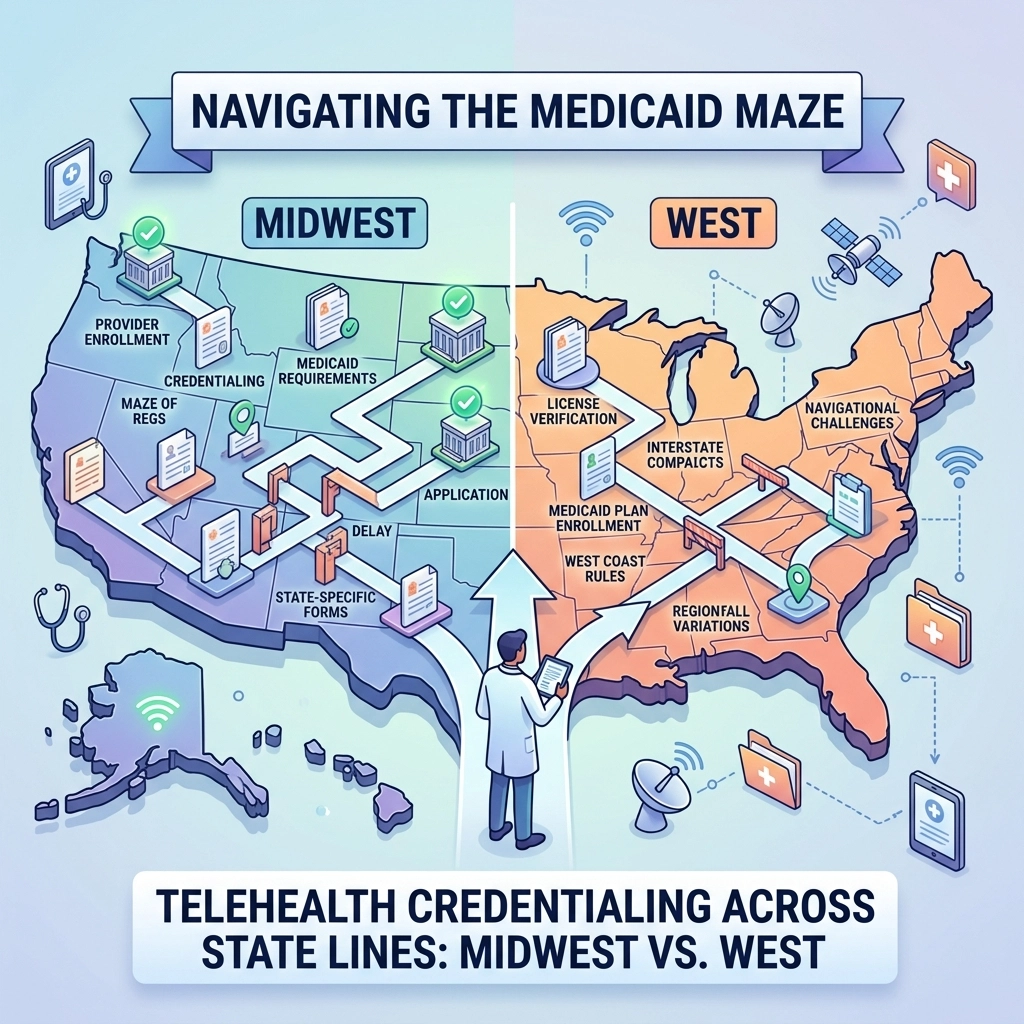
Telehealth Credentialing Across State Lines: Navigating the Midwest vs. West Medicaid Maze

Navigating medical provider enrollment services across state lines while building a reliable telehealth footprint feels like playing a high-stakes game of 5D chess. Your patients do not care about state borders. They care about access to care from their living rooms. But the moment those pixels cross a state line, you enter a regulatory minefield. If you think a single license is your "golden ticket" to a national telehealth model, you are in for a rude awakening. Medicaid programs in Indiana, Illinois, and Nevada are not just different; they are entirely different ecosystems with unique "gotchas" that will stall your revenue if you are not prepared. If your question is "Can I see Medicaid patients across state lines?" the answer is simple: yes, but only after you satisfy each state's licensing, enrollment, and verification rules. If your question is "How do I do it without delays?" the answer is even clearer: you need a state-by-state process that matches your provider type, service location, and payer requirements. Looking for professional provider credentialing services in the USA? 👉 Check our main service page here: veracityeg.com The Golden Rule of the Virtual Visit Before we dive into the regional trenches, let’s establish the foundational law of the land: The provider must be licensed in the state where the patient is physically located at the time of the encounter. This is non-negotiable. Whether you are treating a patient via a smartphone in a cornfield in Indiana or a high-rise in Las Vegas, your legal right to practice is dictated by the ground under the patient’s feet. Failing to secure the correct state-specific enrollment is the fastest way to trigger a claim denial or, worse, an OIG audit. While the Interstate Medical Licensure Compact (IMLC) offers a streamlined pathway for physicians, the Medicaid enrollment process remains a manual, state-by-state slog that requires precision and insider knowledge. Alt-tag: A map of the United States highlighting the Midwest and Western regions for telehealth expansion. 1. The Midwest vs. the West: Streamlining vs. Complexity For general provider enrollment services, the Indiana-Illinois-Nevada comparison tells you exactly what multi-state expansion looks like in practice. One state removes friction. One state slows you down with administrative precision. One state raises the verification bar for every applicant. If you are asking where enrollment is easiest, where it gets sticky, and where extra documentation is non-negotiable, this three-state comparison is the focal point. Indiana: The License-Only Advantage If you have not looked at Indiana lately, you are missing a rare win for administrative efficiency. As of July 1, 2024, Indiana officially removed the requirement for telehealth-specific certificates. That creates a cleaner path for physicians, advanced practice providers, therapists, and other eligible clinicians expanding telehealth services under Medicaid. This is the key Indiana takeaway: if you hold the proper Indiana license, you do not need a separate telehealth certificate to move forward. That is a real operational advantage for multi-state groups asking, "Can I enroll in Indiana without another telehealth approval layer?" The answer is yes, provided your license, ownership information, service location details, and enrollment file are complete. However, do not mistake "easier" for "automatic." You still must submit accurate provider data to the Indiana Health Coverage Programs (IHCP). A clean Indiana rule set does not forgive sloppy applications. Illinois: The Administrative Precision State Cross the border into Illinois, and the vibe shifts. Illinois is the state that forces you to respect process discipline. The core question here is not whether telehealth is possible. The real question is how cleanly your enrollment file matches across every data source. For most medical specialties, Illinois becomes difficult for three reasons: Application detail must align across systems. Provider records must match state and payer files exactly. Delays compound quickly when ownership, practice location, or rendering-provider data is inconsistent. Illinois Medicaid is notoriously meticulous. If your CAQH profile is not synchronized perfectly with your state application, your file will sit in "pending" purgatory for months. That problem is not specialty-specific. It affects primary care, specialty care, surgical groups, therapy practices, and multi-location organizations alike. 2. The West: The Land of Stringent Verification If the Midwest is characterized by shifting legislative sands, the West: specifically Nevada: is characterized by its rigorous verification walls. While Western states often have strong telehealth infrastructure, their "gatekeeper" mentality for Medicaid is significantly more intense than what you will find in the heartland. Nevada: The "Gotcha" State Nevada does not play games. If you are looking to expand your footprint here, prepare for a verification marathon. Nevada Medicaid requires more stringent primary source verification and provider qualification documentation than Indiana or Illinois for many enrollment scenarios. This is the big Nevada question: "Can I enroll as an out-of-state provider if I already bill Medicaid elsewhere?" Yes, but Nevada will still require its own documentation trail, validation standards, and closer review. That is the "gotcha" many groups miss. Prior enrollment success in another state does not buy you a shortcut in Nevada. Nevada is particularly focused on out-of-state telehealth providers. The state wants to confirm that you are not operating as a "ghost clinic" and that every provider meets Nevada-specific requirements for licensure, qualifications, service locations, and supporting records. For general medical provider enrollment services, that means your file must be audit-ready before submission, not cleaned up after the fact. Alt-tag: A comparison chart showing the different requirements for Medicaid enrollment in Indiana, Illinois, and Nevada. Comparing the "Gotchas" Feature Indiana Illinois Nevada Telehealth Certificate Removed (as of 7/1/2024); license-only path is the key advantage Not the main issue; administrative alignment is the real hurdle Stricter review depends on provider type and enrollment facts Verification Speed Moderate Slow and detail-heavy Very stringent and documentation-heavy Key "Gotcha" Valid state license is enough for the telehealth approval piece, but the enrollment file still must be complete Data mismatches stall applications fast High scrutiny on out-of-state providers and stronger primary source verification Enrollment Difficulty Lower Medium-High High 3. Can You Enroll in Multiple Medicaid States at