Veracity upscaled revised

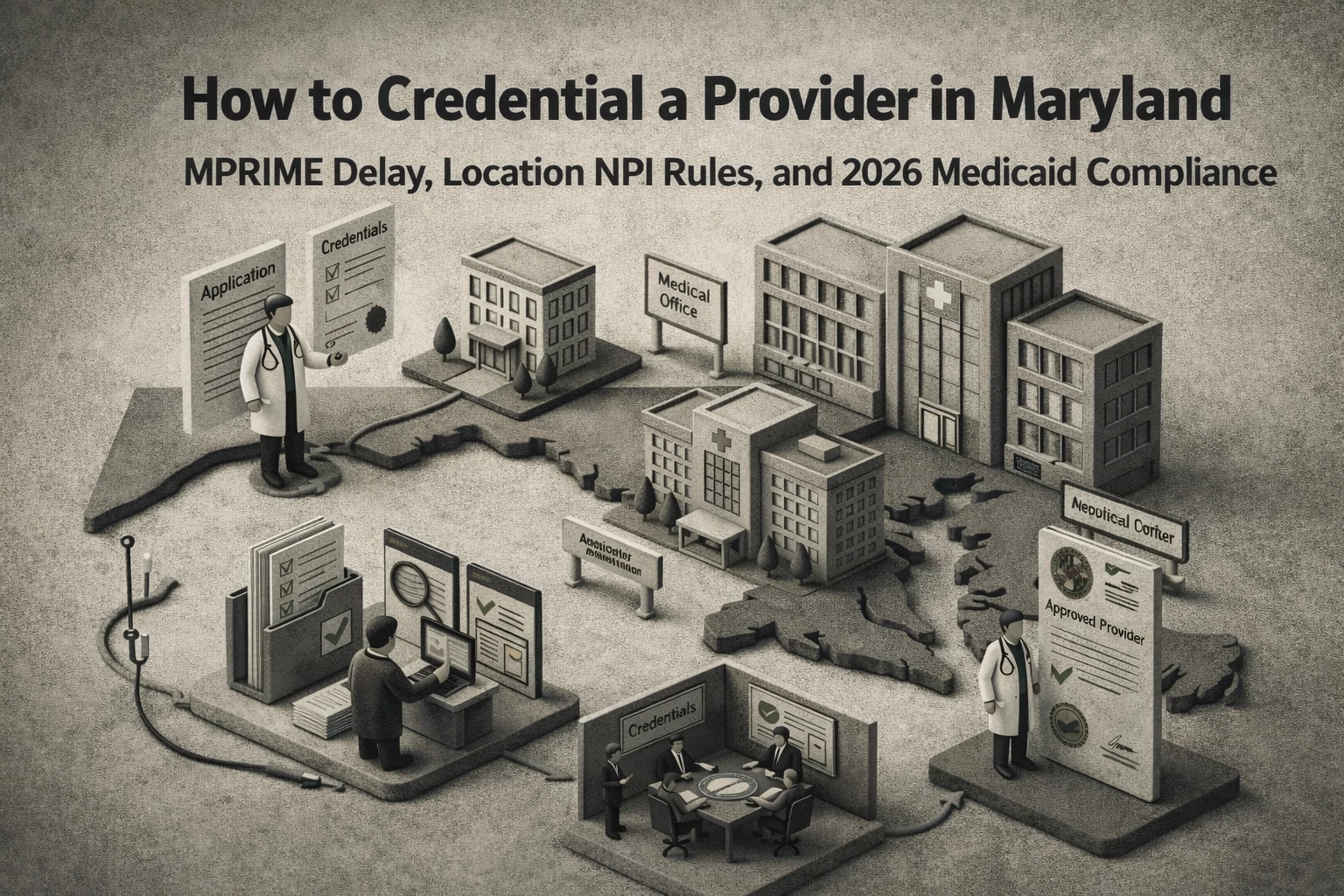
How to Credential a Provider in Maryland: MPRIME Delay, Location NPI Rules, and 2026 Medicaid Pressure

P89r2Ror7wX

Navigating the medical provider enrollment services market in Maryland requires an understanding of a landscape dominated by massive hospital systems and rigid state mandates. Whether you are an independent clinic or a multisite group, the behavioral health enrollment landscape in the Old Line State is especially unforgiving when you miss a portal rule, a location setup requirement, or a state processing standard. In Maryland, you are operating in the shadow of giants like Johns Hopkins, the University of Maryland Medical System (UMMS), and MedStar Health. To compete for talent and patient volume, your enrollment process must be faster, cleaner, and more compliant than the behemoths next door. Looking for professional provider credentialing services in the USA? 👉 Check our main service page here: veracityeg.com The Maryland Regulatory Fortress: Understanding COMAR In Maryland, the "rules of the road" are dictated by the Code of Maryland Regulations (COMAR). Specifically, COMAR 10.07.01.24 mandates that every hospital have a formal, written process for any physician who admits or treats patients. This isn't just a suggestion; it is a statutory requirement that sets the tone for the entire state. For private practices and multisite clinics, this means your internal standards must mirror the high bar set by hospital-owned practices. One of the most critical aspects of Maryland compliance is the Uniform Credentialing Form. Maryland law requires health insurance carriers to accept the Council for Affordable Quality Healthcare (CAQH) form as the sole uniform application. While this sounds like it should simplify your life, the reality is that the CAQH profile must be meticulously maintained. A single outdated attestation or an expired document in CAQH will trigger a cascade of denials across every major payer in the state, from CareFirst BlueCross BlueShield to UnitedHealthcare. Upstream Prerequisites: Licensing and the Maryland CDS You cannot hope to achieve timely enrollment if your upstream ducks are not in a row. Before a provider can even be considered for a payer network, their foundational credentials must be active and flawless. This starts with the Maryland Board of Physicians or the relevant board for mid-level providers and behavioral health professionals. In Maryland, the DEA number is only half of the equation for prescribing. You must also secure a Maryland Controlled Dangerous Substances (CDS) certificate. We often see practices stall for weeks because they secured the state license but forgot the CDS, or secured the CDS but didn't update the address to reflect the new practice location. At The Veracity Group, we treat licensing and DEA/CDS management as the essential first step in the provider enrollment process. If the upstream data is flawed, the downstream revenue is guaranteed to suffer. Image Description: A high-end, studio-lit portrait of a focused healthcare executive reviewing a digital compliance dashboard. The lighting is professional and sharp, emphasizing a clean, clinical environment. Navigating the Hospital Shadow: The Onboarding Churn Maryland has one of the highest densities of hospital-owned or hospital-affiliated practices in the country. This creates a hyper-competitive environment for providers. When you hire a new physician, they are likely coming from another large system or are being courted by one. The "hospital shadow" means that your onboarding process must be seamless to ensure the provider can start seeing patients and generating revenue on day one. Constant onboarding is the norm in Maryland, not the exception. For multisite clinics, the challenge is multiplied. Since 2025, Maryland requires a separate NPI setup for every practice location, which turns location management into a make-or-break operational issue rather than a clerical footnote. Each new site requires updated demographic information with every payer, and your data must match the location-level record exactly. If you are adding a provider to a group that has "admitting privileges" requirements, you must ensure their hospital affiliations are finalized before the payers will pull the trigger on their enrollment. In plain terms: if one location record is wrong, your entire launch schedule starts bleeding time. Medicare and Medicaid Enrollment for Behavioral Health Providers The Medicare and Medicaid enrollment for behavioral health providers in Maryland is a specific area of friction. Maryland’s Medicaid program, managed by the Maryland Department of Health (MDH), still uses ePREP as the main enrollment portal, and that remains true until the planned MPRIME transition in October 2026. If your team is acting like MPRIME is already live for standard workflows, you are setting yourself up for preventable delays. You must work the process that exists now, not the process people keep talking about for later. For reference, Maryland continues to route provider enrollment activity through its Medicaid administration channels, and official program information remains anchored through the state’s Maryland Department of Health and enrollment-facing resources. Behavioral health groups face even tighter pressure. Maryland maintains a behavioral health moratorium for PRP and Health Home enrollment through June 2026, which means expansion plans in those categories hit a hard wall unless and until the state reopens that pathway. That is not a minor footnote. It directly affects hiring models, launch timing, and revenue forecasting for psychiatry groups, LCSWs, PMHNPs, and multidisciplinary behavioral health organizations. Wait times for Maryland Medicaid can stretch for months if the initial application contains even a minor clerical error. That pressure is even sharper in 2026 because CMS has pushed a 30-day processing standard and a digital-only direction for enrollment workflows, raising the operational bar for how practices prepare and submit files. If your documents are incomplete, inconsistent, or trapped in an outdated paper-first process, you will lose time fast. This is where professional medical provider enrollment services become an essential partner. You cannot afford to have a licensed clinical social worker (LCSW) or a psychiatrist sitting idle because the state is kicking back a line item, a location mismatch, or a missing digital document. You must be proactive, aggressive, and precise in your submissions to the Maryland Department of Health and in your alignment with federal enrollment expectations through CMS. Image Description: A professional studio shot of a healthcare provider in a clean, white lab coat, looking confidently