Veracity upscaled revised

Sunshine and Shadows: The Reality of Medicaid Provider Enrollment Florida

PREU4jxFR3z

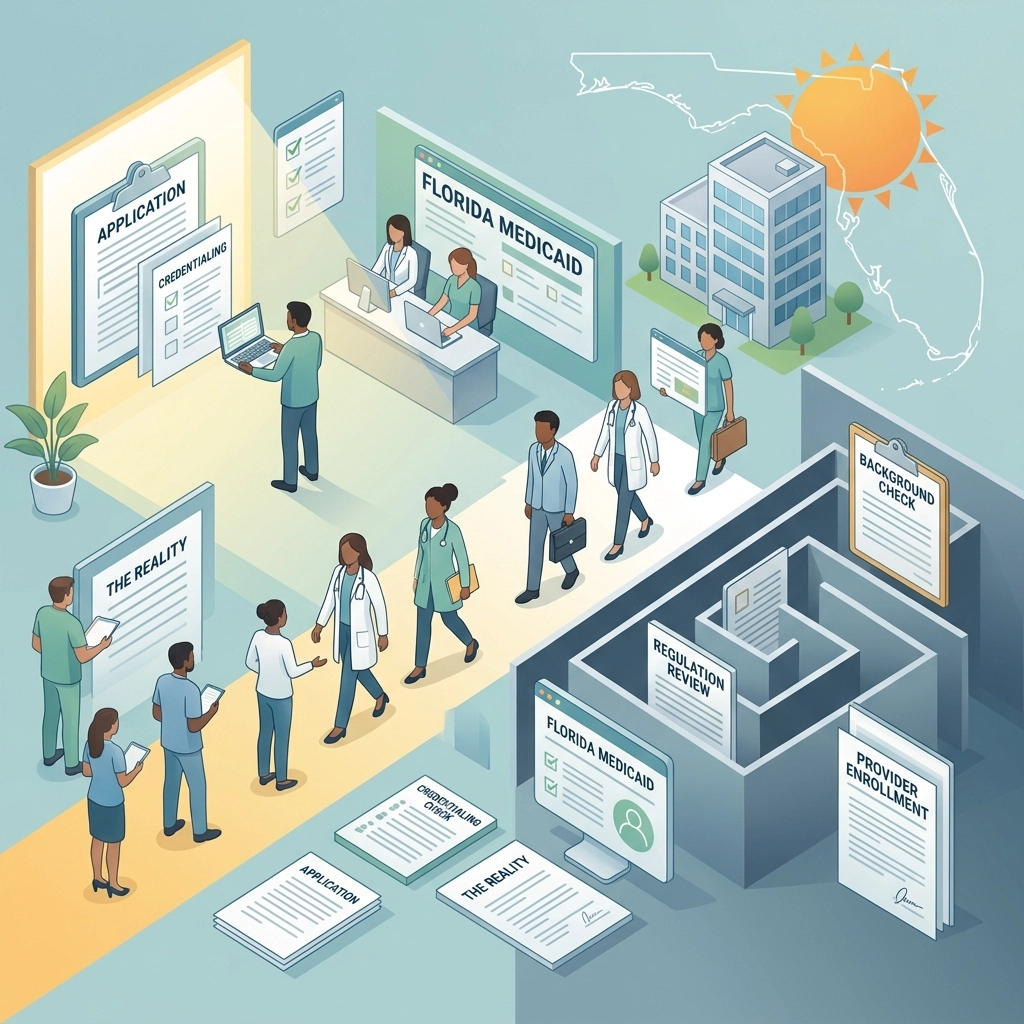
Florida presents a stark dichotomy for healthcare providers: the external promise of the Sunshine State versus the cold, industrial reality of its administrative machinery. Navigating Medicaid provider enrollment Florida is rarely as bright as the postcards suggest; instead, it is a complex, brutalist structure of regulations, digital portals, and rigid compliance standards. Whether you are expanding from a successful Medicaid provider enrollment Texas operation or launching a new clinic in Miami, the transition into the Florida market requires a disciplined approach to overcome the heavy administrative weight that defines the Agency for Health Care Administration (AHCA) requirements. The Administrative Monolith: Understanding AHCA At the heart of Florida’s healthcare system stands the Agency for Health Care Administration (AHCA). To the uninitiated, AHCA functions as a gatekeeper with an uncompromising eye for detail. The enrollment process is not a mere formality; it is a rigorous vetting procedure designed to protect the state's Medicaid integrity. For providers, this translates into a multi-layered verification process that will make or break your ability to treat patients and receive reimbursement. The complexity of Florida’s system is intentional. It is built to filter out those who cannot meet the stringent operational standards required by the state. Every application submitted is scrutinized against the Florida Medicaid Management Information System (FMMIS) standards. If your practice is not fully operational before you begin the enrollment journey, you are already behind. AHCA mandates that clinics must be open and ready to provide services the moment the application is processed, creating a high-pressure environment where timing is everything. Image Description: A high-contrast, gritty noir image of a massive concrete government building with sharp angles and long shadows, symbolizing the industrial weight of healthcare administration. The Digital Labyrinth of the Florida Medicaid Management Information System The Florida Medicaid Management Information System (FMMIS) is the digital backbone of the state's provider network. While it serves as the portal for enrollment, it is often viewed by providers as a labyrinth of technical hurdles. The system demands a precise sequence of actions: determining provider types, creating secure portal accounts, and uploading a mountain of digitized documentation. One of the most significant challenges within FMMIS is the rigidity of the five-step enrollment pathway. Any deviation from the prescribed order: or a single missing document: can trigger a systemic rejection. This is not a system that allows for "placeholders." You must have your W-9 forms, professional licenses, and malpractice insurance perfectly aligned and ready for upload. The high cost of delays in this digital environment is measured in months, not days. An initial enrollment typically spans 30 to 90 days, but this timeline assumes a flawless submission. In the brutalist landscape of state bureaucracy, a "flawless submission" is a rarity for those without dedicated administrative support. Document misrouting or manual verification needs are common bottlenecks that extend the waiting period, leaving your revenue cycle in a state of purgatory. The Three Tiers of Participation In Florida, enrollment is not a one-size-fits-all designation. Providers must strategically choose their category within the provider enrollment framework. Understanding these tiers is essential for aligning your clinical goals with state reimbursement capabilities: Fully Enrolled Providers: These are the backbone of the system. Fully enrolled providers can bill for all covered services on a fee-for-service basis. This requires the highest level of scrutiny and documentation. Limited Enrolled Providers: This category is often utilized for specific programs or emergency services, offering a narrower scope of billing potential. Ordering or Referring (O/R) Providers: These providers do not bill for services directly but are essential for the continuum of care. Without an O/R enrollment, the prescriptions or referrals you write for Medicaid patients will be rejected at the pharmacy or specialist level. Failure to select the correct tier or understand the specific requirements for your provider type: such as the unique LCSW requirements for behavioral health or the surgical center compliance risks: leads to immediate administrative friction. As noted in our deep dive into behavioral health provider enrollment, the nuances of each specialty can add layers of complexity to an already somber process. Image Description: A moody, industrial close-up of a vintage typewriter and a stack of weathered files under a single harsh spotlight, representing the grit required for administrative compliance. The Heavy Weight of Compliance: Documentation and Background Checks Florida’s commitment to "Sunshine State" transparency does not extend to a lenient enrollment process. The state requires Level 2 criminal background screenings for all high-risk provider types. This industrial-strength vetting involves fingerprinting and a review of the AHCA background screening clearinghouse. Furthermore, the documentation burden is relentless. You must provide: True and accurate ownership disclosures. Verification of all professional licenses through the Florida Department of Health. Proof of operational status, including physical site inspections for certain provider categories. If your practice is involved in contracting, you know that the state’s requirements often overlap with those of Managed Care Organizations (MCOs). However, being enrolled in an MCO does not bypass the need for state-level enrollment. You must maintain a valid Medicaid ID to participate in any state-funded program. The Veracity Group: Your Anchor in the Storm In a landscape defined by brutalist architecture and gritty noir complexities, The Veracity Group acts as the anchor for your clinic. The administrative weight of Florida compliance is too heavy for most clinical teams to carry while simultaneously focusing on patient care. We provide the structural support needed to navigate the AHCA and FMMIS maze. We understand that enrollment matters for your bottom line. Our team handles the heavy lifting: from the initial FMMIS account setup to the final verification of your Medicaid ID. We treat the enrollment process as a high-stakes industrial project, ensuring that every "bolt" is tightened and every "beam" is in place. You can read more about how we manage these complexities in our weekend healthcare news recap. By partnering with us, you move away from the shadows of administrative uncertainty and toward a streamlined, professional submission. We act as your liaison with state agencies, mitigating the

Why Florida Medicaid Enrollment Moves Slowly (and How to Keep Your Status Moving)

XGB03YZd gX

Florida Medicaid is one of the most attractive payer programs for high-volume practices : but it’s also one of the most unforgiving. Providers often assume the delays come from the state, but in reality, most issues begin long before the application reaches a reviewer. If your Florida Medicaid provider enrollment status has been sitting in “pending” for weeks, the problem is almost always data alignment. When your practice data is mismatched or outdated, it doesn’t just cause a delay—it directly impacts your bottom line. Check out how demographic update delays can stall your revenue cycle. However, once you understand how the process works, you can keep your enrollment moving without unnecessary stalls. The Florida Medicaid Portal: Accurate, but Unforgiving The Florida Medicaid portal is designed to validate your information against multiple databases before a human ever sees your application. Consequently, your data must match across: NPI registry CAQH IRS records Practice location listings EFT/ERA banking details If one field is off : even punctuation : the system stops processing. It doesn’t notify you. It doesn’t warn you. It simply waits. This is why so many practices think their Medicaid enrollment status is “stuck.” In reality, the portal is waiting for corrected data. The system won’t move forward until every field aligns perfectly across all databases. The Three Most Common Causes of Florida Enrollment Delays 1. Provider Setup Mismatches Florida requires exact alignment between your NPI taxonomy, practice structure, and service locations. If your provider setup lists a location differently than your NPI file, the application stalls immediately. For example, if your NPI record shows “123 Main Street Suite A” but your application lists “123 Main St. Ste. A,” the system flags it as a mismatch. Similarly, these small formatting differences create major processing delays. 2. Payer Setup Conflicts Your payer setup must match the structure you use for other Medicaid programs. If your group NPI is linked to the wrong taxonomy or your rendering providers aren’t associated correctly, the portal won’t load your record. Moreover, Florida cross-references your payer setup with federal databases. Any inconsistency between your group structure and individual provider associations will trigger an automatic hold on your application. 3. CAQH Not Matching the Application Florida cross-checks CAQH more aggressively than most states. If your CAQH profile is outdated, incomplete, or inconsistent, the system flags it : silently. Therefore, before submitting your Florida application, verify that your CAQH profile reflects your current practice information. Even a six-month-old address can cause weeks of processing delays. Why Florida Enrollment Feels Slower Than Other States Florida’s system is built to prevent fraud, which means: More identity verification More ownership disclosures More cross-matching with federal databases More automated checks before human review Following these high standards for data accuracy ensures your practice stays aligned with the benchmarks set by national leaders like NCQA. This creates a perception of slowness, but the real issue is precision. Florida doesn’t tolerate “close enough.” The state’s automated validation system is designed to catch discrepancies that other states might overlook. While this makes the process feel slower, it actually speeds up enrollment once your data is clean. According to the Florida Department of Children and Families, once all necessary information is submitted correctly, the Department typically makes an eligibility determination within 45 days. The delays happen when applications lack clean, aligned data from the start. How to Keep Your Florida Medicaid Enrollment Status Moving 1. Align Your Data Before You Apply Check your NPI, CAQH, W-9, and practice address formatting. If they don’t match exactly, fix them first. This single step eliminates 80% of enrollment delays. Run a comparison audit across all systems before submission. Additionally, ensure your legal business name, DBA, and EIN match across every database. One mismatch will halt your application for weeks. 2. Validate Your Provider Setup Ensure your taxonomy, specialties, and service locations are consistent across all systems. Florida’s portal validates these fields against the NPI registry in real-time. Furthermore, double-check that your primary taxonomy code matches your practice focus. If you’re a family practice but your NPI lists internal medicine as primary, the system will flag the discrepancy. 3. Clean Up Your Payer Setup Florida requires a clean association between group and rendering providers. If your structure is off, the application won’t load. Specifically, verify that all rendering providers are properly linked to your group NPI. Each provider must have their own active NPI, and the taxonomy codes must align with the services you’re enrolling to provide. 4. Monitor Your Status Weekly If your Florida Medicaid provider enrollment status hasn’t changed in 30 days, escalate. Florida responds well to structured follow-up. Use the portal’s tracking system to monitor progress. When you see no movement for four weeks, contact the provider enrollment unit directly with your application number and specific questions about what’s holding up your file. Florida’s 2026 Medicaid Modernization: What It Means for Your Enrollment Florida is launching a new Medicaid modernization system in early 2026 designed to streamline enrollment and renewal processes. The state aims to make enrollment “faster, easier, and more secure.” Nevertheless, faster systems still require clean data. The new platform will automate even more validation checks, which means data accuracy becomes even more critical. Practices that wait for the new system without cleaning their existing data will face the same delays under a different interface. The Bottom Line Florida Medicaid enrollment isn’t slow : it’s precise. When your data is aligned, the process moves quickly. When it isn’t, the system stops without explanation. Treat Florida enrollment like a technical workflow, not a form submission. The state’s automated validation system is unforgiving, but it’s also predictable. You know exactly what it’s checking. Therefore, you can prepare accordingly. Clean data. Clean setup. Clean follow-up. That’s how you stay visible, billable, and accessible to the patients who rely on you. The practices that succeed with Florida Medicaid enrollment in 2026 are the ones that treat it as infrastructure : not paperwork. They standardize their data before applying, validate