Understanding Controlled Substance Registrations (CSR): Do You Need One for Every State?

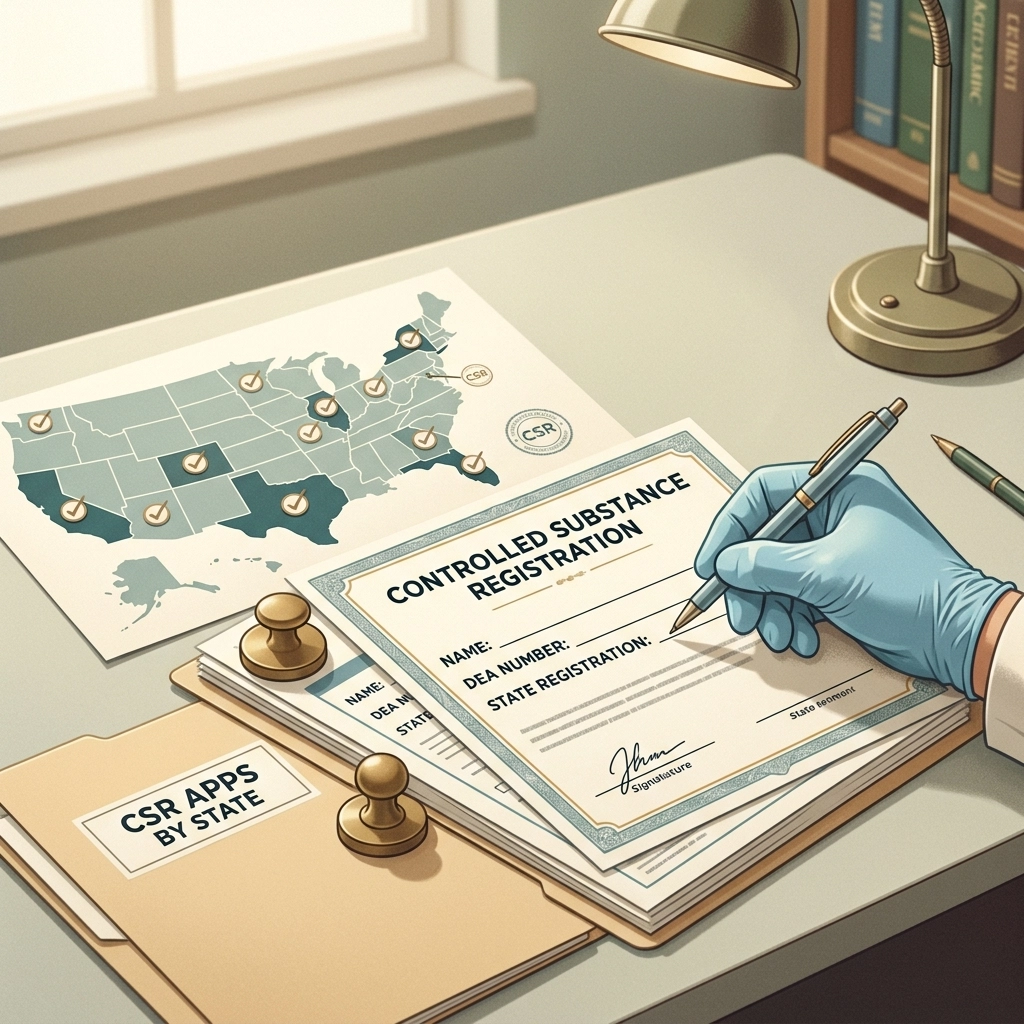
Navigating the landscape of provider enrollment services and regulatory compliance is often a logistical nightmare for expanding practices. Among the most misunderstood requirements is the Controlled Substance Registration (CSR). For any practitioner intending to prescribe, dispense, or distribute controlled substances, the CSR is not just a formality; it is the backbone of professional credibility and legal practice. As you scale your operations across state lines, the question of whether you need a separate CSR for every jurisdiction becomes a critical pivot point for your timeline and budget. Effective healthcare provider enrollment requires an uncompromising attention to detail, particularly regarding state-level mandates. Failing to secure the correct registrations will result in immediate "hard stops" for your practice, leading to delayed starts, lost revenue, and potential legal scrutiny. In this guide, we will dismantle the myths surrounding CSRs and provide the clarity you need to maintain a compliant, multi-state presence. Looking for professional provider credentialing services in the USA? 👉 Check our main service page here: veracityeg.com What Exactly is a Controlled Substance Registration? A Controlled Substance Registration (CSR): sometimes referred to as a state-level DEA license or a State Controlled Substance Certificate: is a permit issued by an individual state that allows a healthcare provider to handle controlled substances. While the Drug Enforcement Administration (DEA) handles federal oversight, individual states exercise their own police power to monitor and regulate how these substances are managed within their borders. The CSR acts as a passport to success for your prescribing authority. Without it, your federal DEA registration may be invalid or impossible to obtain in that state. It is the mechanism by which state boards track the flow of narcotics and other high-risk medications, ensuring that every pill and vial is accounted for by a registered, verified professional. The Multi-State Dilemma: Do You Need One for Every State? The short answer is: It depends entirely on the state where you are practicing. Many providers operate under the dangerous assumption that a federal DEA license is a "golden ticket" that applies everywhere. This is a misconception that can make or break your expansion. The reality is that state requirements vary significantly. 1. States with Mandatory CSRs Most states require a separate, state-issued CSR in addition to your professional medical or pharmacy license. In these jurisdictions, you must obtain the state CSR before you can even apply for a DEA registration tied to that state. States like Texas, Illinois, and Alabama have robust CSR requirements that demand individual attention. If you are practicing in multiple states that all require CSRs, you will indeed need a separate registration for every one of those states. 2. States with Single License Requirements A handful of states do not require a separate CSR. In these locations, your professional license (MD, DO, NP, PA) is sufficient to satisfy the DEA’s requirement for "state authority." However, even in these states, you must ensure your license specifically allows for the handling of controlled substances. 3. The Physical Location Rule The DEA is very clear: you must have a separate registration for each state where you practice. Furthermore, you generally need a separate registration for each physical location where you store or dispense controlled substances. If you are a telehealth provider sitting in Florida but treating patients in New York, the regulatory burden shifts based on where the "act of prescribing" or "dispensing" is legally recognized. For more information on the complexities of multi-state operations, you can review the DEA’s Diversion Control Division guidelines. Common Misunderstandings and Their Consequences Misinterpreting CSR rules is the silent driver of enrollment delays. Here are the most frequent pitfalls we see at The Veracity Group: The "One DEA" Myth: Providers often think they can use their DEA number from State A to prescribe in State B. While the DEA allows for some flexibility with "principals of practice," most state laws are more restrictive. Using a DEA number without the corresponding state CSR where required is a direct violation of state law. The Sequence Error: You cannot obtain a DEA registration for a state that requires a CSR without having the CSR first. If you apply for the DEA first, it will be rejected or held in limbo, wasting weeks of administrative time. The Facility vs. Provider Trap: Many groups assume that because the facility has a CSR, the individual provider does not need one. In many jurisdictions, the individual's authority is independent of the facility’s registration. The high cost of delays in this area cannot be overstated. A missing CSR can stall a provider’s start date by 60 to 90 days, costing a practice tens of thousands of dollars in lost patient encounters. The Strategic Importance of Professional Oversight Managing CSRs across five, ten, or fifty states is a Herculean task for any internal HR or office manager. Each state has its own application portal, fee structure, renewal cycle, and specific prerequisites (such as mandatory PMP/PDMP enrollment). When you partner with The Veracity Group, we take the guesswork out of the equation. We understand that mastering multi-state Medicaid provider enrollment and private payer contracting requires a foundation of perfect primary source verification, and that includes your CSRs. Why Multi-State Practices Choose Veracity: State-Specific Expertise: We know which states require a CSR and which don't, saving you unnecessary application fees and hours of research. Proactive Renewal Tracking: CSRs and DEA registrations often have different expiration dates. We manage the calendar so you never face a "dark period" where you cannot prescribe. Integrated Strategy: We don't just look at the CSR in a vacuum. We look at how it impacts your overall enrollment strategy, ensuring that your CAQH profile and payer applications are synchronized. Actionable Steps for Your Practice If you are planning to expand or are currently managing providers in multiple states, you must take the following steps immediately: Audit Your Current Roster: Verify that every provider has a CSR for every state in which they are seeing patients, unless that state is a "no-CSR" jurisdiction. Verify
DEA, CSR, and State Licenses: The “Triple Threat” of Provider Onboarding

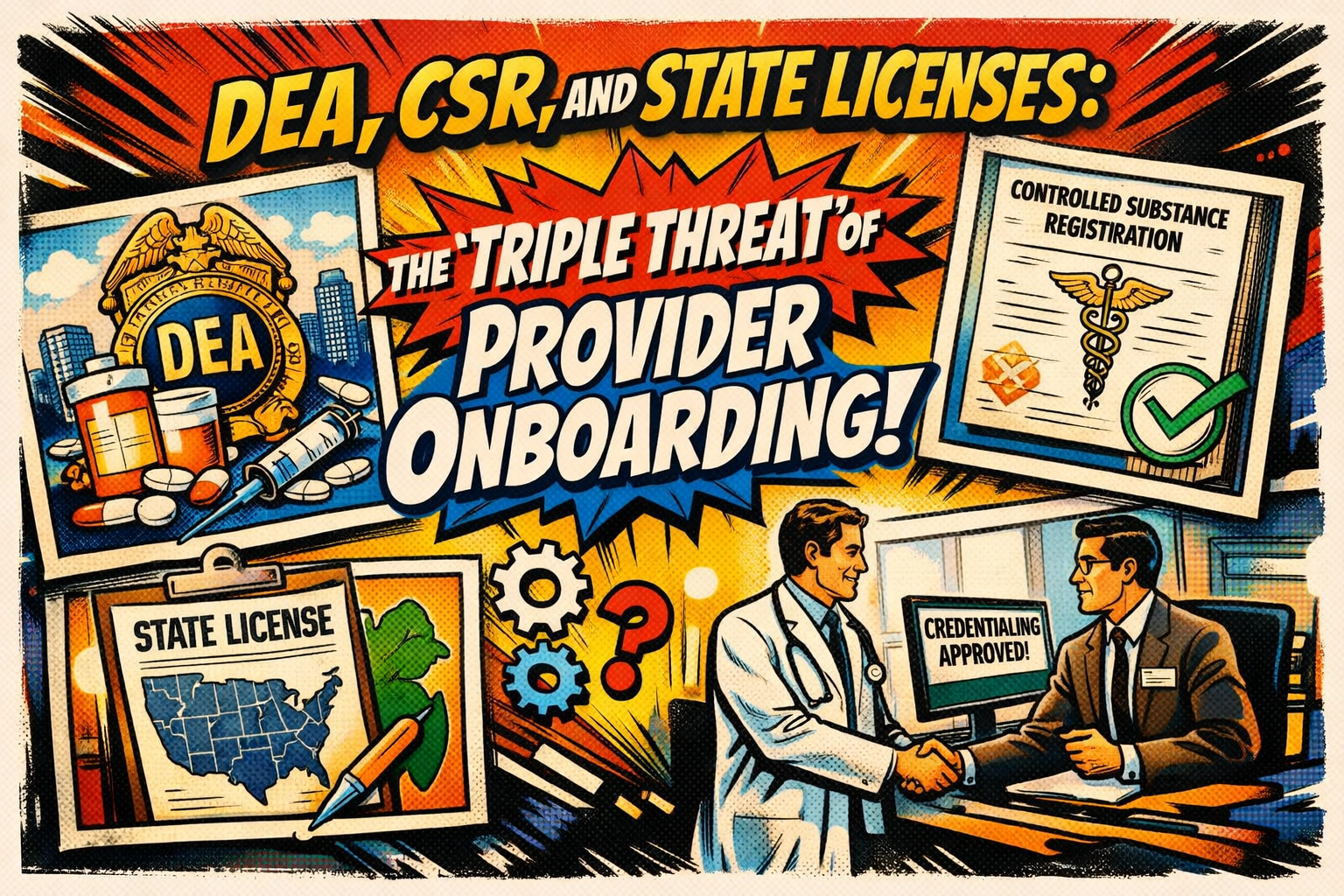
In the high-stakes environment of modern healthcare, the distance between hiring a top-tier provider and that provider actually seeing their first patient is often a bureaucratic chasm. This gap is defined by the "Triple Threat" of provider onboarding: State Medical Licensing, Controlled Substance Registration (CSR), and Federal DEA Registration. For healthcare administrators and practice owners, these three pillars represent the backbone of professional credibility and the absolute prerequisite for clinical operations. However, they are not merely items on a checklist; they are a complex, sequential puzzle where a single missing document or a misread deadline acts as a silent driver of revenue loss. At The Veracity Group, we see the operational rigor required to navigate these waters every day. If your practice treats onboarding as an administrative afterthought, you are likely leaking thousands of dollars in potential revenue before your new hire even puts on a stethoscope. The Sequential Trap: Why Timing is Everything One of the most common mistakes in medical provider enrollment services is attempting to tackle these three requirements simultaneously. In the world of regulatory compliance, sequence is king. The State Medical License: This is the foundational requirement. You cannot apply for state-level prescribing authority or federal registration without an active, unrestricted license in the state where the provider will practice. State-Level Controlled Substance Registration (CSR): Approximately half of U.S. states require a secondary, state-specific permit to handle controlled substances. This must typically be secured after the medical license but before the federal DEA application. Federal DEA Registration: The final step. The DEA requires both the state license and (where applicable) the state CSR to be active before they will issue a federal registration number. If you attempt to jump to the DEA application without the prerequisite state CSR, your application will be rejected. This doesn't just result in a lost application fee; it resets the clock on the entire onboarding timeline, pushing back your "go-live" date by weeks or even months. The $1,550 Daily Leak: The Financial Reality of Delay The cost of licensing delays is not theoretical: it is a mathematical certainty that directly impacts your bottom line. Let’s look at the financial reality of a typical physician generating approximately $400,000 in annual net revenue. When you break that down into working days, that provider is responsible for roughly $1,550 in revenue per day. A 5-day delay (waiting for a transcript to be mailed): $7,750 lost. A 14-day delay (missing a CSR filing window): $21,700 lost. A 30-day delay (re-submitting a rejected DEA application): $46,500 lost. For a multi-provider group or a rapidly scaling telehealth platform, these numbers multiply exponentially. A delay in medical provider enrollment services isn't just an administrative headache; it is a massive financial hemorrhage. When your provider is ready to work but the paperwork is stuck in a state board’s fax machine, your practice is paying for overhead without the offsetting revenue. The Administrative Nightmare: Why It’s Harder Than It Looks On the surface, filling out a form seems simple. In practice, obtaining a state license is an exercise in forensic history. State boards often require 40-page applications that demand: Verified transcripts from medical schools attended decades ago. Letters of recommendation from residency directors who may have retired. Primary source verification of every hospital affiliation held in the last ten years. Strict adherence to "fax-only" communication from antiquated state coordinators. Managing this for one provider is a full-time job. Managing it for a dozen providers across multiple states: especially for telehealth practices expansion: is a logistical mountain. The Veracity Group’s 4-Step "Triple Threat" Solution The Veracity Group eliminates the guesswork and the "wait-and-see" approach to onboarding. We provide an end-to-end management system designed to navigate the specific nuances of all 50 states, the Interstate Medical Licensure Compact (IMLC), and the federal DEA Diversion Control Division requirements. Our process is built on operational rigor: 1. Intake & Assessment We don't just ask for a CV. We perform a deep dive into the provider’s history to identify potential red flags (gaps in work history, previous board actions, or expired registrations) that could trigger a board investigation or delay. 2. Document Coordination We act as the "boots on the ground," chasing down transcripts, verification letters, and peer references. We handle the "fax-machine loop" so your clinical staff doesn't have to. 3. Application & Submission We ensure every box is checked and every sequence is followed. We handle the state license first, the CSR second, and the DEA third, ensuring a seamless flow that satisfies the strict requirements of provider enrollment. 4. Board Follow-Up Submitting the application is only 50% of the work. The real battle is won in the follow-up. We maintain consistent communication with board analysts to ensure your application doesn't sit at the bottom of a digital pile. Scaling Across State Lines: Telehealth and Locums For groups expanding into "border markets" (such as a practice serving the NY/NJ/CT tri-state area) or national telehealth groups, the "Triple Threat" becomes even more dangerous. Each state has unique rules regarding CSRs and whether a provider needs a separate DEA number for each state where they prescribe. Failure to understand these nuances can lead to serious compliance risks. As of June 27, 2023, the DEA also requires a one-time 8-hour training requirement on the treatment and management of patients with opioid or other substance use disorders. Do your providers have their certificates ready? If not, their next DEA renewal will be blocked. Proactive Maintenance: The "Never-Lapse" Policy The most dangerous phone call a practice manager can receive is from a provider standing in front of a patient, unable to send a prescription because their DEA registration lapsed the night before. The Veracity Group provides proactive renewal management. We track expiration dates for licenses, CSRs, and DEA registrations months in advance, ensuring that renewals are filed and confirmed long before they reach the "red zone." This level of foresight is what separates a high-functioning practice from one that is constantly in crisis mode. Conclusion: Stop Chasing