How to Credential a Provider in Utah: Fast-Growth Market and CHIP/Medicaid Rules

Utah is currently witnessing a healthcare metamorphosis that most expansion leads only dream of. Navigating provider enrollment in the Beehive State requires a sophisticated understanding of a market where a significant share of Utah’s population—around 1 in 6—relies on Medicaid or CHIP. For any organization looking to scale, efficient medical group enrollment is the primary lever for capturing this expanding patient base. At The Veracity Group, we see Utah as a blueprint for the future of healthcare administration: a state that has traded 40-year-old legacy systems for a modernized, high-velocity infrastructure. Looking for professional provider credentialing services in the USA? 👉 Check our main service page here: veracityeg.com The PRISM Advantage: Speed as a Competitive Weapon For decades, the administrative burden of Medicaid enrollment was a primary bottleneck for practice growth. In Utah, that bottleneck has been shattered by the PRISM (Provider Enrollment, Registries, and Individualized Support Management) system. This isn't just a minor software update; it is a total overhaul of the state's healthcare data architecture. The most striking feature of PRISM is its speed. Under the old legacy framework, simple demographic updates or enrollment changes could languish for weeks or months. Today, in our experience, PRISM processes many enrollment changes in just a few days. This rapid turnaround is a massive win for practice speed and revenue cycle stability. When your medical group adds a new provider, you are no longer waiting for a black box to eventually spit out an approval. You are engaging with a system designed for high stability and low downtime, ensuring that your applications move through the pipeline without the technical glitches that plague other state portals. Alt text: A digital dashboard representing Utah's PRISM system showing rapid provider processing times and high system stability. This transition away from 40-year-old legacy systems is not just about convenience; it is about operational agility. If your credentialing manager is still treating Utah like a slow-moving bureaucracy, you are leaving revenue on the table. The efficiency of PRISM means you can move from hiring to billing in a fraction of the time required in neighboring states. Navigating Fast-Growth Dynamics in the Utah Market Utah’s population is growing at a rate that consistently outpaces the national average. This demographic shift is accompanied by a significant expansion in the Medicaid and CHIP (Children’s Health Insurance Program) populations. As a medical group expansion lead, you must recognize that 1 in 6 Utahns are on Medicaid. This is no longer a niche payer segment; it is a core pillar of a sustainable patient volume strategy. The demand for services is surging, but the supply of providers must be onboarded with equal speed. Agility is the new currency in the Utah market. If your provider enrollment process is sluggish, you are effectively turning away a massive portion of the market. To succeed here, your organization must adopt an agile onboarding strategy that leverages Utah’s modernized tools to keep pace with the state's growth. Why Agile Onboarding Matters Market Capture: In a fast-growing environment, the first group to provide access wins the patient loyalty. Revenue Realization: Faster enrollment means shorter "lag time" between a provider's start date and their first reimbursable claim. Recruitment Advantage: Providers want to work for groups that have their administrative act together. A seamless enrollment experience is a powerful recruiting tool. CHIP and Medicaid Rules: The Continuous Coverage Shift One of the most critical nuances in Utah's current landscape is the shift toward continuous coverage. Historically, Medicaid and CHIP beneficiaries faced frequent "churn," where small fluctuations in income or administrative hurdles led to temporary losses in coverage. This was a nightmare for providers, leading to denied claims and interrupted care. Utah has moved toward smoother transitions between Medicaid, CHIP, and Marketplace coverage, aiming to reduce churn. This policy shift ensures that patients remain covered even as their eligibility status fluctuates. For your practice, this means more consistent reimbursement and fewer billing "surprises." You can learn more about how these shifts affect broader strategies in our Mastering Multi-State Medicaid Provider Enrollment guide. Understanding CHIP Continuity The Children’s Health Insurance Program in Utah is tightly integrated with the Medicaid infrastructure. When credentialing a provider, you are not just enrolling them in a plan; you are placing them into an ecosystem designed for patient retention. The Utah Department of Health and Human Services emphasizes that maintaining a provider’s active status in PRISM is essential to treating this population without interruption. If a provider's enrollment lapses, the "continuous" nature of the coverage doesn't help you: the claim will still be rejected. Alt text: A flowchart illustrating the seamless transition of a patient between Utah Medicaid and CHIP coverage, highlighting the importance of continuous provider enrollment. The Strategic Advantage Utah’s modern infrastructure makes it easier for the state to align provider data with broader access and outcome goals. This means the data you provide during the enrollment phase is increasingly used to measure network adequacy and access to care in real-time. By maintaining high standards of data integrity in your services and enrollment submissions, your medical group positions itself as a high-value partner to the state. This is a strategic advantage that goes beyond simple billing. It places your group at the forefront of value-based care initiatives. Tactical Execution: Getting Enrolled in Utah To navigate this market effectively, your team must master the technical requirements of the PRISM portal. This is not a process you can "wing." 1. The Utah-ID Prerequisite Before you even touch PRISM, every provider and administrative user must have a Utah-ID Account. This is the gateway to all state digital services. Security is tight, and the authentication process is rigorous. Do not wait until a provider’s start date to initiate this. 2. The PRISM Portal Submission Once the Utah-ID is active, you enter the PRISM portal. This system requires detailed information regarding provider specialties, locations, and affiliations. Because the system is so stable and modernized, it will flag errors immediately. While this might feel frustrating, it is actually
How to Credential a Provider in Louisiana: LaMPP, Medicaid, and Commercial Payers

Louisiana is a unique beast when it comes to healthcare administration. For medical group administrators and RCM leaders, the Pelican State represents both a massive opportunity for expansion and a legendary administrative swamp. If you are managing a multi-state group, you already know that provider enrollment services in Louisiana require a specific kind of expertise that goes beyond the standard CAQH update. Utilizing professional medical credentialing strategies is the only way to navigate a system that is as complex as the bayous themselves. Looking for professional provider credentialing services in the USA? 👉 Check our main service page here: veracityeg.com The Louisiana Landscape: Why It’s Different Louisiana is a high-demand state, but it is also a high-complexity state. Unlike states that have a "set it and forget it" mentality with Medicaid, Louisiana’s system is a dual-track marathon. You aren't just dealing with a single state agency; you are managing a centralized enrollment portal while simultaneously wrestling with five different Managed Care Organizations (MCOs), each with its own quirks and demands. The pressure is high because the demand for providers in Louisiana is surging, particularly in rural areas and behavioral health. If your providers aren't loaded into the system correctly from day one, your revenue cycle will stall before the first claim is even scrubbed. The Foundation: The Louisiana Medicaid Provider Enrollment Portal (LaMPP) The starting point for any provider looking to treat Medicaid patients in Louisiana is the Louisiana Medicaid Provider Enrollment Portal, often referred to within the industry as LaMPP. This is a centralized, web-based system designed to satisfy federal CMS requirements. Every provider must complete this state-level enrollment. This is not optional. Whether you are a solo practitioner or part of a massive multi-state group, the LaMPP portal is your gateway. You will need: A valid Louisiana Provider ID (if you’re re-enrolling). Your National Provider Identifier (NPI). A signed state provider participation agreement. The state uses this portal to perform its own screening, which occurs at the initial application and at least every five years for revalidation. However, do not fall into the trap of thinking that a "complete" status in the LaMPP portal means you are ready to see patients. It is merely the ticket to enter the stadium; you still have to find your seat with the MCOs. The "Big 5" MCOs: Navigating Healthy Louisiana Once the state-level enrollment is underway, the real work begins with the Managed Care Organizations. In Louisiana, these are collectively known under the "Healthy Louisiana" umbrella. To be fully reimbursed, your providers must be enrolled with the Big 5: Aetna Better Health of Louisiana AmeriHealth Caritas Louisiana Healthy Blue Louisiana Healthcare Connections (LHCC) UnitedHealthcare Community Plan Each of these MCOs operates its own portal and has its own internal timeline. While the state-level LaMPP enrollment is centralized, the MCO enrollment is decentralized. This is where most practices lose their momentum. If you aren't tracking the status of each application across all five entities, you will inevitably end up with a provider who can see United patients but is getting denied by Healthy Blue. For groups expanding into the state, this fragmentation is a primary driver of compliance risks and revenue leakage. You must treat each MCO as a separate project with its own follow-up schedule. The Act 143 (2022) Shortcut: A Game Changer If there is one piece of insider knowledge you need for Louisiana, it is Act 143. Passed in 2022, this legislation was a direct response to the massive backlogs that were preventing providers from seeing patients. Act 143 creates a streamlined path for certain providers. If a provider has active hospital privileges or comes from an FQHC (Federally Qualified Health Center) or RHC (Rural Health Clinic) background, the law requires MCOs to accept eligible hospital or state credentialing to reduce duplicative steps in the enrollment process. That does not erase every administrative hurdle, but it does remove unnecessary repetition for qualifying providers. This is a massive win for surgical groups and hospital-based specialties. If your provider qualifies under Act 143, you must lead with this information. It reduces duplicative steps and gives your practice a cleaner path through enrollment. Not leveraging Act 143 is a failure of strategy that will cost your practice valuable time and billable momentum. Commercial Payers and the Role of CAQH While Medicaid is the most complex part of the Louisiana puzzle, commercial payers like Blue Cross Blue Shield of Louisiana (BCBSLA) and UnitedHealthcare (Commercial) still rule the market. For these payers, the CAQH ProView profile is your best friend. Louisiana commercial payers are generally more aligned with national standards, but they still require primary source verification. You must ensure that your CAQH profile is not just "current" but meticulously detailed. For more on how to optimize this, see our guide on navigating the maze of CAQH and Medicare enrollment. Pro-Tip: Louisiana commercial payers are notoriously slow to update their directories. Even after the enrollment is complete, you must verify that the provider's demographics: address, phone number, and specialty: are appearing correctly in the public-facing directories. If a patient can't find you, the enrollment was for nothing. Why Multi-State Groups Struggle with Louisiana If you manage a medical group that operates in Texas, Mississippi, and Florida, Louisiana will feel like a different planet. The state's insistence on its own specific portal (LaMPP) and the rigid separation between state enrollment and MCO enrollment creates a "black hole" for applications. Administrative leaders often make the mistake of applying their Texas workflow to Louisiana. In Texas, the process is relatively streamlined. In Louisiana, you must be aggressive. You must follow up with the Louisiana Department of Health (LDH) regularly. You can find their official resources and contact information at the Louisiana Department of Health website. The High Cost of Delays The consequences of a botched Louisiana enrollment are severe. We aren't just talking about a few weeks of delay; we are talking about: Total Claim Denials: Medicaid will not pay retroactively for periods where the provider
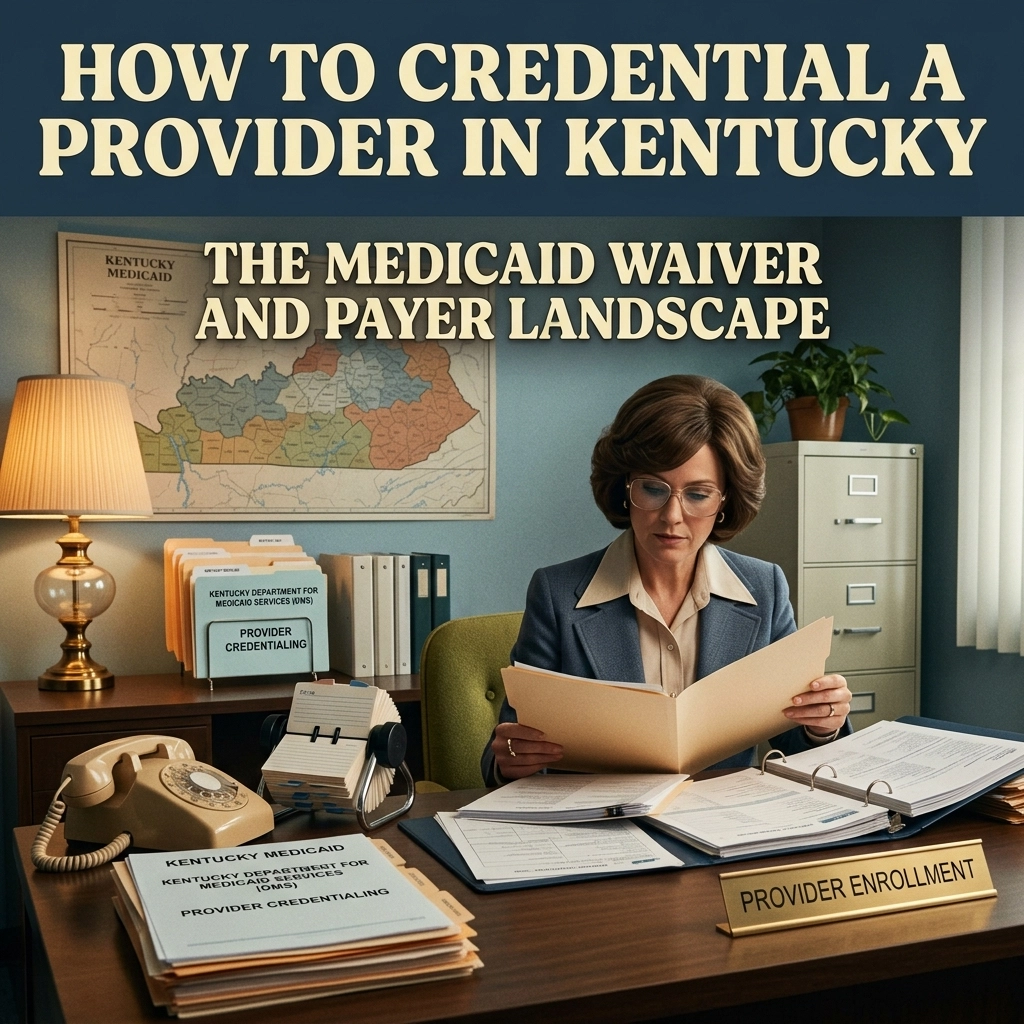
How to Credential a Provider in Kentucky: The Medicaid Waiver and Payer Landscape

Navigating the healthcare environment in the Bluegrass State requires more than just a map; it requires a deep understanding of a system that is as unique as it is complex. If you are looking to expand your footprint in the region, mastering provider enrollment services is your first hurdle. Kentucky is not a state where you can simply "wing it" when it comes to Medicaid provider enrollment. The state’s history with Medicaid waivers has created a layered administrative landscape that can trip up even the most seasoned practice managers. At The Veracity Group, we see clinics struggle with Kentucky’s practical "enrollment first" reality and the nuances of various 1915(c) waivers daily. This isn't just paperwork; it is the backbone of professional credibility and the primary driver of your revenue cycle. If you don't get the sequence right, your providers will be sitting on the sidelines while your overhead continues to climb. Looking for professional provider credentialing services in the USA? 👉 Check our main service page here: veracityeg.com The "Enrollment First" Reality in Kentucky In many states, you might pursue facility licensure and provider enrollment as parallel tracks. In Kentucky, that is a recipe for a rejection letter. In practice, Kentucky functions as an "enrollment first" state. This means a provider or an entity must be enrolled in the DMS system before they can even apply for specific waiver licensures or certifications. Think of DMS enrollment as your passport to success. Without it, the doors to Kentucky’s lucrative waiver programs remain firmly locked. This rule exists to ensure that every provider operating within the state’s ecosystem meets a baseline of administrative and background standards before they are allowed to touch specialized programs. You must utilize the Kentucky Medicaid Partner Portal Application (MPPA) to begin this journey. This electronic system is the gatekeeper for all things Medicaid in Kentucky, and mastering its interface is non-negotiable. The High Cost of Sequence Errors When a medical group ignores the "Enrollment First" mandate, the consequences are immediate and expensive. We have seen instances where groups spend months preparing waiver applications, only to have them tossed out because the underlying DMS enrollment wasn't active. This results in: Stalled Revenue: You cannot bill for services rendered during the gap. Administrative Redo: You will likely have to resubmit documents that have since expired. Provider Frustration: Your clinical staff wants to work, not wait on red tape. Decoding the 1915(c) Waiver Landscape Kentucky is famous in the healthcare world for its robust use of 1915(c) Home and Community-Based Services (HCBS) waivers. These programs are designed to provide services to individuals who would otherwise require institutional care. However, for waiver participation, Kentucky uses specific provider types (such as the certified waiver provider category often referred to as “Type 09” in enrollment matrices), and that process is a different beast entirely compared to standard physician enrollment. You must understand the distinctions between the primary waivers to ensure you are applying for the correct designations: The Michelle P. Waiver: Named after a prominent advocate, this waiver serves individuals with intellectual or developmental disabilities. It is one of the most common waivers in the state and has very specific requirements for behavioral health and personal care services. Supports for Community Living (SCL): This is geared toward individuals who meet the requirements for care in an Intermediate Care Facility for individuals with an Intellectual Disability (ICF/IID). Home and Community Based (HCB) Waiver: This serves the elderly and those with physical disabilities who would otherwise require nursing facility care. Each waiver requires program-specific certification involving the relevant state agencies. For example, the Home and Community Based (HCB) Waiver involves the Department for Aging and Independent Living (DAIL), while the Michelle P. Waiver and Supports for Community Living (SCL) involve the Department for Behavioral Health, Developmental and Intellectual Disabilities (DBHDID). If you are aiming to be a waiver provider, the required certification documentation is a mandatory part of your MPPA submission. This is another area where mastering multi-state Medicaid provider enrollment strategies becomes vital, as Kentucky’s specific state-level certifications are rarely mirrored exactly in neighboring states like Tennessee or Ohio. The Ghost of the 1115 Waiver: KY HEALTH You cannot talk about Kentucky Medicaid without mentioning the 1115 waiver history, specifically the program known as KY HEALTH. While political shifts eventually led to the termination of the more controversial work-requirement aspects of this waiver, the legacy of KY HEALTH changed the administrative culture in Frankfort. The 1115 waiver era shifted administrative expectations toward higher levels of reporting and stricter compliance monitoring. Even though the program was overhauled, the state's infrastructure for provider enrollment remained rigorous. It taught the state how to implement complex, multi-layered systems, and they haven't looked back. For you, this means that Kentucky's DMS is more "tech-forward" and data-hungry than ever. You must be prepared to provide exhaustive tax information, NPI details, and county-specific service listings with high precision. Navigating the Kentucky MCO Payer Landscape Once you have successfully navigated the state-level DMS enrollment, congratulations, you're halfway there. Now you have to deal with the Managed Care Organizations (MCOs). In Kentucky, getting your Medicaid Provider ID is just the ticket to the dance; you still have to ask the MCOs to dance. Kentucky utilizes several MCOs to manage its Medicaid population, such as Aetna Better Health, Humana Healthy Horizons, Passport Health Plan (by Molina), and UnitedHealthcare Community Plan. Each of these payers has its own internal process, and they do not always play well with each other's timelines. The Veracity Take: Do not wait for your DMS approval to arrive in the mail before looking at your contracting strategy. While you cannot finalize MCO enrollment without that state ID, you should have your CAQH profile updated and your demographic data ready to go. Any lag between state approval and MCO application is literally money left on the table. Common Pitfalls for Kentucky Providers Even the most organized medical groups run into issues when expanding into Kentucky. Here are the "silent drivers"
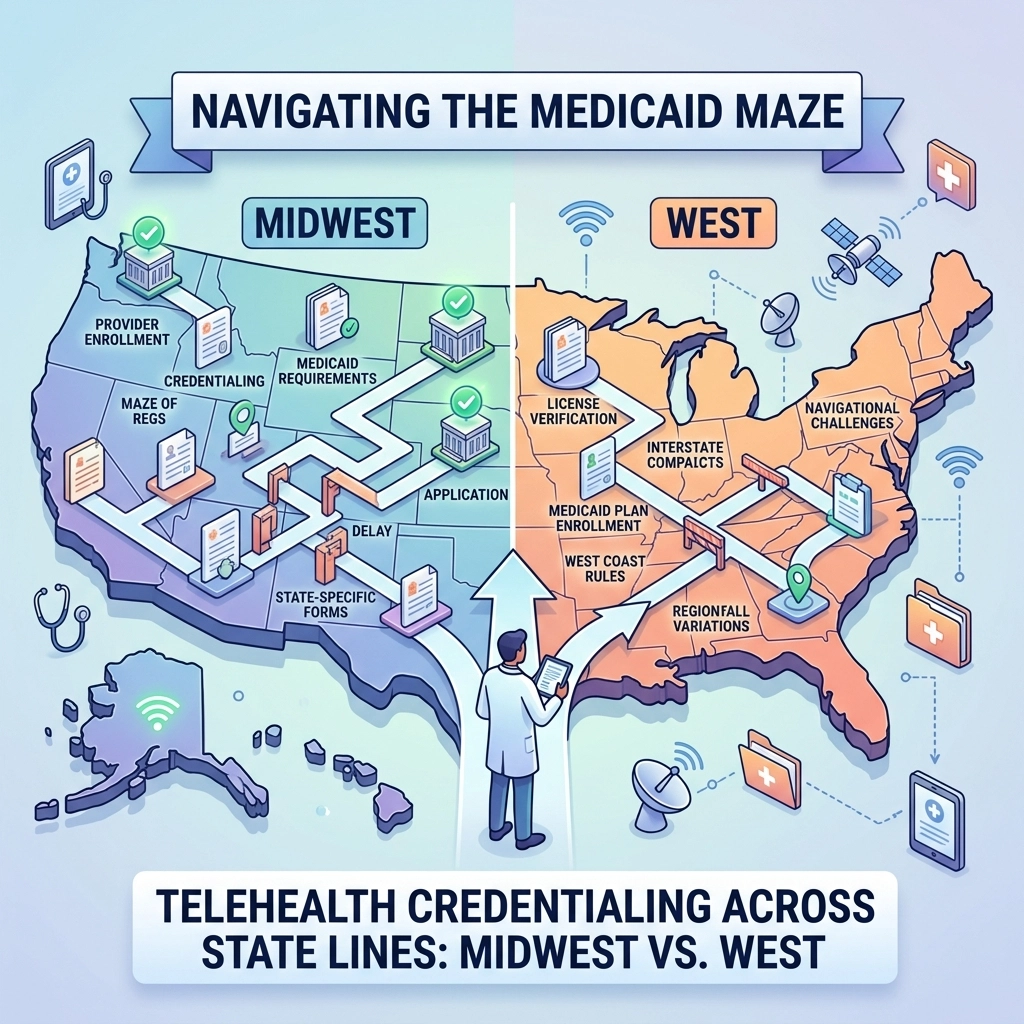
Telehealth Credentialing Across State Lines: Navigating the Midwest vs. West Medicaid Maze

Navigating medical provider enrollment services across state lines while building a reliable telehealth footprint feels like playing a high-stakes game of 5D chess. Your patients do not care about state borders. They care about access to care from their living rooms. But the moment those pixels cross a state line, you enter a regulatory minefield. If you think a single license is your "golden ticket" to a national telehealth model, you are in for a rude awakening. Medicaid programs in Indiana, Illinois, and Nevada are not just different; they are entirely different ecosystems with unique "gotchas" that will stall your revenue if you are not prepared. If your question is "Can I see Medicaid patients across state lines?" the answer is simple: yes, but only after you satisfy each state's licensing, enrollment, and verification rules. If your question is "How do I do it without delays?" the answer is even clearer: you need a state-by-state process that matches your provider type, service location, and payer requirements. Looking for professional provider credentialing services in the USA? 👉 Check our main service page here: veracityeg.com The Golden Rule of the Virtual Visit Before we dive into the regional trenches, let’s establish the foundational law of the land: The provider must be licensed in the state where the patient is physically located at the time of the encounter. This is non-negotiable. Whether you are treating a patient via a smartphone in a cornfield in Indiana or a high-rise in Las Vegas, your legal right to practice is dictated by the ground under the patient’s feet. Failing to secure the correct state-specific enrollment is the fastest way to trigger a claim denial or, worse, an OIG audit. While the Interstate Medical Licensure Compact (IMLC) offers a streamlined pathway for physicians, the Medicaid enrollment process remains a manual, state-by-state slog that requires precision and insider knowledge. Alt-tag: A map of the United States highlighting the Midwest and Western regions for telehealth expansion. 1. The Midwest vs. the West: Streamlining vs. Complexity For general provider enrollment services, the Indiana-Illinois-Nevada comparison tells you exactly what multi-state expansion looks like in practice. One state removes friction. One state slows you down with administrative precision. One state raises the verification bar for every applicant. If you are asking where enrollment is easiest, where it gets sticky, and where extra documentation is non-negotiable, this three-state comparison is the focal point. Indiana: The License-Only Advantage If you have not looked at Indiana lately, you are missing a rare win for administrative efficiency. As of July 1, 2024, Indiana officially removed the requirement for telehealth-specific certificates. That creates a cleaner path for physicians, advanced practice providers, therapists, and other eligible clinicians expanding telehealth services under Medicaid. This is the key Indiana takeaway: if you hold the proper Indiana license, you do not need a separate telehealth certificate to move forward. That is a real operational advantage for multi-state groups asking, "Can I enroll in Indiana without another telehealth approval layer?" The answer is yes, provided your license, ownership information, service location details, and enrollment file are complete. However, do not mistake "easier" for "automatic." You still must submit accurate provider data to the Indiana Health Coverage Programs (IHCP). A clean Indiana rule set does not forgive sloppy applications. Illinois: The Administrative Precision State Cross the border into Illinois, and the vibe shifts. Illinois is the state that forces you to respect process discipline. The core question here is not whether telehealth is possible. The real question is how cleanly your enrollment file matches across every data source. For most medical specialties, Illinois becomes difficult for three reasons: Application detail must align across systems. Provider records must match state and payer files exactly. Delays compound quickly when ownership, practice location, or rendering-provider data is inconsistent. Illinois Medicaid is notoriously meticulous. If your CAQH profile is not synchronized perfectly with your state application, your file will sit in "pending" purgatory for months. That problem is not specialty-specific. It affects primary care, specialty care, surgical groups, therapy practices, and multi-location organizations alike. 2. The West: The Land of Stringent Verification If the Midwest is characterized by shifting legislative sands, the West: specifically Nevada: is characterized by its rigorous verification walls. While Western states often have strong telehealth infrastructure, their "gatekeeper" mentality for Medicaid is significantly more intense than what you will find in the heartland. Nevada: The "Gotcha" State Nevada does not play games. If you are looking to expand your footprint here, prepare for a verification marathon. Nevada Medicaid requires more stringent primary source verification and provider qualification documentation than Indiana or Illinois for many enrollment scenarios. This is the big Nevada question: "Can I enroll as an out-of-state provider if I already bill Medicaid elsewhere?" Yes, but Nevada will still require its own documentation trail, validation standards, and closer review. That is the "gotcha" many groups miss. Prior enrollment success in another state does not buy you a shortcut in Nevada. Nevada is particularly focused on out-of-state telehealth providers. The state wants to confirm that you are not operating as a "ghost clinic" and that every provider meets Nevada-specific requirements for licensure, qualifications, service locations, and supporting records. For general medical provider enrollment services, that means your file must be audit-ready before submission, not cleaned up after the fact. Alt-tag: A comparison chart showing the different requirements for Medicaid enrollment in Indiana, Illinois, and Nevada. Comparing the "Gotchas" Feature Indiana Illinois Nevada Telehealth Certificate Removed (as of 7/1/2024); license-only path is the key advantage Not the main issue; administrative alignment is the real hurdle Stricter review depends on provider type and enrollment facts Verification Speed Moderate Slow and detail-heavy Very stringent and documentation-heavy Key "Gotcha" Valid state license is enough for the telehealth approval piece, but the enrollment file still must be complete Data mismatches stall applications fast High scrutiny on out-of-state providers and stronger primary source verification Enrollment Difficulty Lower Medium-High High 3. Can You Enroll in Multiple Medicaid States at