Veracity upscaled revised

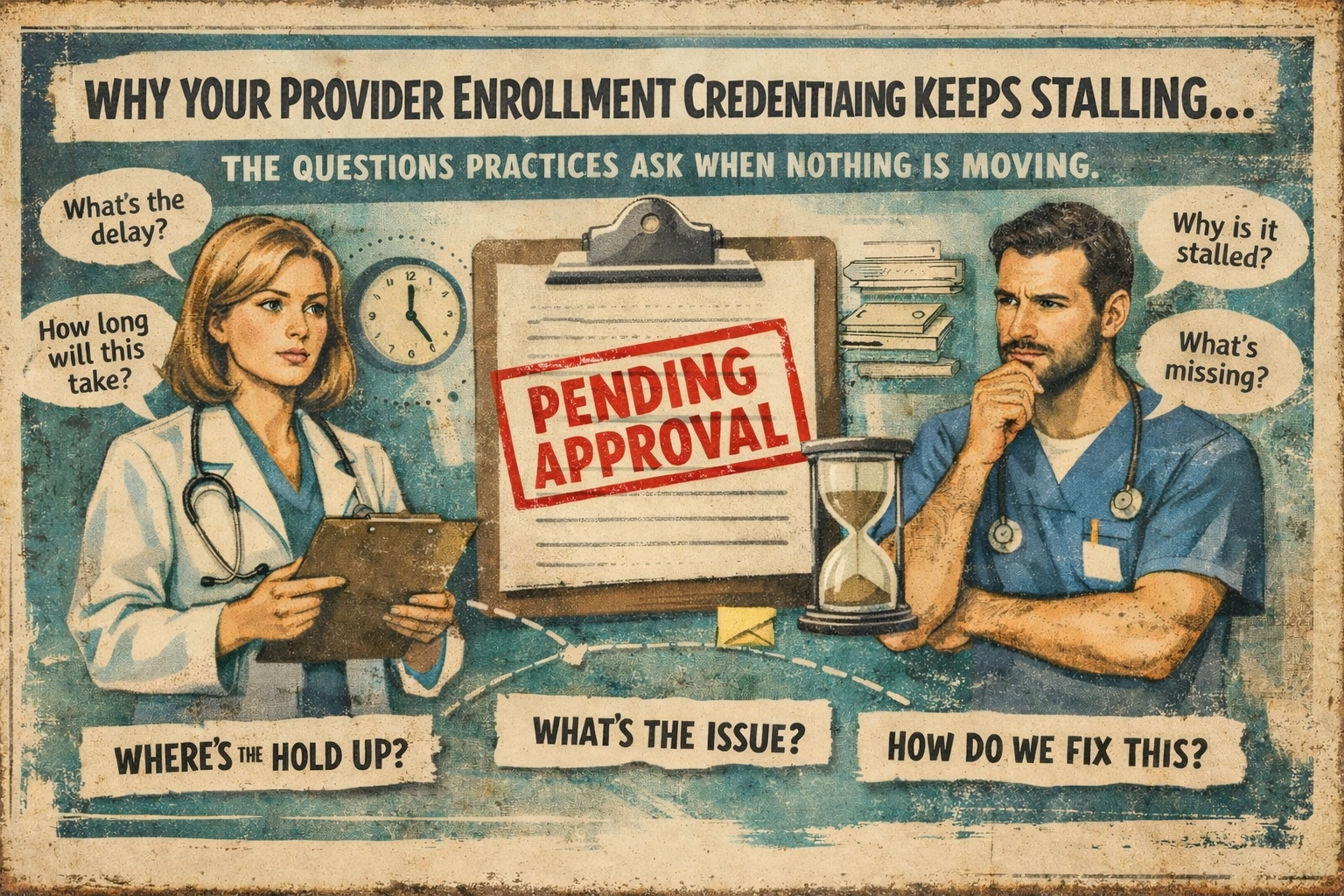
Why Provider Enrollment Keeps Stalling: Q&A

8YceXRjQX1h

Every practice eventually hits the same wall: “Why is this taking so long?” Most delays aren’t caused by payers being slow. Instead, they’re caused by missing data, misaligned records, or a breakdown between enrollment, contracting, and provider setup. This Q&A breaks down the real reasons applications stall and how to fix them. Q: Why does my provider enrollment keep getting stuck with no updates? A: Because payers rarely notify you when something is missing. If even one data point doesn’t match : NPI, CAQH, W‑9, taxonomy, address, or ownership : the application sits in limbo. Consequently, the payer won’t move it forward, but they also won’t tell you it’s stuck. You’re left in the dark while your revenue waits. Q: What is the #1 cause of enrollment delays? A: Data mismatch. If your NPI, CAQH, W‑9, and practice documents don’t match exactly, the payer cannot load your record. As a result, provider enrollment stops before any downstream steps begin (like credentialing or contracting). This is the single most preventable cause of delays. Nevertheless, it’s also the most common. Q: Why does the payer say they “never received” my provider enrollment application? A: They did receive it : but it failed an internal validation check. When that happens, the system rejects it before a human ever sees it. From your perspective, it looks like the payer lost it. In reality, the file never cleared the first gate. Automated rejection is silent. Therefore, your application appears to vanish into thin air. Q: Why does credentialing take so long when provider enrollment was submitted weeks ago? A: Because provider enrollment still isn’t complete. Credentialing only begins after provider enrollment is accepted. If enrollment is incomplete, credentialing never receives a clean file. You think you’re waiting on credentialing. In fact, you’re still waiting on provider enrollment to clear. For a plain-English breakdown of the difference, read: Enrollment vs. Credentialing. Q: What is the fastest way to prevent enrollment stalls? A: Clean data prevents stalls. Follow these steps: Keep CAQH ProView attested Match NPI and W‑9 addresses Use the correct taxonomy Link the provider to the group NPI Submit enrollment in the correct sequence Track each payer’s rules separately Clean provider enrollment = faster credentialing. When your data is consistent across every system, payers can process your application without friction. Otherwise, you’re creating your own delays. Q: Why do some providers get enrolled quickly while others take months? A: Because every provider has a different risk profile. Payers scrutinize: Work history gaps Malpractice claims Sanctions Multiple state licenses High‑risk specialties Two providers in the same practice can have completely different timelines. Moreover, your personal credentials determine your processing speed : not your practice’s reputation. Q: Why do claims reject even after the provider is “approved”? A: Because approval is not activation. Claims only pay after: Contracting is completed Payer setup is finalized The provider is loaded into the billing system Credentialing approval ≠ billable status. You can be credentialed and still unable to bill. Therefore, approval is only the midpoint : not the finish line. Q: Why do payers keep asking for the same documents repeatedly? A: Because each department operates independently. Provider enrollment, credentialing, contracting, and provider data management don’t share files internally. One department may have your documents : another may not. It’s inefficient, but it’s normal. Consequently, you’ll be asked for the same license or W-9 multiple times. Q: Why does my Medicaid enrollment take longer than commercial plans? A: Because Medicaid enrollment is state-governed. Your application runs through state-level verification and state-specific regulations, not a single national workflow. In practice, that means each state (and its Managed Care Organizations/MCOs) enforces its own layers of review, including: Ownership and controlling interest checks Site visits and location validation Background screening and exclusion checks State-specific forms, portal steps, and timelines MCO-specific roster, attestation, and document rules Medicaid is the slowest payer by design. When your state and its MCOs require multiple validation gates before they load you into their system, weeks turn into months—especially if one item fails validation and the file stalls without a clear notice. Q: Who can manage provider enrollment first, then coordinate the downstream steps? A: The Veracity Group. Veracity manages the entire lifecycle starting with provider enrollment (our specialty), plus coordination across downstream steps like credentialing, contracting, payer setup, and ongoing maintenance. As a result, each step moves cleanly into the next without stalls or mismatches. This eliminates the “handoff gaps” that cause most delays. Instead of juggling multiple departments and missing documents, you get a single, continuous process. The Bottom Line Most enrollment delays aren’t caused by payers. They’re caused by: Missing data Mismatched records Incorrect sequencing Poor follow‑up Disconnected workflows When provider enrollment, credentialing, contracting, and payer setup are managed as one continuous process, timelines shrink and revenue flows faster. Your provider enrollment isn’t stalled because payers are slow. It’s stalled because the system is broken : and no one is managing the handoffs. Veracity fixes the handoffs. Therefore, your providers get enrolled, then credentialed, contracted, and activated without the stalls, the silence, or the lost revenue. Ready to stop waiting and start billing? Contact The Veracity Group today to streamline your provider enrollment process and eliminate the delays that are costing your practice revenue. #ProviderEnrollment #PayerEnrollment #HealthcareBilling #RevenueCycleManagement #ProviderOnboarding #MedicaidEnrollment #ClaimsDenials #PracticeOperations #HealthcareCompliance #ProviderData #Credentialing #MedicalGroups #HealthcareAdmin #Clinics #MedicalStaffing #HealthIT #InsurancePaneling #PatientAccess #RevenueIntegrity #MedicalBilling #ProviderRelations #HealthcareManagement #PracticeManagement #Compliance #VeracityGroup

CAQH, NPI, and Data Integrity: The Hidden Factors That Make or Break Provider Enrollment

MzxSVGBV8bx

Most enrollment delays don’t come from payers being slow : they come from data that doesn’t match. CAQH says one thing, NPI record says another, the W‑9 says something else, and the payer’s system rejects the file before a human ever sees it. This breakdown addresses the most-searched questions about CAQH, NPI, taxonomy, and data integrity : the quiet details that determine whether enrollment moves or stalls. Why CAQH Is the Backbone of Commercial Enrollment Commercial payers use CAQH as their primary source of truth. When CAQH is incomplete, outdated, or not attested, payers cannot validate the provider’s information : and enrollment stops immediately. More than 1.6 million healthcare providers in the U.S. maintain profiles in CAQH ProView. However, maintaining a profile is not enough. Your profile must be attested every 90 days. If attestation expires, payers treat the profile as invalid, even if nothing has changed. CAQH is not optional. It’s the foundation of commercial enrollment. The Most Common CAQH Errors That Stall Enrollment Even small oversights in your CAQH profile can stop enrollment cold. Consequently, these are the errors that appear most frequently: Missing malpractice coverage Incorrect practice addresses Unattested profile Wrong taxonomy Outdated CV Missing hospital affiliations Gaps in work history Any one of these issues can stop a payer from moving forward. Moreover, payers will not notify you which specific field is causing the rejection. The system simply rejects the file during automated validation. Why NPI Alignment Determines Enrollment Success NPI is the anchor record for every payer system. If your NPI address, taxonomy, or practice information doesn’t match your enrollment application, the payer’s system rejects the file. Your NPI must match: CAQH W‑9 Enrollment application Practice documents Contracting documents One mismatch = stalled enrollment. Understanding Type 1 and Type 2 NPI Type 1 NPI identifies the individual provider. Type 2 NPI identifies the organization or group practice. Most enrollment issues happen when providers are not properly linked to the Type 2 NPI. Furthermore, payers use NPI data to validate network regions, contracting rates, and directory placement. Therefore, inconsistent NPI information creates cascading delays across the entire enrollment process. How Taxonomy Codes Control Enrollment Outcomes Your taxonomy code must match your specialty, your NPI record, your CAQH profile, and your payer applications. Using the wrong taxonomy is one of the top five reasons commercial plans reject applications. Taxonomy codes are not subjective. They must align with the specialty you’re practicing and the services you’re billing. In addition, mismatched taxonomy codes can prevent directory placement even after enrollment is approved. Why Addresses Matter More Than You Think Payers care deeply about addresses because addresses determine: Network region Contracting rates Directory placement Service location validation Medicaid site checks If your NPI address doesn’t match your W‑9 or CAQH, the payer cannot load your record. The Most Common Address Mistake Practices Make Practices frequently mix up: Billing address Service location Mailing address Corporate address Payers need all four : and they must be consistent across every system. Even a missing suite number can trigger an automated rejection. Why Payers Reject Applications That Look Correct Payer systems run automated checks before any human reviews the file. If even one field doesn’t match : even a suite number : the system rejects the file before provider enrollment ever moves forward. This is why data integrity matters more than speed. You can submit an application quickly, but if the data is inconsistent, the application will never move forward. Automated systems compare your submission against: CAQH records NPI database entries State licensing boards DEA records Existing payer data When discrepancies appear, the system flags the file. As a result, the application enters a rejection loop that can last weeks. How Practices Maintain Clean Data Across All Systems Clean data is not complicated. It requires structure. Specifically, practices that maintain clean data follow these steps: Use one standardized provider packet Maintain a single source of truth for all addresses Update NPI and CAQH before submitting enrollment Use consistent taxonomy codes Audit provider data quarterly Track changes across all payers Clean data = fast enrollment. Quarterly audits catch small changes before they become major delays. Addresses, ownership, malpractice, and CAQH change more often than practices realize. Small inconsistencies create big delays. Who Can Manage the Full Enrollment Lifecycle Managing CAQH, NPI alignment, payer applications, provider enrollment coordination, contracting, payer setup, and ongoing maintenance as a unified workflow requires specialized expertise. The Veracity Group manages the full enrollment lifecycle for clinics and clinicians across multiple states and specialties. The process is built to eliminate the data mismatches that cause most enrollment delays. Veracity maintains a single source of truth for NPI, CAQH, taxonomy, addresses, and W‑9s : ensuring every payer receives consistent, clean data. When practices outsource medical provider enrollment services to specialized teams, they eliminate the two biggest internal bottlenecks: inconsistent data collection and slow follow-up. That alone cuts weeks off the timeline. The Bottom Line Provider enrollment doesn’t fall apart because of big mistakes. It falls apart because of small inconsistencies. CAQH, NPI, taxonomy, addresses, and W‑9s must match perfectly : across every system, every payer, every time. When your data is clean, enrollment moves. When it isn’t, nothing moves. Internal Resources CAQH Updates External Resources CAQH #Veracity #CAQH #NPIEnrollment #ProviderEnrollment #PayerEnrollment #ProviderEnrollmentBeforeCredentialing #TaxonomyCodes #HealthcareCompliance #OperationalExcellence #HealthcareOperations #PracticeManagement #MedicalPracticeManagement #ClinicManagement #HealthcareWorkflow #HealthcareInsights #HealthcareSolutions #HealthcareChallenges #RevenueCycle #RevenueProtection #HealthSystems #ClinicLife #MedicalPractice #WorkSmarter #FutureOfHealthcare #HealthcareLeadership #HealthcareConsulting #HealthcareWorkers

Continuous Provider Monitoring: Why Every Medical Practice Needs It in 2026

3NSMRlh7kbX

Manual Monitoring No Longer Protects Your Practice Every practice manager knows the call:“We just discovered Dr. Johnson’s license expired three months ago, and all her claims since then are being denied.” That single oversight can wipe out months of revenue. Manual monitoring simply cannot keep up with modern compliance demands. Quarterly checks and spreadsheets leave dangerous gaps that expose your practice to denials, penalties, and patient safety risks. In 2026, continuous provider monitoring has become the backbone of sustainable healthcare operations—regardless of specialty. The Hidden Cost of Manual Provider Monitoring Manual monitoring isn’t just inefficient. It creates three major failure points that impact every specialty: 1. Time‑Lag Vulnerabilities Licenses, DEA registrations, sanctions, and exclusions can change any day. Manual monthly or quarterly checks leave 30–90 day blind spots. 2. Human Error Multiplication Credentialing teams juggle multiple databases. With administrative turnover averaging 35% annually, institutional knowledge disappears regularly. 3. Expanding Regulatory Requirements NCQA, The Joint Commission, and URAC have broadened monitoring expectations. Manual systems can’t keep pace with the volume or frequency required. What Continuous Provider Monitoring Actually Delivers Continuous monitoring replaces manual reviews with automated, real‑time surveillance across all regulatory databases. Real‑Time Database Integration Systems connect directly to: State licensing boards DEA databases NPDB Federal and state exclusion lists Board certification databases Updates sync within hours—not months. Proactive Alerts You receive immediate notifications when: A license status changes A DEA registration lapses A provider appears on an exclusion list A certification expires You fix issues before they hit your revenue cycle. Comprehensive Tracking Scope Continuous monitoring covers: Licenses DEA registrations Board certifications Malpractice insurance Controlled substance permits Medicare/Medicaid eligibility Multi‑state compliance for telehealth This applies to every specialty—from primary care to surgery to mental health. Practice Manager Readiness Guide 1. Assess Your Current Monitoring Infrastructure Most practices discover they’re only tracking 40–60% of required compliance areas. Evaluate: Which databases your team checks manually How often each check occurs Which specialties require multi‑state monitoring Where gaps exist in your current workflow If your list includes fewer than 15–20 databases for multi‑state providers, you’re missing critical areas. 2. Evaluate Technology Integration Capabilities Continuous monitoring requires seamless integration with your existing systems. Check: Whether your EHR or practice management system supports API connections Whether your billing system can receive real‑time updates Whether your IT infrastructure can handle continuous data feeds Whether your staff can transition from spreadsheets to dashboards 3. Understand Regulatory Compliance Requirements Every specialty must meet: State‑specific licensing rules Federal program participation requirements Medicare and Medicaid monitoring standards Commercial payer monitoring expectations Telehealth expansion has multiplied complexity. A provider practicing in five states must remain compliant in all five. Your 90‑Day Implementation Plan Days 1–30: Build the Foundation Create a full provider inventory Document all practice locations List every license, DEA number, and payer participation Calculate the true cost of manual monitoring Research continuous monitoring vendors Most practices underestimate manual monitoring costs by 200–300%. Days 31–60: Select and Configure Your System Choose a platform designed for provider enrollment compliance Integrate it with your EHR and billing systems Configure alert types and severity levels Train staff on dashboards and response protocols Days 61–90: Launch and Validate Run manual and automated systems in parallel for 30 days Compare alerts to identify gaps Document response workflows for each alert type Adjust sensitivity to reduce false positives The Financial Impact: Why Automated Monitoring Pays for Itself Direct Cost Savings Practices with 5–15 providers save $15,000–$45,000 annually by eliminating manual monitoring tasks. Revenue Protection Compliance issues cause $8,000–$12,000 per month in preventable denials. Risk Mitigation Regulatory penalties for inadequate monitoring can reach six figures. Operational Efficiency Credentialing staff can focus on: Network expansion Payer relationships Enrollment accuracy Instead of routine database checks. Measuring Success: Key Performance Indicators Track: Detection time for compliance issues False positive rates Prevented revenue loss Reduction in claim denials Continuous monitoring should identify issues within 24–48 hours, not 30–90 days. Continuous Improvement After Implementation Review system performance quarterly Update monitoring parameters as regulations change Incorporate staff feedback Maintain vendor communication Benchmark against industry standards The Bottom Line: Your Practice Can’t Afford to Wait Continuous provider monitoring isn’t optional anymore. It’s the only reliable way to protect your revenue cycle, maintain compliance, and safeguard patient safety. Manual monitoring leaves dangerous gaps. Automated monitoring closes them. Your providers’ credentials are the foundation of your revenue cycle. Continuous monitoring keeps that foundation solid—no matter your specialty. Industry Standards & Further Reading For practice managers aiming for the highest level of compliance, keeping up with the NCQA (National Committee for Quality Assurance) is essential, as their standards often dictate the "best practices" that payers expect. Additionally, if you want to see how these monitoring steps fit into your broader financial health, don't miss our deep dive on how to Stop Wasting Money on Credentialing Errors: 5 Steps to Protect Your Medical Clinic's Revenue Cycle. It’s the perfect next step for securing your practice's income. #ContinuousProviderMonitoring #ProviderEnrollment #HealthcareCompliance #PracticeManagement #AutomatedMonitoring #HealthcareTechnology #ComplianceTracking #RevenueProtection

Continuous Provider Monitoring: Why Every Medical Practice Needs It in 2026

3NSMRlh7kbX

Manual Monitoring No Longer Protects Your Practice Every practice manager knows the call:“We just discovered Dr. Johnson’s license expired three months ago, and all her claims since then are being denied.” That single oversight can wipe out months of revenue. Manual monitoring simply cannot keep up with modern compliance demands. Quarterly checks and spreadsheets leave dangerous gaps that expose your practice to denials, penalties, and patient safety risks. In 2026, continuous provider monitoring has become the backbone of sustainable healthcare operations—regardless of specialty. The Hidden Cost of Manual Provider Monitoring Manual monitoring isn’t just inefficient. It creates three major failure points that impact every specialty: 1. Time‑Lag Vulnerabilities Licenses, DEA registrations, sanctions, and exclusions can change any day. Manual monthly or quarterly checks leave 30–90 day blind spots. 2. Human Error Multiplication Credentialing teams juggle multiple databases. With administrative turnover averaging 35% annually, institutional knowledge disappears regularly. 3. Expanding Regulatory Requirements NCQA, The Joint Commission, and URAC have broadened monitoring expectations. Manual systems can’t keep pace with the volume or frequency required. What Continuous Provider Monitoring Actually Delivers Continuous monitoring replaces manual reviews with automated, real‑time surveillance across all regulatory databases. Real‑Time Database Integration Systems connect directly to: State licensing boards DEA databases NPDB Federal and state exclusion lists Board certification databases Updates sync within hours—not months. Proactive Alerts You receive immediate notifications when: A license status changes A DEA registration lapses A provider appears on an exclusion list A certification expires You fix issues before they hit your revenue cycle. Comprehensive Tracking Scope Continuous monitoring covers: Licenses DEA registrations Board certifications Malpractice insurance Controlled substance permits Medicare/Medicaid eligibility Multi‑state compliance for telehealth This applies to every specialty—from primary care to surgery to mental health. Practice Manager Readiness Guide 1. Assess Your Current Monitoring Infrastructure Most practices discover they’re only tracking 40–60% of required compliance areas. Evaluate: Which databases your team checks manually How often each check occurs Which specialties require multi‑state monitoring Where gaps exist in your current workflow If your list includes fewer than 15–20 databases for multi‑state providers, you’re missing critical areas. 2. Evaluate Technology Integration Capabilities Continuous monitoring requires seamless integration with your existing systems. Check: Whether your EHR or practice management system supports API connections Whether your billing system can receive real‑time updates Whether your IT infrastructure can handle continuous data feeds Whether your staff can transition from spreadsheets to dashboards 3. Understand Regulatory Compliance Requirements Every specialty must meet: State‑specific licensing rules Federal program participation requirements Medicare and Medicaid monitoring standards Commercial payer monitoring expectations Telehealth expansion has multiplied complexity. A provider practicing in five states must remain compliant in all five. Your 90‑Day Implementation Plan Days 1–30: Build the Foundation Create a full provider inventory Document all practice locations List every license, DEA number, and payer participation Calculate the true cost of manual monitoring Research continuous monitoring vendors Most practices underestimate manual monitoring costs by 200–300%. Days 31–60: Select and Configure Your System Choose a platform designed for provider enrollment compliance Integrate it with your EHR and billing systems Configure alert types and severity levels Train staff on dashboards and response protocols Days 61–90: Launch and Validate Run manual and automated systems in parallel for 30 days Compare alerts to identify gaps Document response workflows for each alert type Adjust sensitivity to reduce false positives The Financial Impact: Why Automated Monitoring Pays for Itself Direct Cost Savings Practices with 5–15 providers save $15,000–$45,000 annually by eliminating manual monitoring tasks. Revenue Protection Compliance issues cause $8,000–$12,000 per month in preventable denials. Risk Mitigation Regulatory penalties for inadequate monitoring can reach six figures. Operational Efficiency Credentialing staff can focus on: Network expansion Payer relationships Enrollment accuracy Instead of routine database checks. Measuring Success: Key Performance Indicators Track: Detection time for compliance issues False positive rates Prevented revenue loss Reduction in claim denials Continuous monitoring should identify issues within 24–48 hours, not 30–90 days. Continuous Improvement After Implementation Review system performance quarterly Update monitoring parameters as regulations change Incorporate staff feedback Maintain vendor communication Benchmark against industry standards The Bottom Line: Your Practice Can’t Afford to Wait Continuous provider monitoring isn’t optional anymore. It’s the only reliable way to protect your revenue cycle, maintain compliance, and safeguard patient safety. Manual monitoring leaves dangerous gaps. Automated monitoring closes them. Your providers’ credentials are the foundation of your revenue cycle. Continuous monitoring keeps that foundation solid—no matter your specialty. Industry Standards & Further Reading For practice managers aiming for the highest level of compliance, keeping up with the NCQA (National Committee for Quality Assurance) is essential, as their standards often dictate the “best practices” that payers expect. Additionally, if you want to see how these monitoring steps fit into your broader financial health, don’t miss our deep dive on how to Stop Wasting Money on Credentialing Errors: 5 Steps to Protect Your Medical Clinic’s Revenue Cycle. It’s the perfect next step for securing your practice’s income. #Veracity #ProviderMonitoring #CredentialMonitoring #ComplianceManagement #HealthcareCompliance #OperationalExcellence #HealthcareOperations #RevenueCycle #RevenueProtection #PayerEnrollment #ProviderEnrollment #HealthcareCredentialing #PracticeManagement #MedicalPracticeManagement #ClinicManagement #HealthcareWorkflow #HealthcareInsights #HealthcareSolutions #HealthcareChallenges #HealthSystems #Automation #WorkSmarter #FutureOfHealthcare #HealthcareLeadership #HealthcareConsulting #HealthcareWorkers #ClinicLife #MedicalPractice

Monthly Credential Monitoring in 2026: 7 Common Mistakes That Could Cost Your Clinic

HXko0QBAxsO

As of 2026, NCQA's monthly credential monitoring expectations are the established standard across the industry. If your practice is still operating under quarterly or annual monitoring systems, you're not just behind: you're actively exposing your organization to compliance violations, revenue disruptions, and regulatory penalties. The cost of non-compliance isn't hypothetical. Healthcare organizations face immediate reimbursement delays, potential exclusions from payer networks, and mounting administrative burdens when their provider enrollment monitoring falls short of these new standards. Your current monitoring approach will determine whether your practice thrives or struggles under these standards. Most healthcare organizations are making critical mistakes that will cost them significantly in 2026 and beyond. The High Stakes of Monthly Monitoring Compliance Before diving into the specific mistakes, understand what's at stake. Monthly monitoring compliance directly impacts your revenue cycle, operational efficiency, and regulatory standing. Organizations that fail to adapt face: 30-day response windows for addressing expired credentials Increased verification volumes from roughly 800 annual checks to over 10,000 for typical practices Enhanced audit requirements with rigorous documentation standards Potential network exclusions for non-compliance The financial implications are immediate and severe. Every day of non-compliance increases your exposure to reimbursement delays and regulatory action. Mistake #1: Relying on Manual Tracking Systems Manual processes consume 60-75% of credentialing staff time, leaving minimal capacity for strategic work or compliance management. If your practice still uses Excel spreadsheets, paper calendars, or manual reminder systems for tracking provider credentials, you're operating with a system that cannot scale to meet monthly monitoring demands. Manual tracking fails because: Human error rates increase exponentially with higher verification volumes Staff burnout accelerates when administrative burdens multiply Response times lag when critical expirations require immediate attention Audit trails remain incomplete without automated documentation The solution requires immediate technology investment. Automated monitoring systems integrate with licensing boards, OIG databases, and payer systems to provide real-time status updates and automated alerts. Mistake #2: Incomplete Monitoring Scope Many organizations monitor only sanctions lists, missing three other critical verification areas mandated under NCQA standards: License status verification across all practice states OIG exclusion list monitoring for federal program participation SAM.gov debarment checks for government contract eligibility State disciplinary action tracking for professional misconduct Partial monitoring creates compliance gaps that expose your practice to regulatory penalties. Each missed verification area represents a potential point of failure during payer audits or regulatory reviews. Your monitoring system must verify all four areas monthly for every enrolled provider. Selective monitoring is non-compliant monitoring. Mistake #3: Missing the 30-Day Response Window NCQA standards require a strict 30-day window for addressing expired or lapsed credentials. Organizations without automated alert systems consistently miss these deadlines, creating immediate compliance violations. The 30-day clock starts when an expiration occurs, not when you discover it. Late discovery means even less time to remediate issues and maintain compliance standing. Effective response systems must: Alert stakeholders immediately when expirations occur Escalate notifications when initial alerts go unaddressed Track response times to ensure compliance with deadlines Document all remediation efforts for audit purposes Missing the 30-day window triggers automatic compliance violations that can affect your organization's standing with multiple payers simultaneously. Mistake #4: Inadequate Technology Infrastructure Most healthcare organizations' current systems cannot support the 10x increase in verification volume that monthly monitoring requires. Legacy credentialing management systems lack: Real-time integration with external verification databases Automated workflow capabilities for high-volume processing Custom reporting functions for compliance documentation Multi-user access controls for distributed team management Technology gaps create operational bottlenecks that prevent timely compliance and increase administrative costs. Your infrastructure investment must happen before compliance deadlines, not after. Implementing new systems while managing compliance violations creates exponentially more complexity and cost. Mistake #5: Insufficient Staffing for Increased Workload The shift to monthly monitoring increases verification workload by approximately 1,200% annually. A typical 500-bed hospital must process roughly 10,000 annual verifications instead of the previous 800. Current staffing levels cannot absorb this increase without significant productivity losses or quality compromises. Organizations must either: Hire additional credentialing specialists to manage increased volume Implement automation solutions that reduce per-verification time requirements Outsource monitoring functions to specialized service providers Understaffed credentialing departments create immediate compliance risks that compound over time as verification backlogs grow. The staffing calculation is straightforward: each additional 1,000 annual verifications requires approximately 0.3 FTE credentialing staff under manual processes, or 0.1 FTE with automated systems. Mistake #6: Poor Data Integrity and Documentation NCQA's enhanced audit requirements demand comprehensive documentation of every verification activity, including: Who performed each verification When verification occurred What databases were checked Results of each verification Actions taken on any exceptions Manual documentation systems cannot maintain this level of detail across thousands of monthly verifications. Poor data integrity creates audit vulnerabilities that expose organizations to compliance penalties. Your documentation system must automatically capture and store every verification event with timestamp and user identification. Incomplete audit trails equal compliance failures during regulatory reviews. Mistake #7: Neglecting Staff Training on New Requirements NCQA standards require comprehensive staff training for all credentialing and administrative team members. Many organizations defer training investments, leaving staff unprepared for implementation requirements. Untrained staff create compliance gaps through: Misunderstanding new verification requirements Improper use of monitoring systems Inadequate response protocols for identified issues Poor documentation practices that compromise audit readiness Annual training must cover: Updated verification requirements and timelines New system functionalities and workflows Escalation procedures for compliance issues Documentation standards for audit preparation Staff training is not optional: it's a compliance requirement that directly affects your organization's ability to meet monitoring standards. The True Cost of Non-Compliance Organizations that fail to address these seven mistakes face mounting costs: Immediate revenue disruptions from delayed reimbursements Regulatory penalties for compliance violations Increased administrative costs for remediation efforts Potential network exclusions that limit patient access Competitive disadvantages in payer negotiations The cost of prevention is significantly lower than the cost of remediation. Organizations that invest proactively in compliance systems avoid the exponential costs of playing catch-up under regulatory pressure. Taking Action on Monthly Monitoring Compliance Your response to these requirements will determine

Stop Wasting Money on Credentialing Errors: 5 Steps to Protect Your Medical Clinic's Revenue Cycle

QyW1onpQF g

Credentialing errors cost healthcare practices $2,750 per day in lost revenue: that's nearly $247,000 in just 90 days of delays. But here's what most practice managers don't realize: many of these costly "credentialing errors" actually stem from provider enrollment mistakes that happen long before the credentialing process even begins. While credentialing verifies your qualifications, provider enrollment is the critical gateway that gets you into insurance networks and enables you to bill for services. When provider enrollment goes wrong, your entire revenue cycle suffers: regardless of how pristine your credentials are. The distinction matters. Credentialing proves you're qualified to practice medicine. Provider enrollment proves you're qualified to get paid by specific insurance networks. Miss a step in provider enrollment, and you'll watch revenue walk out the door while your perfectly credentialed providers sit idle. The Hidden Cost of Provider Enrollment Errors Hospitals collectively spend $20 billion annually fighting denied claims, with each reworked claim averaging $118. Many of these denials trace back to enrollment issues that could have been prevented with proper provider enrollment management. When your provider enrollment process breaks down, you're not just losing money: you're hemorrhaging it. Uncredentialed providers leak approximately $2,750 per day in revenue, but enrolled providers with enrollment errors can lose even more because they're already seeing patients who expect to be covered. Your practice can't afford these mistakes. Every day a provider remains unenrolled or incorrectly enrolled with insurance networks represents thousands in lost revenue and mounting administrative costs. Step 1: Master Your Provider Enrollment Timeline Management Establish continuous compliance monitoring by understanding your re-enrollment and renewal timeline across all payers. Unlike credentialing which typically occurs every 2-3 years, provider enrollment deadlines vary significantly by insurance network, state requirements, and provider type. Create a comprehensive tracking system that monitors: Medicare enrollment renewals (required every 5 years) Medicaid enrollment deadlines (varies by state) Commercial payer enrollment requirements (typically annual or biannual) State-specific enrollment mandates for multi-state practices Missing these deadlines results in immediate suspension from payer networks, halting reimbursements entirely. Your practice management system must flag these dates at least 90 days in advance to prevent revenue disruption. The stakes are too high for manual tracking. Implement automated alerts that trigger enrollment renewal processes before deadlines approach. This proactive approach prevents the costly reactive scramble that leads to enrollment gaps. Step 2: Implement Rock-Solid Primary Source Verification for Enrollment Accurate documentation is your first line of defense against enrollment delays and denials. Payers conduct rigorous primary source verification during the enrollment process, and incomplete or inaccurate information triggers immediate rejections. Your provider enrollment documentation checklist must include: Current state medical licenses with verification of standing DEA registrations and controlled substance certificates Malpractice insurance policies meeting network requirements Tax identification numbers (both individual and group) Practice location information with accurate addresses Hospital affiliation documentation where required Meticulous record-keeping prevents enrollment delays. Establish a centralized system where all enrollment documentation is stored, updated, and easily accessible. When payers request additional information during enrollment review, you need immediate access to avoid processing delays. Don't rely on outdated information. Verify all documentation is current before submission. Expired licenses or lapsed insurance policies will derail your enrollment application and restart the entire process. Step 3: Streamline Your Provider Enrollment Workflow Reduce administrative burden by removing unnecessary steps while maintaining strict compliance standards. Inefficient enrollment processes contribute to the $60 billion spent on administrative tasks, with 15% representing pure administrative waste. Your streamlined provider enrollment workflow should eliminate: Duplicate data entry across multiple systems Manual tracking of application statuses Chasing providers for routine documentation updates Redundant verification of the same information Implement a standardized process that moves enrollment applications through clearly defined stages: documentation gathering, verification, submission, follow-up, and completion tracking. Each stage should have defined timelines and automatic escalation triggers. Technology is your competitive advantage. Manual enrollment processes are error-prone and time-intensive. Practices that automate their enrollment workflows see 30% faster processing times and significantly fewer errors. Step 4: Leverage Provider Enrollment Technology Solutions Integrate practice management software that automates enrollment documentation storage, application tracking, and renewal monitoring. Digital systems eliminate the manual interventions that create bottlenecks and errors in traditional enrollment processes. Your technology stack should include: Centralized enrollment database for all provider information Automated renewal alerts tied to specific payer requirements Application status tracking with real-time updates Digital document storage with easy retrieval capabilities Integration capabilities with major payer portals Digital enrollment management reduces errors by 40% compared to manual processes. When enrollment information is automatically populated and verified, you eliminate the transcription errors that plague paper-based systems. Choose solutions that scale. As your practice grows and adds providers, your enrollment technology must accommodate increased volume without proportional increases in administrative overhead. Step 5: Master Multi-State Provider Enrollment Strategies Use specialized provider enrollment expertise to navigate complex multi-state requirements that vary significantly across jurisdictions. Each state has unique enrollment requirements, deadlines, and compliance standards that can derail inexperienced practices. Multi-state enrollment complexity includes: Varying state licensing requirements for telemedicine practice Different Medicaid enrollment processes by state State-specific documentation standards for provider verification Unique renewal timelines that don't align across states Consider delegated enrollment services to expedite complex multi-state applications. Professional enrollment specialists understand the nuances of each state's requirements and can navigate the process more efficiently than internal staff learning on the job. This approach standardizes applications, reduces compliance risks, and improves provider recruitment by offering a smoother entry point into multiple state networks. When providers can practice across state lines without enrollment delays, your practice captures more revenue opportunities. Specialized enrollment services also provide ongoing monitoring of state requirement changes that could affect your enrolled status. Staying ahead of regulatory changes protects your practice from unexpected enrollment disruptions. Protecting Your Revenue Cycle Starts Now Provider enrollment errors are revenue killers that most practices discover too late. By the time enrollment problems surface, you've already lost thousands in revenue and created administrative chaos that takes months to resolve. The cost of inaction is measurable: $2,750 per day

License Expired? Credentialing Horror Stories from the Trenches: And How to Never Be That Clinic

VTlWmsScGHP

The phone call hits at 3:47 AM. A practice manager is panicked, your schedule is full, and yet the EDI feeds show a sea of denials. Your biggest revenue stream vanished overnight. Patients are turned away. The cause reads like a jump-scare: an expired item your team missed, followed by a provider enrollment lapse that slams every payer door shut. Welcome to the operational dark side, where one missed enrollment deadline will cripple a medical practice. The headlines say “credentialing,” but the revenue damage almost always comes from enrollment, not credentials. 1. Real Horror Stories You Don’t Want to Relive Case 1: The $400,000 FreezeA family practice discovers a lapse and watches payers suspend claim processing. Unpaid claims swell to $400,000. Re-enrollment drags for months. The lesson: Enrollment is the passport to payment. Case 2: ER Group, Network LockoutAn emergency group’s provider enrollment with a major plan lapses. Patients are diverted. Revenue collapses by 70% in days. Physicians exit. The backbone of credibility isn’t the wall certificate—it’s your active contracts. Case 3: The CAQH Chain ReactionA behavioral health clinic skips the 120-day CAQH attestation. Multiple plans drop the group simultaneously. Schedules empty. Staff furloughs follow. The “silent driver” behind stability is accurate, current data. 2. Credentialing vs. Enrollment: Get the Difference Right Credentialing verifies training and competence. Provider enrollment places you in payer networks so you get paid—contracts, applications, validations, and ongoing compliance. The Veracity Group is laser-focused on provider enrollment. We keep you “turnkey in-network” so revenue flows. 3. The Financial Hit When Enrollment Lapses 3.1 Revenue Stops First When healthcare provider enrollment lapses, payers do not grant grace periods. Claims stop immediately. Average losses reach $75,000 per month, and high-acuity specialties surpass $200,000 per month. 3.2 The Domino Effect Failed insurance provider enrollment triggers: Patient leakage when visits aren’t covered Staff exits as hours and pay shrink Brand damage as directories show “out-of-network” Closures for practices that don’t recover fast 3.3 Hidden Costs That Bleed Cash 40+ admin hours weekly chasing applications and status Legal fees tied to contract issues and revalidations Expensive bridge financing to meet payroll Lost growth as referrals and new patients stall 4. Why Practices Fail the Enrollment Test 4.1 Complexity by Design Every payer runs a unique process—forms, documents, timelines, renewal cycles, directory and demographic update rules. Most groups juggle 15–25 plans. Miss one, and you lose that revenue stream. 4.2 Documentation Drift Active licenses, DEA, malpractice, TIN/W-9, hospital privileges, board certs—one outdated address or missing signature and your application sits. 4.3 CAQH: 120-Day Reality CAQH centralizes data for major plans. You must re-attest every 120 days and keep expiring documents current. Ignore it and multiple plans drop you at once. Tip: For a quick refresher on avoiding the admin slowdown that stalls enrollment, skim this short read: prevent credentialing delays that stall enrollment. It’s practical, not fluff. 5. The Veracity Group Fix: Enrollment That Stays Done 5.1 Military-Precision Tracking Our provider enrollment services run automated monitoring on every expiration, contract, and revalidation date across all plans—alerts at 90/60/30 days. No more missed renewals. 5.2 CAQH Support That Holds the Line We deliver CAQH support services for providers: Quarterly attestations and document refreshes Error cleanup and status verification Proactive monitoring as items approach expiration 5.3 Demographic Updates, Done Right When you move, change phones, add tax IDs, or modify specialties, every plan must be updated individually. Our demographic update services for medical practices notify all payers fast so claims keep paying. 5.4 Full-Spectrum Enrollment Management The Veracity Group manages the full healthcare provider enrollment lifecycle. Initial Enrollment Application completion and submission Document compilation and organization Direct payer follow-up and status reporting Ongoing Maintenance Renewal monitoring and revalidation Document updates and audits Contract change support and compliance checks Problem Resolution Rejection analysis and appeal packages Expedited processing when timelines are at risk Emergency enrollment assistance 6. Your Prevention Protocol (Follow This, Sleep Better) Outsource enrollment to experts. The cost of one failure dwarfs years of professional fees. Use a partner focused on insurance provider enrollment management. Run redundant monitoring. Combine automated ticklers with manual audits, weekly worklists, and named owner accountability. Centralize documents. Cloud storage, version control, renewal calendars, and same-day upload standards keep you payment-ready. Treat CAQH like a revenue channel. 120-day attestations on cadence, zero expired docs, and preemptive updates. Hardwire demographic updates. Moves, phones, NPIs, tax IDs, locations, and specialties trigger immediate multi-payer notifications. Have an emergency playbook. Identify the root cause in hours, assemble packets, escalate with payers, and prioritize top-revenue plans first. The Bottom Line Credentialing builds credibility, but provider enrollment pays your bills. The fastest way to tank a thriving clinic is an enrollment lapse. The fastest way to safeguard revenue is disciplined, expert medical provider enrollment services for clinics—with airtight CAQH and bulletproof demographic data. Enrollment excellence is not optional. It is the backbone of financial health and the passport to payment. You either manage it like a mission-critical system, or you become the next cautionary tale. Don’t let your practice become another horror story. Contact The Veracity Group and lock down your provider enrollment—so your schedule stays full, your patients stay covered, and your revenue stays predictable. Learn more about our provider enrollment services and join the practices that never worry about enrollment disasters again.