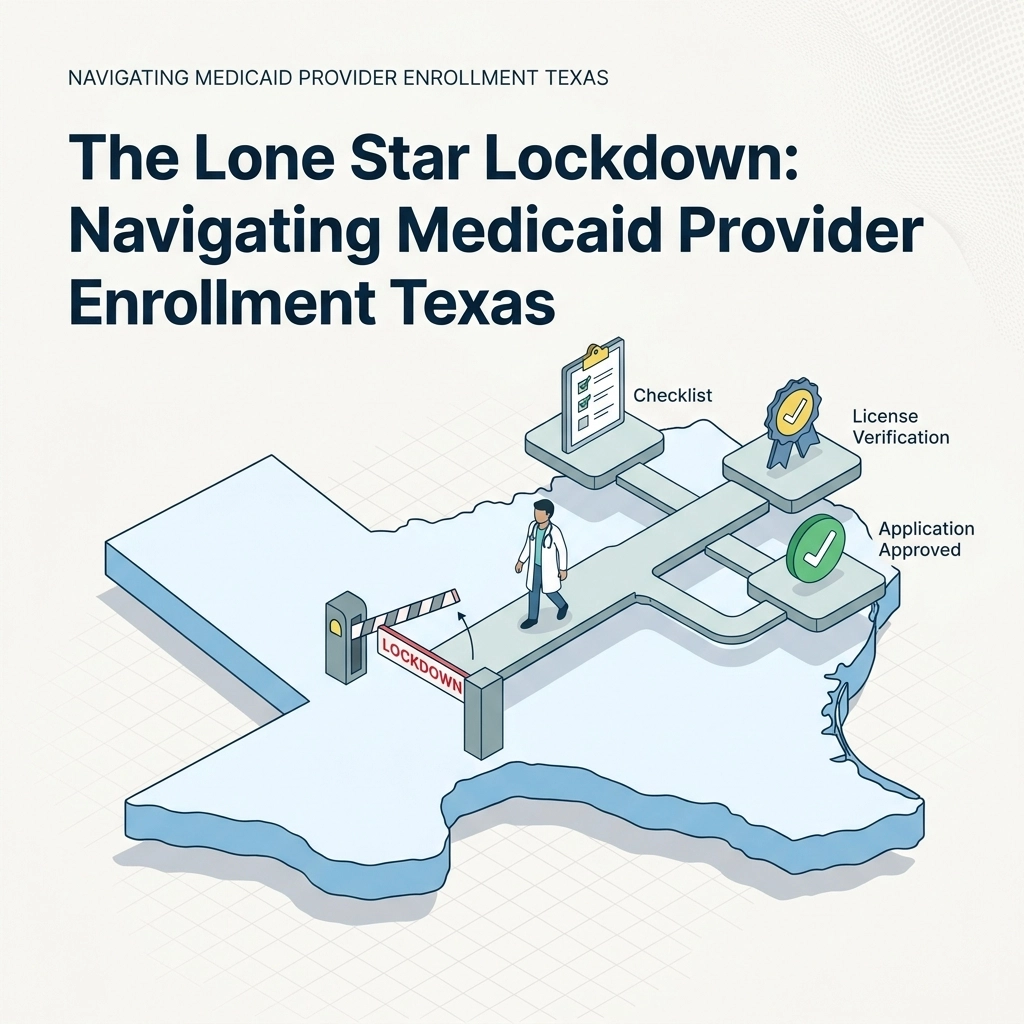
The Lone Star Lockdown: Navigating Medicaid Provider Enrollment Texas

Navigating the administrative landscape of the South requires more than just clinical expertise; it demands a mastery of the Medicaid provider enrollment Texas framework, a system designed with rigid checkpoints and zero margin for error. For healthcare entities operating within the borders of the Lone Star State, the Texas Medicaid & Healthcare Partnership (TMHP) acts as the ultimate gatekeeper. Failure to sync your operational pace with their regulatory requirements does not just result in a paperwork delay: it triggers a total revenue lockdown. In an environment where reimbursement is the lifeblood of your practice, treating enrollment as a secondary task is a high-stakes gamble that most clinics eventually lose. The sheer scale of the Texas healthcare market creates a brutalist architecture of bureaucracy. Whether you are a solo practitioner or a multi-facility surgical center, your entry into this market is dictated by the Provider Enrollment and Management System (PEMS). This digital fortress is the only way in, and it is notoriously unforgiving. The PEMS Portal: A Digital Gauntlet The transition to the Provider Enrollment and Management System (PEMS) represents a fundamental shift in how Texas manages its healthcare workforce. Gone are the days of paper-trailing and loose deadlines. Today, PEMS serves as the singular point of entry for all providers seeking to participate in Texas Medicaid, the Children’s Health Insurance Program (CHIP), and other state-sponsored initiatives. PEMS is designed for technical precision. It requires you to upload exhaustive documentation, from valid state licenses to proof of Medicare enrollment where applicable. The system provides immediate feedback, but that feedback often takes the form of hard rejections that can set your revenue cycle back by months. Because Texas requires prerequisite enrollment in Medicaid before you can participate in managed care organizations (MCOs), a bottleneck at the PEMS level effectively freezes your ability to see a massive segment of the patient population. Alt Text: A high-contrast, gritty noir image of a massive industrial gate closing, symbolizing the rigid barriers of the PEMS portal and the "Lone Star Lockdown" of provider enrollment. The 5-Year Revalidation: A Looming Operational Threat Compliance is not a one-time event; it is a recurring cycle of survival. Under federal regulations (Title 42 CFR §455.414), most providers must complete a full revalidation of their enrollment every five years. In Texas, this process is handled through TMHP and is managed with zero leniency. If your practice misses the revalidation window, your billing privileges are terminated. There is no "grace period" that allows for continued billing while you fix the error. Once you are de-enrolled, the path to re-entry is identical to a new enrollment, meaning you will face the full weight of the PEMS gauntlet all over again while your accounts receivable stagnate. This cycle is the "silent driver" of financial instability for many Texas practices. The Veracity Group manages this operational rigor by maintaining a proactive stance on revalidation dates. We do not wait for the notification from TMHP; we anticipate the window, ensuring that your practice remains "active" and compliant long before the deadline approaches. This level of oversight is the difference between seamless continuity and a catastrophic break in service. Expanding the Frontier: Multi-State Complexity For growing healthcare organizations, the challenges of Texas are often just the beginning. Expanding across state lines introduces a fragmented reality where every jurisdiction operates under its own set of brutalist rules. If you find the Texas system demanding, the nuances of Medicaid provider enrollment Florida will present an entirely different set of administrative hurdles, often involving distinct background screening and site visit requirements. Similarly, the administrative weight of Medicaid provider enrollment Pennsylvania or the highly specific regulatory environment of Medicaid provider enrollment California requires a dedicated team that understands the local landscape. Even in the Midwest, the process for Medicaid provider enrollment Ohio demands a level of precision that can overwhelm internal staff who are already stretched thin by patient care. Managing a multi-state footprint requires a centralized strategy. You cannot afford to have different processes for different states. By partnering with The Veracity Group, you gain access to a unified management structure that masters the Mastering Multi-State Medicaid Provider Enrollment process, ensuring that your expansion is not throttled by state-specific red tape. Alt Text: A somber, brutalist architectural shot of multiple industrial towers, representing the complex and separate Medicaid systems of Texas, Florida, Ohio, Pennsylvania, and California. The Operational Rigor of TMHP Compliance The Texas Medicaid & Healthcare Partnership (TMHP) operates with an industrial-grade focus on compliance. To stay in their good graces, your practice must adhere to the Affordable Care Act (ACA) screening requirements, which categorize providers into "limited," "moderate," or "high" risk levels. Each level brings a heightened degree of scrutiny, including potential site visits and criminal background checks. Managing these requirements internally often leads to "enrollment fatigue." Your staff might miss a subtle update in the TMHP provider manual or fail to update a demographic change within the required timeframe. These minor oversights lead to denied claims and, eventually, a total suspension of payments. Looking for professional provider credentialing services in the USA? 👉 Check our main service page here: veracityeg.com At The Veracity Group, we treat provider enrollment as a mission-critical function. We understand that your NPI is more than just a number: it is the backbone of your professional credibility and your financial health. We navigate the TMHP help desks and the PEMS error codes so your clinicians can stay focused on the patients who need them. The High Cost of Administrative Delays Every day a provider is not enrolled is a day of lost revenue that can never be recovered. Retroactive billing is often limited and difficult to secure. In Texas, the gap between hiring a new physician and seeing their first Medicaid-reimbursed dollar can span several months if the enrollment is not handled with expert precision. Consider the impact on a surgery center or a high-volume behavioral health clinic. A single missing link in the Medicaid provider enrollment Texas chain can cause a
Enrollment Matters: Weekend Healthcare News Recap

Managing a healthcare practice in 2026 requires more than clinical expertise; it demands a proactive stance on the shifting tides of insurance markets. As we navigate this first weekend of March, the latest data from the Affordable Care Act (ACA) Marketplace reveals a landscape in flux. For The Veracity Group, these numbers are not just statistics: they are a direct signal that your provider enrollment strategy must be agile enough to handle significant shifts in patient volume and payer mix. 2026 ACA Enrollment: The 22.8 Million Snapshot The primary headline dominating the healthcare sector this weekend is the latest national snapshot for 2026 Marketplace enrollment. As reported in the CMS Marketplace 2026 Open Enrollment Period Report (National Snapshot), total plan selections reached 22,774,847 (22.8 million) as of January 3, 2026 across the federal and state-based exchanges. That total is down by approximately 830,000 compared to the same time period last year, a decline also highlighted by RISE Health’s analysis of the preliminary data. This decline is largely attributed to the expiration of enhanced federal premium tax credits on December 31, 2025. Without these subsidies, many consumers saw their out-of-pocket premiums more than double, leading to an average annual cost increase of over $1,000 per person. Despite these financial hurdles, the 2.8 million new consumers joining the 20.0 million returning consumers reinforce that the Marketplace remains a critical “passport to success” for millions of Americans seeking coverage. The Veracity Take: Why Enrollment Volatility Demands Action At The Veracity Group, we differentiate between the initial administrative hurdles of credentialing and the final, revenue-critical step of provider enrollment. While credentialing verifies your background, enrollment is what connects you to the payer’s system so you can actually get paid. When Marketplace enrollment drops by 5% nationally, it doesn’t happen uniformly. This volatility means your local “payer mix” is shifting in real-time. If your clinic is not enrolled with the specific plans that are gaining traction in your region, you are effectively locking your doors to potential patients. You must verify that your providers are fully enrolled with the top-performing plans in your state to avoid the high cost of claim denials. Geographic Disparities: Focus on What the Snapshot Supports The January 3, 2026 snapshot is most reliable when you treat it as a national volume-and-channel signal, not a state leaderboard. In the CMS national snapshot, plan selections split cleanly across platforms: HealthCare.gov platform selections: 15.6 million State-based Exchanges (SBEs) selections: 7.2 million These platform shifts still create real-world enrollment pressure for your practice. When plan selections move between federal and state-based channels—or decline year-over-year—your patient population changes payer-by-payer and network-by-network. That change becomes a “silent driver” of revenue: if, and only if, your provider enrollment is complete and active for the plans patients actually selected. The Veracity Take: State-Specific Enrollment Strategy The disparity between Texas and North Carolina highlights why a “one-size-fits-all” approach to enrollment fails. If you are operating in a growth state, your provider enrollment backlog is your biggest liability. Every day a new physician sits in your office without a linked NPI to a specific payer, your clinic loses thousands in unrealized revenue. For those in states seeing declines, the competition for the remaining insured patient base is fierce. Ensuring your practice is listed accurately in every provider directory is essential. This starts with meticulous enrollment. To stay ahead of these regional shifts, you should review our guide on Medicaid news and enrollment impacts to see how state-level changes affect your bottom line. The Subsidy Cliff and the Payer Mix Shift The expiration of the enhanced premium tax credits is the “backbone” of this year’s enrollment narrative. When premiums spike, consumers don’t just leave the market; they often “down-shop” to lower-tier plans with narrower networks. This behavior creates a significant challenge for clinics. A patient who was once on a PPO plan may now be on a high-deductible Bronze plan or a restrictive HMO. If your providers are not enrolled in these specific “narrow networks,” you will face an influx of “out-of-network” issues that frustrate patients and stall your cash flow. The Veracity Take: Adapting to Narrower Networks The “Safety Formula” for your clinic’s financial health is simple: Enroll early, enroll often. As consumers shift to more affordable plans, payers are tightening their networks. You cannot assume that because you were enrolled in a plan in 2025, your status remains optimal for the 2026 “narrower” versions of those plans. Maintaining continuous provider monitoring and ensuring compliance with new payer requirements is non-negotiable. For more insights on keeping your practice ready for these changes, explore our resources on enrollment compliance and monitoring. Immediate Steps for Clinic Owners The news of the 23 million enrollees is a call to action. You cannot afford to be reactive when it comes to your revenue cycle. Here is how you should respond this week: Audit Your Payer Mix: Identify which plans are gaining or losing members in your specific zip code. Fast-Track New Providers: If you have new hires starting this spring, begin the provider enrollment process today. Do not wait for the “perfect” time; the high cost of delays will erode your margins. Validate Directory Accuracy: Ensure your providers are correctly listed in the 2026 directories for HealthCare.gov and state exchanges. An unlisted provider is an invisible provider. Distinguish the Process: Remind your administrative staff that while credentialing is a prerequisite, enrollment is the final “passport” to receiving insurance reimbursements. The Consequences of Inaction In the healthcare industry, time is literally money. The 5% decline in national enrollment means that every patient counts more than ever. If a patient walks into your clinic with a new 2026 Marketplace plan and your provider enrollment is “pending” or “incomplete,” you face a serious consequence: a denied claim that may never be recovered. At The Veracity Group, we specialize in navigating these complexities. We ensure that your providers are not just qualified, but enrolled and ready to bill from day one. In a year of shifting numbers
Three States, Three Realities: Medicaid Enrollment in Texas, Indiana, and California

Medicaid enrollment is never a one‑size‑fits‑all process. In 2026, the differences between states are wider than ever. Practices expanding across regions quickly learn that what works in one state fails in another—not because the workflow is wrong, but because the rules, systems, and expectations are fundamentally different. Texas, Indiana, and California represent three completely different Medicaid environments. Understanding those differences is the key to avoiding delays, protecting revenue, and keeping your providers active. Texas Medicaid Enrollment: High Volume, High Scrutiny Texas runs one of the busiest Medicaid programs in the country, and the enrollment process reflects that scale. Success in Texas depends on precise alignment between your NPI, taxonomy, practice structure, and program selection. Even small inconsistencies can trigger a full restart. Texas is strict about: Accurate taxonomy codes Group vs. individual enrollment sequencing Ownership disclosures Service location validation Program‑specific requirements (TMHP, MCOs, specialty programs) In Texas, the challenge isn’t complexity—it’s precision. If your data isn’t clean, the system stops processing without warning. Indiana Medicaid Provider Enrollment: Detail‑Heavy and Documentation‑Driven Indiana takes a documentation‑first approach. The state focuses heavily on accuracy, identity verification, and complete provider files. Missing even one field can stall the entire application. Indiana is especially strict about: Background checks Ownership and control disclosures Provider type classification Rendering vs. billing provider distinctions Address formatting and service location details Indiana’s system is slower to process but faster to reject. If something is wrong, they tell you—but they will not move forward until it’s fixed. California Medi‑Cal Enrollment: Policy‑Driven and Constantly Changing California operates in its own category. Medi‑Cal enrollment is shaped by frequent policy changes, immigration‑related eligibility rules, and program requirements that shift year to year. California’s biggest challenges include: Frequent regulatory updates Distinct rules for undocumented adults Emergency‑only coverage categories County‑specific processing differences Additional documentation for behavioral health and specialty programs California’s system isn’t slow—it’s layered. Each layer adds a new verification step, and each step requires clean, consistent data. Why These Differences Matter for Multi‑State Practices Practices operating in multiple states often assume they can replicate the same workflow everywhere. But Texas, Indiana, and California require different: Document sets Sequencing Follow‑up strategies Enrollment timelines Data validation steps A workflow that succeeds in Texas may fail immediately in California. A process that works in Indiana may be too slow for Texas. A documentation packet built for California may overwhelm Indiana’s system. Multi‑state enrollment only works when each state gets its own tailored workflow. How to Stay Ahead in All Three States 1. Build State‑Specific Checklists Each state has its own rules—treat them that way. 2. Standardize Your Data Before You Customize Clean NPI, CAQH, and practice documents make state‑specific adjustments easier. 3. Track Timelines Separately Texas moves fast when data is clean. Indiana moves slow but communicates clearly. California moves in layers—expect multiple review cycles. 4. Assign Ownership Multi‑state enrollment requires someone who understands the differences and manages them intentionally. The Bottom Line Texas, Indiana, and California each represent a different Medicaid reality. Success isn’t about working harder—it’s about working state‑specific. When your workflows match the state’s expectations, enrollment becomes predictable. This level of state‑level detail is why Medicaid.gov maintains such specific waiver and program lists: the rules are moving targets. Clean data. Tailored processes. State‑specific strategy. That’s how you stay active, billable, and compliant across multiple Medicaid programs. #Veracity #MedicaidEnrollment #TexasMedicaid #IndianaMedicaid #CaliforniaMedicaid #MediCal #ProviderEnrollment #PayerEnrollment #HealthcareCredentialing #MedicaidUpdates #PayerUpdates #HealthcareCompliance #OperationalExcellence #HealthcareOperations #PracticeManagement #MedicalPracticeManagement #ClinicManagement #HealthcareWorkflow #HealthcareInsights #HealthcareSolutions #HealthcareChallenges #RevenueCycle #RevenueProtection #HealthSystems #ClinicLife #MedicalPractice #WorkSmarter #FutureOfHealthcare #HealthcareLeadership #HealthcareConsulting #HealthcareWorkers