Veracity upscaled revised

How to Credential a Provider in Minnesota: Patience and Precision with the DHS

AvPtIp i0F1

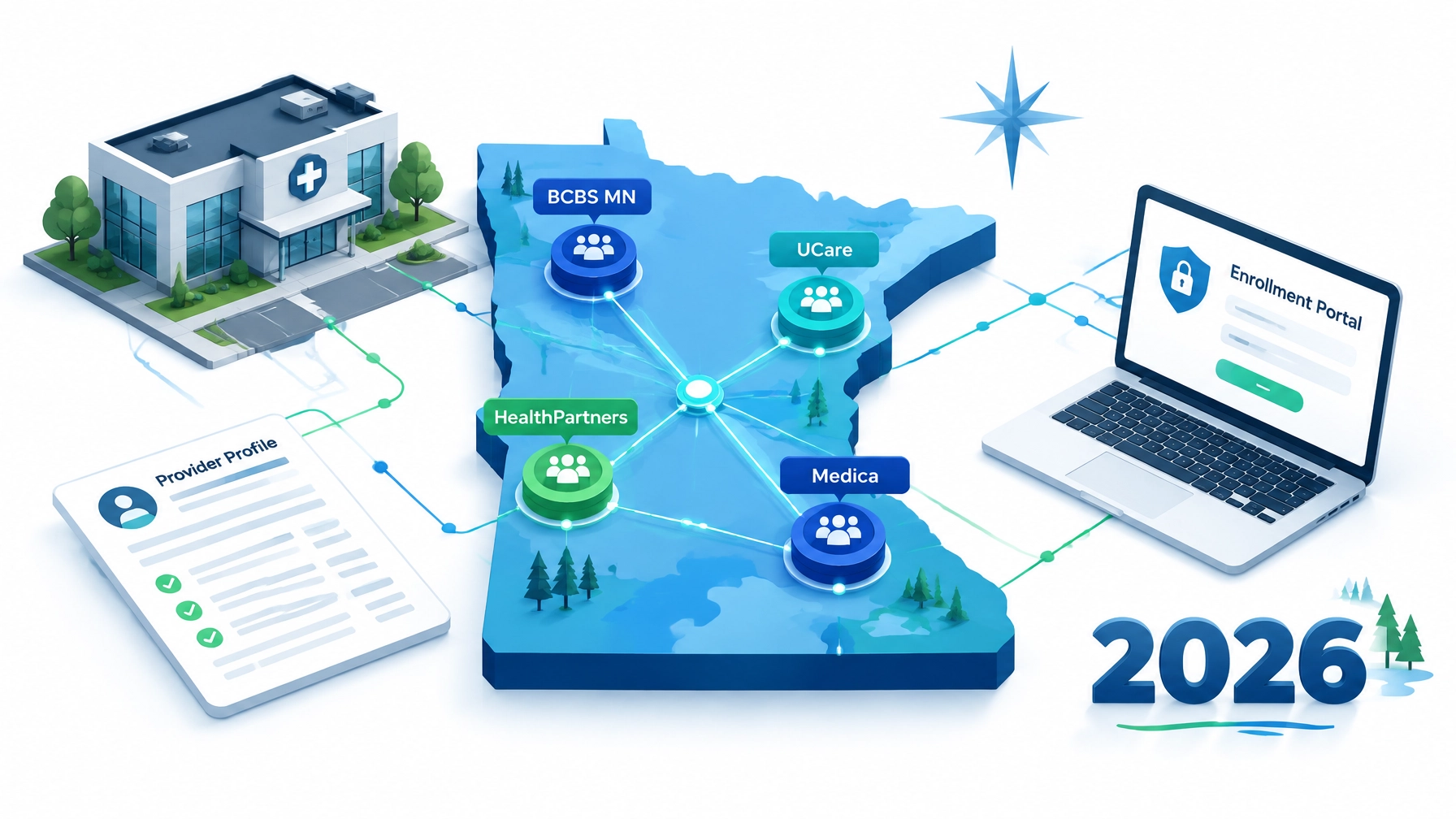
Minnesota’s healthcare market is tightening, not loosening. With a massive push toward integrated health systems and a rapidly expanding behavioral health enrollment landscape, you now face a harder operating environment shaped by program integrity crackdowns, tighter federal standards, and longer payment risk for flagged services. To keep your revenue cycle moving, securing high-quality medical provider enrollment services and dedicated behavioral health provider enrollment support is not just an advantage: it is a survival strategy for growing clinics and multisite groups. Looking for professional provider credentialing services in the USA? 👉 Check our main service page here: veracityeg.com The Minnesota Landscape: Integrated Systems and BH Growth Minnesota is unique because of its high density of large, integrated delivery networks. Systems like Mayo Clinic, M Health Fairview, and Allina Health set a high standard for administrative precision. For smaller practices or expanding multisite groups, this means your enrollment data must be flawless to compete for space within the same payer networks. Furthermore, the state has seen an unprecedented explosion in behavioral health growth. As more clinics open to meet the mental health needs of the community, the behavioral health enrollment landscape has become increasingly crowded. This surge has put a significant strain on the Minnesota Department of Human Services (DHS), resulting in processing queues that can stall a provider’s start date by months if the initial application isn't perfect. Image Description: A minimalist, earth-tone overhead shot of a clean wooden desk with a single ceramic mug and a high-end notebook. The lighting is soft and natural, emphasizing a calm and organized professional atmosphere. The "Upstream" Essentials: Licensing and DEA Before you even look at a payer application in Minnesota, you must address the upstream licensing and DEA requirements. You cannot enroll a provider who does not have a valid Minnesota Board of Medical Practice (or relevant board) license in hand. At The Veracity Group, we emphasize that enrollment is the final stage of a much longer journey. If your licensing process is lagging, your enrollment is dead on arrival. We track the expiration dates and application statuses of state licenses and DEA registrations with the same intensity that we track payer approvals. For behavioral health providers, ensuring the correct licensure (such as LICSW, LPCC, or LMFT) is verified early is critical to avoiding immediate rejections from the DHS. Navigating the Minnesota Credentialing Collaborative (MCC) Minnesota was a pioneer in streamlining the administrative burden through the Minnesota Credentialing Collaborative (MCC). The MCC uses the ApplySmart system, a centralized hub where providers can submit their data once and distribute it to multiple health plans, including Blue Cross and Blue Shield of Minnesota, HealthPartners, and Medica. While the MCC is designed to simplify your life, it is not a "set it and forget it" tool. Precision is mandatory. A single typo in an NPI number or a missing signature on an electronic form can halt the entire distribution process. Our team at Veracity ensures that every data point in the MCC is cross-referenced with your CAQH profile to maintain total data integrity. 1. The DHS and MHCP: A Test of Patience Under New Integrity Pressure If your practice sees patients covered by Minnesota Health Care Programs (MHCP), you will deal directly with the DHS. This is where Minnesota has become far less forgiving. The state continues to use the Minnesota Provider Screening and Enrollment (MPSE) portal, but the bigger story is the compliance environment surrounding that portal. Key hurdles in the MHCP enrollment process now include: Enrollment freeze on 13 high-risk categories through 2026: Minnesota has extended an enrollment moratorium on selected high-risk provider and service categories, including segments such as adult day services and certain residential or community-based program types. If your organization expands into one of these lines, your timeline is not just slow; your path may be blocked unless you qualify for a permitted exception. Optum pre-payment review pressure: Minnesota has expanded pre-payment review activity through Optum for selected high-risk services. That means claims can sit in review before money hits your account, and payment delays can stretch toward 90 days when documentation, site data, ownership details, or service records do not line up cleanly. Stricter screening tied to federal funding pressure: Minnesota’s heightened program integrity posture follows a period of intense scrutiny tied to a roughly $2 billion federal funding withhold dispute, which pushed the state to tighten oversight, documentation controls, and risk-based monitoring. CMS 2026 processing and digital expectations: CMS has continued pressing states toward faster, more standardized processing, including a 30-day benchmark for cleaner digital workflows and stronger movement toward electronic submission and maintenance rather than paper-first processes. In practical terms, your team must treat digital file accuracy as non-negotiable. Site-level validation still matters: Certain high-risk provider types remain subject to site review, ownership verification, and enhanced screening before approval or continued participation. What this means for your practice If you are opening, adding locations, or onboarding providers in Minnesota, you must work backwards from the compliance risk: High-risk service lines require a go/no-go check before application work starts Ownership, address, licensure, and service-location records must match across every system Claims readiness must be built alongside enrollment readiness Any missing field will delay approval and can also delay payment after approval The cost of a delay with the DHS is high. In a state with major Medicaid and MinnesotaCare participation, being out-of-network or stuck in review for even 30 days can result in serious revenue disruption. A 90-day pre-payment hold is worse: it turns your receivables into wet concrete. They are there, but they do not move. This is exactly why why behavioral health provider enrollment is so hard often comes down to state-specific controls that demand constant monitoring. Image Description: A gritty, professional visual with concrete textures, muted gray tones, and structured paperwork motifs that reflect Minnesota’s stricter MHCP screening environment and operational pressure. Downstream Impact: Contracting and Renegotiation Enrollment is not the finish line; it is the starting block. Once a provider is successfully loaded into