Telehealth Credentialing Across State Lines: Navigating the Midwest vs. West Medicaid Maze

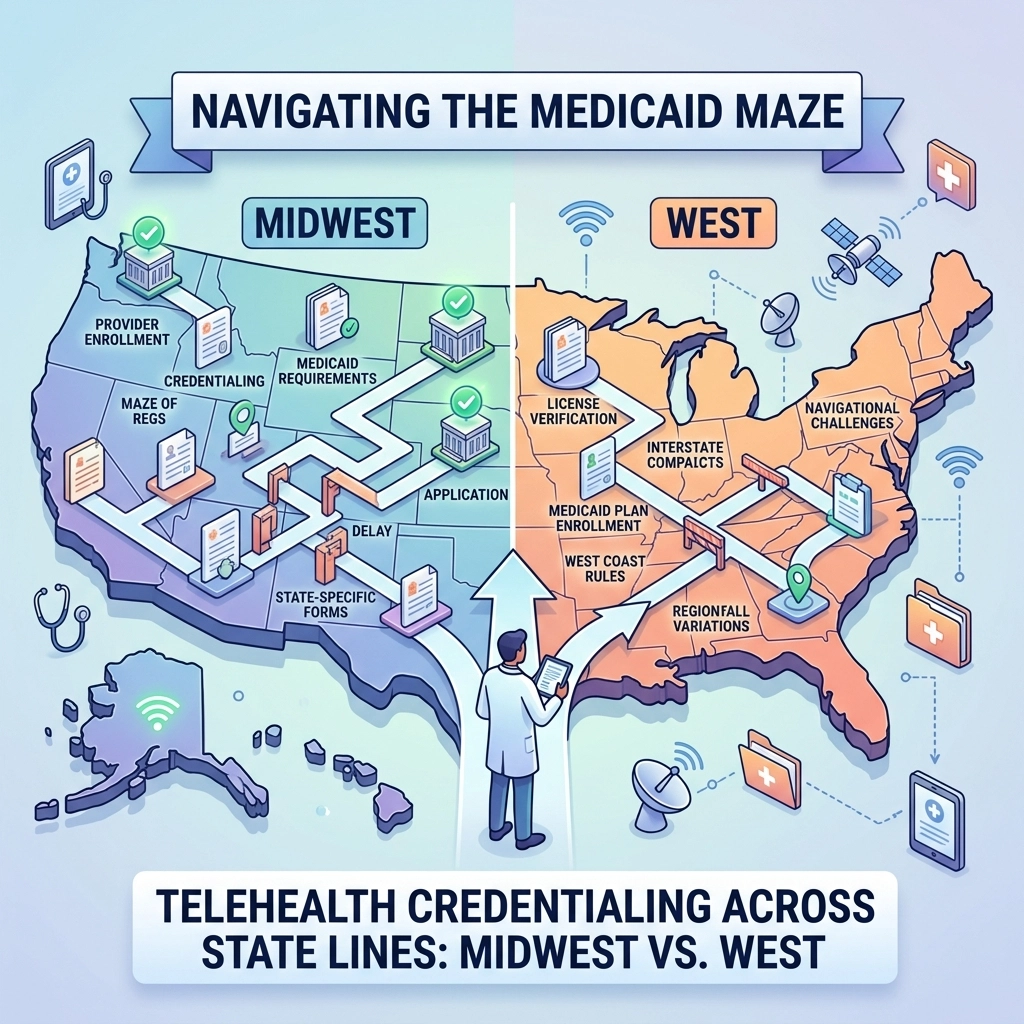
Navigating medical provider enrollment services across state lines while building a reliable telehealth footprint feels like playing a high-stakes game of 5D chess. Your patients do not care about state borders. They care about access to care from their living rooms. But the moment those pixels cross a state line, you enter a regulatory minefield. If you think a single license is your "golden ticket" to a national telehealth model, you are in for a rude awakening. Medicaid programs in Indiana, Illinois, and Nevada are not just different; they are entirely different ecosystems with unique "gotchas" that will stall your revenue if you are not prepared. If your question is "Can I see Medicaid patients across state lines?" the answer is simple: yes, but only after you satisfy each state's licensing, enrollment, and verification rules. If your question is "How do I do it without delays?" the answer is even clearer: you need a state-by-state process that matches your provider type, service location, and payer requirements. Looking for professional provider credentialing services in the USA? 👉 Check our main service page here: veracityeg.com The Golden Rule of the Virtual Visit Before we dive into the regional trenches, let’s establish the foundational law of the land: The provider must be licensed in the state where the patient is physically located at the time of the encounter. This is non-negotiable. Whether you are treating a patient via a smartphone in a cornfield in Indiana or a high-rise in Las Vegas, your legal right to practice is dictated by the ground under the patient’s feet. Failing to secure the correct state-specific enrollment is the fastest way to trigger a claim denial or, worse, an OIG audit. While the Interstate Medical Licensure Compact (IMLC) offers a streamlined pathway for physicians, the Medicaid enrollment process remains a manual, state-by-state slog that requires precision and insider knowledge. Alt-tag: A map of the United States highlighting the Midwest and Western regions for telehealth expansion. 1. The Midwest vs. the West: Streamlining vs. Complexity For general provider enrollment services, the Indiana-Illinois-Nevada comparison tells you exactly what multi-state expansion looks like in practice. One state removes friction. One state slows you down with administrative precision. One state raises the verification bar for every applicant. If you are asking where enrollment is easiest, where it gets sticky, and where extra documentation is non-negotiable, this three-state comparison is the focal point. Indiana: The License-Only Advantage If you have not looked at Indiana lately, you are missing a rare win for administrative efficiency. As of July 1, 2024, Indiana officially removed the requirement for telehealth-specific certificates. That creates a cleaner path for physicians, advanced practice providers, therapists, and other eligible clinicians expanding telehealth services under Medicaid. This is the key Indiana takeaway: if you hold the proper Indiana license, you do not need a separate telehealth certificate to move forward. That is a real operational advantage for multi-state groups asking, "Can I enroll in Indiana without another telehealth approval layer?" The answer is yes, provided your license, ownership information, service location details, and enrollment file are complete. However, do not mistake "easier" for "automatic." You still must submit accurate provider data to the Indiana Health Coverage Programs (IHCP). A clean Indiana rule set does not forgive sloppy applications. Illinois: The Administrative Precision State Cross the border into Illinois, and the vibe shifts. Illinois is the state that forces you to respect process discipline. The core question here is not whether telehealth is possible. The real question is how cleanly your enrollment file matches across every data source. For most medical specialties, Illinois becomes difficult for three reasons: Application detail must align across systems. Provider records must match state and payer files exactly. Delays compound quickly when ownership, practice location, or rendering-provider data is inconsistent. Illinois Medicaid is notoriously meticulous. If your CAQH profile is not synchronized perfectly with your state application, your file will sit in "pending" purgatory for months. That problem is not specialty-specific. It affects primary care, specialty care, surgical groups, therapy practices, and multi-location organizations alike. 2. The West: The Land of Stringent Verification If the Midwest is characterized by shifting legislative sands, the West: specifically Nevada: is characterized by its rigorous verification walls. While Western states often have strong telehealth infrastructure, their "gatekeeper" mentality for Medicaid is significantly more intense than what you will find in the heartland. Nevada: The "Gotcha" State Nevada does not play games. If you are looking to expand your footprint here, prepare for a verification marathon. Nevada Medicaid requires more stringent primary source verification and provider qualification documentation than Indiana or Illinois for many enrollment scenarios. This is the big Nevada question: "Can I enroll as an out-of-state provider if I already bill Medicaid elsewhere?" Yes, but Nevada will still require its own documentation trail, validation standards, and closer review. That is the "gotcha" many groups miss. Prior enrollment success in another state does not buy you a shortcut in Nevada. Nevada is particularly focused on out-of-state telehealth providers. The state wants to confirm that you are not operating as a "ghost clinic" and that every provider meets Nevada-specific requirements for licensure, qualifications, service locations, and supporting records. For general medical provider enrollment services, that means your file must be audit-ready before submission, not cleaned up after the fact. Alt-tag: A comparison chart showing the different requirements for Medicaid enrollment in Indiana, Illinois, and Nevada. Comparing the "Gotchas" Feature Indiana Illinois Nevada Telehealth Certificate Removed (as of 7/1/2024); license-only path is the key advantage Not the main issue; administrative alignment is the real hurdle Stricter review depends on provider type and enrollment facts Verification Speed Moderate Slow and detail-heavy Very stringent and documentation-heavy Key "Gotcha" Valid state license is enough for the telehealth approval piece, but the enrollment file still must be complete Data mismatches stall applications fast High scrutiny on out-of-state providers and stronger primary source verification Enrollment Difficulty Lower Medium-High High 3. Can You Enroll in Multiple Medicaid States at
How to Credential a Provider in Illinois: Conquering the IMPACT Barrier

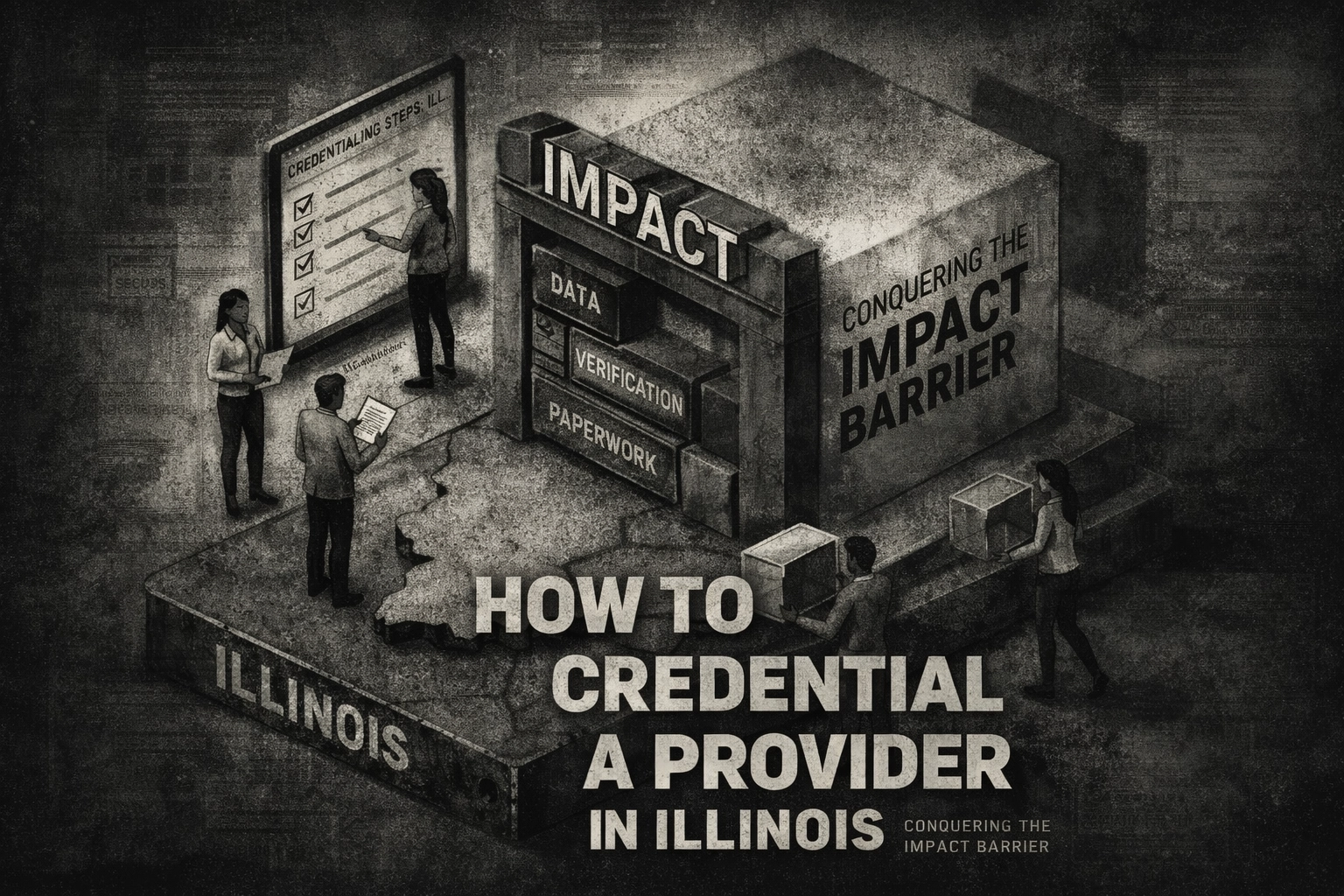
Navigating the Illinois healthcare market requires more than just clinical excellence; it demands a sharp, disciplined response to the administrative gauntlet known as the IMPACT system. For organizations trying to scale, friction in medical provider enrollment services quickly becomes a revenue choke point that slows onboarding and delays payment. Whether you manage one location or a sprawling multisite group, understanding the behavioral health provider enrollment landscape is how you keep your revenue cycle moving in the Land of Lincoln. In Illinois, the enrollment process is defined by high-stakes documentation, a state-mandated digital portal, and hard compliance deadlines that carry real consequences. If your practice is not prepared for the rigorous demands of the Illinois Medicaid Program Advanced Cloud Technology (IMPACT), you will hit avoidable delays, rejected submissions, and payment disruption. 1. The Digital Gatekeeper: Understanding HFS IMPACT The primary obstacle in Illinois is the IMPACT portal, managed by the Illinois Department of Healthcare and Family Services (HFS). This system serves as the single source of truth for Medicaid-related provider enrollment activity in the state. Under HealthChoice Illinois, a provider must be fully approved in IMPACT before participating with Medicaid managed care plans. That setup sounds clean. In practice, it is a concrete wall with a login screen. Illinois expects your information to be complete, accurate, and maintained inside IMPACT, and the state is actively enforcing revalidation requirements on the current five-year cycle. As reflected in Illinois HFS revalidation guidance, providers who miss their IMPACT revalidation deadline face immediate disenrollment, which stops participation and billing until the record is restored through the required process. That is the real Illinois risk: not just slow approval, but sudden loss of active status because a required update sat untouched in the portal. Digital glitch art displaying high-contrast kinetic typography of the words "IMPACT SYSTEM" shattering into data streams, symbolizing the complexity of the Illinois enrollment portal. 2. Mandatory Documentation: The "Yellow Paper," Revalidation Timing, and IMPACT Application Type In Illinois, missing one required item does not create a minor delay. It triggers rejection, rework, or a revalidation miss that knocks you out of active status. To move a provider through the pipeline, you must secure the following items before upload and before the revalidation clock runs out: The Application ID Number: This is the state-assigned identifier often tied to the physical notice many teams call the "yellow paper." Without it, matching the record and moving the file forward becomes far harder. Certified W-9 alignment: If a provider receives state or federal funds directly, the tax record must align with the enrollment record. A mismatch between legal name, TIN, or pay-to information and the IMPACT profile is a fast path to failure. National Provider Identifier (NPI): Your 10-digit NPI must match taxonomy, licensure, and service setup exactly. Correct IMPACT application type: Illinois places real weight on selecting the right record structure, including the Individual/Sole Proprietor pathway when that is the proper enrollment type. If your filing structure does not match how the provider is organized and billing, the rest of the application starts crooked. Operational availability for follow-up: Illinois has also been reinforcing practical support through office hours and provider assistance sessions connected to IMPACT revalidation. If your team is not monitoring those opportunities and the portal notices that drive them, you lose time you do not have. For large multisite groups, managing these documents and deadlines across dozens of providers creates a serious administrative burden. The Veracity Group uses monday.com boards to give you total transparency during this phase, ensuring every yellow paper, portal task, and follow-up item is tracked from receipt through final submission. 3. Scaling the Friction: Multisite and Behavioral Health Challenges The behavioral health enrollment landscape in Illinois is especially unforgiving because site-level accuracy matters. As the state pushes integrated care and tighter program oversight, behavioral health providers run into unique complications around service locations, affiliations, and record maintenance. Unlike markets where one approval effectively travels everywhere, Illinois often demands precise site linkage for each location where a provider renders services. For massive multisite groups, this creates an exponential increase in the number of moving parts you must control. One demographic mistake, one location mismatch, or one overlooked revalidation notice can cascade into denied claims across multiple sites. Maintaining demographic updates with precision is not optional. It is your pressure valve against payment disruption. Looking for professional provider credentialing services in the USA? 👉 Check our main service page here: veracityeg.com Upstream Preparation: Licensing and DEA Enrollment does not start with the IMPACT portal; it starts months earlier with licensing and DEA registration. The Veracity Group handles the upstream heavy lifting, ensuring that a provider’s Illinois state license and controlled substance registrations are in perfect order before the enrollment clock even starts ticking. If your provider’s DEA address does not match their primary service location in IMPACT, the system will flag the application for manual review, which can add weeks or months to your timeline. By aligning these upstream factors, we clear the path for a smoother transition into the provider enrollment phase. Kinetic typography in a high-speed digital blur showing the words "UPSTREAM LICENSING" and "DOWNSTREAM REVENUE" connecting through a series of geometric, glitched lines. 4. The 2025–2026 Revalidation Mandate: Miss the Deadline, Lose Your Status Illinois is actively operating on the standard five-year revalidation cycle in the 2025–2026 window. That cycle is not background noise. It is a live compliance trigger inside IMPACT. HFS has made clear that if you fail to complete revalidation by your assigned deadline in the portal, the consequence is immediate disenrollment. That means: Your provider record drops out of active status Your Medicaid billing ability stops Your managed care participation is disrupted Your revenue takes the hit before your operations team finishes asking what happened Illinois has also been running monthly Revalidation Town Halls throughout 2025 to help providers navigate the process, along with additional assistance resources through HFS. If your team is not attending those sessions, monitoring portal notices, and acting before