Veracity upscaled revised

How to Credential a Provider in Arizona: Scaling for the Desert Churn

ZsNQOAYHALC

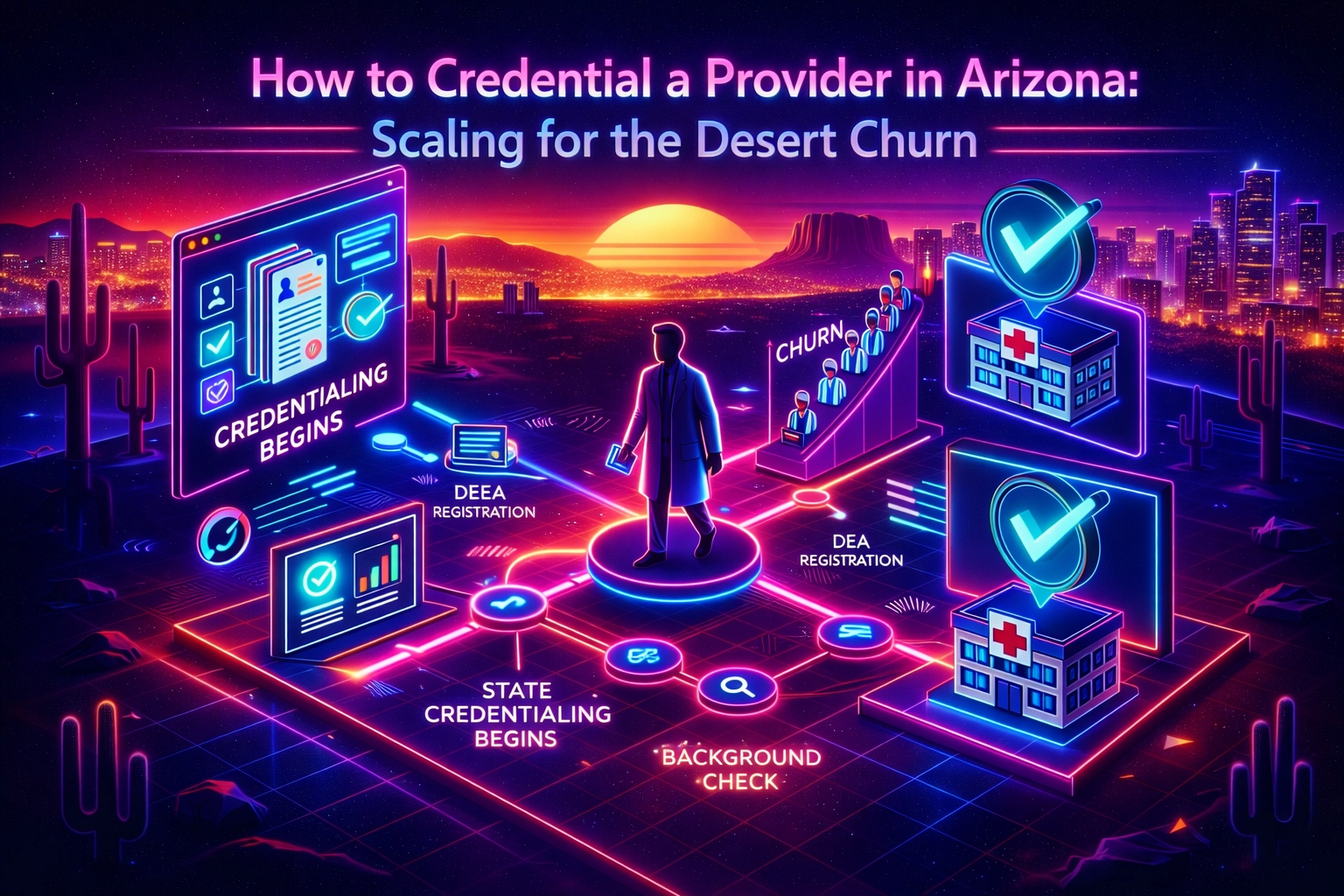
Navigating the healthcare landscape in the Grand Canyon State requires more than just a map; it requires a high-octane strategy to handle the sheer volume of growth and turnover. Whether you are expanding a primary care network in Maricopa County or scaling a specialized clinic in Pima, professional medical provider enrollment services are the engine that keeps your revenue cycle moving. In a state where behavioral health provider enrollment is surging alongside a transient workforce, your ability to onboard providers quickly is the difference between a thriving practice and a financial drought. That urgency sits inside one of the most important healthcare economies in the country: Arizona healthcare is the state’s largest sector, employing more than 410,000 people, accounting for nearly 10% of the workforce, and contributing $78 billion to state GDP. The Arizona market is unique. It is defined by "Desert Churn": a high rate of provider movement fueled by rapid population growth, a physician supply of just 2.3 physicians per 1,000 residents versus the 2.6 national average, and a payer mix that leans heavily on Medicare Advantage and AHCCCS (Arizona Health Care Cost Containment System). The pressure is not theoretical. Arizona faces a shortage of 23,300 healthcare professionals by 2030, and today it already needs 667 primary care and 228 mental health practitioners just to reach basic access ratios. Public coverage has also expanded fast: AHCCCS and Medicare enrollment has grown 110% since 2000, AHCCCS now covers 31% of the population, or roughly 2.3 million people, and Medicaid reimbursement still lands at only about 60% of private insurance rates. At the same time, Arizona ranks 4th in the nation for quality of care, outperforming states such as California and Massachusetts, with systems like Banner Health and Mayo Clinic-Phoenix helping set the pace. The payer side is becoming even more volatile in 2026. Arizona is staring down a 46.3% weighted average rate increase in the individual market, including reported jumps of 49.0% for AZ Complete Health/Ambetter, 48.7% for Blue Cross Blue Shield of Arizona, and 44.3% for UnitedHealthcare. On top of that, Banner/Aetna CVS is exiting the Arizona individual market on December 31, 2025, forcing more than 55,000 policyholders to shop for new coverage and triggering a major patient-rebalancing event across the state. That combination of growth, shortage, quality pressure, payer volatility, and reimbursement compression makes enrollment execution a board-level issue. In the 2025-2026 consolidation and sale cycle, efficient provider onboarding is not back-office housekeeping; it is a direct driver of practice valuation. In a market with 46% rate hikes and a major carrier exit, provider enrollment speed is the only reliable way for your practice to capture displaced patient demand, protect directory visibility, and maintain revenue stability. To stay ahead, you must look beyond the standard paperwork and treat enrollment as a strategic, multi-phase operation. At The Veracity Group, we run that operation through monday.com, giving you a disciplined, visible control tower to move providers into payer networks fast enough to match Arizona’s high-stakes market. The Foundation: Upstream Licensing and DEA Verification Before a single enrollment application can be submitted to a payer like Blue Cross Blue Shield of Arizona or UnitedHealthcare, the "upstream" work must be flawless. In Arizona, this begins with the Arizona Medical Board or the Arizona Board of Physician Assistants. You cannot afford to wait until a provider’s start date to realize their DEA registration is still tied to a previous out-of-state address. We see this mistake constantly: practices focus so much on the "middle" of the process that they neglect the foundation. At Veracity, our provider enrollment services include a rigorous audit of these upstream credentials. If the license is pending or the DEA isn't Arizona-compliant, the entire machine grinds to a halt. You must ensure that every box is checked: from the initial state application to the specific prescriptive authority required for behavioral health specialists: before you ever touch a payer portal. Image Alt: A polished Retro 80s Neon Arizona healthcare operations scene with enrollment documents and bright magenta-cyan accents, symbolizing fast-moving provider onboarding across the state. Navigating the AzAHP Credentialing Alliance Arizona is home to one of the most structured credentialing environments in the country: the Arizona Association of Health Plans (AzAHP) Credentialing Alliance. This is a centralized system where multiple health plans participate in a unified process managed through a Credentialing Verification Organization (CVO). For your practice, this means there is a "single source of truth," but it also means there is a single point of failure. If your CAQH profile is not perfectly aligned with the AzAHP requirements, your provider will be stuck in a loop of "information requested" statuses. Key Components of the AzAHP Process: CAQH Accuracy: Your CAQH (Council for Affordable Quality Healthcare) profile is the heartbeat of Arizona enrollment. It must be re-attested every 90 days without fail. The Data Form: AzAHP requires a specific data form that supplements the CAQH profile. Missing one signature on this form can delay a provider’s effective date by 30 to 60 days. Primary Source Verification: The CVO will verify everything: education, board certifications, and a minimum five-year work history. Any gap in that history longer than 30 days must be explained in writing. For more information on the official standards, you can visit the AzAHP Credentialing Alliance portal. Managing the "Desert Churn" with Transparency In Arizona’s fast-growing primary care and behavioral health (BH) sectors, provider churn is a constant reality. Providers move between multisite groups frequently, and the state’s below-average physician density intensifies the problem. With only 2.3 physicians per 1,000 residents, Arizona runs leaner than the national benchmark, so every delayed onboarding creates immediate access gaps, referral leakage, and scheduling bottlenecks. The pressure is now colliding with payer upheaval. Arizona’s 2026 individual market rate filings show a jaw-dropping 46.3% weighted average increase, while Banner/Aetna CVS exits the Arizona individual market on December 31, 2025, forcing more than 55,000 policyholders to find new coverage. That is not background noise. It is a massive patient-rebalancing event, and practices that