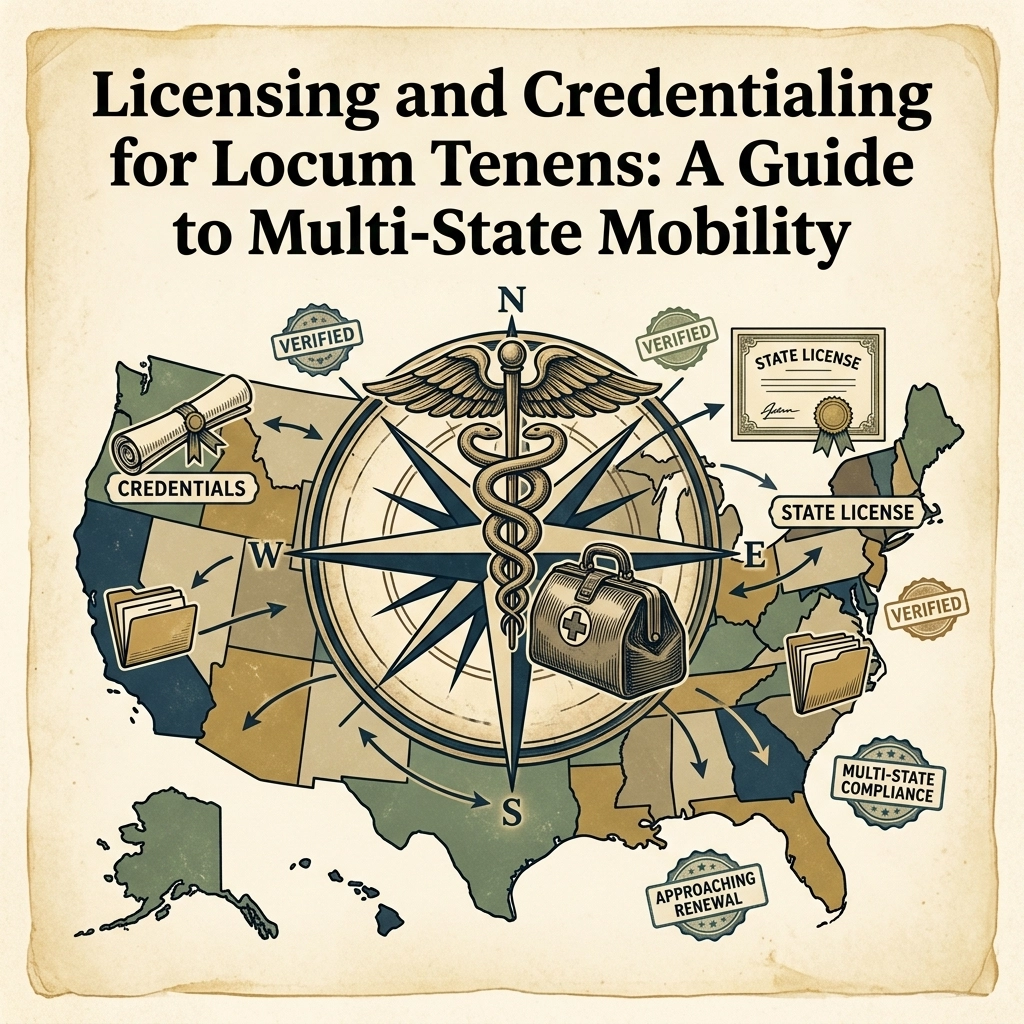
Licensing and Credentialing for Locum Tenens: A Guide to Multi-State Mobility

Locum tenens work is the lifeblood of modern healthcare flexibility, and in 2026’s booming locum tenens market, that mobility has become a direct path to high-value assignments. However, the administrative burden of securing multi-state medical licensure and navigating comprehensive provider enrollment services is often the single greatest barrier to moving fast enough to capture those opportunities. For the high-performing physician or advanced practice provider, a single missing document or a misunderstood state regulation will not just delay an assignment: it will stop revenue, stall momentum, and push a premium placement to someone else. Looking for professional provider credentialing services in the USA? 👉 Check our main service page here: veracityeg.com The High Stakes of Healthcare Mobility The healthcare industry is currently experiencing a massive shift toward "gig economy" models, where specialized talent moves across state lines to address staffing shortages and seasonal surges. In 2026, the locum tenens market is booming, and that surge in temporary staffing demand is intensifying competition for providers who are licensed, enrolled, and ready to start without delay. A provider seeking to work in California faces a vastly different set of hurdles than one heading to Wisconsin. This is exactly why rapid, multi-state licensing solutions are no longer optional. They are the operational backbone of locum success. When facilities need coverage fast, they do not wait for paperwork to catch up. They move to the next available clinician with active credentials. Failing to manage these requirements with surgical precision leads to more than just frustration. It results in revenue leakage, lost opportunities, and potential compliance risks that can shadow a provider for years. In this high-stakes environment, hope is not a strategy. You must have a rigorous framework for managing your professional credentials across multiple jurisdictions. The Power of the Interstate Medical Licensure Compact (IMLC) For physicians, the most effective tool for achieving rapid multi-state mobility is the Interstate Medical Licensure Compact (IMLC). This agreement between 42 states, the District of Columbia, and Guam simplifies the process for licensed physicians to practice in multiple states. Instead of submitting entirely new applications to every individual board, qualified physicians can use their State of Principle Licensure (SPL) to expedite the process. Eligibility is the Gatekeeper To utilize the IMLC, you must meet stringent eligibility criteria that demonstrate professional stability. You must hold a full, unrestricted medical license in an SPL that is a member of the compact. Furthermore, you must meet at least one of the following: Your primary residence is in the SPL. At least 25% of your medical practice occurs in the SPL. Your employer is located in the SPL. Your SPL is your state of residence for federal income tax purposes. Beyond location, the IMLC requires a clean disciplinary record. Any history of disciplinary action, active investigations, or criminal history will disqualify you from this expedited pathway. When you meet these standards, the IMLC acts as a "passport to success," allowing you to obtain licenses in participating states in a matter of weeks rather than the standard six-month wait. Beyond Physicians: The eNLC for Advanced Practice Nurse practitioners and travel nurses are equally vital to the locum tenens ecosystem. The Enhanced Nurse Licensure Compact (eNLC) serves a similar purpose, allowing providers to hold one multistate license with the privilege to practice in other compact states. For an NP, this mobility is the backbone of professional credibility. However, even with a compact license, the work is not finished. You must still contend with state-specific scope-of-practice laws and individual facility requirements. Navigating these nuances requires a deep understanding of provider enrollment protocols that vary by payer and facility type. The Operational Rigor: How The Veracity Group Handles the Complexity At The Veracity Group, we understand that locum tenens providers cannot afford to be bogged down by paperwork. Our approach to provider enrollment services is built on operational rigor and a refusal to accept administrative delays. We don't just "submit forms"; we manage the entire lifecycle of your professional standing. Total Data Integrity The cornerstone of multi-state mobility is a pristine CAQH profile. We treat CAQH maintenance as a mission-critical task. Our team ensures that every update, from a new DEA registration to a change in professional liability insurance, is reflected accurately and immediately. As we’ve detailed in our guide on navigating the maze of CAQH and Medicare enrollment, even a minor discrepancy in your demographic data can trigger a chain reaction of claim denials. Multi-State Medicaid Complexity One of the most significant challenges for locum providers is mastering multi-state Medicaid provider enrollment. Medicaid is notoriously fragmented. Each state has its own portal, its own set of required attachments, and its own unique timeline. The Veracity Group handles this complexity by maintaining an exhaustive database of state-specific requirements, ensuring that your enrollment in a new state's Medicaid program is handled with the same urgency as your primary medical license. The 90-Day Rule: Timing Your Multi-State Strategy In the world of locum tenens, timing is everything. In a booming 2026 market for temporary staffing, speed is not a convenience; it is a competitive advantage. While the IMLC has reduced wait times for many, the reality of state board processing and payer enrollment still necessitates a 90-day lead time. Professional boards are often understaffed and overwhelmed. A license application in California can take six months, while Wisconsin might process it in a week. If you are planning an assignment, you must work backward from your start date. If you wait until a recruiter calls with a premium opening, you are already behind. The providers who capitalize on the best assignments are the ones who have their multi-state licenses, supporting documents, and enrollment files ready before demand spikes. This timeline includes: The Discovery Phase: Identifying all state-specific requirements, including fingerprints, background checks, and primary source verification. The Documentation Phase: Gathering original transcripts, exam scores, and a full, chronological work history. Any gap longer than 30 days must be explained in detail; boards view unexplained gaps as red flags. The