
New York has one of the nation's most demanding provider enrollment and credentialing environments. From New York Medicaid (eMedNY) and Medicare enrollment to Data Spring by CAQH profile management, commercial payer credentialing, and hospital privileging, every step requires precision, timely documentation, and ongoing follow-up. Veracity Group helps physicians, medical practices, behavioral health providers, hospitals, and healthcare organizations navigate the entire credentialing lifecycle with confidence—reducing administrative burdens, preventing enrollment delays, and helping providers reach billing readiness faster.
New York's health system is uniquely complex. Providers face strict state licensing, annual revalidations, and multiple managed care networks. Unlike many other states, New York requires both eMedNY (state Medicaid) enrollment and separate managed care organization credentialing. These additional requirements, documentation reviews, and verification steps frequently extend provider enrollment timelines.
Healthcare providers entering the New York market quickly discover that credentialing involves far more than completing a single application. Every provider must satisfy multiple regulatory agencies, maintain accurate provider data across several platforms, and meet the unique enrollment requirements established by government programs, commercial insurance carriers, and healthcare facilities.
Whether opening a new practice, expanding into New York, or adding providers to an existing organization, delays at any stage can postpone patient appointments, interrupt reimbursements, and increase administrative workloads across the entire practice.
New York providers must satisfy stringent licensing, credential verification, and accreditation standards before payer enrollment can begin. Multiple verification checkpoints often increase processing times compared to many other states.
Ongoing license monitoring, revalidation requirements, DEA verification, and provider record updates require continuous maintenance. Missing deadlines or outdated information can delay reimbursements or interrupt participation.
Although many applications begin online, several enrollment processes still require supporting documentation, mailed forms, or manual reviews, adding additional processing time before providers become billing eligible.
eMedNY is the entry point for New York Medicaid provider enrollment. Providers must complete an online application through the New York Medicaid Provider Portal, including ownership disclosures and OPRA registration where applicable. Missing documentation, incorrect taxonomy codes, or incomplete applications frequently result in delays or returned submissions, making accurate preparation essential before enrollment begins.
Every provider must have the appropriate National Provider Identifier (NPI) before beginning the eMedNY enrollment process. Individual providers and organizations must ensure their provider information matches across all registration platforms.
Applications are submitted through the New York Medicaid Provider Portal using accurate ownership information, provider demographics, specialty classifications, and supporting documentation required by the New York State Department of Health.
Once submitted, the New York State Department of Health reviews the application, verifies provider information, validates ownership disclosures, confirms taxonomy selections, and evaluates all supporting documentation. Requests for additional information or missing documentation may extend the review timeline.
After the review is complete, providers receive an enrollment determination. Once approved, the provider can proceed with Medicaid participation and begin completing any additional credentialing requirements required by participating managed care organizations.
Many enrollment delays occur long before the application reaches final review. Incorrect ownership disclosures, mismatched provider taxonomy codes, incomplete supporting documentation, missing signatures, and inaccurate provider information frequently result in returned applications or additional documentation requests. Identifying these issues before submission significantly reduces unnecessary delays.
After completing New York Medicaid enrollment through eMedNY, providers must also credential with individual Medicaid Managed Care Organizations (MCOs) before treating members enrolled in those health plans. State enrollment alone does not automatically grant participation in managed care networks. Each MCO maintains its own credentialing requirements, review process, participation agreements, and provider approval timelines.
Establishes the provider as an approved New York Medicaid provider through eMedNY and the New York State Department of Health.
New York State Department of Health (NYSDOH) through the eMedNY Provider Enrollment program.
Allows providers to participate in the New York Medicaid program before pursuing participation with individual Managed Care Organizations.
Enrolls providers into individual Medicaid Managed Care Organization (MCO) networks so they can treat members covered by those health plans and receive reimbursement.
Each Medicaid Managed Care Organization administers its own credentialing, contracting, provider participation requirements, and ongoing recredentialing process.
Providers become eligible to see members enrolled in participating Medicaid managed care plans after credentialing, contracting, and network approval are completed.
Completing eMedNY enrollment is only the first step. Most New York Medicaid beneficiaries receive healthcare through Managed Care Organizations rather than directly through the State Medicaid program. Without completing credentialing for each participating health plan, providers may be unable to serve managed care members even after receiving New York Medicaid approval. Coordinating both enrollment pathways simultaneously helps reduce delays and supports faster access to patient care.
New York providers enroll in Medicare through National Government Services (NGS) under Jurisdiction K using the CMS PECOS enrollment system. Medicare enrollment requires accurate provider information, supporting documentation, Electronic Funds Transfer (EFT) registration, and the appropriate CMS enrollment application. Proper preparation helps reduce processing delays while supporting faster Medicare participation.
Providers begin by determining the appropriate Medicare enrollment pathway based on their practice structure, provider classification, and billing requirements before initiating the CMS enrollment process.
Enrollment applications are submitted through the Provider Enrollment, Chain, and Ownership System (PECOS), where provider demographics, ownership information, practice locations, and supporting documentation are reviewed.
Providers submit the appropriate CMS enrollment application based on their practice type. Individual practitioners, group practices, reassignment of benefits, and ordering or referring providers each require specific CMS 855 enrollment forms supported by complete documentation.
National Government Services (NGS), the Medicare Administrative Contractor for Jurisdiction K, reviews provider eligibility, ownership information, Electronic Funds Transfer (EFT) registration, supporting documentation, and Medicare compliance requirements before issuing an enrollment determination.
Following successful review, Medicare assigns an effective enrollment date, allowing providers to begin billing Medicare for covered services while maintaining ongoing compliance with Medicare participation requirements and future revalidation cycles.
Typical Medicare Enrollment Timeline
National Government Services (NGS)
CMS Online Enrollment System
855I • 855B • 855R Enrollment Forms
Each commercial payer (BCBS, United, Aetna, Cigna, Emblem, etc.) has its own credentialing. In NYC/Long Island, many networks are closed, requiring appeals. New York plans often use the CAQH profile and require consistent data. We bundle CAQH updates and payer submissions to speed approvals.
Many commercial insurance networks throughout New York, particularly in New York City and Long Island, periodically close provider panels based on network adequacy and market demand. Even when a panel is closed, providers may still have opportunities to request participation through the payer's appeal or exception process when additional provider access is needed.
Understanding each payer's credentialing requirements, monitoring panel availability, maintaining an accurate CAQH profile, and submitting complete supporting documentation can improve the likelihood of successful participation. Coordinating payer applications together also helps practices reduce administrative effort while keeping provider information consistent across multiple commercial insurance carriers.
NY providers must maintain accurate CAQH ProView and NPPES profiles. An expired CAQH attestation will halt any pending Medicaid or payer enrollment. We audit and synchronize all NPI/CAQH data up front so that state and commercial applications go through smoothly.
Complete and maintain accurate provider information within the CAQH ProView profile before payer credentialing begins.
Keep licenses, DEA registration, malpractice insurance, certifications, and supporting documents current to avoid interruptions during payer review.
Maintain timely CAQH attestations so participating payers always have access to the most current provider information.
Verify that individual and organizational National Provider Identifier (NPI) records remain accurate and consistent across NPPES, CAQH ProView, Medicare, Medicaid, and commercial payer enrollment applications.
Confirm specialty taxonomy codes accurately reflect the provider's clinical specialty and remain consistent across every enrollment system to help prevent processing delays and payer verification issues.
Maintain identical provider names, practice locations, licensing information, and contact details across all credentialing platforms so payer reviews proceed without unnecessary requests for corrections or additional documentation.
Joining NY hospital networks requires separate medical staff privileges. Each hospital has its own process (often through a medical staff office). We gather primary source verifications and meet NCQA/AAAHC standards so hospitals grant privileges more quickly. This is critical for facilities like surgery centers (ASCs).
Each New York hospital and healthcare facility maintains its own medical staff office responsible for reviewing provider applications, coordinating credential verification, and presenting completed files to the credentialing committee for approval.
Veracity Group works closely with providers to organize documentation, coordinate primary source verification, and manage communication throughout the hospital credentialing process, helping reduce administrative delays before committee review.
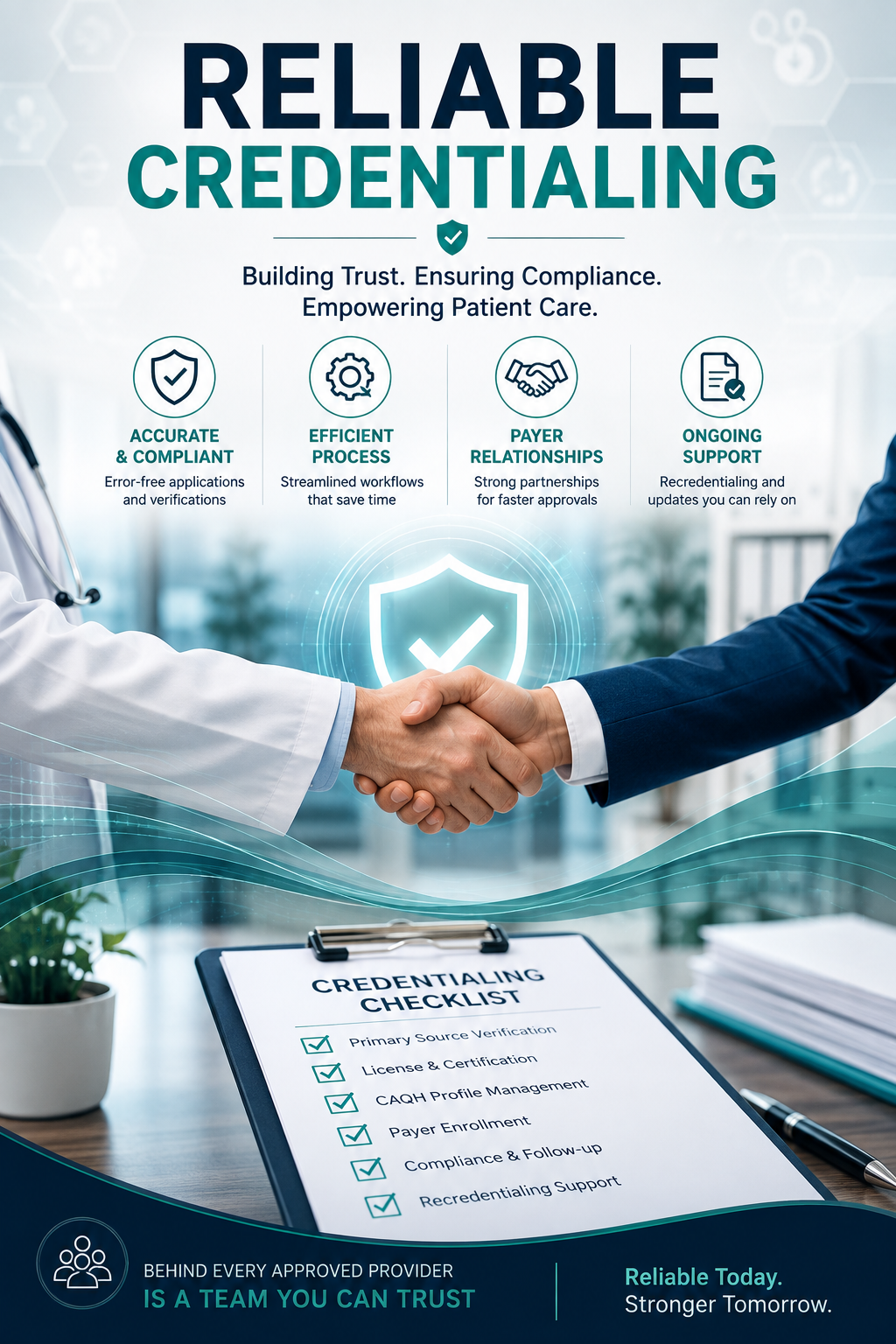
New York credentialing takes time. On average, eMedNY Medicaid enrollment is 60–90 days, Medicare ~45–90 days, and each commercial plan 60–120 days. We present an interactive timeline of steps: intake, CAQH/PECOS prep, submission, follow-up, and final contract.
We review your provider profile, licensing information, specialty, enrollment goals, and collect all required documentation before applications are prepared.
Provider records are reviewed, synchronized, and prepared across CAQH ProView, NPPES, PECOS, and supporting enrollment systems before submission.
Applications are submitted to the appropriate enrollment systems with complete supporting documentation. Every submission is tracked to monitor progress and respond quickly to additional information requests.
Our team follows up with state agencies, Medicare contractors, and commercial insurance carriers throughout the review process to resolve outstanding requirements and help keep applications moving.
After approval, we verify effective enrollment dates, confirm billing readiness, and provide final enrollment details so providers can begin submitting claims with confidence.
Providers ask "What documents do I need?" We present a checklist: medical license, DEA, malpractice, board certification, diploma, driver's license, W-9, voided check, CAQH, NPI, collaborative agreements (if applicable).
The most common causes of credentialing delays in New York include incomplete applications, inconsistent provider data, expired supporting documents, missed payer requests, and inaccurate CAQH or NPPES information. Identifying these issues before submission helps reduce delays and unnecessary rework.
Veracity Group reviews provider information, licensing, CAQH, NPI, enrollment documentation, and payer requirements before submission to help identify issues that commonly delay credentialing approvals.
Healthcare organizations need more than application processing. They need an enrollment partner that understands payer requirements, manages documentation accurately, communicates proactively, and keeps provider enrollment projects moving toward approval with complete visibility throughout the credentialing lifecycle.
Our team works exclusively with provider enrollment, credentialing, Medicare, Medicaid, commercial insurance, and ongoing compliance, allowing practices to reduce administrative complexity while maintaining enrollment accuracy.
Every enrollment project is managed through a structured workflow with documented milestones, helping providers understand where applications stand throughout the credentialing process.

From initial applications and payer follow-up to revalidation and provider data maintenance, every enrollment is managed through a structured process designed to improve accuracy and reduce administrative burden for healthcare organizations.
Credentialing does not end with approval. Ongoing monitoring, provider updates, recredentialing, and enrollment maintenance help practices remain compliant while avoiding unnecessary interruptions to reimbursement.
Answers to the questions healthcare providers most frequently ask about credentialing, provider enrollment, Medicare, Medicaid, commercial insurance participation, and credentialing timelines in New York.
Credentialing timelines vary by payer. eMedNY Medicaid enrollment generally takes 60–90 days, Medicare enrollment approximately 45–90 days, and commercial insurance credentialing commonly ranges from 60–120 days depending on payer requirements and application completeness.
Yes. Most commercial insurance carriers use CAQH ProView to review provider information during the credentialing process. Maintaining an accurate and current profile helps reduce delays caused by incomplete or inconsistent provider data.
Typical enrollment documentation includes a medical license, DEA registration, malpractice insurance, board certification, medical diploma, W-9, NPI information, CAQH profile, and other supporting documents requested by individual payers.
Yes. Veracity Group coordinates Medicare enrollment, New York Medicaid enrollment, commercial insurance credentialing, CAQH profile management, and provider data verification through a structured enrollment process designed to reduce duplicate work and maintain consistent provider information across multiple payers.
Enrollment delays may occur when supporting documentation is incomplete, provider information is inconsistent, CAQH records are outdated, or additional information is requested by the payer. Monitoring application status and responding promptly to payer requests helps minimize unnecessary delays.
Yes. Hospital privileges and facility credentialing are separate from insurance payer enrollment. Each hospital maintains its own medical staff credentialing process, documentation requirements, committee review procedures, and approval timelines.
Provider information should be reviewed whenever there are changes to practice locations, licensing, ownership, taxonomy codes, malpractice insurance, or contact information. Regular updates across CAQH, NPPES, Medicare, Medicaid, and commercial payer records help maintain enrollment accuracy.
Consistent provider information across enrollment systems helps reduce requests for corrections, minimizes credentialing delays, supports faster payer review, and improves overall enrollment accuracy throughout the credentialing lifecycle.
Whether you're enrolling a single provider or managing credentialing for an expanding healthcare organization, Veracity Group delivers the expertise, accuracy, and ongoing support needed to help you reach billing readiness with confidence.
Whether you’re opening a new practice, expanding locations, renewing provider credentials, or enrolling with Medicare, Medicaid, and commercial payers, The Veracity Group provides reliable nationwide credentialing support.

Simplifying provider credentialing, payer enrollment, and compliance management through transparent processes, dedicated support, and industry expertise.
Schedule Consultation© 2026 The Veracity Group. All Rights Reserved.