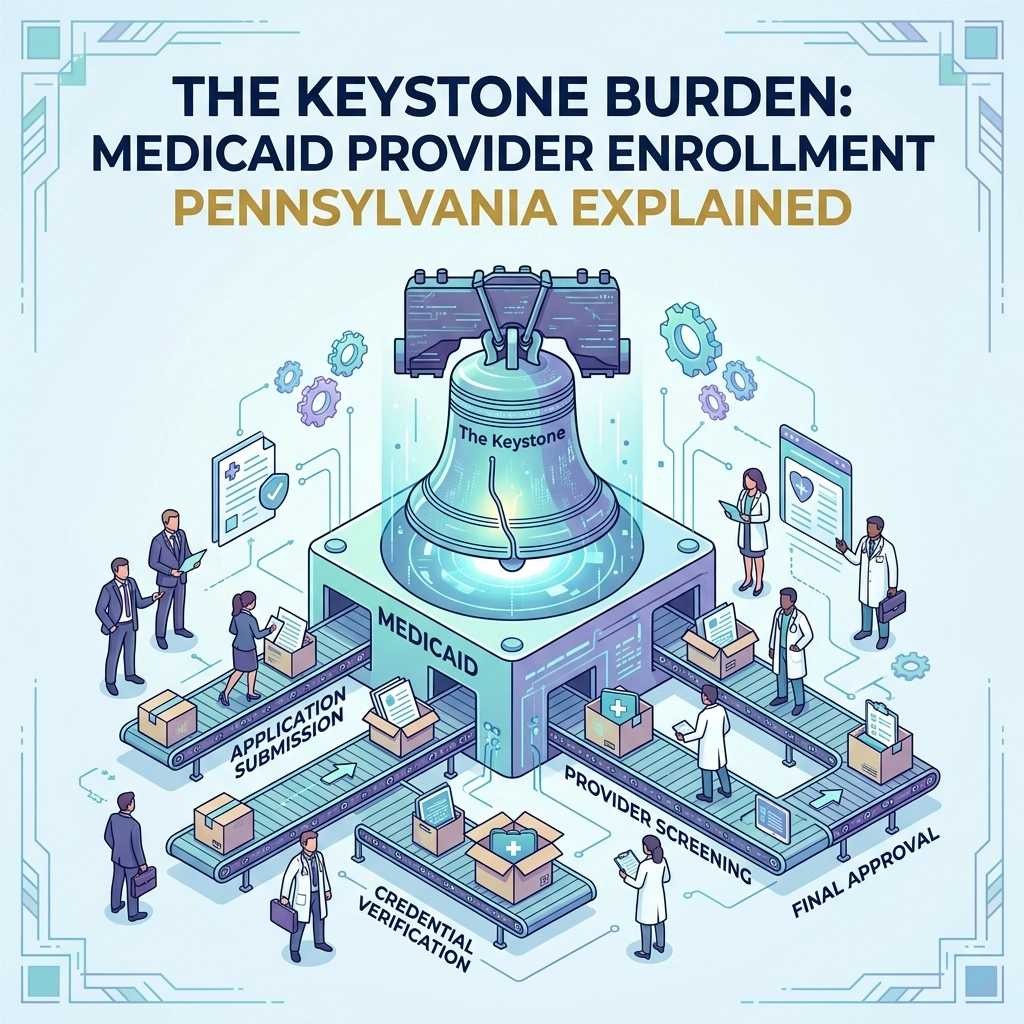
The Keystone Burden: Medicaid Provider Enrollment Pennsylvania Explained

Navigating the healthcare landscape in the Commonwealth requires more than clinical expertise; it demands an iron will to withstand the industrial weight of administrative compliance. For practitioners and facilities looking to serve the state’s most vulnerable populations, Medicaid provider enrollment Pennsylvania stands as a formidable gatekeeper. This process is not a simple registration but a complex, multi-layered gauntlet that involves rigorous state-level scrutiny and the mastery of specialized digital systems. Without a strategic approach, your practice will stall before it even opens its doors to Medicaid patients, caught in a cycle of technical rejections and background check delays. Looking for professional provider credentialing services in the USA? 👉 Check our main service page here: veracityeg.com The PROMISe Portal: Pennsylvania’s Digital Monolith The heart of the Pennsylvania Medicaid machine is the PROMISe™ (Provider Reimbursement and Operations Management Information System) portal. This is the single point of entry for enrollment activity, but its utility is matched only by its complexity. It is where Pennsylvania’s Department of Human Services (DHS) drives the operational workflow behind enrollment actions and downstream billing administration. (See the official DHS PROMISe provider resources: https://www.pa.gov/agencies/dhs/resources/for-providers/promise/promise-provider-enrollment.) For a new provider, the PROMISe portal can feel like a brutalist structure: functional, yes, but cold and unforgiving. Every field must be populated with surgical precision. A single discrepancy between your NPI data and your Pennsylvania business registration will result in an immediate stall. The system is designed to filter out errors through automated rejection, often leaving providers wondering where the "crack in the foundation" actually lies. The Three Pillars of PROMISe Submissions New Enrollment: For those entering the Pennsylvania market for the first time or adding a new service location. Revalidation: A mandatory process occurring every five years to ensure your practice remains compliant with evolving state standards. Reactivation: Necessary for providers whose billing privileges have lapsed due to inactivity or missed revalidation windows. Alt-tag: A high-contrast, noir-style image of a glowing computer screen in a dark, industrial office setting, displaying a complex login portal representing PROMISe. The Scrutiny of DHS Background Check Requirements Pennsylvania is notorious for the depth of its background check requirements, particularly for those in the home health and behavioral health sectors. This is where the "Keystone Burden" becomes most palpable. The DHS does not simply take your word for your history; it demands a trifecta of clearances that can take weeks: or months: to clear. The Mandatory Clearances Act 34 (PA State Police Criminal Record Check): A baseline requirement for all individuals associated with the provider entity. Act 33 (PA Child Abuse History Clearance): Essential for any provider whose services might intersect with minors, a common requirement for multi-disciplinary practices. Act 73 (FBI Fingerprinting): This federal-level check often creates the longest bottleneck, requiring physical appointments and coordination with third-party vendors. The high cost of delays in these background checks is not just administrative; it is financial. While your background check sits in a queue at a state office, your revenue cycle remains at a standstill. You cannot bill for services provided until the enrollment is finalized, and retroactive billing is limited and difficult to secure. The 30-Day Expiration: The "Ticking Clock" Inside PROMISe PROMISe runs on deadlines, not sympathy. Incomplete or returned enrollment applications expire after 30 calendar days. Once that clock runs out, you are no longer “waiting”: you are restarting, re-uploading, and re-explaining the same facts under a new tracking record. That is how a clerical miss becomes a quarter of lost revenue. The Weight of "High-Risk" Classifications In the eyes of the Pennsylvania Department of Human Services, not all providers are created equal. Federal and state regulations dictate a Risk-Based Screening model that categorizes providers into "limited," "moderate," or "high" risk levels. If your practice falls into a high-risk classification: such as a newly enrolling home health agency or a supplier of durable medical equipment (DME): the level of scrutiny intensifies significantly. High-risk providers are subject to mandatory site visits and unannounced inspections. Furthermore, any provider with a history of payment suspensions, prior exclusions from federal programs, or qualifying overpayments within the last ten years is automatically flagged for maximum oversight. Here’s the detail teams miss until PROMISe forces it into the open: service locations are often flagged as “high-risk” at logon when PROMISe identifies outstanding provider overpayments tied to the enrollment record. The system does not “politely” wait for the end of your application. It triggers the moment you enter the building. Navigating a high-risk enrollment is like walking through a minefield in the dark. One misstep regarding your physical location’s compliance or your corporate structure can lead to an outright denial. This is where The Veracity Group provides its greatest value, acting as the industrial-grade spotlight that illuminates the path forward. We map the triggers that activate maximum oversight and keep your submission fortified against DHS pushback. Alt-tag: A moody, gritty noir image of a heavy iron door with "AUTHORIZED PERSONNEL ONLY" etched into it, symbolizing the barriers of high-risk provider enrollment. The MCO Disconnect: A Common Pitfall One of the most dangerous misconceptions in Medicaid provider enrollment Pennsylvania is the belief that state enrollment guarantees access to patients. It does not. Enrollment through the PROMISe portal only makes you "eligible" to participate in the Medicaid program. The Administrative Gauntlet: ACNs, Timely Filing, and the Paper Trail That Never Dies Even after enrollment clears, Pennsylvania’s workflow punishes messy documentation. Two PROMISe mechanics show up again and again when cash flow gets trapped: Attachment Control Number (ACN): When supporting documentation has to be tied to a claim action or an exception workflow, PROMISe uses an ACN as the tracking spine. If the ACN trail is wrong, the paperwork exists but effectively “doesn’t exist” in the system’s eyes. 180-day timely filing rule + exception request: Pennsylvania enforces a 180-day timely filing window for claims, and when you miss it, you must push an exception request through PROMISe’s rules and documentation requirements. This is not a simple “please reprocess” note. It is a controlled,