
Every day your provider sits in credentialing limbo, your practice is bleeding money. We're talking about $3,000-$5,000 in lost daily revenue per provider while they wait for approval to start seeing patients and billing insurance. Multiply that across multiple providers and lengthy delays, and you're looking at six-figure revenue losses that could have been completely preventable.
The healthcare credentialing industry costs practices over $1 billion annually in lost revenue due to preventable delays. But here's what most practice administrators don't realize: the majority of these delays stem from simple operational mistakes that you can fix today.
After working with hundreds of healthcare practices, we've identified the 7 most effective enrollment hacks that slash credentialing timelines and protect your bottom line. These aren't theoretical strategies: they're battle-tested methods that smart practices use to get their providers billing faster.
Hack #1: Start Your Credentialing Process 120-180 Days Early
Stop waiting until you need the provider to start working. The biggest mistake practices make is treating credentialing as a last-minute task. The moment you decide to hire a provider: even before they officially start: begin the credentialing process immediately.
Why this works: Insurance payers have their own internal timelines that you cannot control. Primary source verification, committee reviews, and administrative processing all take time. By starting early, you create a buffer zone that absorbs unexpected delays without impacting your provider's start date.
Implementation tip: Build this timeline into your hiring process. Make credentialing initiation a standard HR checklist item that happens within 48 hours of extending a job offer.

Hack #2: Create Your Complete Documentation Package Before Submitting Anything
Never submit a partial application: it's credentialing suicide. Payers will reject incomplete applications immediately, sending you back to square one. Instead, compile every single document you need before touching that first application.
Your complete package must include:
- Current professional liability insurance (with proper coverage amounts)
- Valid medical licenses (primary and any additional states)
- Board certifications (with expiration dates clearly visible)
- Education verification (medical school, residency, fellowship)
- Work history (complete, with no gaps in employment)
- Hospital affiliations (current and accurate)
The revenue impact: Practices that submit complete applications on the first try get approved 40-60 days faster than those playing document ping-pong with payers.
Hack #3: Use Payer-Specific Checklists (Not Generic Forms)
Stop using one-size-fits-all credential packets. Each insurance payer has unique requirements, preferred formats, and specific forms. Using generic applications is like showing up to a black-tie event in casual clothes: you're getting turned away at the door.
Create dedicated checklists for each major payer that include:
- Their specific application forms (not generic versions)
- Required attachments in their preferred formats
- Submission deadlines and processing timelines
- Contact information for follow-ups
- Common rejection reasons to avoid
Pro tip: Update these checklists quarterly. Payers change their requirements regularly, and outdated information causes unnecessary delays.
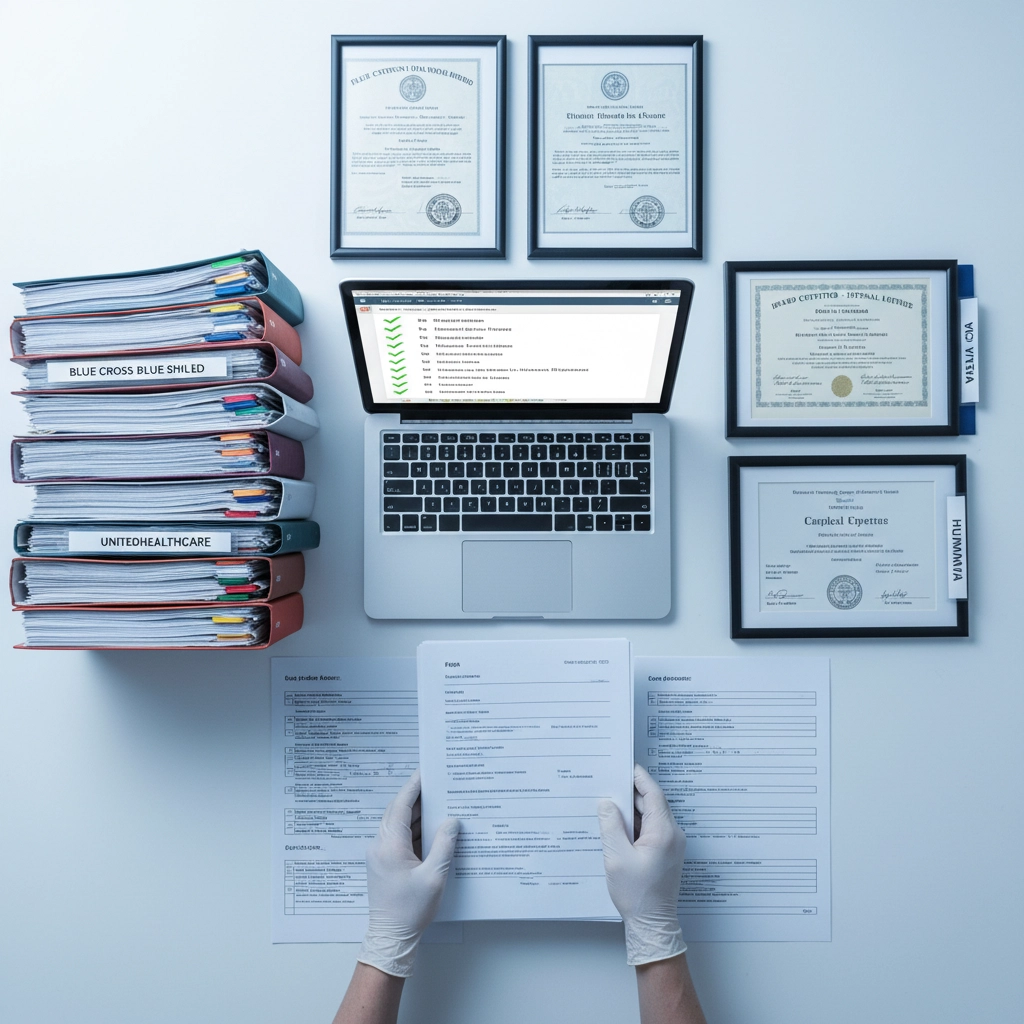
Hack #4: Verify Every Single Detail Against Official Sources
Don't trust anything: verify everything. The smallest data inconsistency will trigger an automatic rejection. We're talking about mismatched middle initials, slightly different license numbers, or dates that don't align across documents.
Cross-check these critical details:
- Provider names (exactly as they appear on licenses)
- License numbers (verify against state licensing boards)
- NPI numbers (check the official NPI registry)
- DEA numbers (if applicable)
- Tax ID numbers (ensure they match your practice)
- Addresses (use consistent formatting across all documents)
The credentialing killer: A pediatrician's credentialing was delayed four months because his medical school transcript showed "Michael J. Smith" while his license showed "Michael Smith" (no middle initial). That tiny discrepancy cost the practice $60,000 in lost revenue.
Hack #5: Track Expiration Dates Like Your Revenue Depends On It (Because It Does)
Expired credentials equal automatic rejection: no exceptions. Payers won't credential providers with licenses, insurance, or certifications that expire within 90 days of application submission.
Build an expiration tracking system that alerts you:
- 90 days before expiration (time to start renewal process)
- 60 days before expiration (ensure renewal is in progress)
- 30 days before expiration (renewal must be completed)
Implementation hack: Use a simple spreadsheet with conditional formatting that highlights upcoming expirations in red. Check this monthly during team meetings.

Hack #6: Monitor Communications Daily (Every Single Channel)
Payers communicate through multiple channels, and missing one communication restarts your entire timeline. You need to check email, physical mail, online portals, and sometimes even fax communications daily.
Set up a daily monitoring routine:
- Check all payer portals first thing in the morning
- Review email inboxes (including spam folders)
- Open all physical mail immediately
- Document every communication with date, time, and reference numbers
Follow-up aggressively: After submitting documents, call within 48 hours to confirm receipt. If you don't hear back within the expected timeframe, call again. Squeaky wheels get credentialed faster.
Hack #7: Assign Single-Point Accountability for Each Application
The fastest way to lose applications in the system is to make credentialing "everyone's responsibility." When multiple people handle pieces of the process, critical tasks fall through the cracks.
Designate one person or team to own each provider's entire credentialing journey from start to finish. This person:
- Tracks all submission deadlines
- Monitors communication channels
- Follows up on pending requests
- Maintains documentation
- Escalates issues when necessary
Real-world results: A multi-location practice reduced their average credentialing time from 90 days to 21 days and dropped processing errors by 80% simply by implementing single-point accountability.

The Revenue Protection You Can't Afford to Ignore
These hacks don't just speed up credentialing: they protect massive revenue streams. Every day of credentialing delay costs you:
- Direct revenue loss from providers who can't see patients or bill insurance
- Patient appointment cancellations when providers aren't in-network
- Staff utilization problems when you're paying providers who can't generate revenue
- Claim denials and rejections that require expensive appeals processes
- Provider turnover costs when delays frustrate locum tenens and specialists
The practices that implement these seven hacks consistently see 40-60% faster credentialing times and eliminate the majority of preventable delays that cost thousands in daily revenue.
Your credentialing process either protects your revenue or destroys it: there's no middle ground. These seven hacks give you the operational control to ensure your providers get credentialed fast, start billing immediately, and generate revenue from day one.
The question isn't whether you can afford to implement these strategies( it's whether you can afford not to.)
