The Golden State Wall: Breaking Through Medicaid Provider Enrollment California

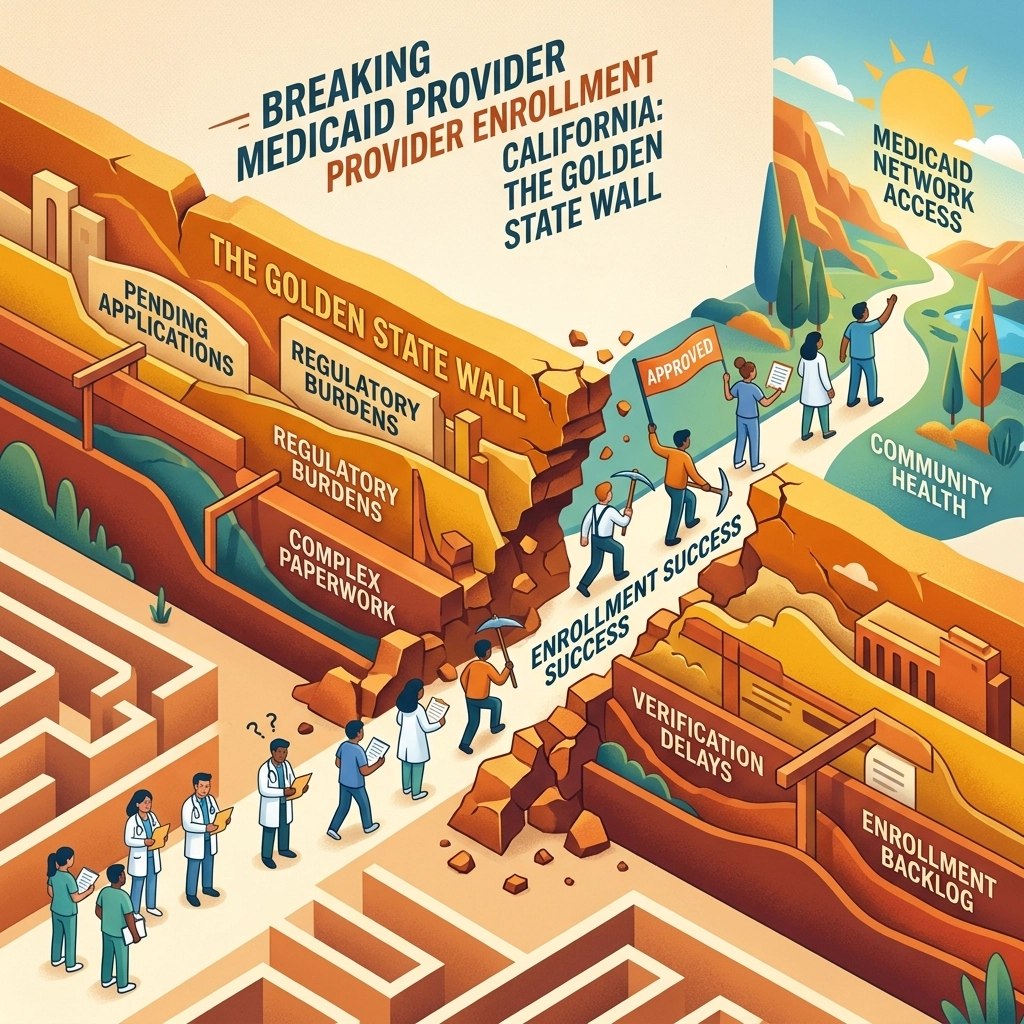
California’s healthcare landscape is a brutalist expanse, a monolithic structure where the barrier to entry is high and the margin for error is non-existent. Navigating Medicaid provider enrollment California is no longer a choice for organizations looking to capture a share of the nation’s largest state-funded market; it is a necessity that demands total operational alignment. Whether you are expanding from a base in Medicaid provider enrollment Texas or managing a nationwide footprint, the Golden State presents a regulatory wall that can either be scaled with precision or crashed against with devastating financial consequences. The Monolith: Understanding the Medi-Cal Scale California doesn't do things in half-measures. With over 15 million members, Medi-Cal is a titan. To provide services here, you aren't just filling out forms; you are entering a high-stakes ecosystem governed by the Department of Health Care Services (DHCS). The scale is so massive that the system itself feels industrial: cold, efficient when it works, and punishing when it doesn't. If you have navigated Medicaid provider enrollment Florida or Medicaid provider enrollment Ohio, you might think you understand the drill. You don't. California operates on a different frequency. The sheer volume of applications means that the DHCS does not have time for incomplete data or minor discrepancies. A single transposed digit in a NPI or an outdated address isn't just a "tweak": it is a catalyst for an immediate rejection that puts you back at the end of a very long, very dark line. The PAVE Portal: Your Industrial Gateway The Provider Application and Validation for Enrollment (PAVE) portal is the primary conduit for entry. Think of PAVE as the digital equivalent of a brutalist concrete fortress. It is designed to be the "single point of entry," but for the uninitiated, it often feels like a labyrinth of logic checks and document uploads. The DHCS moved to PAVE to streamline the process, yet the operational rigor required to manage a PAVE account is intense. Every provider type has specific requirements that must be met with surgical precision. Key challenges within the PAVE landscape include: Identity Verification: The system uses a multi-factor approach that can stall if the provider's underlying data in the NPPES or PECOS systems isn't perfectly mirrored. Document Integrity: Uploading blurry or poorly scanned credentials will result in an immediate "Deficiency Letter." Application Maintenance: Enrollment is not a "set it and forget it" task. You must manage revalidations and demographic updates with the same intensity as the initial application. For those used to the processes of Medicaid provider enrollment Pennsylvania, the PAVE portal’s rigid structure can be a shock to the system. There is no room for "close enough" here. Alt-text: A high-contrast, moody image of a massive concrete wall with a single, glowing digital screen embedded in it, representing the PAVE portal in a brutalist style. The Looming Deadline: June 2026 The clock is ticking in a way that many providers are choosing to ignore: at their own peril. As reported in this CMADocs update on DHCS enforcement of the Medi-Cal prescriber enrollment requirement beginning June 26, 2026 (https://www.cmadocs.org/newsroom/news/view/ArticleId/51130/DHCS-to-enforce-Medi-Cal-prescriber-enrollment-requirement-beginning-June-26-2026), a critical deadline is approaching for all prescribers. By June 26, 2026, all ordering, referring, and prescribing (ORP) physicians and other professionals must be fully enrolled in Medi-Cal. This is not a suggestion. This is a mandate. Failure to comply will result in denied pharmacy claims and a complete shutdown of your ability to serve the Medi-Cal population. The "Golden State Wall" will simply close its gates. If you think the system will be lenient because of patient care concerns, you haven't been paying attention to the shift toward strict regulatory enforcement. Looking for professional provider credentialing services in the USA? 👉 Check our main service page here: veracityeg.com The Operational Cost of Delay In a gritty, high-stakes market like California, time is a depleting resource. The high cost of delays isn't just a line item on a spreadsheet; it's a hole in your revenue cycle that can swallow an entire practice. While you wait for an enrollment specialist to figure out why a PAVE application was kicked back, your providers are seeing patients for free. The consequences of poor enrollment management are stark: Total Revenue Stoppage: Unlike some private payers that might allow for retroactive billing, Medi-Cal is notoriously rigid. If you aren't enrolled, you aren't getting paid. Administrative Burnout: Forcing your clinical staff to handle the industrial-strength bureaucracy of the DHCS is a recipe for turnover. Patient Attrition: When pharmacy claims are denied because a prescriber missed the June 2026 deadline, patients will find a provider who was prepared. Scaling your operations effectively requires a deep understanding of mastering multi-state Medicaid provider enrollment. You cannot treat California like a side project; it must be the focal point of your compliance strategy. Alt-text: A gritty, industrial office setting with high-contrast shadows and stacks of paper, symbolizing the administrative weight of Medicaid enrollment. Navigating the DHCS Regulatory Landscape The DHCS is the architect of the Golden State Wall. They set the rules, and those rules are enforced with industrial coldness. To survive, your organization must adopt a posture of proactive compliance. Effective April 1, 2026, the DHCS has even announced contingency plans for system outages, allowing for paper-based submissions if PAVE fails. However, relying on a paper fallback is not a strategy: it’s a desperate measure. The "Veracity Take" on this is simple: The state is preparing for a system-wide bottleneck as the June 2026 deadline approaches. If you wait until the last minute, you will be caught in the surge. You must view provider enrollment as the industrial backbone of your professional credibility. Without it, your high-end medical equipment and expert clinicians are just expensive decorations. The Veracity Blueprint for Success Breaking through the Golden State Wall requires more than just filling out forms. It requires a tactical approach to the DHCS and the PAVE system. Data Scrubbing: Before even touching the PAVE portal, every piece of provider data must be verified against federal and
Three States, Three Realities: Medicaid Enrollment in Texas, Indiana, and California

Medicaid enrollment is never a one‑size‑fits‑all process. In 2026, the differences between states are wider than ever. Practices expanding across regions quickly learn that what works in one state fails in another—not because the workflow is wrong, but because the rules, systems, and expectations are fundamentally different. Texas, Indiana, and California represent three completely different Medicaid environments. Understanding those differences is the key to avoiding delays, protecting revenue, and keeping your providers active. Texas Medicaid Enrollment: High Volume, High Scrutiny Texas runs one of the busiest Medicaid programs in the country, and the enrollment process reflects that scale. Success in Texas depends on precise alignment between your NPI, taxonomy, practice structure, and program selection. Even small inconsistencies can trigger a full restart. Texas is strict about: Accurate taxonomy codes Group vs. individual enrollment sequencing Ownership disclosures Service location validation Program‑specific requirements (TMHP, MCOs, specialty programs) In Texas, the challenge isn’t complexity—it’s precision. If your data isn’t clean, the system stops processing without warning. Indiana Medicaid Provider Enrollment: Detail‑Heavy and Documentation‑Driven Indiana takes a documentation‑first approach. The state focuses heavily on accuracy, identity verification, and complete provider files. Missing even one field can stall the entire application. Indiana is especially strict about: Background checks Ownership and control disclosures Provider type classification Rendering vs. billing provider distinctions Address formatting and service location details Indiana’s system is slower to process but faster to reject. If something is wrong, they tell you—but they will not move forward until it’s fixed. California Medi‑Cal Enrollment: Policy‑Driven and Constantly Changing California operates in its own category. Medi‑Cal enrollment is shaped by frequent policy changes, immigration‑related eligibility rules, and program requirements that shift year to year. California’s biggest challenges include: Frequent regulatory updates Distinct rules for undocumented adults Emergency‑only coverage categories County‑specific processing differences Additional documentation for behavioral health and specialty programs California’s system isn’t slow—it’s layered. Each layer adds a new verification step, and each step requires clean, consistent data. Why These Differences Matter for Multi‑State Practices Practices operating in multiple states often assume they can replicate the same workflow everywhere. But Texas, Indiana, and California require different: Document sets Sequencing Follow‑up strategies Enrollment timelines Data validation steps A workflow that succeeds in Texas may fail immediately in California. A process that works in Indiana may be too slow for Texas. A documentation packet built for California may overwhelm Indiana’s system. Multi‑state enrollment only works when each state gets its own tailored workflow. How to Stay Ahead in All Three States 1. Build State‑Specific Checklists Each state has its own rules—treat them that way. 2. Standardize Your Data Before You Customize Clean NPI, CAQH, and practice documents make state‑specific adjustments easier. 3. Track Timelines Separately Texas moves fast when data is clean. Indiana moves slow but communicates clearly. California moves in layers—expect multiple review cycles. 4. Assign Ownership Multi‑state enrollment requires someone who understands the differences and manages them intentionally. The Bottom Line Texas, Indiana, and California each represent a different Medicaid reality. Success isn’t about working harder—it’s about working state‑specific. When your workflows match the state’s expectations, enrollment becomes predictable. This level of state‑level detail is why Medicaid.gov maintains such specific waiver and program lists: the rules are moving targets. Clean data. Tailored processes. State‑specific strategy. That’s how you stay active, billable, and compliant across multiple Medicaid programs. #Veracity #MedicaidEnrollment #TexasMedicaid #IndianaMedicaid #CaliforniaMedicaid #MediCal #ProviderEnrollment #PayerEnrollment #HealthcareCredentialing #MedicaidUpdates #PayerUpdates #HealthcareCompliance #OperationalExcellence #HealthcareOperations #PracticeManagement #MedicalPracticeManagement #ClinicManagement #HealthcareWorkflow #HealthcareInsights #HealthcareSolutions #HealthcareChallenges #RevenueCycle #RevenueProtection #HealthSystems #ClinicLife #MedicalPractice #WorkSmarter #FutureOfHealthcare #HealthcareLeadership #HealthcareConsulting #HealthcareWorkers