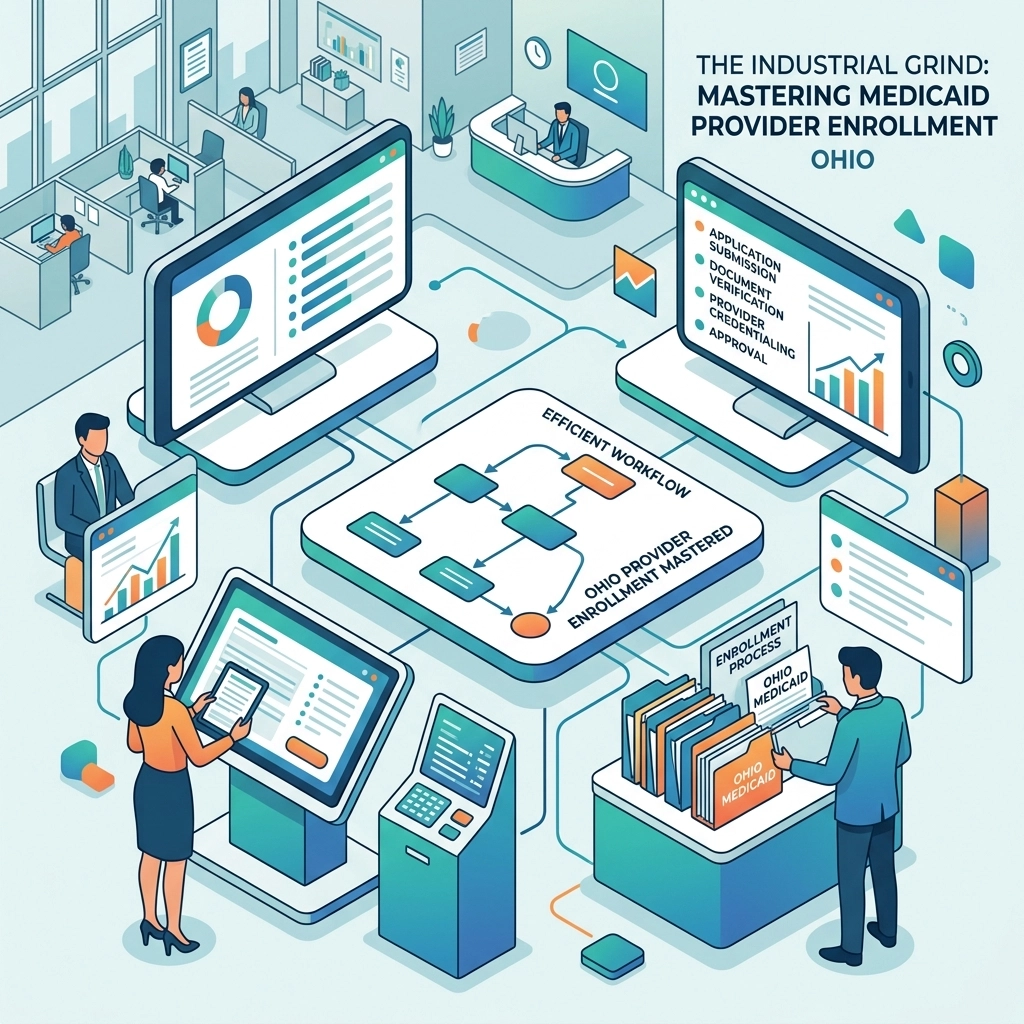
The Industrial Grind: Mastering Medicaid Provider Enrollment Ohio

The landscape of healthcare administration is often a cold, grey expanse of regulation and red tape. Navigating Medicaid provider enrollment Ohio requires more than just clinical expertise; it demands a brutalist approach to precision and documentation. While some might look toward Medicaid provider enrollment California as a benchmark for complexity, Ohio has built its own industrial-grade system that leaves no room for error. For healthcare organizations operating in the Buckeye State, the machinery of the Ohio Department of Medicaid (ODM) is either a well-oiled engine for revenue or a grinding wall of administrative delays. In this high-stakes environment, the difference between a successful enrollment and a rejected application is the attention paid to the smallest gear in the machine. At The Veracity Group, we see the consequences of "good enough" every day: stalled claims, credentialing gaps, and the sudden cessation of cash flow. The PNM Module: Ohio’s Digital Fortress Ohio has fully transitioned to a web-based electronic application system known as the Provider Network Management (PNM) Module. This is not a suggestion; it is a mandate. Gone are the days of paper applications and physical signatures sent via certified mail. To enter the Ohio Medicaid ecosystem, you must first secure an OHID. The OHID acts as your digital key to the state’s industrial complex. Without a properly configured OHID and a designated Provider Administrator, the gates remain closed. This system is designed for high-volume data processing, but it is notoriously unforgiving. A single typo in your NPI or a mismatch in your tax identification number will trigger an automated rejection that can set your practice back weeks. When you begin the application, the system issues a Registration ID (Reg ID). You must record this ID immediately. Think of it as your tracking number through the industrial fog; without it, you cannot return to an incomplete application or track your status. If you lose this ID, you are essentially starting from scratch, wasting valuable administrative hours. Image Alt Tag: A gritty noir depiction of massive industrial gears and high-contrast shadows representing the complex ODM PNM module. OhioRISE: Specialized Enrollment for High-Intensity Care If your practice involves behavioral health or specialized pediatric care, you are likely looking at the OhioRISE (Resilience through Integrated Systems and Excellence) program. OhioRISE is a specialized managed care program for children with complex behavioral health and multi-system needs. Enrollment here is not a "one size fits all" process. The requirements for OhioRISE are stringent. It involves specific licensure levels: such as LCSW or LPCC: and requires providers to demonstrate a capacity for integrated care that goes beyond standard Medicaid expectations. Because the stakes for these patients are so high, the state’s scrutiny of these applications is intense. If you are struggling with these specific hurdles, understanding why behavioral health provider enrollment is so hard can provide clarity on the systemic challenges unique to this field. Failure to align your PNM application with OhioRISE specifications results in more than just a denial; it leaves a vulnerable population without the care they desperately need. Precision is the only path forward. The Cost of Friction: Billing Interruptions and Delays In the world of provider enrollment, time is quite literally money. You cannot render services to Medicaid members: and more importantly, you cannot get paid: until you are fully screened, enrolled, and credentialed. The "Industrial Grind" refers to the period where your providers are seeing patients but the billing department is hitting a wall because the enrollment isn't active. The Medicaid Department of Ohio automatically enrolls providers into RAPBACK, a background check system. While this is a streamlined safety feature, any red flags here will immediately halt the enrollment process. Furthermore, application fees are a reality for many provider types. Unless you have paid a fee to Medicare or another state’s Medicaid program within the last five years, you must be prepared to settle this financial requirement upfront. Looking for professional provider credentialing services in the USA? 👉 Check our main service page here: veracityeg.com If your application remains unprocessed due to missing documentation, the state will eventually purge it. This forces you to restart, often leading to a gap in coverage that causes claims to be denied retroactively. For a growing clinic, this is a catastrophic failure that is entirely preventable through meticulous management. Image Alt Tag: A brutalist concrete wall with a small opening of light, symbolizing the high-contrast difficulty of overcoming enrollment barriers. Strategic Precision: Mastering the Standard Application Whether you are navigating Medicaid provider enrollment Texas or the specific rigors of Ohio, the "Standard Application" path for individual practitioners is a sequence of logic gates. You must choose the correct provider type from the outset. Selecting "individual practitioner" when you should have selected "Medicaid Waiver (ODM)" for home-based services is a fundamental error that the system will not auto-correct for you. Each screen in the PNM module is tailored to your provider type. If you provide inaccurate answers, even by mistake, you risk more than just a delay. Knowingly making false statements on these applications can result in prosecution under federal or state law. This is why we advocate for an authoritative, expert-led approach to every submission. For those managing providers across state lines, the challenges multiply. Ohio’s system does not communicate with Medicaid provider enrollment Pennsylvania or Medicaid provider enrollment Florida. Each state is its own industrial silo. To manage this effectively, many organizations look toward mastering multi-state Medicaid provider enrollment to create a cohesive strategy that prevents regional gaps. The Veracity Take: Why You Can’t Afford to Wait At The Veracity Group, we treat enrollment as the backbone of professional credibility. If your enrollment isn't solid, your entire revenue cycle is built on sand. The "Industrial Grind" of the PNM module and Ohio Department of Medicaid (ODM) is designed to filter out the unprepared. We recommend a three-point check for all Ohio providers: Verification of OHID Credentials: Ensure your Provider Administrator is active and has the correct permissions. Reg ID Management: Never start an
Provider Enrollment: The Backbone of Clinic Revenue

Meta Description: Discover why provider enrollment is the silent driver of your clinic’s revenue and how a dedicated specialist ensures your growth remains uninterrupted. In the high-stakes world of healthcare administration, there is a silent driver that determines whether your clinic flourishes or founders: provider enrollment. While most practice owners focus on patient care and marketing, the “back office” reality of getting paid is often treated as an afterthought. This is a mistake that costs thousands in lost revenue and months of administrative headaches. At The Veracity Group, we see it every day. A clinic hires a brilliant new provider, but because the paperwork wasn’t handled with precision, that provider sits on the sidelines for months, unable to see insured patients. If you want to scale your practice, you must stop viewing enrollment as a clerical task and start seeing it as the backbone of your professional credibility. The Big Picture: Enrollment vs. Credentialing Before we dive into the “why,” we need to clear up a common industry misconception. People often use the terms medical credentialing and provider enrollment interchangeably. They are not the same thing. Medical credentialing is the process of verifying a provider’s qualifications: their education, training, experience, and licensure. It is the “gatekeeper” process that proves a doctor is who they say they are. Provider enrollment, on the other hand, is the actual process of requesting participation in a health insurance network as a participating provider. It is the “key” that unlocks the door to reimbursement. You can have a perfectly credentialed doctor, but if they aren’t enrolled with the payer, you won’t see a dime of insurance money for their services. When you hire a credentialing specialist from a firm like Veracity, you aren’t just paying for data entry. You are investing in a strategic partner who understands the nuances of provider enrollment & credentialing as two distinct but overlapping pillars of your revenue cycle. The High Cost of the “DIY” Approach Many small to mid-sized clinics try to handle enrollment in-house. It seems simple enough on the surface: fill out some forms, upload some PDFs, and wait. But the reality is a bureaucratic labyrinth that can consume forty or more hours of staff time per provider. The consequences of DIY errors are severe: Application Rejections: A single missing signature or an outdated DEA license can lead to an immediate rejection. Most payers won’t tell you exactly what’s wrong; they’ll just send it back to the bottom of the pile. Delayed Revenue: The standard timeline for enrollment is 90 to 120 days. If your staff makes a mistake and you have to restart, you’re looking at six months of a provider seeing patients for “free” because you can’t bill their insurance. Lapsed Contracts: Enrollment isn’t a “one and done” deal. Re-validation and re-enrollment cycles are constant. If you miss a deadline, your contract is terminated, and your “in-network” status vanishes overnight. To avoid these pitfalls, your practice must maintain a proactive stance. For example, keeping up with ongoing compliance standards is the only way to ensure your enrollment status remains active and your claims continue to process without interruption. Why a Specialist is Your Best Asset Think of a credentialing specialist as a navigator through a storm. They know where the reefs are hidden and how to bypass the delays that trap the inexperienced. 1. Expert Knowledge of Payer Nuances Every payer has a different “flavor” of bureaucracy. Medicare uses the PECOS system, which is notoriously rigid. According to the Centers for Medicare & Medicaid Services (CMS), failing to adhere to specific enrollment standards can result in a provider’s billing privileges being deactivated. A specialist understands the specific requirements for credentialing services across commercial, federal, and state-funded plans. 2. Faster Turnaround Times Specialists have established relationships and workflows. At The Veracity Group, we don’t just “submit and pray.” We follow a rigorous follow-up schedule that keeps your application moving through the payer’s queue. We know how to escalate issues when a payer is sitting on a file for too long. 3. Data Integrity and Security Your providers’ most sensitive information: Social Security numbers, home addresses, and DEA registrations: must be handled with extreme care. Professional credentialing services use secure, encrypted portals to manage this data, reducing the risk of a breach that could devastate your clinic’s reputation. The Strategic Impact on Clinic Growth If you are planning to expand: whether by adding new specialties like Physical Therapy or opening a new location: your enrollment strategy will make or break your timeline. Growth requires momentum. When you bring on a new specialist, you need them billing on day one. A dedicated specialist manages the timeline so that the provider’s start date aligns perfectly with their “active” status in the payer’s system. This allows you to market the new provider immediately, confident that you can accept the patients who call to book an appointment. Furthermore, as your practice grows, the complexity of managing multiple providers across different states or locations increases exponentially. A specialist provides the centralized oversight necessary to track every expiration date and re-attestation deadline. This level of continuous monitoring ensures that your revenue stream is never choked off by an administrative oversight. Navigating the Maze: Medicare and Beyond Government payers are particularly unforgiving. If you are looking to enroll in Medicare or Medicaid, the margin for error is zero. These programs have strict site-visit requirements and stringent background check protocols. A specialist acts as your liaison, ensuring that your facility meets all the physical and administrative requirements before the application is even submitted. They help you navigate the CAQH (Council for Affordable Quality Healthcare) database, which is the industry standard for commercial insurance data. If your CAQH profile is incomplete or inaccurate, your medical credentialing will stall, and your enrollment will follow suit. Conclusion: Your Partner in Success At the end of the day, your clinic exists to provide high-quality care to your community. You didn’t go into medicine to become an expert in
Canbots & Paperwork: The Rise of AI Chatbots in Provider Enrollment Workflows

Provider enrollment has always been a paperwork-heavy process that healthcare practices can't afford to get wrong. While credentialing verifies your qualifications, provider enrollment is what gets you on insurance networks so you can actually get paid. And if you've ever navigated the maze of payer-specific forms, requirements, and follow-up processes, you know it's a different beast entirely. Now AI chatbots are entering the enrollment workflow picture, promising to streamline some of the most tedious aspects of getting providers enrolled with payers. But before you imagine a future where chatbots handle everything automatically, let's look at what they're actually doing right now: and what they're not. The Reality of Provider Enrollment Workflows Provider enrollment is fundamentally about establishing contracts and payment relationships with insurance companies, Medicare, Medicaid, and other payers. Unlike credentialing, which focuses on verifying qualifications, enrollment is about completing the specific paperwork, agreements, and administrative steps each payer requires before they'll process claims and send payments. The process typically involves: Completing payer-specific enrollment applications Submitting required documentation (W9 forms, voided checks, facility information) Tracking application status through various payer portals Responding to requests for additional information Managing contract negotiations and fee schedules Maintaining ongoing compliance with payer requirements Each payer has its own requirements, timelines, and quirks. What works for Blue Cross Blue Shield won't necessarily work for UnitedHealthcare, and Medicare has an entirely different set of forms and processes. Where Current Workflows Break Down The biggest pain points in provider enrollment aren't necessarily about speed: they're about complexity, accuracy, and communication gaps: Information Overload: Every payer wants slightly different information formatted in slightly different ways. Practices spend significant time figuring out what each payer actually needs and how they want it presented. Status Black Holes: Once applications are submitted, getting status updates often means calling payer customer service lines, navigating phone trees, and waiting on hold. Many payers' online portals provide limited visibility into where applications stand. Incomplete Submissions: Missing documents or incorrect information can stall applications for weeks or months. Often, practices don't discover issues until they try to submit claims and get rejection notices. Manual Data Entry: The same provider information gets entered repeatedly across multiple payer systems, creating opportunities for transcription errors and inconsistencies. Communication Delays: When payers request additional information, it often comes through slow channels like mail or generic email notifications that don't clearly explain what's needed. How AI Chatbots Are Actually Being Used AI chatbots in provider enrollment workflows aren't replacing entire processes, but they are addressing some specific friction points: Guided Form Completion Smart chatbots can walk providers through complex enrollment forms by asking questions in plain language and translating responses into the specific format each payer requires. Instead of staring at a 20-page PDF wondering what goes in each field, providers can have a conversation that guides them through the process step by step. For example, rather than trying to interpret "Primary Practice Location Taxonomy Code," a chatbot might ask, "What type of medical practice is this?" and automatically populate the correct taxonomy code based on the response. Real-Time Status Updates Some healthcare organizations are implementing chatbots that connect to payer APIs and internal systems to provide instant status updates. Instead of calling customer service, providers can ask the chatbot, "What's the status of Dr. Johnson's Aetna enrollment?" and get an immediate response. Documentation Checklists and Reminders Chatbots excel at helping providers organize required documentation before starting enrollment applications. They can create customized checklists based on the specific payers and provider types involved, then send reminders about missing items. Basic Question Answering Many enrollment questions are variations on the same themes: "What documents do I need for Medicare enrollment?" or "How long does UnitedHealthcare typically take to process applications?" Chatbots can provide immediate answers to these routine questions, freeing up human staff for more complex issues. Realistic Workflow Improvements The most effective AI chatbot implementations in provider enrollment focus on reducing friction rather than eliminating steps: Pre-Application Preparation: Chatbots help gather and organize all required information before starting formal applications, reducing the likelihood of incomplete submissions that cause delays. Error Prevention: By validating information as it's entered and flagging potential issues, chatbots can catch problems before applications are submitted rather than after they're rejected. Multi-Payer Coordination: When enrolling with multiple payers simultaneously, chatbots can track which requirements are common across payers and which are unique, helping practices avoid duplicate work while ensuring nothing is missed. Follow-Up Management: Automated reminders and status checks help ensure enrollment applications don't get lost in the shuffle or forgotten about until providers need to submit claims. What Chatbots Can't Do (Yet) AI chatbots cannot speed up payer processing times. If Medicare takes 60-90 days to process enrollments, a chatbot isn't going to change that. The bottleneck is on the payer side, not with your application submission. They can't negotiate contracts or resolve complex enrollment issues that require human judgment. When payers request additional documentation or there are questions about practice ownership or organizational structure, human expertise is still essential. Chatbots can't substitute for understanding payer-specific requirements. While they can guide form completion, successful enrollment still requires knowledge of each payer's unique processes, timelines, and preferences. Implementation Considerations If you're considering AI chatbots for your enrollment workflows, focus on these practical applications: Start with high-volume, routine tasks like status inquiries and basic documentation requirements rather than trying to automate complex scenarios. Ensure integration with existing systems so chatbots can access real enrollment data rather than just providing generic information. Plan for human handoffs when chatbots encounter questions they can't answer or situations that require human intervention. Test thoroughly with actual enrollment scenarios before rolling out to providers. Enrollment requirements change frequently, and chatbots need to stay current with the latest payer policies. The Future of Enrollment Automation While AI chatbots are making enrollment workflows more efficient, they're not revolutionary: they're evolutionary. The real value comes from reducing the administrative burden on your staff so they can focus on higher-value activities like relationship building with payers
Provider Enrollment in 2026: Why AI-Powered Credentialing Will Change the Way You Manage Your Medical Practice

The healthcare landscape is shifting faster than ever, and AI-powered healthcare administration is about to revolutionize how medical practices handle their most critical operational processes. While everyone's talking about AI in diagnostics and patient care, the real game-changer for practice management will happen behind the scenes with automated provider enrollment processes. Your practice's financial health depends on seamless provider enrollment, and 2026 will mark the year when artificial intelligence transforms this traditionally manual, error-prone process into a streamlined digital powerhouse. If you're still managing provider enrollment the old-fashioned way, you're about to be left behind. Why Traditional Provider Enrollment Is Failing Medical Practices Provider enrollment delays cost the average medical practice $75,000 annually in lost revenue. These aren't just numbers: they represent real money walking out your door while you wait for manual processes to crawl through bureaucratic systems. Current provider enrollment workflows suffer from three critical flaws: Manual data entry errors that cause application rejections and restart the entire process Inconsistent follow-up on pending applications that sit dormant for months Lack of real-time visibility into enrollment status across multiple payers The traditional approach forces practice administrators to juggle dozens of different payer portals, each with unique requirements, deadlines, and documentation standards. It's a recipe for missed opportunities and revenue hemorrhaging. The AI Revolution: How Automated Systems Will Transform Provider Enrollment Artificial intelligence will fundamentally change provider enrollment by eliminating the three biggest bottlenecks that plague medical practices today. These aren't theoretical improvements: they're practical solutions that will be standard practice by 2026. Intelligent Document Processing and Validation AI-powered systems will automatically extract provider information from existing databases, cross-reference it with payer requirements, and flag potential issues before submission. This means no more rejected applications due to missing signatures, incorrect tax IDs, or incomplete board certifications. Smart validation algorithms will ensure every application meets specific payer criteria before it leaves your system. The result? 95% first-time acceptance rates compared to the current industry average of 60%. Predictive Timeline Management Machine learning algorithms will analyze historical enrollment data to predict exactly how long each payer will take to process applications. Your AI system will automatically submit applications at optimal times to ensure provider directories are updated precisely when you need them. No more guessing when to start the enrollment process for new hires. AI will tell you exactly when to begin based on your practice's specific needs and each payer's processing patterns. Automated Status Monitoring and Follow-Up Instead of manually checking dozens of payer portals, AI systems will continuously monitor all pending applications and automatically escalate stalled cases. When an application sits idle beyond predicted timelines, the system will generate follow-up communications and alert your team to potential issues. Real-World Impact: What This Means for Your Practice Operations The streamline provider enrollment workflow benefits extend far beyond just faster processing times. AI-powered enrollment management will create cascading improvements throughout your entire practice operations. Revenue Acceleration Faster provider enrollment directly translates to faster revenue recognition. When new providers can see patients sooner and existing providers can bill additional payers without delays, your cash flow improves immediately. Consider this scenario: A new physician joins your practice in January. With traditional enrollment, they might not be credentialed with all major payers until April or May, losing three months of potential revenue. AI-powered systems will compress this timeline to weeks, not months. Reduced Administrative Overhead Your staff currently spends approximately 15-20 hours per week managing provider enrollment tasks. AI automation will reduce this to 2-3 hours of oversight and exception handling, freeing up valuable human resources for patient-focused activities. Enhanced Compliance and Audit Readiness AI systems maintain complete audit trails of all enrollment activities, automatically track license renewal dates, and ensure ongoing compliance requirements are met. Digital transformation healthcare enrollment means never again scrambling to find documentation during payer audits. Key AI Features That Will Define 2026 Provider Enrollment Systems The most successful medical practices in 2026 will leverage AI systems with these essential capabilities: Dynamic Payer Intelligence AI systems will maintain real-time databases of payer requirements, automatically updating when payer policies change. Your enrollment submissions will always reflect the most current requirements, eliminating rejections due to outdated information. Intelligent Workflow Orchestration Smart routing algorithms will determine the optimal sequence for multi-payer enrollments, ensuring dependent applications are submitted in the correct order and timing. Predictive Exception Handling Machine learning will identify patterns that typically lead to enrollment delays or rejections, allowing proactive intervention before problems occur. Integrated Communication Management AI will generate personalized follow-up communications with payers, automatically escalating to human oversight when responses are required. Preparing Your Practice for the AI-Powered Enrollment Future The transition to AI-powered provider enrollment isn't optional: it's inevitable. Practices that adopt these systems early will gain significant competitive advantages, while those that wait will struggle to catch up. Data Foundation Requirements Start by cleaning and organizing your current provider data. AI systems perform best when fed high-quality, standardized information. Inconsistent data entry practices will undermine even the most sophisticated AI platform. Process Documentation and Optimization Map your current enrollment workflows to identify bottlenecks and inefficiencies. AI will amplify your existing processes, so optimizing them before implementation ensures maximum benefit. Staff Training and Change Management Your team will need to understand how to work alongside AI systems effectively. The goal isn't to replace human oversight but to eliminate manual, repetitive tasks that drain productivity. Speaking of productivity improvements, if you're currently dealing with enrollment bottlenecks that are costing your practice revenue, you might want to check out proven strategies that work right now while you prepare for the AI transformation ahead. The Competitive Advantage of Early AI Adoption Medical practices that implement AI-powered enrollment systems in 2026 will establish market advantages that will be difficult for competitors to overcome. Early adopters will benefit from: Faster time-to-market for new providers and service lines Lower operational costs through automation of routine tasks Higher staff satisfaction by eliminating frustrating manual processes Improved cash flow through accelerated enrollment timelines Enhanced scalability to support