Addiction Medicine Credentialing: DEA X-Waiver Gone, Now What?

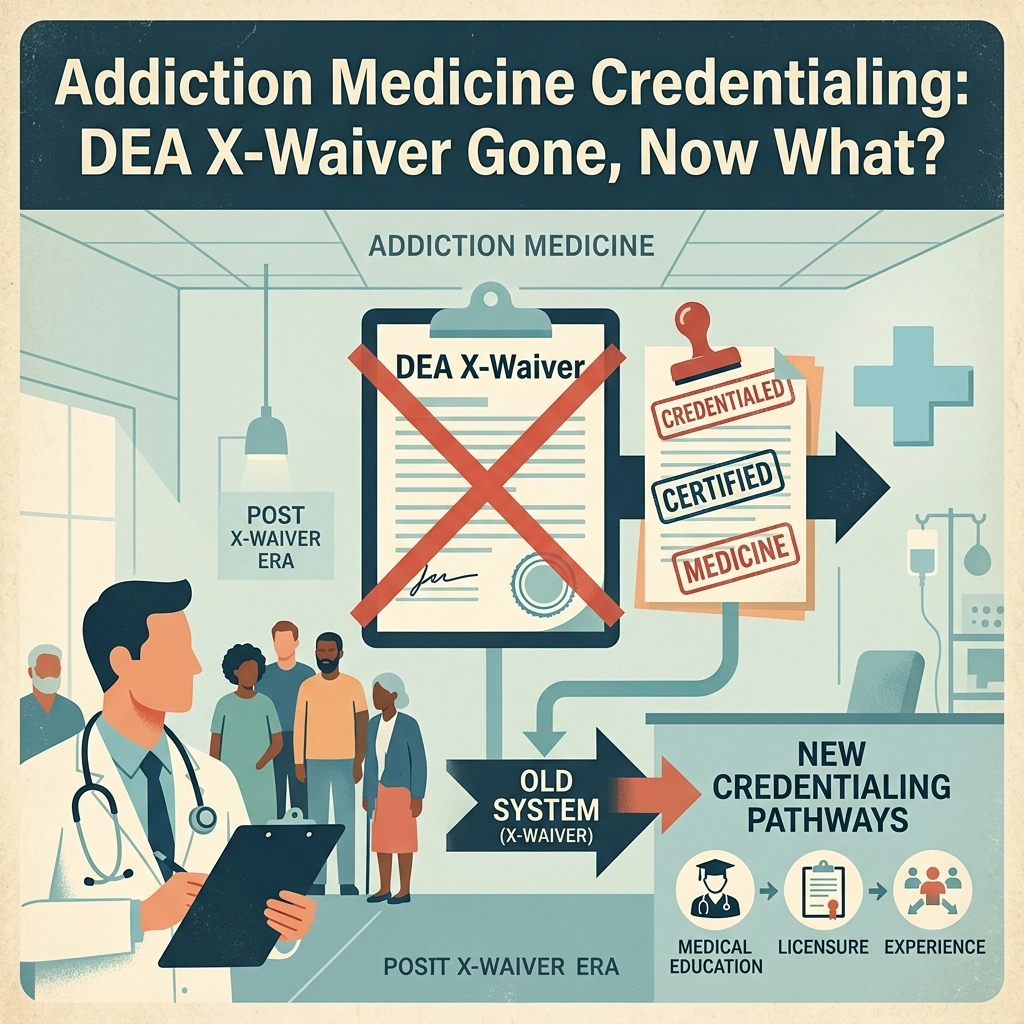
The landscape of Medication-Assisted Treatment (MAT) shifted beneath our feet following the elimination of the DATA-Waiver, commonly known as the X-waiver. For years, the X-waiver acted as a regulatory bottleneck, restricting the number of providers who could prescribe buprenorphine and creating a complex layer of medical credentialing that many found prohibitive. Today, in 2026, we are operating in a post-waiver environment where provider enrollment for addiction medicine has been streamlined at the federal level, yet significant administrative hurdles remain at the payer and state levels. The removal of the X-waiver was intended to expand access to life-saving treatment for Opioid Use Disorder (OUD), but simply having the legal authority to prescribe does not automatically translate into a seamless billing experience. If you are launching a new MAT program or adding addiction specialists to your group, you must understand that the "X" may be gone, but the scrutiny from insurance panels has only intensified. The End of the X-Waiver: What Actually Changed? Effective January 12, 2023, the Substance Abuse and Mental Health Services Administration (SAMHSA) and the DEA officially stopped requiring the specialized waiver to prescribe buprenorphine. This change, spurred by the Consolidated Appropriations Act of 2023, removed the cap on the number of patients a single provider can treat and eliminated the need for a separate DEA registration number starting with the letter "X." For your practice, this means: Standard DEA Authority is Sufficient: Any provider with a valid DEA registration that includes Schedule III authority can now prescribe buprenorphine for OUD. No More Patient Caps: The previous 30, 100, and 275-patient limits are a thing of the past. Your capacity is now dictated by your clinical bandwidth, not a federal ceiling. Simplified DEA Forms: You no longer have to submit a Notice of Intent (NOI) to SAMHSA to start treating patients with MAT. While these changes are a massive win for public health, they have created a "Wild West" atmosphere for provider enrollment. Payers are now looking for other ways to verify that a provider is actually qualified to manage these high-risk patients. The Mandatory 8-Hour Training: The New Bar for Enrollment While the X-waiver is dead, its ghost lives on in the form of the MATE (Medication Access and Training Expansion) Act. As of June 2023, all DEA-registered practitioners must complete at least eight hours of training on the treatment and management of patients with opioid or other substance use disorders. This is a one-time requirement tied to the first DEA application or first DEA renewal submitted after June 2023. If a provider completed the training in 2023, that provider does not repeat it for a 2026 renewal. Your job in 2026 is to ensure the documentation remains valid, accessible, and present in the provider’s CAQH profile and payer files. To satisfy this requirement for your next medical credentialing cycle, you must demonstrate one of the following: Board Certification: Being board-certified in addiction medicine or addiction psychiatry from the American Board of Medical Specialties (ABMS) or the American Osteopathic Association (AOA). Recent Graduation: Having graduated in good standing from a medical, dental, PA, or NP school within the last five years, with that five-year window measured specifically from the date of the provider’s DEA application or DEA renewal, and having completed at least eight hours of OUD curriculum. Accredited Training: Completion of eight hours of training from organizations like the American Society of Addiction Medicine (ASAM) or the American Academy of Addiction Psychiatry (AAAP). At the federal level, the DEA uses a self-attestation checkbox during the registration process. That does not satisfy payer operations in 2026. At The Veracity Group, we frequently see enrollment applications stalled because a provider checked "yes" to having the training but failed to upload the actual certificate of completion to their CAQH 2 portal. In 2026, major payers and CAQH treat the physical upload of the training certificate as a mandatory field, and they will not take your word for it; they want the paper trail. The Payer Enrollment Trap: Why Your Taxonomy Code Is Your New X-Number In the absence of the X-waiver, insurance companies are relying heavily on NPI taxonomy codes to identify which providers in a group are eligible to bill for MAT-related services. If your provider is a Family Medicine physician but is providing addiction treatment, their enrollment must reflect the correct sub-specialty or secondary taxonomy. If your taxonomy codes are outdated or generic, you will face: Automatic Claim Denials: Payers may flag MAT services as "outside the scope of practice" for a generalist. Lower Reimbursement Rates: Some contracts offer specific rates for addiction specialists that general practitioners cannot access without the correct enrollment data. Directory Inaccuracies: Patients searching for MAT providers through their insurance portal won't find you, leading to a direct loss in patient volume. We recommend a thorough review of your demographic updates to ensure that every provider offering MAT is correctly identified in the NPPES and payer databases. This is especially vital for behavioral health provider enrollment, which you can learn more about in our beginner’s guide. State Laws vs. Federal Freedom: The Compliance Gap It is a common misconception that federal law supersedes all state-level restrictions regarding MAT. While the DEA removed the X-waiver, roughly 15–18 states still maintain their own "mini-waivers," additional registrations, specific administrative code requirements, or strict collaborative and supervision ratio rules for Nurse Practitioners (NPs) and Physician Assistants (PAs) who prescribe buprenorphine. For example, a state can allow an NP to prescribe buprenorphine federally, but that same state can still require a separate state registration, a physician collaboration document, or a stricter supervision ratio before the mid-level prescriber is treated as fully compliant for Medicaid or commercial panel participation. Failing to have this documentation on file during the contracting phase leads to denials, enrollment holds, or outright rejection from state Medicaid panels. If you are operating in multiple states, you are navigating a minefield of conflicting regulations. We detail these complexities in our post on mastering multi-state Medicaid provider
A Guide to Choosing Healthcare Credentialing Vendors

Navigating the complexities of payer networks is the single most important hurdle for any growing medical practice. When you are looking for what are the top services to credential a provider quickly?, you are essentially searching for a partner who understands that speed and accuracy in enrollment are the lifeblood of your revenue cycle. Identifying who provides provider credentialing services in the US? is the first step toward securing your practice's financial future and ensuring your providers can begin seeing patients without administrative delay. The process of getting a practitioner linked to an insurance carrier: often referred to as provider enrollment: is a high-stakes administrative marathon. If a single application is sidelined due to a minor error, the high cost of delays manifests in thousands of dollars of lost potential revenue. To maintain a healthy bottom line, you must align with healthcare credentialing vendors who treat your enrollment timeline with the urgency it deserves. The Critical Role of Provider Enrollment Provider enrollment is the silent driver of your practice’s cash flow. It is the process of requesting participation in a health insurance network as a participating provider. Without successful enrollment, your claims will be rejected, and your providers will remain out-of-network, placing an unnecessary financial burden on both the practice and the patients. When you find companies offering outsourced provider credentialing services, you are looking for more than just data entry. You are seeking experts who can navigate the labyrinth of Medicare enrollment and private payer requirements across different states. The Veracity Group specializes in this high-level coordination, ensuring that your practice stays ahead of the curve. Alt Text: A professional 3D render of a digital shield and a medical cross, symbolizing the security and compliance of healthcare enrollment systems. Key Qualities of Top-Tier Enrollment Partners Choosing a vendor is not just about checking a box; it is about finding a strategic ally. As you look to find companies specializing in medical provider credentialing, evaluate potential partners based on these non-negotiable criteria: Multi-State Expertise: In an era of telehealth and multi-state medical groups, your vendor must be proficient in the specific regulations of every state where you operate. Mastering multi-state Medicaid provider enrollment requires a level of detail that generic services simply cannot match. Payer Relationship Depth: The best vendors maintain open lines of communication with major payers like UnitedHealthcare, Blue Cross Blue Shield, and Aetna. This insider knowledge allows them to bypass common bottlenecks. Real-Time Transparency: You should never be left wondering about the status of an application. A professional vendor provides a clear portal or regular reporting that shows exactly where each provider stands in the enrollment pipeline. Accuracy Guarantee: A single typo on a NPI or tax ID can reset the 90-day clock for an insurance company. Precision is the backbone of professional credibility in this industry. Why Outsourcing is the Standard for Modern Practices Many practices attempt to handle enrollment in-house, only to find their office managers overwhelmed by the sheer volume of paperwork and follow-up calls required. When you find companies specializing in medical provider credentialing, you reclaim your internal resources. Outsourcing to specialized healthcare credentialing vendors ensures that your enrollment tasks are managed by professionals whose sole focus is getting you paid. These specialists understand the nuances of the CAQH database, which is essential for the majority of commercial insurance enrollments. By leveraging an external team, you move the administrative burden off your desk and into the hands of experts who use proprietary systems to track every application detail. Looking for professional provider credentialing services in the USA? 👉 Check our main service page here: veracityeg.com Alt Text: A professional 3D render of interconnected gears and a stethoscope, representing the seamless integration of medical practice management and administrative support. Identifying Which Companies Specialize in Your Needs Not all vendors are created equal. Some focus on large hospital systems, while others are built for independent clinics or behavioral health groups. To determine which companies specialize in provider credentialing for healthcare professionals that match your specific model, you must ask the right questions: Do you have experience with my specific specialty? For example, behavioral health provider enrollment has unique requirements that differ significantly from orthopedic surgery. What is your average turnaround time? While no vendor can control the speed of an insurance company, they should have data on how quickly they submit clean applications. How do you handle re-enrollment and revalidation? Enrollment is not a one-time event. Payers require periodic revalidation to maintain active status. The Veracity Group excels in helping clinics with fast, accurate multi-state onboarding. Whether you are adding a single physician or launching a new multi-specialty facility, our team ensures the process is handled with surgical precision. The Impact of Efficient Enrollment on Patient Access Efficient enrollment is your passport to success in the modern healthcare market. When a provider is properly enrolled, they appear in the insurance company's directory. This is often the first place a patient looks when searching for a new doctor. If your enrollment is lagging, you are invisible to thousands of potential patients. Furthermore, delays in enrollment can lead to "held claims": services provided to patients that cannot be billed because the provider is not yet active in the system. This creates a massive backlog that can take months to clear, severely impacting your revenue cycle. Strategic Selection: Who Offers Provider Credentialing Services? When asking who offers provider credentialing services, the answer varies from solo consultants to massive tech firms. The "sweet spot" is a dedicated partner like The Veracity Group, which combines personalized service with high-tech efficiency. We understand that behind every application is a provider ready to work and a patient waiting for care. A professional enrollment partner will also assist with contracting, ensuring that once you are enrolled, the rates you receive are fair and reflective of your value in the market. This holistic approach to provider lifecycle management is what separates an average vendor from a top-tier partner. Alt Text: A professional 3D
Strategic Credentialing Support for Your Medical Practice

Managing a modern healthcare facility requires extreme precision, yet administrative bottlenecks frequently stall even the most ambitious growth plans. If you are currently asking, "Where can I find credentialing support for my practice?", you likely already recognize that manual processing is a liability. Securing the best services for doctor credentialing is not merely an administrative checkbox; it is a strategic imperative that ensures your revenue remains uninterrupted and your expansion remains viable. At The Veracity Group, we understand that delays are not just an inconvenience: they are a direct threat to your bottom line. The Administrative Backbone of Healthcare In the current healthcare landscape, credentialing is the silent driver of your professional credibility. It serves as the bridge between hiring a top-tier provider and actually generating revenue from their services. Without a robust system in place, your practice faces the high cost of delays, including thousands of dollars in lost billing for every week a provider remains "un-credentialed" with major payers. The process is inherently complex. It involves deep dives into professional history, primary source verification, and the meticulous management of expirations. For many practices, the burden of maintaining this data in-house leads to oversight and errors. This is where professional intervention becomes a necessity. Alt tag: A professional 3D render of a digital shield and medical symbols representing the security and integrity of medical credentialing data. Why Strategic Outsourcing is Essential Many practice managers begin their search by asking, "Where can I find provider credentialing service providers near me?" While local proximity was once a primary concern, the shift toward telehealth and multi-state medical groups has changed the requirements for excellence. You need a partner who understands the nuances of various state boards and insurance carriers across the country. The Veracity Group eliminates delays and supports multi-state growth. By centralizing your credentialing efforts, you gain a high-level view of your entire organization's compliance status. This perspective is vital for surgery centers and medical groups that are navigating complex regulatory environments. For instance, medical group enrollment for surgery centers involves specific compliance risks that a generalist might overlook. Evaluating the Market: What to Look For When you are identifying the top-rated provider credentialing service companies for medical practices?, your criteria must be rigorous. A "low-cost" vendor often results in higher costs later due to rejected applications or missed re-credentialing deadlines. You must prioritize accuracy, speed, and transparency. A high-tier service provider will offer: Primary Source Verification (PSV): Directly contacting institutions to verify credentials, ensuring compliance with National Committee for Quality Assurance (NCQA) standards. Proactive Monitoring: Notifying you months in advance of license or certification expirations. Carrier Relations: Established pathways with major payers to expedite the enrollment process. Multi-State Capability: The ability to move your providers into new markets without restarting the learning curve. Looking for professional provider credentialing services in the USA? 👉 Check our main service page here: veracityeg.com How to Choose a Provider Credentialing Service Provider? The decision-making process should be methodical. How to choose a provider credentialing service provider? Start by assessing their technology stack and their human expertise. While software can track dates, it cannot navigate the bureaucracy of a state Medicaid office or resolve a complex CAQH conflict. You must ask potential vendors about their experience with specialized fields. For example, behavioral health provider enrollment presents unique challenges that differ significantly from orthopedic or general practice requirements. Ensure your partner has a track record in your specific niche to avoid unnecessary delays. Alt tag: A 3D render of interconnected globes and data nodes, illustrating a seamless multi-state healthcare expansion network. The Consequences of Inaction The high cost of administrative stagnation is often felt too late. When a provider's credentials lapse, or an application is delayed by months, the practice must absorb the salary of that provider while being unable to bill for their work. This "credentialing gap" is a primary cause of cash flow instability in growing medical groups. Furthermore, the risk of claim denials increases exponentially without expert oversight. Payers like Medicare and Medicaid have stringent requirements for enrollment updates. If your practice data is out of sync, your claims will be rejected, leading to a massive backlog in your accounts receivable. Moving Beyond "Near Me" to "Best in Class" While the search for "providers near me" is a natural starting point, the most successful practices prioritize expertise over geography. The digital nature of modern healthcare means that the best support can come from a national leader like The Veracity Group. We provide the infrastructure needed to scale your operations from a single location to a multi-state powerhouse. Whether you are dealing with CAQH and Medicare enrollment or managing a rotating staff of gig-economy providers, your credentialing strategy must be dynamic. The "set it and forget it" approach no longer works in a landscape defined by rapid regulatory shifts and increasing payer scrutiny. Alt tag: A professional 3D render of a stylized hourglass filled with medical icons, representing the elimination of time-delays in healthcare administration. A Culture of Compliance and Speed Expert credentialing support transforms your practice from a reactive entity into a proactive one. Instead of scrambling to fix a provider's status after a denial, you operate with the confidence that every practitioner is fully authorized to provide care and receive payment. This level of organization is attractive to both investors and potential new hires, who want to join a practice that values professional standards. To maintain this edge, you must integrate monthly credential monitoring into your standard operating procedures. This ensures that no license expires and no certification goes unverified. It is the only way to safeguard your practice against the 7 common mistakes that frequently cost clinics their revenue. Conclusion The Veracity Group provides the strategic support necessary to navigate the maze of modern healthcare administration. We don't just process paperwork; we build the foundation for your practice’s long-term growth and stability. By eliminating the friction in provider enrollment, we allow you to focus on what truly matters: delivering high-quality
How to Credential an Addiction Medicine Provider: A Specialist’s Guide to Payer Enrollment

The demand for specialized addiction treatment has never been higher, yet the administrative hurdles to get these providers in-network remain some of the most complex in the healthcare industry. When you are looking at how to credential an addiction medicine provider, you aren’t just filling out standard forms; you are navigating a specialized landscape of federal regulations, sub-specialty certifications, and clinical levels of care that payers scrutinize with extreme prejudice. At The Veracity Group, we see practices stumble because they treat addiction medicine like a standard internal medicine specialty. It isn’t. To secure the highest reimbursement tiers and ensure compliance, your enrollment strategy must be as specialized as the care your providers deliver. The Foundation: NPI and Specific Taxonomy Codes The journey begins with the National Provider Identifier (NPI). For an addiction medicine specialist, simply having an NPI is not enough. You must ensure the taxonomy code is accurately reflected in the NPPES NPI Registry. For physicians, the specific taxonomy code for Addiction Medicine (2084P0804X) is critical. This code tells payers that the provider has the specific expertise required for high-acuity substance use disorder (SUD) treatment. If your provider is listed under a general “Family Medicine” or “Internal Medicine” taxonomy, you will likely face immediate denials for specialized addiction treatment codes. Professional Certifications: ABPM and ABAM One of the most significant factors in how to credential an addiction medicine provider is their board certification. Payers prioritize providers who hold certification from the American Board of Preventive Medicine (ABPM) or the American Board of Addiction Medicine (ABAM). Historically, addiction medicine was a self-designated specialty, but as of 2025, the pathways have tightened significantly. Certification now typically requires an ACGME-accredited addiction medicine fellowship. When submitting enrollment applications to major payers like Aetna, Blue Cross Blue Shield, or UnitedHealthcare, including these board certifications is the “passport to success.” It positions your provider in the highest quality tier, which often results in better fee schedules and fewer “prior authorization” headaches. The DEA and the Removal of the DATA 2000 Waiver For years, the “X-waiver” (DATA 2000 waiver) was a mandatory prerequisite for any provider prescribing buprenorphine for opioid use disorder. However, federal law has changed significantly. As noted by SAMHSA, the X-waiver requirement has been eliminated. While this removes a significant administrative barrier, it introduces a new requirement: the MATE Act. All DEA-registered practitioners must now complete at least eight hours of training on opioid or other substance use disorders. When you are credentialing your provider, you must maintain documentation of this training. Payers and state Medicaid agencies will verify that your provider’s DEA registration is active and compliant with these new federal standards before allowing them to bill for Medication-Assisted Treatment (MAT). Aligning with ASAM Levels of Care In addiction medicine, the clinical setting is just as important as the provider’s license. The American Society of Addiction Medicine (ASAM) defines specific Levels of Care (e.g., Level 1: Outpatient, Level 2.1: Intensive Outpatient, Level 3.5: Clinically Managed High-Intensity Residential). When you are figuring out how to credential an addiction medicine provider, you must ensure the provider’s enrollment data matches your facility’s ASAM designation. If your provider is enrolled to provide services at an outpatient level but is billing for residential treatment, your claims will be flagged for audit. This alignment is the “silent driver” of revenue integrity. Much like our previous discussion on specialized dental enrollment, where specific board status changes the billing landscape, addiction medicine requires a perfect match between the provider’s credentials and the facility’s licensed capability. Navigating CAQH and Payer-Specific Portals The CAQH ProView portal is the backbone of professional credibility in the enrollment world. For addiction medicine, your CAQH profile must be impeccable. This includes: Up-to-date Malpractice Insurance: Ensure the coverage limits meet the high-risk requirements often mandated for addiction treatment. Work History: Any gaps longer than 30 days must be explained, as payers are particularly sensitive to “provider hopping” in the behavioral health and addiction space. Hospital Affiliations: Even if your provider only works in an office-based setting, you must clearly state their admitting privileges or their plan for patient hospitalization. Failure to maintain a clean CAQH profile is the fastest way to stall your enrollment. For a deeper look at why these platforms can be so difficult, read our guide on why behavioral health provider enrollment is so hard. The High Cost of Delays in Addiction Medicine The financial consequences of a botched enrollment in this specialty are severe. Addiction medicine providers often see a high volume of patients with urgent needs. If a provider is not successfully enrolled with a payer, you are faced with a terrible choice: turn away a patient in crisis or provide care that you will never be reimbursed for. A typical enrollment delay of 90 days can cost a practice tens of thousands of dollars in lost revenue. This is why a proactive approach is mandatory. You cannot wait for the provider to start seeing patients before beginning the process. You must initiate the payer enrollment at least 120 days before the provider’s first day. The Veracity Group Advantage Credentialing an addiction medicine specialist is a high-stakes endeavor that requires an insider’s knowledge of both medical and behavioral health regulations. From managing Multi-State Medicaid requirements to ensuring your provider meets the rigorous standards of the American Association of Dental Boards (when applicable to oral surgeons in the addiction space) or the ABPM, the details are overwhelming. The Veracity Group specializes in these high-complexity enrollments. We don’t just “fill out forms”; we manage the entire lifecycle of your provider’s professional identity. Our team ensures that your ASAM levels, board certifications, and DEA registrations are perfectly synchronized across every payer platform. If you are ready to stop fighting with payer portals and start focusing on patient recovery, explore our services today. We take the administrative burden off your shoulders so you can provide the life-saving care your community needs. Summary of Key Requirements for Addiction Medicine NPI Taxonomy: Must reflect Addiction Medicine (2084P0804X).