Weekend Update: Enrollment Trends Explained in 3 Minutes

Welcome back to your weekend brief. Navigating the world of medical provider enrollment services shouldn't feel like a high-stakes escape room, but when you're managing Medicare and Medicaid enrollment for behavioral health providers, the walls tend to close in fast. If you were hoping for a smooth digital transformation this season, I have some bad news: it’s April 2026, and we are still playing a waiting game with the ghosts of administrative promises past. The PECOS 2.0 Rollout Update PECOS 2.0 is currently rolling out. CMS is transitioning the platform to a cloud environment between April 20, 2026, and May 3, 2026, and PECOS 2.0 will be fully live on May 4, 2026. That means this is no longer a vaporware story. It is an active federal system transition with real operational implications for your practice. The rollout matters because CMS is introducing several functional upgrades designed to reduce duplicate work and improve visibility across the enrollment process. The new platform includes a single application for multiple enrollments, pre-populated data that carries forward existing provider information, and real-time status updates so you can track progress without relying entirely on email chains and manual follow-up. The Veracity Take This timeline changes the conversation, but it does not remove the operational pressure on your team. During a live transition window, delays, processing variability, and documentation issues still create serious consequences for revenue. You must stay disciplined while CMS moves PECOS into the new environment. The practical advantage is clear: single-application workflows, pre-populated records, and real-time status visibility will make enrollment tracking more efficient once the rollout completes. Until then, your best move is the same one that protects cash flow every time: submit early, verify every data field, and monitor application movement closely through the transition period. Alt-tag: A cyberpunk-style watercolor illustration of a complex digital landscape with two perfectly interlocking puzzle pieces in the center: one male and one female: glowing with golden energy to represent a perfect administrative fit. The Puzzle Logic: Why Enrollment is Your "Interlocking" Piece Think of your healthcare practice as a complex puzzle. You have the clinicians, the patients, and the facility. But there is a final, critical connection that many administrators overlook until it’s too late. To make the revenue cycle work, you need a perfectly engineered male and female interlocking system. One side is your provider’s clinical data; the other is the payer's enrollment requirements. If both sides are "female": meaning you have two gaps and no bridge: nothing fits. If you try to force a provider into a schedule without the "male" interlocking piece of a completed enrollment, the whole structure collapses. You are left with a provider who can see patients but cannot generate a single cent of collectible revenue. This is the silent driver of practice failure. We see this most often when clinics assume a provider's previous enrollment will "follow" them. It won't. Enrollment is location-specific, group-specific, and tax-ID-specific. Without that exact fit, the puzzle remains incomplete, and your cash flow remains stalled. The "Silent Driver" of Revenue Loss: Enrollment Gaps The most dangerous threat to your bottom line isn't a drop in patient volume; it's the enrollment gap. This is the period between when a provider starts seeing patients and the date their enrollment becomes effective. For Medicare and Medicaid enrollment for behavioral health providers, these gaps can be devastating. Because behavioral health often relies on high-volume, lower-reimbursement sessions (like 90834 or 90837), even a two-week gap in enrollment can result in tens of thousands of dollars in unbillable services. The Effective Date Trap: Payers like CMS often set the effective date based on when the application was received, not when the provider started. If your paperwork sits on a desk for three weeks, you lose three weeks of revenue. The Retroactive Limitation: Medicaid, in particular, has strict and often non-existent retroactive windows. If you miss the window, those claims are dead on arrival. The Credentialing Carry-over: While some believe "credentialing" is the finish line, the enrollment phase is where the money actually lives. You can be "credentialed" by a board but not "enrolled" in a plan, leaving you in a state of professional limbo. The high cost of credentialing-delays is often the difference between a profitable quarter and a massive deficit. You cannot afford to treat enrollment as an afterthought. Alt-tag: A vibrant watercolor image of a clock melting into a pile of money, symbolizing the high cost of time delays in medical provider enrollment services. Specialized Focus: Behavioral Health Hurdles Behavioral health is currently the "Wild West" of enrollment. With the surge in demand for mental health services, payers have increased scrutiny on provider types like LCSWs (Licensed Clinical Social Workers) and PMHNPs (Psychiatric Mental Health Nurse Practitioners). If you are expanding your behavioral health group, you must navigate these specialty-specific hurdles: Supervision Requirements: Many Medicaid plans require specific supervisory signatures for provisionally licensed clinicians. If the enrollment application doesn't reflect the exact supervisory relationship on file with the state board, it will be rejected instantly. NPI Type 2 Alignment: Ensure your group NPI (Type 2) is correctly linked to every individual NPI (Type 1). A common mistake in behavioral health is billing under the individual NPI for a group-based service, which leads to immediate denials. Telehealth Taxonomy: Since 2024, the use of specific telehealth taxonomies has become mandatory for most behavioral health enrollments. Using an outdated "office-only" taxonomy code while providing 100% remote therapy is an invitation for an audit. For a deeper dive into the specific requirements for different license levels, check out our guide on medical-licensing-csr-dea. Alt-tag: A cyberpunk-inspired watercolor of a brain interconnected with digital nodes and medical icons, highlighting the technical complexity of behavioral health enrollment. Why Manual Reviews Are the New Normal Because PECOS 2.0 is still in rollout, we are seeing a period where aggressive manual reviews remain part of the process. This means that instead of a fully stabilized automated system checking your boxes, a human being at
What is the Medicare fee schedule and why your commercial rates should be based on it

Navigating the complexities of provider enrollment and medical credentialing is the foundational step for any healthcare practice looking to secure its financial future in an increasingly competitive landscape. Understanding how you get paid is just as important as the care you provide, and at the heart of the American healthcare reimbursement system lies the Medicare Physician Fee Schedule (MPFS). For many practice owners, the MPFS is viewed merely as a government price list, but in reality, it is the backbone of professional credibility and the most critical benchmark for negotiating commercial insurance contracts. To maintain a sustainable practice, you must move beyond passive acceptance of payer rates. You must understand the mechanics of the MPFS and implement a strategic "130% Medicare framework" for your commercial contracts. This guide will break down the technicalities of the fee schedule and explain why anchoring your commercial rates to this public standard is the only way to ensure your practice covers its costs while remaining profitable. Decoding the Medicare Physician Fee Schedule (MPFS) The Medicare Physician Fee Schedule is more than just a list of prices; it is a sophisticated, data-driven system known as the Resource-Based Relative Value Scale (RBRVS). Established to create a level playing field, the RBRVS determines the "value" of a medical service based on the resources required to provide it. Every CPT code is assigned a Relative Value Unit (RVU), which is broken down into three distinct components: Work RVU: This accounts for the time, technical skill, physical effort, and mental judgment the clinician exercises during the procedure. Practice Expense (PE) RVU: This covers the overhead costs of running a practice, including clinical and administrative staff salaries, office rent, medical supplies, and equipment. Malpractice (MP) RVU: This reflects the cost of professional liability insurance associated with the specific service. To arrive at a final payment amount, these RVUs are adjusted by a Geographic Practice Cost Index (GPCI): which accounts for regional differences in the cost of living and doing business: and then multiplied by a fixed Conversion Factor set annually by the Centers for Medicare & Medicaid Services (CMS). You can review the latest updates on these regulatory shifts through resources like CMS.gov. Why the MPFS is the Industry’s "Fairness" Baseline The primary reason the MPFS serves as the industry standard is its transparency. Unlike commercial contracts, which are often shrouded in "proprietary" secrecy and non-disclosure agreements, the MPFS is public record. Every provider and every payer knows exactly what the baseline is. Using the MPFS as a benchmark provides a common language for negotiations. When you sit down at the table with a commercial payer, discussing rates in terms of "percentages of Medicare" allows for an objective comparison. It removes the guesswork and prevents payers from offering "black box" rates that look acceptable on the surface but fail to account for the rising costs of labor and medical supplies. Without a clear benchmark, your practice is flying blind. You cannot determine if a commercial offer is a "good deal" unless you know how it relates to the national standard. This is why contract analysis and renegotiation are vital; you must have the data to prove your worth. The 130% Medicare Framework: A Strategy for Sustainability While Medicare is the standard, it is rarely enough to sustain a private practice on its own. Medicare rates frequently sit at or near the margin for many private practices, especially after years of conversion factor cuts and rising overhead. For a commercial practice to be healthy, generate a profit, and reinvest in new technology, you must target a higher threshold. This is where the 130% Medicare framework comes into play. A common and defensible internal target is to aim for commercial rates in the range of 120–130% of current Medicare, adjusted for your market, specialty, and cost structure. Why 130%? Cost Coverage: Inflation and the rising cost of clinical staff mean that 100% of Medicare often results in a net loss for private practices after overhead is calculated. Negotiation Buffer: Payers will frequently offer "100% of Medicare" as a starting point. By establishing a 130% goal, you create a buffer for negotiation that ensures you don't settle for rates that compromise your practice’s viability. Standard of Care: To provide high-quality care and maintain modern facilities, your revenue must exceed the baseline "government" rate. Implementing this framework is a silent driver of practice growth. It ensures that every commercial patient seen contributes meaningfully to the practice’s bottom line. If your commercial contracts sit at or below Medicare while your overhead continues to rise, there’s a high likelihood you’re effectively subsidizing those payers with your own labor. Why Commercial Rates Vary (And Why You Need Leverage) You may notice that your colleague across town or a provider in a different specialty receives higher rates for the same CPT codes. Commercial rates are not static; they are influenced by several variables: Geography: As mentioned with the GPCI, it simply costs more to operate in Manhattan than it does in rural Missouri. However, commercial payers often have their own internal "market rates" that go beyond federal adjustments. Specialty Demand: If you provide a high-demand, low-supply specialty service, your leverage increases. Payers need you in their network to meet adequacy requirements. Negotiation Leverage: This is where many practices fail. Leverage is built through volume, quality data, and, most importantly, having your provider enrollment and credentialing house in order. You cannot negotiate from a position of strength if your enrollment is incomplete or your data is inaccurate in the payer's system. The High Cost of Passive Contracting The "set it and forget it" mentality is the enemy of practice profitability. Many providers sign a contract when they first open their doors and never look at it again. Over a decade, as the MPFS adjusts and inflation climbs, that "fixed" rate becomes a financial anchor. The consequences of ignoring your fee schedule alignment are severe: Revenue Leakage: Losing 5–10% on every claim because your rates haven't kept pace with
Can a telemedicine provider be credentialed in multiple states at once?

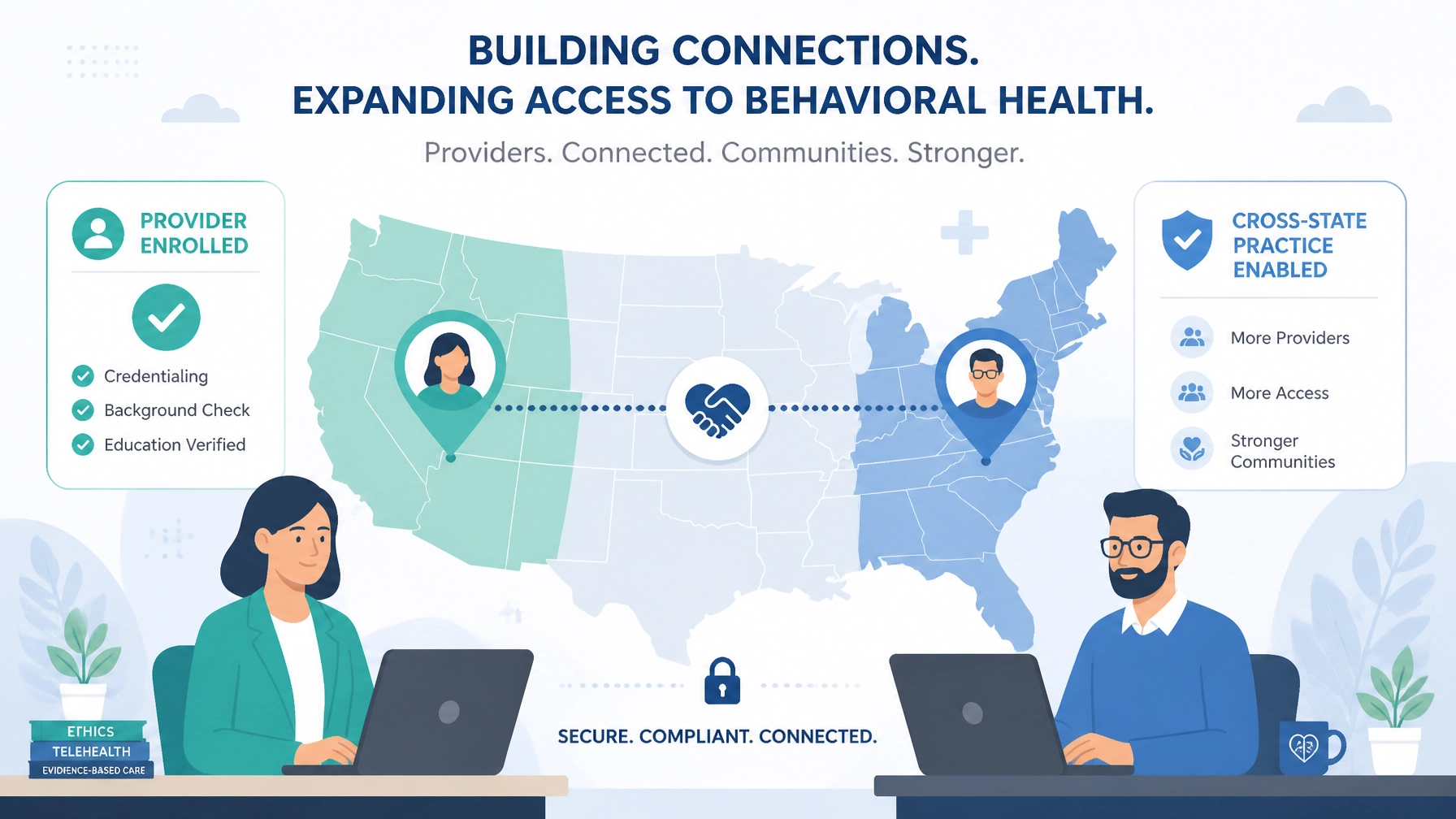
As the healthcare landscape shifts toward a digital-first approach, the ability to practice across state lines has become the backbone of professional credibility for modern practitioners. Navigating the world of telemedicine requires more than just a stable internet connection; it demands a sophisticated understanding of how provider credentialing works across multiple jurisdictions simultaneously. The short answer is yes: you can and often must be credentialed in multiple states to maintain a viable telehealth presence. However, doing so without a strategic roadmap is a recipe for administrative gridlock. Looking for professional provider credentialing services in the USA? 👉 Check our main service page here: veracityeg.com The Golden Rule: Patient Location Dictates Jurisdiction The most critical principle in telehealth is that the location of the patient at the time of the encounter determines which state’s laws apply. Even if you are sitting in your office in Pennsylvania, if your patient is logging in from Kansas, you are technically practicing medicine in Kansas. This reality creates a complex web of requirements. You must hold a valid license in every state where you intend to see patients. While this sounds like an administrative nightmare, it is the non-negotiable foundation of compliance. Failing to secure the proper authority before seeing a patient across state lines is not just a billing error: it is practicing medicine without a license, which carries severe legal and professional consequences. The Interstate Medical Licensure Compact (IMLC): Your Multi-State Passport For physicians, the Interstate Medical Licensure Compact (IMLC) is a game-changer. Think of the IMLC as a streamlined "passport" system that significantly reduces the time it takes to obtain licenses in participating states. Instead of submitting entirely separate, redundant applications to ten different state boards, you apply through your "State of Principal Licensure" (SPL). Once your SPL verifies your qualifications, you can select any number of member states and receive those licenses in a fraction of the time. This system is the silent driver of multi-state telemedicine growth. It allows telehealth groups to scale their operations rapidly, ensuring that their providers are legally cleared to practice as they expand their digital footprint. Alt: A conceptual map showing interconnected states representing the Interstate Medical Licensure Compact for telehealth providers. State-Specific Telehealth Registries: An Alternative Pathway Not every state requires a full, traditional medical license for out-of-state telehealth providers. Some jurisdictions have established specific telehealth registries or "out-of-state telehealth licenses." These are often less expensive and involve a faster application process than a full license, but they come with strict limitations. For example, these registrations often prohibit the provider from opening a physical office in that state or seeing patients in person. If your practice model is strictly virtual, these registries can be an efficient way to broaden your reach without the heavy lift of full licensure. However, you must carefully monitor these registrations, as they often have unique revalidation schedules that differ from standard medical licenses. Licensure vs. Payer Credentialing: Two Sides of the Same Coin Obtaining a state license is only the first half of the battle. Once you are legally allowed to practice in a new state, you must address payer credentialing and enrollment. Having a license in Florida does not mean you can automatically bill Florida Blue Cross Blue Shield or Florida Medicaid. 1. Payer-Specific Requirements Each insurance carrier in a new state has its own panel requirements. Even if you are already credentialed with Cigna in your home state, you will likely need to go through a "location addition" or a new credentialing process for their network in a different state. 2. Government Programs If you plan to treat Medicare beneficiaries in multiple states, you must ensure your enrollment reflects those locations. While Medicare is a federal program, it is administered by different Medicare Administrative Contractors (MACs) depending on the region. Similarly, Medi-Cal and other state Medicaid programs have extremely rigid enrollment processes that must be completed before you can submit a single claim. 3. CAQH Synchronization Your CAQH profile is the central hub for this information. For multi-state providers, keeping CAQH updated with all active licenses, current malpractice insurance (covering all relevant states), and work history is mandatory. Any discrepancy in your CAQH profile will trigger credentialing delays that can stall your revenue for months. Alt: A checklist showing the steps for payer credentialing and CAQH profile updates for multi-state providers. The High Cost of Administrative Friction Managing credentials in five, ten, or fifty states simultaneously is a high-stakes balancing act. The high cost of delays in this process is measured in lost revenue and administrative burnout. When a provider’s license expires in one state, payers in that state will immediately suspend claims and directory listings, and national plans may pause updates until the issue is corrected. Patients searching directories expect to find providers who are active and ready to see them. If your data is incorrect because you failed to manage your multi-state enrollments properly, you lose patient trust before the first appointment is even scheduled. Strategic Steps for Multi-State Expansion If you are a telehealth group or an individual provider looking to expand, you must approach the process with a modular strategy. Prioritize States by Volume: Don’t try to get 50 licenses at once. Target states with the highest patient demand or the most favorable reimbursement rates for your specialty, such as mental health or vision. Verify Malpractice Coverage: Ensure your professional liability insurance covers "multi-state telemedicine." Some policies are restricted to specific geographies. Centralize Your Data: Use a centralized system to track expiration dates for licenses, DEAs, and board certifications across all states. Monitor Legislative Changes: Telehealth laws are in a constant state of flux. What was allowed during a public health emergency may not be allowed today. Staying updated via resources like the Payer Gridlock Report 2026 is essential for long-term viability. Alt: A professional looking at a digital dashboard tracking medical license expirations across multiple US states. Maintaining Compliance in a Virtual World The complexity of being credentialed in multiple states
Does an NPI change when a provider changes practices?

Navigating the complexities of provider enrollment is a core responsibility for modern medical practices, and ensuring NPI management is handled correctly is the first step in that journey. When a new clinician joins your team, the onboarding process often begins with one fundamental question: Does their NPI change now that they are with us? For front-office staff and practice managers, the answer to this question dictates how quickly claims can be processed and how soon the provider can begin generating revenue. The National Provider Identifier (NPI) is the backbone of professional credibility in the American healthcare system. It is a unique, 10-digit identification number that is mandated by HIPAA for all covered healthcare providers. However, there is often confusion regarding how these numbers function during professional transitions. To maintain a high-functioning practice, you must understand that while the number itself is static for the individual, the data attached to it is fluid and requires active management. The Lifetime Passport: Understanding the Type 1 NPI A Type 1 NPI is assigned to individual healthcare providers, including physicians, dentists, nurses, and many other clinicians. This number is a passport to success that follows the provider for their entire career. Regardless of how many times a physician moves across state lines, changes specialties, or switches between private practice and hospital employment, their Type 1 NPI remains the same. This permanent nature is intentional. The Centers for Medicare & Medicaid Services (CMS) designed the NPI to simplify the administrative side of healthcare by providing a consistent identifier that does not change based on employment status. If a provider were to receive a new NPI every time they moved, the resulting administrative backlog would be catastrophic for payers and providers alike. The Type 2 NPI: The Identity of the Practice While the provider carries their Type 1 NPI from job to job, the practice itself operates under a Type 2 NPI. This is an organizational identifier. It belongs to the legal entity: the corporation, the group practice, or the clinic. When a provider joins your organization, they do not "adopt" your Type 2 NPI as their own. Instead, your practice management team must link the provider’s individual Type 1 NPI to the practice’s Type 2 NPI for billing purposes. This linkage is a critical component of the complete provider onboarding checklist. If this connection is not correctly established in payer systems and on claim forms, your practice will face immediate denials. The 30-Day Rule: Updating the NPPES The National Plan and Provider Enumeration System (NPPES) is the central database where all NPI information is stored. While the NPI number does not change, the demographic information associated with that number is the provider's responsibility to maintain. Federal regulations require that providers update their NPPES record within 30 days of a change in their professional information. This includes: Legal name changes Business mailing addresses Practice location addresses Primary taxonomy codes (specialty changes) Contact information (phone and email) For practice managers, this is a non-negotiable step in the onboarding process. You must ensure that the provider logs into the NPPES website to update their primary practice location to your address. Failing to do this causes a ripple effect of data inaccuracies across the entire healthcare ecosystem. Why Outdated NPI Data is a Silent Revenue Killer Allowing a provider to practice under your roof while their NPI record still points to a former employer is a recipe for financial disaster. Inaccurate NPI data is a silent driver of claim denials and delayed reimbursements. Directory Inaccuracy: Under the No Surprises Act, health plans are under immense pressure to maintain accurate provider directories. If a patient searches a directory and finds a provider listed at an old location because the NPI record was never updated, the practice may face scrutiny or penalties. Payer Verification Failures: When you submit an enrollment application to a payer like Blue Cross Blue Shield or UnitedHealthcare, the first thing their system does is "ping" the NPPES database. If the address on your application does not match the address on the NPI record, the application is often rejected automatically. Pharmacy and Lab Delays: When your new provider sends a prescription or an order for blood work, the receiving pharmacy or lab verifies the NPI. If the data is outdated, it can cause delays in patient care, leading to frustration and potential safety risks. Implementing simple NPI management steps is the only way to ensure your practice remains out of trouble and your revenue cycle stays healthy. Practical Steps for Front-Office Staff and Practice Managers Managing the NPI transition for a new hire requires a systematic approach. You cannot leave this to the provider to handle "when they have time." Use this direct, practical workflow to secure your practice’s interests: Request the NPPES Login Immediately: During the credentialing phase of onboarding, ensure the provider has their NPPES username and password. If they have lost it (which is common), they must use the "Forgot Password" or "Forgot User ID" features or contact the NPI Enumerator for assistance. Verify the Current Record: Use the public NPI Registry to see what is currently listed. If the provider is still listed at their previous practice, this is a red flag that must be addressed before you submit any payer enrollment paperwork. Update the Mailing Address vs. Practice Location: Ensure the "Provider Business Practice Location" is updated to your clinic’s physical address. The "Mailing Address" should be where you want official correspondence and NPI-related notices to be sent. Check Taxonomy Codes: If the provider is shifting focus: for example, moving from a general practice to a specialized clinic: verify that their primary taxonomy code accurately reflects the services they will be billing under your Tax ID. The High Cost of NPI Neglect Consider a scenario where a high-volume orthopedic surgeon joins your group. In the rush to get them into the OR, the office manager neglects to update the surgeon's NPPES profile. Three months later, the practice realizes that $150,000 in claims
What happens if I miss my CAQH re-attestation deadline?

If you are a healthcare provider, the letters CAQH represent the backbone of your professional credibility and the primary gateway to your revenue. Missing a CAQH updates deadline is not a minor administrative oversight; it is a critical failure that triggers a domino effect of financial and operational disruptions. When you miss that 120-day re-attestation window, your provider enrollment status enters a state of high-risk volatility that can halt your practice's cash flow in an instant. Looking for professional provider credentialing services in the USA?👉 Check our main service page here: veracityeg.com The 120-Day Clock: Why CAQH Re-attestation is Non-Negotiable The Council for Affordable Quality Healthcare (CAQH) operates on a strict 120-day re-attestation cycle. This mechanism ensures that insurance payers have access to the most current data regarding your licensure, malpractice insurance, and clinical locations. Think of your CAQH profile as your professional passport; if the stamps are expired, you aren't crossing the border into "payable" territory. When you miss this deadline, your profile status flips from "Active" to "Expired" or "Initial." This status change is visible to every participating health plan that uses the CAQH ProView platform to verify your data. For a busy practice, the 120-day window closes faster than you realize, and the consequences of letting it lapse are both immediate and severe. Alt-tag: A digital dashboard showing a CAQH re-attestation deadline warning in red, highlighting the urgency for healthcare providers. The Silent Payer Penalties: The "No Notification" Trap One of the most dangerous aspects of missing a re-attestation deadline is the lack of warning. Payers will not call you to remind you that your CAQH profile is about to expire. Instead, they will simply pend or stop processing your enrollments and claims the moment they pull your expired documents. Because most major insurance carriers automate their data pulls, an expired CAQH profile acts as a "kill switch" for your payment cycle. You might continue seeing patients for weeks, unaware that your claims are being routed to a "pending" queue or denied outright. This "no notification" trap creates a massive backlog of uncompensated care that can take months to rectify. If you are already experiencing issues, you should read about how to stop losing revenue to enrollment delays. Immediate Financial Fallout: Claims and Cash Flow The moment your attestation lapses, the financial integrity of your practice is compromised. Payers use the CAQH database as their "source of truth." If that source is stale, the following will occur: Claim Denials: Claims will be rejected with codes indicating "Provider not found" or "Provider not authorized." Out-of-Network Reclassification: Even if you have a signed contract, an expired CAQH profile can cause a payer’s system to default your status to out-of-network, leaving patients with massive bills and you with unpaid invoices. Payment Suspension: Payers may place a "hard hold" on all funds associated with your Tax ID until the profile is corrected and re-verified. This is why many providers enter "panic mode" when they realize a deadline has passed. The loss of revenue isn't just a future threat: it is happening in real-time, affecting your ability to meet payroll and cover overhead costs. Network Termination and the Nightmare of Re-enrollment Missing a deadline doesn't just stall current payments; it puts your long-term contracts at risk. If a health plan attempts to perform their mandated re-verification and finds an inactive CAQH profile, some payers may terminate your network participation if they attempt re-credentialing and find an inactive CAQH profile. Once you are terminated from a network for a data lapse, getting back in isn't as simple as clicking a button. You will likely be forced to start the entire provider enrollment process from scratch. In the current healthcare climate, where many panels are "closed" to new providers, a termination due to administrative negligence could mean you are permanently locked out of a key payer market. Alt-tag: A frustrated medical office manager looking at a claim denial letter due to a missed CAQH deadline. The Operational Ripple Effect on Your Practice The stress of a missed CAQH deadline extends beyond the billing department. It creates a administrative nightmare that pulls your staff away from patient care. Front Desk Confusion: Patients receive Explanation of Benefits (EOB) statements showing denied claims, leading to an influx of angry phone calls. Directory Inaccuracies: Payers may remove you from their "Find a Doctor" online directories. This decreases your visibility to new patients, causing a dip in new patient volume that can last long after the CAQH profile is fixed. Audit Risks: Operating with expired documentation in the CAQH system can flag your practice for a more intensive administrative audit by federal or state agencies like CMS. For those managing vision or eye care practices, the rules are even more complex. You can explore the odd rules of vision enrollment to see how these lapses hit specialized fields. How to Fix a Lapsed CAQH Profile Immediately If you have already missed your deadline, you must act now. Every hour your profile remains un-attested is an hour of lost revenue. Log in to CAQH ProView: Immediately verify which documents are expired. Usually, this includes your state license, DEA certificate, or malpractice face sheet. Upload Fresh Documents: Ensure the scans are clear and all dates are legible. Re-attest: Click the "Attest" button to push the updates to the database. Contact Key Payers: Do not wait for them to find the update. Reach out to your provider relations representatives at your top five payers and inform them that the re-attestation is complete. However, simply fixing the profile doesn't solve the "pending" claim issue. You will need to manually track every claim denied during the lapse and request reprocessing: a task that can take hundreds of man-hours. Proactive Maintenance: The Veracity Group Solution The "panic mode" associated with CAQH lapses is entirely preventable. At The Veracity Group, we understand that you didn't go to medical school to spend your weekends uploading PDFs and tracking 120-day clocks. We handle the ongoing maintenance of
What Documents Do I Need to Get Credentialed With Insurance? (A Complete Checklist)

Navigating the provider enrollment services landscape requires more than just clinical expertise; it demands an airtight insurance credentialing process that leaves zero room for administrative error. For healthcare administrators and practice owners, documentation is the backbone of professional credibility and the literal passport to reimbursement. When a single date is missing or a document is expired, the entire revenue cycle grinds to a halt. In the high-stakes world of payer enrollment, being "mostly prepared" is the same as being completely unprepared. Looking for professional provider credentialing services in the USA?👉 Check our main service page here: veracityeg.com The High Cost of Administrative Friction The enrollment process is notoriously unforgiving. Payers do not view a missing document as a minor oversight; they view it as a reason to pend your application, pushing your start date back by weeks or even months. These credentialing delays are silent revenue killers that create massive bottlenecks for new providers joining a group. To ensure your practice remains financially healthy and your providers are ready to see patients on day one, you must approach documentation with surgical precision. This is not a task for the disorganized. It is a rigorous compliance exercise that determines how quickly you can turn clinical encounters into deposited checks. Alt text: A professional healthcare administrator organizing a comprehensive digital folder of provider documents for insurance enrollment. The Definitive Documentation Checklist To move through the enrollment pipeline efficiently, you must have the following documents digitized, organized, and ready for submission. Any discrepancy between these documents will trigger a manual review, leading to further delays. 1. Core Provider Identifiers NPI Confirmation: You must provide the official notification from the National Plan and Provider Enumeration System (NPPES). This confirms your Type 1 (Individual) and/or Type 2 (Organizational) NPI numbers. Tax ID / W-9: A current, signed W-9 form is non-negotiable. It must match the legal business name registered with the IRS. Discrepancies here are a primary cause for application rejection. CAQH ID and Login: Your CAQH profile is the central hub for most payers. You must ensure your profile is not only active but fully attested with the most recent versions of all documents. 2. State and Federal Authorizations State Medical Licenses: You must include every active license for each state where you intend to practice. Ensure the expiration dates are well into the future; submitting a license that expires in 30 days will cause an immediate pend. DEA and State-Controlled Substance Certificates: If your specialty requires prescribing controlled substances, these certificates are mandatory. If you are a specialist who does not require a DEA, you must provide a written explanation or waiver as required by specific payers. Learn more about medical licensing requirements to ensure you are fully compliant. Board Certifications: Provide proof of current board status. If you are board-eligible but not yet certified, you must provide the specific timeline and letters from the board confirming your status. 3. Education and Training History Educational Diplomas: Copies of your medical school diplomas are required. If the diploma is in a foreign language, a certified translation must be included. Training Certificates: This includes internships, residencies, and fellowships. There must be a clear, documented path from graduation to current practice. Hospital Privilege Letters: Current hospital affiliations and admitting privileges must be documented. If you do not have admitting privileges, you must have a formal "Hospitalist Agreement" in place to cover your patients. 4. Professional Liability and Peer Review Malpractice Insurance Face Sheet: This is the Certificate of Insurance (COI) showing your name, policy numbers, effective dates, and coverage limits (typically $1M/$3M, though this varies by state and payer). Comprehensive CV: Your CV must be in MM/YYYY format. Payers are hyper-focused on "gapless" histories. Any gap in employment or education exceeding 30 days must be explained in writing. A fragmented CV is an automatic red flag for auditors. Peer References: Most payers require at least three peer references from providers in your same specialty who have worked with you within the last 12 to 24 months. These cannot be relatives or subordinates. Alt text: A detailed checklist showing the various medical licenses and certifications required for the provider enrollment process. Why the "Gapless" CV is Your Most Critical Asset The curriculum vitae is often where the enrollment process fails. In the eyes of an insurance auditor, an unexplained 60-day gap between residency and your first job is a period of "unmonitored activity" that poses a risk. To satisfy the stringent requirements of provider enrollment, your CV must be an unbroken chain of dates. If you took time off for travel, family, or studying for boards, you must list that time as "Sabbatical" or "Personal Leave" with the corresponding MM/YYYY dates. Transparency is the only way to bypass the manual review triggers that stall applications. Practice-Level Documentation Requirements Beyond the individual provider’s credentials, the facility or practice itself must be validated. This is especially true for groups and new practice start-ups. Individual-Level Documentation Requirements These documents are required for the individual provider and should be collected separately from the group or facility file. If even one provider-level item is missing, outdated, or inconsistent with the application, that provider’s enrollment will stop cold. Current State Medical License Current DEA Registration Certificate Malpractice Liability Insurance Certificate – current Medical School Diploma Internship/Residency/Fellowship Diplomas/Certifications (if applicable) Board Certification Certificate Driver’s License – current ECFMG Certificate (if applicable) Copies of any lawsuit/malpractice claim paperwork Updated CV (Must include Month/Year for all employment and education, and any gaps > 6 months must be explained) Group-Level Documentation Requirements These documents are required for the group/facility entity itself, not just the individual provider. If these entity-level items are missing, unsigned, expired, or inconsistent with the group’s legal and tax records, the entire enrollment file will stall. Completed and signed W-9 Copy of IRS Letter CP575 or 147C Voided business check (must be a color copy) Business License for each practice location Signed & dated Lease General Liability Certificate Articles of Incorporation Copy of
How to credential a provider in Montana: frontier medicine and telemedicine payers

Navigating the healthcare landscape in the "Big Sky Country" requires more than just a map; it requires a deep understanding of the unique regulatory environment that governs Montana Healthcare Programs. For organizations expanding into the Treasure State, the provider enrollment process is the primary gatekeeper to accessing a patient base that is often geographically isolated. Montana presents a distinct set of challenges: frontier medicine, vast distances, and a reliance on telemedicine: that make a standard approach to administrative onboarding insufficient. If you are not prepared for the specific documentation rigors and 2026 compliance updates, your revenue cycle in Montana will stall before it even begins. Looking for professional provider credentialing services in the USA? 👉 Check our main service page here: veracityeg.com The Frontier Medicine Reality: Credentialing by Proxy Montana is home to some of the most remote "frontier" counties in the lower 48 states. In these areas, healthcare delivery often relies on Critical Access Hospitals (CAHs) and small rural clinics that do not have the administrative bandwidth to process massive volumes of applications. To combat this, Montana leverage’s a regulatory shortcut known as "Credentialing by Proxy." For remote hospitals, this is a strategic lifeline. It allows a community hospital to rely on the decisions made by a distant-site hospital (typically a larger hub in Billings, Missoula, or even out-of-state) when bringing on telemedicine specialists. Instead of the rural facility performing an exhaustive primary source verification from scratch, they can accept the credentialing data of the "sending" facility. However, this is not an automatic pass. To utilize proxy processes, there must be a written agreement in place that meets CMS and Montana state standards. Without this contract, your practitioners are practicing without proper authorization, creating a massive compliance liability that can lead to immediate claim denials. Mastering the MHCP Portal (medicaidprovider.mt.gov) The Montana Healthcare Programs (MHCP) portal is the central nervous system for state-level enrollment. Unlike states that allow for loose interpretations of data, Montana Medicaid is notoriously strict regarding documentation accuracy. When utilizing the medicaidprovider.mt.gov portal, you must ensure that every piece of data: from the NPI to the taxonomy codes: aligns perfectly with the provider’s state license. In 2026, the portal has integrated more rigorous automated checks. If your provider's physical practice address does not match the USPS verified database or if there is a discrepancy in the CAQH profile, the system will trigger a manual review, adding weeks or even months to your timeline. For groups operating across multiple regions, mastering multi-state Medicaid provider enrollment is essential, as Montana’s requirements often overlap with neighbor states like Wyoming or North Dakota, yet require specific Montana-only supplemental forms. The IMLC: Your Passport to Telemedicine Success For telemedicine models, the Interstate Medical Licensure Compact (IMLC) is the gold standard for rapid entry into the Montana market. As a member state, Montana allows physicians who hold a Letter of Qualification from their home state to obtain a Montana license in a fraction of the traditional time. The IMLC is the backbone of professional mobility in frontier medicine. It allows specialized neurologists, psychiatrists, and cardiologists to provide care to patients in Havre or Miles City without the traditional six-month wait for state board approval. If your organization is not utilizing the IMLC, you are voluntarily choosing a path of administrative friction that your competitors have already bypassed. 2026 Telemedicine Payer Rules: The Shift to Audio-Only In 2026, Montana Medicaid and several commercial payers continue to support audio-only telehealth coverage, reflecting the realities of frontier broadband limitations. Recognizing that many frontier residents live in "digital deserts" without reliable high-speed internet for video conferencing, Montana Medicaid and several major commercial payers provide ongoing coverage for audio-only telehealth, particularly for frontier regions with limited broadband access. This update aligns with Medicare’s 2026 standards, ensuring that providers are reimbursed at the same rate as in-person or video-based visits for specific diagnostic and evaluation codes. From an enrollment perspective, this means your provider contracts must specifically reflect telehealth capabilities. If a provider is not correctly designated as a "telehealth-eligible" practitioner during the initial enrollment phase, the payer’s system will auto-reject audio-only claims as "non-covered services." Prescribing Barriers: The "Good Faith Exam" One of the most significant hurdles for telemedicine providers in Montana is the "Good Faith Exam" requirement. Montana law is stringent regarding the establishment of a provider-patient relationship before certain medications can be prescribed. To prescribe controlled substances via telemedicine, Montana requires an in-person examination or a real-time audio-visual examination to establish a valid provider-patient relationship before prescribing. Simply filling out a questionnaire is not enough. For your telemedicine practice to remain compliant, your clinical protocols must be documented and submitted during the payer enrollment process to prove that your providers are following these prescribing guardrails. Full Practice Authority for Montana NPs Montana is a full-practice authority state for Nurse Practitioners (NPs). This means that NPs in Montana do not require a collaborative agreement with a physician to diagnose, treat, or prescribe. This autonomy has a massive impact on your enrollment strategy. Because NPs can function as independent primary care providers, the enrollment process is often faster and less complex than in states requiring physician oversight documents. Impact on Enrollment: You can enroll NPs as lead providers in rural clinics, significantly lowering the cost of care delivery. Payer Acceptance: Most Montana payers, including regional giants like Blue Cross Blue Shield of Montana, treat NPs with parity regarding panel inclusion. By empowering your mid-level providers, you create a more agile healthcare delivery model that can respond to the needs of frontier populations without being tethered to a physician's availability. 2026 Standards for Monthly Monitoring Compliance in 2026 has shifted from annual checks to continuous, monthly monitoring. Montana has aligned its state standards with federal OIG requirements, necessitating monthly checks against: SAM (System for Award Management) OIG LEIE (List of Excluded Individuals/Entities) Montana State Sanction Lists Failure to perform these monthly checks is a high-stakes gamble. If a provider on your roster appears on a sanction list
How to credential a provider in Idaho: rural expansion and Medicaid enrollment gaps

Navigating the healthcare landscape in the Gem State requires a precise understanding of the shifting regulatory environment. As Idaho continues to experience a massive influx of new residents and a significant surge in Medicaid participants, the demand for streamlined provider enrollment and robust credentialing solutions has never been higher. For practices looking to capture the expanding market in Boise or reach underserved populations in the Panhandle, understanding the nuances of the Idaho Department of Health and Welfare (IDHW) is the first step toward long-term operational success. Looking for professional provider credentialing services in the USA? 👉 Check our main service page here: veracityeg.com The Idaho Medicaid Surge: Why Speed Matters Now The implementation of Medicaid expansion in Idaho has fundamentally altered the state’s healthcare delivery model. By closing the coverage gap for those earning between 100% and 138% of the federal poverty level, the state has added over 90,000 enrollees to the system. This expansion acts as a silent driver for practice growth, but it also creates a bottleneck at the administrative level. If your practice is not positioned to handle this surge, you face the high cost of delays. In Idaho, the enrollment process is not just a formality; it is the backbone of professional credibility and the only pathway to reimbursement for a massive segment of the population. Whether you are a solo practitioner or a large multi-specialty group, your ability to navigate the Gainwell portal will determine your financial health in this expanding market. Mastering the Gainwell Portal and the TPA Requirement The primary gateway for all Idaho Medicaid activity is the Gainwell Technologies portal, located at idmedicaid.com. Unlike some states that allow for a variety of submission methods, Idaho is strictly digital and highly structured. Before you can even begin an application, you must establish a Trading Partner Account (TPA). This is not merely a login; it is a formal registration that identifies your entity to the state’s Medicaid Enterprise System (MES). The TPA requirement is often the first hurdle where providers stumble. Without a correctly configured TPA, your application remains invisible to the system. Alt Tag: A professional administrative environment showing a digital interface for healthcare provider enrollment portals. Essential Idaho-Specific Documentation To move through the Gainwell system successfully, you must have your documentation prepared with surgical precision. Idaho requires: The Medicaid Provider Enrollment Agreement: A legally binding document that outlines your compliance with state and federal regulations. W-9 Form: This must be current and match the exact legal name and Tax ID associated with your NPI. Specific Taxonomy Codes: Idaho is notoriously strict about taxonomy alignment. If your provider type does not perfectly match your chosen taxonomy code, the system will trigger an automatic rejection. The Receipt-Based Effective Date: No Retroactive Magic One of the most critical aspects of Idaho’s system is its stance on effective dates. Many states allow for a "look-back" period or retroactive effective dates based on when services began. Idaho generally uses a receipt-based effective date and rarely grants retroactive enrollment unless the delay was state-caused. In Idaho, your effective date is typically receipt-based. This means your enrollment starts the very day a complete and error-free application hits the Gainwell system. If you submit an application today, but it is rejected due to a missing signature or a mismatched taxonomy code, you lose those days of potential reimbursement. The clock only starts ticking once the state confirms the application is 100% compliant. Retroactive relief is not the standard path. It is rare and generally tied to state-caused delays, which creates a high-stakes environment where errors result in permanent revenue loss. For more on managing these risks, explore our insights on mastering multi-state Medicaid provider enrollment. Behavioral Health Nuances and the Magellan Transition The behavioral health landscape in Idaho is currently undergoing a significant transformation. Historically managed through various channels, Behavioral Health (BH) services are now heavily centralized. Medicaid enrollment always goes through the Gainwell portal. Magellan Healthcare, which administers the Idaho Behavioral Health Plan (IBHP), handles network contracting, participation, authorizations, and BH plan operations, but it does not process the actual Medicaid enrollment. This distinction creates confusion for many mental health practitioners, including LCSWs and psychologists. If you are a BH provider, you must handle both pieces correctly: Gainwell for core Medicaid enrollment and Magellan for IBHP network participation and plan operations. Failing to bridge the gap between Gainwell enrollment and Magellan participation will result in a total cessation of payments. Our team has detailed why behavioral health provider enrollment is so hard and how to navigate these specific challenges. Alt Tag: A behavioral health specialist reviewing complex medical billing and enrollment documentation in a modern office. Solving Rural Logistics with the "Provider Bridge" Idaho’s geography presents a unique challenge for healthcare access. From the remote corners of the Salmon River Mountains to the agricultural hubs in the Magic Valley, rural expansion is the state’s top priority. In emergency staffing discussions, some providers encounter Provider Bridge as part of the conversation. Provider Bridge is a national emergency licensure portability platform created by the Federation of State Medical Boards (FSMB) that Idaho participates in. It is not an Idaho-specific program, and it is not a routine shortcut for standard provider enrollment. Its purpose is to support emergency response mobility, not to replace the normal Medicaid enrollment or payer onboarding process. That distinction matters. If your practice is using locums or temporary coverage for rural clinics, Provider Bridge may help in qualifying emergency scenarios, but it does not let you skip the state’s standard administrative steps. This is particularly relevant for practices involved in the gig economy or using part-time providers to cover rural clinics. Taxonomy Strictness: Preventing Billing Rejections In Idaho, the alignment between your provider type and your taxonomy code is the "silent driver" of clean claims. The state’s system is programmed to cross-reference these codes against the National Plan and Provider Enumeration System (NPPES) data. If a provider is listed as a General Practitioner but submits a taxonomy
How to Credential a Provider in Utah: Fast-Growth Market and CHIP/Medicaid Rules

Utah is currently witnessing a healthcare metamorphosis that most expansion leads only dream of. Navigating provider enrollment in the Beehive State requires a sophisticated understanding of a market where a significant share of Utah’s population—around 1 in 6—relies on Medicaid or CHIP. For any organization looking to scale, efficient medical group enrollment is the primary lever for capturing this expanding patient base. At The Veracity Group, we see Utah as a blueprint for the future of healthcare administration: a state that has traded 40-year-old legacy systems for a modernized, high-velocity infrastructure. Looking for professional provider credentialing services in the USA? 👉 Check our main service page here: veracityeg.com The PRISM Advantage: Speed as a Competitive Weapon For decades, the administrative burden of Medicaid enrollment was a primary bottleneck for practice growth. In Utah, that bottleneck has been shattered by the PRISM (Provider Enrollment, Registries, and Individualized Support Management) system. This isn't just a minor software update; it is a total overhaul of the state's healthcare data architecture. The most striking feature of PRISM is its speed. Under the old legacy framework, simple demographic updates or enrollment changes could languish for weeks or months. Today, in our experience, PRISM processes many enrollment changes in just a few days. This rapid turnaround is a massive win for practice speed and revenue cycle stability. When your medical group adds a new provider, you are no longer waiting for a black box to eventually spit out an approval. You are engaging with a system designed for high stability and low downtime, ensuring that your applications move through the pipeline without the technical glitches that plague other state portals. Alt text: A digital dashboard representing Utah's PRISM system showing rapid provider processing times and high system stability. This transition away from 40-year-old legacy systems is not just about convenience; it is about operational agility. If your credentialing manager is still treating Utah like a slow-moving bureaucracy, you are leaving revenue on the table. The efficiency of PRISM means you can move from hiring to billing in a fraction of the time required in neighboring states. Navigating Fast-Growth Dynamics in the Utah Market Utah’s population is growing at a rate that consistently outpaces the national average. This demographic shift is accompanied by a significant expansion in the Medicaid and CHIP (Children’s Health Insurance Program) populations. As a medical group expansion lead, you must recognize that 1 in 6 Utahns are on Medicaid. This is no longer a niche payer segment; it is a core pillar of a sustainable patient volume strategy. The demand for services is surging, but the supply of providers must be onboarded with equal speed. Agility is the new currency in the Utah market. If your provider enrollment process is sluggish, you are effectively turning away a massive portion of the market. To succeed here, your organization must adopt an agile onboarding strategy that leverages Utah’s modernized tools to keep pace with the state's growth. Why Agile Onboarding Matters Market Capture: In a fast-growing environment, the first group to provide access wins the patient loyalty. Revenue Realization: Faster enrollment means shorter "lag time" between a provider's start date and their first reimbursable claim. Recruitment Advantage: Providers want to work for groups that have their administrative act together. A seamless enrollment experience is a powerful recruiting tool. CHIP and Medicaid Rules: The Continuous Coverage Shift One of the most critical nuances in Utah's current landscape is the shift toward continuous coverage. Historically, Medicaid and CHIP beneficiaries faced frequent "churn," where small fluctuations in income or administrative hurdles led to temporary losses in coverage. This was a nightmare for providers, leading to denied claims and interrupted care. Utah has moved toward smoother transitions between Medicaid, CHIP, and Marketplace coverage, aiming to reduce churn. This policy shift ensures that patients remain covered even as their eligibility status fluctuates. For your practice, this means more consistent reimbursement and fewer billing "surprises." You can learn more about how these shifts affect broader strategies in our Mastering Multi-State Medicaid Provider Enrollment guide. Understanding CHIP Continuity The Children’s Health Insurance Program in Utah is tightly integrated with the Medicaid infrastructure. When credentialing a provider, you are not just enrolling them in a plan; you are placing them into an ecosystem designed for patient retention. The Utah Department of Health and Human Services emphasizes that maintaining a provider’s active status in PRISM is essential to treating this population without interruption. If a provider's enrollment lapses, the "continuous" nature of the coverage doesn't help you: the claim will still be rejected. Alt text: A flowchart illustrating the seamless transition of a patient between Utah Medicaid and CHIP coverage, highlighting the importance of continuous provider enrollment. The Strategic Advantage Utah’s modern infrastructure makes it easier for the state to align provider data with broader access and outcome goals. This means the data you provide during the enrollment phase is increasingly used to measure network adequacy and access to care in real-time. By maintaining high standards of data integrity in your services and enrollment submissions, your medical group positions itself as a high-value partner to the state. This is a strategic advantage that goes beyond simple billing. It places your group at the forefront of value-based care initiatives. Tactical Execution: Getting Enrolled in Utah To navigate this market effectively, your team must master the technical requirements of the PRISM portal. This is not a process you can "wing." 1. The Utah-ID Prerequisite Before you even touch PRISM, every provider and administrative user must have a Utah-ID Account. This is the gateway to all state digital services. Security is tight, and the authentication process is rigorous. Do not wait until a provider’s start date to initiate this. 2. The PRISM Portal Submission Once the Utah-ID is active, you enter the PRISM portal. This system requires detailed information regarding provider specialties, locations, and affiliations. Because the system is so stable and modernized, it will flag errors immediately. While this might feel frustrating, it is actually
How to Credential a Provider in Louisiana: LaMPP, Medicaid, and Commercial Payers

Louisiana is a unique beast when it comes to healthcare administration. For medical group administrators and RCM leaders, the Pelican State represents both a massive opportunity for expansion and a legendary administrative swamp. If you are managing a multi-state group, you already know that provider enrollment services in Louisiana require a specific kind of expertise that goes beyond the standard CAQH update. Utilizing professional medical credentialing strategies is the only way to navigate a system that is as complex as the bayous themselves. Looking for professional provider credentialing services in the USA? 👉 Check our main service page here: veracityeg.com The Louisiana Landscape: Why It’s Different Louisiana is a high-demand state, but it is also a high-complexity state. Unlike states that have a "set it and forget it" mentality with Medicaid, Louisiana’s system is a dual-track marathon. You aren't just dealing with a single state agency; you are managing a centralized enrollment portal while simultaneously wrestling with five different Managed Care Organizations (MCOs), each with its own quirks and demands. The pressure is high because the demand for providers in Louisiana is surging, particularly in rural areas and behavioral health. If your providers aren't loaded into the system correctly from day one, your revenue cycle will stall before the first claim is even scrubbed. The Foundation: The Louisiana Medicaid Provider Enrollment Portal (LaMPP) The starting point for any provider looking to treat Medicaid patients in Louisiana is the Louisiana Medicaid Provider Enrollment Portal, often referred to within the industry as LaMPP. This is a centralized, web-based system designed to satisfy federal CMS requirements. Every provider must complete this state-level enrollment. This is not optional. Whether you are a solo practitioner or part of a massive multi-state group, the LaMPP portal is your gateway. You will need: A valid Louisiana Provider ID (if you’re re-enrolling). Your National Provider Identifier (NPI). A signed state provider participation agreement. The state uses this portal to perform its own screening, which occurs at the initial application and at least every five years for revalidation. However, do not fall into the trap of thinking that a "complete" status in the LaMPP portal means you are ready to see patients. It is merely the ticket to enter the stadium; you still have to find your seat with the MCOs. The "Big 5" MCOs: Navigating Healthy Louisiana Once the state-level enrollment is underway, the real work begins with the Managed Care Organizations. In Louisiana, these are collectively known under the "Healthy Louisiana" umbrella. To be fully reimbursed, your providers must be enrolled with the Big 5: Aetna Better Health of Louisiana AmeriHealth Caritas Louisiana Healthy Blue Louisiana Healthcare Connections (LHCC) UnitedHealthcare Community Plan Each of these MCOs operates its own portal and has its own internal timeline. While the state-level LaMPP enrollment is centralized, the MCO enrollment is decentralized. This is where most practices lose their momentum. If you aren't tracking the status of each application across all five entities, you will inevitably end up with a provider who can see United patients but is getting denied by Healthy Blue. For groups expanding into the state, this fragmentation is a primary driver of compliance risks and revenue leakage. You must treat each MCO as a separate project with its own follow-up schedule. The Act 143 (2022) Shortcut: A Game Changer If there is one piece of insider knowledge you need for Louisiana, it is Act 143. Passed in 2022, this legislation was a direct response to the massive backlogs that were preventing providers from seeing patients. Act 143 creates a streamlined path for certain providers. If a provider has active hospital privileges or comes from an FQHC (Federally Qualified Health Center) or RHC (Rural Health Clinic) background, the law requires MCOs to accept eligible hospital or state credentialing to reduce duplicative steps in the enrollment process. That does not erase every administrative hurdle, but it does remove unnecessary repetition for qualifying providers. This is a massive win for surgical groups and hospital-based specialties. If your provider qualifies under Act 143, you must lead with this information. It reduces duplicative steps and gives your practice a cleaner path through enrollment. Not leveraging Act 143 is a failure of strategy that will cost your practice valuable time and billable momentum. Commercial Payers and the Role of CAQH While Medicaid is the most complex part of the Louisiana puzzle, commercial payers like Blue Cross Blue Shield of Louisiana (BCBSLA) and UnitedHealthcare (Commercial) still rule the market. For these payers, the CAQH ProView profile is your best friend. Louisiana commercial payers are generally more aligned with national standards, but they still require primary source verification. You must ensure that your CAQH profile is not just "current" but meticulously detailed. For more on how to optimize this, see our guide on navigating the maze of CAQH and Medicare enrollment. Pro-Tip: Louisiana commercial payers are notoriously slow to update their directories. Even after the enrollment is complete, you must verify that the provider's demographics: address, phone number, and specialty: are appearing correctly in the public-facing directories. If a patient can't find you, the enrollment was for nothing. Why Multi-State Groups Struggle with Louisiana If you manage a medical group that operates in Texas, Mississippi, and Florida, Louisiana will feel like a different planet. The state's insistence on its own specific portal (LaMPP) and the rigid separation between state enrollment and MCO enrollment creates a "black hole" for applications. Administrative leaders often make the mistake of applying their Texas workflow to Louisiana. In Texas, the process is relatively streamlined. In Louisiana, you must be aggressive. You must follow up with the Louisiana Department of Health (LDH) regularly. You can find their official resources and contact information at the Louisiana Department of Health website. The High Cost of Delays The consequences of a botched Louisiana enrollment are severe. We aren't just talking about a few weeks of delay; we are talking about: Total Claim Denials: Medicaid will not pay retroactively for periods where the provider