Veracity upscaled revised

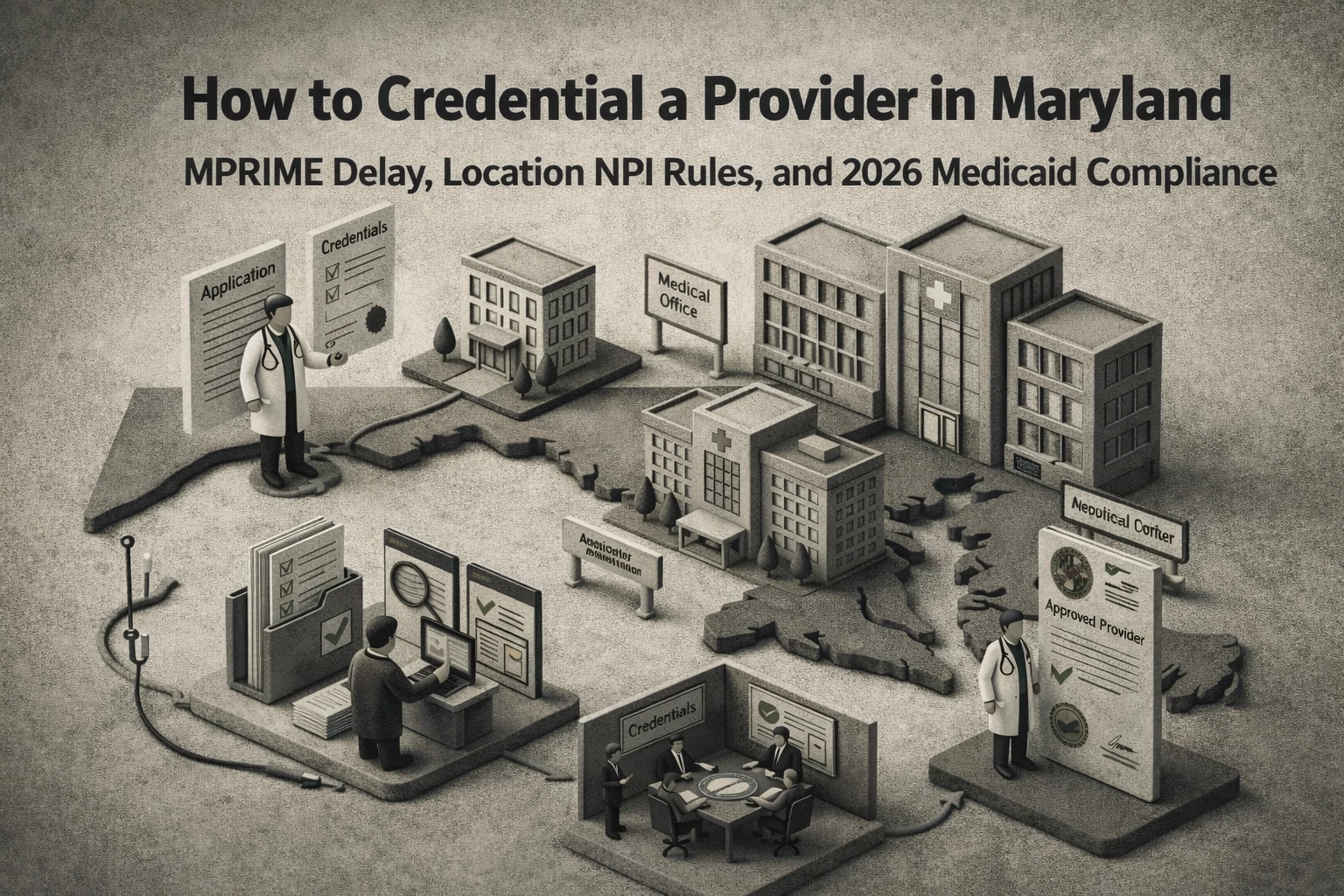
How to Credential a Provider in Maryland: MPRIME Delay, Location NPI Rules, and 2026 Medicaid Pressure

P89r2Ror7wX

Navigating the medical provider enrollment services market in Maryland requires an understanding of a landscape dominated by massive hospital systems and rigid state mandates. Whether you are an independent clinic or a multisite group, the behavioral health enrollment landscape in the Old Line State is especially unforgiving when you miss a portal rule, a location setup requirement, or a state processing standard. In Maryland, you are operating in the shadow of giants like Johns Hopkins, the University of Maryland Medical System (UMMS), and MedStar Health. To compete for talent and patient volume, your enrollment process must be faster, cleaner, and more compliant than the behemoths next door. Looking for professional provider credentialing services in the USA? 👉 Check our main service page here: veracityeg.com The Maryland Regulatory Fortress: Understanding COMAR In Maryland, the "rules of the road" are dictated by the Code of Maryland Regulations (COMAR). Specifically, COMAR 10.07.01.24 mandates that every hospital have a formal, written process for any physician who admits or treats patients. This isn't just a suggestion; it is a statutory requirement that sets the tone for the entire state. For private practices and multisite clinics, this means your internal standards must mirror the high bar set by hospital-owned practices. One of the most critical aspects of Maryland compliance is the Uniform Credentialing Form. Maryland law requires health insurance carriers to accept the Council for Affordable Quality Healthcare (CAQH) form as the sole uniform application. While this sounds like it should simplify your life, the reality is that the CAQH profile must be meticulously maintained. A single outdated attestation or an expired document in CAQH will trigger a cascade of denials across every major payer in the state, from CareFirst BlueCross BlueShield to UnitedHealthcare. Upstream Prerequisites: Licensing and the Maryland CDS You cannot hope to achieve timely enrollment if your upstream ducks are not in a row. Before a provider can even be considered for a payer network, their foundational credentials must be active and flawless. This starts with the Maryland Board of Physicians or the relevant board for mid-level providers and behavioral health professionals. In Maryland, the DEA number is only half of the equation for prescribing. You must also secure a Maryland Controlled Dangerous Substances (CDS) certificate. We often see practices stall for weeks because they secured the state license but forgot the CDS, or secured the CDS but didn't update the address to reflect the new practice location. At The Veracity Group, we treat licensing and DEA/CDS management as the essential first step in the provider enrollment process. If the upstream data is flawed, the downstream revenue is guaranteed to suffer. Image Description: A high-end, studio-lit portrait of a focused healthcare executive reviewing a digital compliance dashboard. The lighting is professional and sharp, emphasizing a clean, clinical environment. Navigating the Hospital Shadow: The Onboarding Churn Maryland has one of the highest densities of hospital-owned or hospital-affiliated practices in the country. This creates a hyper-competitive environment for providers. When you hire a new physician, they are likely coming from another large system or are being courted by one. The "hospital shadow" means that your onboarding process must be seamless to ensure the provider can start seeing patients and generating revenue on day one. Constant onboarding is the norm in Maryland, not the exception. For multisite clinics, the challenge is multiplied. Since 2025, Maryland requires a separate NPI setup for every practice location, which turns location management into a make-or-break operational issue rather than a clerical footnote. Each new site requires updated demographic information with every payer, and your data must match the location-level record exactly. If you are adding a provider to a group that has "admitting privileges" requirements, you must ensure their hospital affiliations are finalized before the payers will pull the trigger on their enrollment. In plain terms: if one location record is wrong, your entire launch schedule starts bleeding time. Medicare and Medicaid Enrollment for Behavioral Health Providers The Medicare and Medicaid enrollment for behavioral health providers in Maryland is a specific area of friction. Maryland’s Medicaid program, managed by the Maryland Department of Health (MDH), still uses ePREP as the main enrollment portal, and that remains true until the planned MPRIME transition in October 2026. If your team is acting like MPRIME is already live for standard workflows, you are setting yourself up for preventable delays. You must work the process that exists now, not the process people keep talking about for later. For reference, Maryland continues to route provider enrollment activity through its Medicaid administration channels, and official program information remains anchored through the state’s Maryland Department of Health and enrollment-facing resources. Behavioral health groups face even tighter pressure. Maryland maintains a behavioral health moratorium for PRP and Health Home enrollment through June 2026, which means expansion plans in those categories hit a hard wall unless and until the state reopens that pathway. That is not a minor footnote. It directly affects hiring models, launch timing, and revenue forecasting for psychiatry groups, LCSWs, PMHNPs, and multidisciplinary behavioral health organizations. Wait times for Maryland Medicaid can stretch for months if the initial application contains even a minor clerical error. That pressure is even sharper in 2026 because CMS has pushed a 30-day processing standard and a digital-only direction for enrollment workflows, raising the operational bar for how practices prepare and submit files. If your documents are incomplete, inconsistent, or trapped in an outdated paper-first process, you will lose time fast. This is where professional medical provider enrollment services become an essential partner. You cannot afford to have a licensed clinical social worker (LCSW) or a psychiatrist sitting idle because the state is kicking back a line item, a location mismatch, or a missing digital document. You must be proactive, aggressive, and precise in your submissions to the Maryland Department of Health and in your alignment with federal enrollment expectations through CMS. Image Description: A professional studio shot of a healthcare provider in a clean, white lab coat, looking confidently

How to Credential a Provider in Minnesota: Patience and Precision with the DHS

AvPtIp i0F1

Minnesota’s healthcare market is tightening, not loosening. With a massive push toward integrated health systems and a rapidly expanding behavioral health enrollment landscape, you now face a harder operating environment shaped by program integrity crackdowns, tighter federal standards, and longer payment risk for flagged services. To keep your revenue cycle moving, securing high-quality medical provider enrollment services and dedicated behavioral health provider enrollment support is not just an advantage: it is a survival strategy for growing clinics and multisite groups. Looking for professional provider credentialing services in the USA? 👉 Check our main service page here: veracityeg.com The Minnesota Landscape: Integrated Systems and BH Growth Minnesota is unique because of its high density of large, integrated delivery networks. Systems like Mayo Clinic, M Health Fairview, and Allina Health set a high standard for administrative precision. For smaller practices or expanding multisite groups, this means your enrollment data must be flawless to compete for space within the same payer networks. Furthermore, the state has seen an unprecedented explosion in behavioral health growth. As more clinics open to meet the mental health needs of the community, the behavioral health enrollment landscape has become increasingly crowded. This surge has put a significant strain on the Minnesota Department of Human Services (DHS), resulting in processing queues that can stall a provider’s start date by months if the initial application isn't perfect. Image Description: A minimalist, earth-tone overhead shot of a clean wooden desk with a single ceramic mug and a high-end notebook. The lighting is soft and natural, emphasizing a calm and organized professional atmosphere. The "Upstream" Essentials: Licensing and DEA Before you even look at a payer application in Minnesota, you must address the upstream licensing and DEA requirements. You cannot enroll a provider who does not have a valid Minnesota Board of Medical Practice (or relevant board) license in hand. At The Veracity Group, we emphasize that enrollment is the final stage of a much longer journey. If your licensing process is lagging, your enrollment is dead on arrival. We track the expiration dates and application statuses of state licenses and DEA registrations with the same intensity that we track payer approvals. For behavioral health providers, ensuring the correct licensure (such as LICSW, LPCC, or LMFT) is verified early is critical to avoiding immediate rejections from the DHS. Navigating the Minnesota Credentialing Collaborative (MCC) Minnesota was a pioneer in streamlining the administrative burden through the Minnesota Credentialing Collaborative (MCC). The MCC uses the ApplySmart system, a centralized hub where providers can submit their data once and distribute it to multiple health plans, including Blue Cross and Blue Shield of Minnesota, HealthPartners, and Medica. While the MCC is designed to simplify your life, it is not a "set it and forget it" tool. Precision is mandatory. A single typo in an NPI number or a missing signature on an electronic form can halt the entire distribution process. Our team at Veracity ensures that every data point in the MCC is cross-referenced with your CAQH profile to maintain total data integrity. 1. The DHS and MHCP: A Test of Patience Under New Integrity Pressure If your practice sees patients covered by Minnesota Health Care Programs (MHCP), you will deal directly with the DHS. This is where Minnesota has become far less forgiving. The state continues to use the Minnesota Provider Screening and Enrollment (MPSE) portal, but the bigger story is the compliance environment surrounding that portal. Key hurdles in the MHCP enrollment process now include: Enrollment freeze on 13 high-risk categories through 2026: Minnesota has extended an enrollment moratorium on selected high-risk provider and service categories, including segments such as adult day services and certain residential or community-based program types. If your organization expands into one of these lines, your timeline is not just slow; your path may be blocked unless you qualify for a permitted exception. Optum pre-payment review pressure: Minnesota has expanded pre-payment review activity through Optum for selected high-risk services. That means claims can sit in review before money hits your account, and payment delays can stretch toward 90 days when documentation, site data, ownership details, or service records do not line up cleanly. Stricter screening tied to federal funding pressure: Minnesota’s heightened program integrity posture follows a period of intense scrutiny tied to a roughly $2 billion federal funding withhold dispute, which pushed the state to tighten oversight, documentation controls, and risk-based monitoring. CMS 2026 processing and digital expectations: CMS has continued pressing states toward faster, more standardized processing, including a 30-day benchmark for cleaner digital workflows and stronger movement toward electronic submission and maintenance rather than paper-first processes. In practical terms, your team must treat digital file accuracy as non-negotiable. Site-level validation still matters: Certain high-risk provider types remain subject to site review, ownership verification, and enhanced screening before approval or continued participation. What this means for your practice If you are opening, adding locations, or onboarding providers in Minnesota, you must work backwards from the compliance risk: High-risk service lines require a go/no-go check before application work starts Ownership, address, licensure, and service-location records must match across every system Claims readiness must be built alongside enrollment readiness Any missing field will delay approval and can also delay payment after approval The cost of a delay with the DHS is high. In a state with major Medicaid and MinnesotaCare participation, being out-of-network or stuck in review for even 30 days can result in serious revenue disruption. A 90-day pre-payment hold is worse: it turns your receivables into wet concrete. They are there, but they do not move. This is exactly why why behavioral health provider enrollment is so hard often comes down to state-specific controls that demand constant monitoring. Image Description: A gritty, professional visual with concrete textures, muted gray tones, and structured paperwork motifs that reflect Minnesota’s stricter MHCP screening environment and operational pressure. Downstream Impact: Contracting and Renegotiation Enrollment is not the finish line; it is the starting block. Once a provider is successfully loaded into

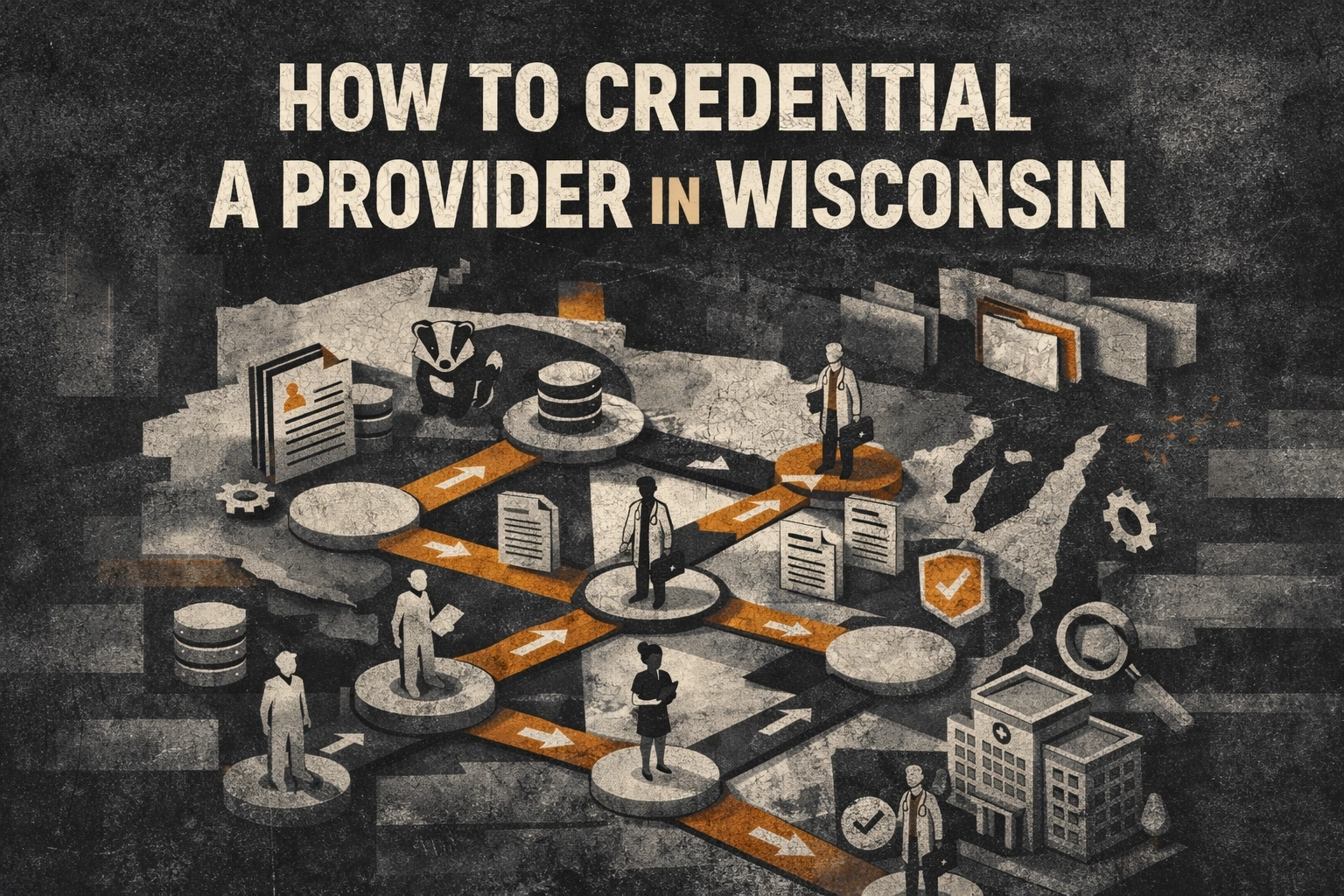
How to Credential a Provider in Wisconsin: Streamlining the Badger State Workflow

K2aBtWm1FLn

Navigating the healthcare landscape in Wisconsin requires more than just clinical expertise; it demands a sophisticated command of medical provider enrollment services to keep your revenue moving without interruption. Whether you are managing a mid-sized multisite group in Milwaukee or expanding a specialized clinic in Madison, the complexity of Medicare and Medicaid enrollment for behavioral health providers and specialists creates real friction. In the Badger State, where payer processes shift and documentation rules stay unforgiving, a passive approach to enrollment creates denials, delays, and preventable cash-flow damage. Looking for professional provider credentialing services in the USA? 👉 Check our main service page here: veracityeg.com The Upstream Foundation: Licensing and DEA Before you even look at a payer application, you must secure the foundation. In Wisconsin, the path to successful enrollment starts upstream with meticulous attention to state-specific licensing and DEA registrations. A provider cannot legally practice or bill until the Wisconsin Department of Safety and Professional Services (DSPS) has issued the appropriate physician license through LicensE, the agency’s online application portal. Veracity manages this critical first step by ensuring all primary source verification is completed long before the payer sees the file. This includes the mandatory Wisconsin DEA certificate, which must reflect a Wisconsin-based practice address. Without these "passports to practice," your enrollment timeline will stall indefinitely. We treat these administrative prerequisites as the backbone of your professional credibility, clearing the way for the downstream enrollment activities that follow. Fact-Check: The Wisconsin 2026 Licensing Guardrails Wisconsin’s physician licensing rules are not a vibe-based exercise. They are statutory guardrails, and if your file misses one, your enrollment plan will skid into a ditch. Here are the points your team must get right: For full MD/DO licensure, Wisconsin requires 24 months of postgraduate training in an ACGME- or AOA-approved program under Wis. Stat. § 448.05(2)(a)2.a. If your onboarding checklist still says one year, it is outdated. Wisconsin also recognizes an Administrative Physician License under Wis. Stat. § 448.05(2c) for physicians who are functioning in administrative roles and not seeing patients. That distinction matters when you are onboarding executives, medical directors, or physician leaders whose role does not include clinical encounters. The state’s International Physician Provisional License under Wis. Stat. § 448.05(2m) is a separate pathway for qualifying internationally trained physicians. It requires an employment offer in Wisconsin, at least 5 years of practice in the physician’s home country, and it can convert to a full license after 3 years of successful practice in Wisconsin. This is not a loophole. It is a defined statutory lane. The Visiting Physician route is also narrower than many teams assume. Under Wis. Stat. § 448.05(2)(e)3, the applicant must provide proof that they teach, research, or practice medicine or surgery outside Wisconsin. In plain English: DSPS wants evidence that the physician is genuinely visiting, not quietly relocating through the side door. The physician renewal date is October 31 of every odd-numbered year under Wis. Stat. § 440.08(2). Miss that deadline and your enrollment timeline stops being a workflow problem and starts becoming a revenue problem. If you want the official front door, DSPS maintains physician licensing information on its Physician page and processes applications through LicensE. In Wisconsin, the licensing file is the first domino. If it falls late, everything behind it falls late too. 1. Navigating the ForwardHealth Portal: The 10-Day Clock and the 2025 LTC Deadline The Wisconsin Medicaid program, known as ForwardHealth, stays rigid about application timing. Once you initiate an enrollment application in the ForwardHealth Portal, you have exactly 10 calendar days to complete and submit it. If you miss that window, the system purges the data and you start over. That timing pressure matters even more for adult long-term care and HCBS providers. Wisconsin guidance requires affected LTC waiver and HCBS providers to enroll or revalidate in ForwardHealth by December 31, 2025 to stay on track for continued reimbursement, with state communications warning that missing the deadline creates serious payment disruption for services tied to those programs. For practices serving Family Care, IRIS, PACE, or related waiver populations, this is not background noise. It is an operational deadline that will make or break continuity. This ticking-clock scenario is where internal teams lose momentum. At Veracity, we stage every document before the first click in the portal, from the NPI to the professional liability certificate to service-location data and ownership records. Because ForwardHealth acts as a gateway for multiple state-funded programs, one avoidable mistake will ripple across your payer mix and stall revenue at the exact moment you need providers active. Alt: A sleek, holographic digital interface displaying a countdown clock and medical data streams, representing the high-tech precision required for Wisconsin ForwardHealth enrollment. 2. Managing the Multisite Group Complexity Wisconsin is seeing a massive surge in mid-sized multisite groups, particularly in the primary care and urgent care sectors. For these organizations, managing 50 or 100 providers across ten different locations creates a logistical nightmare. The risk of provider churn is high, and the administrative burden of tracking revalidation cycles: which commonly hit on a 36-month cadence in Medicaid workflows: is immense. We solve this through the strategic implementation of monday.com. By using high-transparency project boards, Veracity gives your leadership team a real-time view of every provider’s status. You will not be left guessing whether a provider is active in Green Bay but still pending in Waukesha. That visibility now matters even more for Physician Assistants. Wisconsin ForwardHealth announced that starting June 1, 2025, enrolled PAs can bill as separate providers, which changes how many groups must structure enrollment records, demographic updates, and claim workflows. If your team still treats Wisconsin PA setup like the old rendering-only model, your file structure and billing readiness will break at the exact point revenue should start. This is especially important for primary care, urgent care, surgical, and multispecialty groups that rely on PA productivity across multiple service sites. This level of transparency is the silent driver of operational efficiency. It lets you schedule patients with

How to Credential a Provider in Massachusetts: Navigating the Bay State Complexity

UPelOgtHwyZ

Navigating the Massachusetts healthcare market requires more than just clinical expertise; it demands a sophisticated approach to medical provider enrollment services. In a state defined by prestigious academic medical centers and a rapidly shifting behavioral health enrollment landscape, staying ahead of payer requirements is the difference between a thriving practice and a mounting pile of uncompensated care. Massachusetts is notoriously complex, characterized by a dense concentration of providers, aggressive payer gatekeeping, and a regulatory environment that leaves no room for administrative error. If you are operating a multi-site group or a specialized clinic in the Bay State, you are already aware that the "standard" 90-day window is often a myth. Between the intricacies of MassHealth and the dominant market share of Blue Cross Blue Shield of Massachusetts (BCBS MA), your administrative team must be prepared for a marathon, not a sprint. At The Veracity Group, we treat enrollment as a strategic pillar of your revenue cycle, ensuring that your providers are not just licensed, but fully integrated into the payer networks that drive your business. Looking for professional provider credentialing services in the USA? 👉 Check our main service page here: veracityeg.com The Massachusetts Framework: HCAS and the IMA Massachusetts utilizes a centralized system designed to streamline the process, but centralized does not always mean simple. HealthCare Administrative Solutions (HCAS) serves as the hub for many of the state’s largest payers. For providers based within the Commonwealth, the Integrated Massachusetts Application (IMA) is the mandatory vehicle for data submission. While the IMA is intended to reduce redundancy, the sheer volume of data required is staggering. Payers like Tufts Health Plan, Harvard Pilgrim (Point32Health), and Fallon Health all pull from this data, yet each maintains its own internal vetting nuances. If your internal team treats the IMA as a "set it and forget it" task, you will face delays. You must actively manage the transition from the IMA submission to the individual payer’s secondary review. As of 2026, the pressure on that handoff is higher. CMS is enforcing faster processing expectations, including a 30-day standard in key enrollment workflows, while pushing providers toward digital-first submission through PECOS and related electronic channels. In plain English: paper-heavy habits slow you down, and incomplete digital files will jam the whole machine. Alt Text: A grainy, high-contrast 90s editorial style photograph of a medical professional reviewing a thick stack of documents under a bright, moody desk lamp, emphasizing the weight of regulatory compliance. Upstream Essentials: Licensure and the MCSR Before you even consider behavioral health provider enrollment, your "upstream" credentials must be impeccable. In Massachusetts, this begins with the Board of Registration in Medicine (BORIM). The licensure process in the Bay State is one of the most rigorous in the country, often requiring extensive primary source verification that can take months. Furthermore, Massachusetts requires a state-specific Massachusetts Controlled Substances Registration (MCSR) in addition to the federal DEA certificate. We frequently see practices stall because they secured the federal DEA but neglected the MCSR, or vice versa. The Veracity Group manages these licensing requirements as a prerequisite to enrollment, ensuring that when the application hits the payer's desk, there are zero "missing document" triggers to reset your timeline. Navigating the MassHealth Maze For those involved in Medicare and Medicaid enrollment for behavioral health providers, MassHealth represents the most significant administrative hurdle. Massachusetts has moved toward a highly regionalized Medicaid model, involving Accountable Care Organizations (ACOs) and Managed Care Organizations (MCOs) that each have distinct enrollment protocols. Strict Documentation: MassHealth requires a Provider Contract and a specialized Data Collection Form that must match your NPI registry and PECOS data exactly. The Behavioral Health Carve-Out: Many behavioral health services are managed through the Massachusetts Behavioral Health Partnership (MBHP). Navigating the intersection of standard MassHealth and MBHP requires a specialized understanding of which codes are covered under which umbrella. High Churn Risks: Massachusetts sees significant provider movement due to the high density of residency and fellowship programs. This "churn" means your enrollment team must be in a constant state of motion to prevent gaps in coverage as providers move between groups. SCO Eligibility Shift for 2026: Effective January 1, 2026, Senior Care Options (SCO) enrollment requires members to have Medicare Part A and Part B. If your practice serves older adults and dual-eligible populations, your front-end eligibility workflow must reflect that change immediately. If you miss it, your billing team inherits the mess. Tighter PA Timelines: Effective January 1, 2026, MassHealth applies 7 calendar days for standard prior authorization requests and 72 hours for expedited requests for the medical benefit under updated interoperability rules. That sounds provider-friendly, but only if your submissions are complete on day one. Stricter Encounter Data Rules: For the 2025–2026 cycle, encounter reporting is under tighter scrutiny. 10-digit NPIs and accurate taxonomy reporting are now non-negotiable data points in managed care submission workflows. When those fields do not reconcile cleanly, denials, rejections, and downstream payment friction follow fast. Alt Text: A bold, grainy 90s magazine-style shot of a busy Boston street corner with a medical building in the background, captured with a wide-angle lens and saturated colors to represent the fast-paced provider churn. Transparency Through Technology: The monday.com Advantage The biggest frustration for CEOs and Owners is the "black hole" of enrollment. You submit an application, and then you wait weeks for an update that never comes. The Veracity Group eliminates this opacity by utilizing monday.com as our primary project management engine. Every client we partner with gains access to a live, transparent board where every provider’s status is tracked in real-time. You don’t have to call us to ask if the BCBS MA application was received; you can see the timestamp of the submission, the name of the representative we spoke with, and the projected "go-live" date. This level of provider enrollment transparency is essential for multi-site groups in Massachusetts where a single missing credential can stall a whole department's revenue. The Cost of High Provider Churn Massachusetts is a hub for medical