How to credential a provider in Oklahoma: SoonerCare Medicaid and rural health expansion

Oklahoma is currently at the center of a rural healthcare renaissance, but for many practices, the administrative hurdle of entering this market feels more like a roadblock than a gateway. Navigating provider enrollment services in the Sooner State has evolved rapidly since the full implementation of SoonerSelect, and securing the right credentialing services usa is now the primary factor determining whether your practice thrives in the new Medicaid landscape or gets buried under a mountain of denied claims. As of April 2026, the shift toward a managed care model has fundamentally altered the timeline and requirements for every provider in Oklahoma, specifically those looking to bridge the rural health gaps that have long plagued the state’s interior. Looking for professional provider credentialing services in the USA? 👉 Check our main service page here: veracityeg.com The SoonerSelect Landscape: A New Era for Oklahoma Medicaid The transition from a traditional fee-for-service model to the SoonerSelect managed care organization (MCO) structure represents the most significant overhaul in Oklahoma healthcare history. For providers, this means you are no longer just dealing with the Oklahoma Health Care Authority (OHCA) in a vacuum. You must now navigate the specific requirements of the three major MCOs that have taken the reigns: Aetna Better Health of Oklahoma, Humana Healthy Horizons, and Oklahoma Complete Health. This shift was designed to improve health outcomes through better care coordination, but the administrative reality is complex. Each MCO has its own readiness review process. If your practice hasn't cleared these reviews with surgical precision, you are effectively locked out of the SoonerCare network. The "wait and see" approach is a recipe for financial disaster. In 2026, the backbone of professional credibility for an Oklahoma provider is a seamless integration into these MCO networks. Bridging the Gap: The Rural Health Transformation Program (RHTP) Oklahoma has long struggled with "healthcare deserts," particularly in its western and southeastern quadrants. To combat this, the state launched the Rural Health Transformation Program (RHTP), backed by $223.5 million in year-one funding. This isn't just a subsidy; it is a targeted investment in rural system capacity. The RHTP is designed to support workforce development, technology, and innovation for rural hospitals and clinics. It is not structured as funding for direct patient care. For providers, that distinction matters. The opportunity sits in building operational strength, expanding infrastructure, and improving access tools such as telehealth. Participation in RHTP initiatives requires organizational readiness and alignment with state processes, which makes accurate Medicaid enrollment essential for most rural providers. The Directed-Payment Model: Why Now is the Time to Join One of the most talked-about features of the current Oklahoma Medicaid environment is the directed-payment model. Traditionally, Medicaid rates lagged significantly behind commercial insurance, making it difficult for hospitals and health systems to sustain broad access for SoonerCare patients. In Oklahoma, this directed-payment approach is specifically tied to hospital supplemental payments designed to help bridge funding gaps. Directed-payment models in Oklahoma aim to bring Medicaid reimbursement closer to commercial levels, with some hospital programs approaching higher benchmark percentages. That is an important distinction. This is not the same as the state's separate $100 million annual provider incentive program, which focuses on performance areas such as primary care access, well-visits, and behavioral health screenings. The directed payments and the incentive program serve different functions inside the broader SoonerSelect model. For practices entering the market, this matters because the payment environment is being reshaped in multiple lanes at once. If you are not currently credentialed with SoonerSelect, you are stepping into a transition landscape without a clean operational footing. The High Cost of Delays: Payment Timelines and Revenue Risks While the new model offers better rates in some areas, it also came with a significant transition challenge: the "payment lag." In the old SoonerCare system, providers often pointed to a very fast 3-day payment cycle. During the SoonerSelect transition phase, some providers reported that payments stretched dramatically, in some cases to up to 2 months. Those reports are best understood as transition-period challenges, not a blanket permanent standard across all claims and all plans. Still, for a small rural clinic, even a temporary 60-day gap in cash flow creates real pressure. This is where the importance of "MCO readiness" becomes a survival issue. Any error in your initial enrollment application or a failure to link your CAQH profile correctly to the specific MCO will result in "pended" claims. In this environment, a pended claim doesn't just mean a delay; it means your overhead continues to mount while your revenue is frozen in an administrative loop. Step-by-Step: How to Credential in Oklahoma (2026 Update) To get your providers into the Oklahoma network efficiently, you must follow a rigid hierarchy of steps. Missing even one can reset your 60-to-90-day clock. Obtain an Oklahoma State License: This seems obvious, but with the increase in telehealth, ensuring your medical licensing is current and specific to Oklahoma is the first hurdle. OHCA Enrollment: Every provider must first be enrolled with the Oklahoma Health Care Authority. This is the foundation upon which all MCO contracts are built. Availity Registration: For SoonerSelect, Availity is a central platform used by SoonerSelect plans for credentialing data exchange and administrative workflows. You must ensure your data is scrubbed and accurate here before the MCOs pull your file. MCO Contracting: You must individually contract with Aetna Better Health, Humana Healthy Horizons, and Oklahoma Complete Health. Each has its own contracting nuances and specific addendums for rural health providers. Site Visits and Screenings: Federal law requires certain provider types to undergo on-site screening. In Oklahoma, the OHCA conducts these for providers who haven't been screened by other federal agencies. If you are a high-risk provider type, this is often where the credentialing delays occur. The Veracity Take: Why Professional Intervention is Mandatory At The Veracity Group, we see the "SoonerSelect transition" as a double-edged sword. On one hand, the $223.5 million year-one RHTP funding for workforce, technology, and innovation makes Oklahoma one of the most closely watched
How to Credential a Provider in Utah: Fast-Growth Market and CHIP/Medicaid Rules

Utah is currently witnessing a healthcare metamorphosis that most expansion leads only dream of. Navigating provider enrollment in the Beehive State requires a sophisticated understanding of a market where a significant share of Utah’s population—around 1 in 6—relies on Medicaid or CHIP. For any organization looking to scale, efficient medical group enrollment is the primary lever for capturing this expanding patient base. At The Veracity Group, we see Utah as a blueprint for the future of healthcare administration: a state that has traded 40-year-old legacy systems for a modernized, high-velocity infrastructure. Looking for professional provider credentialing services in the USA? 👉 Check our main service page here: veracityeg.com The PRISM Advantage: Speed as a Competitive Weapon For decades, the administrative burden of Medicaid enrollment was a primary bottleneck for practice growth. In Utah, that bottleneck has been shattered by the PRISM (Provider Enrollment, Registries, and Individualized Support Management) system. This isn't just a minor software update; it is a total overhaul of the state's healthcare data architecture. The most striking feature of PRISM is its speed. Under the old legacy framework, simple demographic updates or enrollment changes could languish for weeks or months. Today, in our experience, PRISM processes many enrollment changes in just a few days. This rapid turnaround is a massive win for practice speed and revenue cycle stability. When your medical group adds a new provider, you are no longer waiting for a black box to eventually spit out an approval. You are engaging with a system designed for high stability and low downtime, ensuring that your applications move through the pipeline without the technical glitches that plague other state portals. Alt text: A digital dashboard representing Utah's PRISM system showing rapid provider processing times and high system stability. This transition away from 40-year-old legacy systems is not just about convenience; it is about operational agility. If your credentialing manager is still treating Utah like a slow-moving bureaucracy, you are leaving revenue on the table. The efficiency of PRISM means you can move from hiring to billing in a fraction of the time required in neighboring states. Navigating Fast-Growth Dynamics in the Utah Market Utah’s population is growing at a rate that consistently outpaces the national average. This demographic shift is accompanied by a significant expansion in the Medicaid and CHIP (Children’s Health Insurance Program) populations. As a medical group expansion lead, you must recognize that 1 in 6 Utahns are on Medicaid. This is no longer a niche payer segment; it is a core pillar of a sustainable patient volume strategy. The demand for services is surging, but the supply of providers must be onboarded with equal speed. Agility is the new currency in the Utah market. If your provider enrollment process is sluggish, you are effectively turning away a massive portion of the market. To succeed here, your organization must adopt an agile onboarding strategy that leverages Utah’s modernized tools to keep pace with the state's growth. Why Agile Onboarding Matters Market Capture: In a fast-growing environment, the first group to provide access wins the patient loyalty. Revenue Realization: Faster enrollment means shorter "lag time" between a provider's start date and their first reimbursable claim. Recruitment Advantage: Providers want to work for groups that have their administrative act together. A seamless enrollment experience is a powerful recruiting tool. CHIP and Medicaid Rules: The Continuous Coverage Shift One of the most critical nuances in Utah's current landscape is the shift toward continuous coverage. Historically, Medicaid and CHIP beneficiaries faced frequent "churn," where small fluctuations in income or administrative hurdles led to temporary losses in coverage. This was a nightmare for providers, leading to denied claims and interrupted care. Utah has moved toward smoother transitions between Medicaid, CHIP, and Marketplace coverage, aiming to reduce churn. This policy shift ensures that patients remain covered even as their eligibility status fluctuates. For your practice, this means more consistent reimbursement and fewer billing "surprises." You can learn more about how these shifts affect broader strategies in our Mastering Multi-State Medicaid Provider Enrollment guide. Understanding CHIP Continuity The Children’s Health Insurance Program in Utah is tightly integrated with the Medicaid infrastructure. When credentialing a provider, you are not just enrolling them in a plan; you are placing them into an ecosystem designed for patient retention. The Utah Department of Health and Human Services emphasizes that maintaining a provider’s active status in PRISM is essential to treating this population without interruption. If a provider's enrollment lapses, the "continuous" nature of the coverage doesn't help you: the claim will still be rejected. Alt text: A flowchart illustrating the seamless transition of a patient between Utah Medicaid and CHIP coverage, highlighting the importance of continuous provider enrollment. The Strategic Advantage Utah’s modern infrastructure makes it easier for the state to align provider data with broader access and outcome goals. This means the data you provide during the enrollment phase is increasingly used to measure network adequacy and access to care in real-time. By maintaining high standards of data integrity in your services and enrollment submissions, your medical group positions itself as a high-value partner to the state. This is a strategic advantage that goes beyond simple billing. It places your group at the forefront of value-based care initiatives. Tactical Execution: Getting Enrolled in Utah To navigate this market effectively, your team must master the technical requirements of the PRISM portal. This is not a process you can "wing." 1. The Utah-ID Prerequisite Before you even touch PRISM, every provider and administrative user must have a Utah-ID Account. This is the gateway to all state digital services. Security is tight, and the authentication process is rigorous. Do not wait until a provider’s start date to initiate this. 2. The PRISM Portal Submission Once the Utah-ID is active, you enter the PRISM portal. This system requires detailed information regarding provider specialties, locations, and affiliations. Because the system is so stable and modernized, it will flag errors immediately. While this might feel frustrating, it is actually
Credentialing in Missouri: Medicaid Managed Care and Closing Rural Health Gaps

Missouri is currently navigating a pivotal shift in its healthcare landscape. Missouri has been awarded $216M in Year 1 Rural Health Transformation funding as part of a 2026–2030 federal initiative. For clinics and health systems to survive this transition, securing top-tier medical provider enrollment services is no longer optional. As a premier provider of provider credentialing services in the usa, The Veracity Group sees firsthand how administrative readiness dictates financial solvency. This isn't just about paperwork; it's about the survival of rural access points across the Show-Me State. Looking for professional provider credentialing services in the USA? 👉 Check our main service page here: veracityeg.com The $216M Transformation: A New Era for Missouri Health By 2026, Missouri has moved from planning into active rollout of its Rural Health Transformation initiative. This massive investment aims to stabilize a system that has historically struggled with hospital closures and provider shortages. The state has committed to launching 30 community health hubs strategically placed to serve the most vulnerable populations. These hubs are the backbone of professional credibility for the region. However, a hub is only as effective as its enrolled providers. If a clinic is part of this $216M rollout but fails to manage its enrollment, it cannot draw down the federal and state funds allocated for its operation. This creates a "funding ghost" where a facility exists on paper but remains financially paralyzed. For providers operating near our home base in Arkansas, the cross-border implications are significant. Missouri’s reform mimics many of the regional shifts we see in the Ozarks, requiring a sophisticated approach to mastering multi-state medicaid provider enrollment. The ToRCH Model: Transforming Rural Community Health At the center of Missouri’s strategy is the ToRCH (Transformation of Rural Community Health) model. ToRCH moves beyond traditional fee-for-service by emphasizing integrated care and payment reform. It combines primary care, behavioral health, and social determinants of health into a single delivery stream. For a provider to participate in ToRCH, their enrollment status must be impeccable. The model relies on a "hub-and-spoke" architecture. If the primary hub encounters an enrollment lapse, every "spoke" (specialist or satellite clinic) associated with that hub faces reimbursement delays. Key Technical Requirements for ToRCH Participation: NPI Alignment: Ensuring every provider's National Provider Identifier is correctly linked to the specific rural health hub taxonomy. State-Specific Licensure: For behavioral health providers, such as LCSWs and LPCs, Missouri requires strict adherence to MO HealthNet’s specialized enrollment categories. Site Visit Compliance: Rural community hubs often trigger mandatory site visits under Medicaid managed care regulations. Failure to prepare for these is a fast track to application denial. MO HealthNet and the Shift to Outcome-Based Payments Missouri’s Medicaid program, MO HealthNet, is no longer just paying for volume. MO HealthNet is incorporating more outcome-based elements into managed care contracts. This means your reimbursement is tied to patient health metrics and quality of care. However, there is a catch: you cannot report outcomes if you aren't enrolled in the system correctly. Managed Care Organizations (MCOs) like Healthy Blue, Home State Health, and UnitedHealthcare Community Plan use automated systems to filter claims. If a provider's data in the MMAC (Missouri Medicaid Audit & Compliance) system is even slightly outdated, the claim is rejected before the "outcome" is even measured. The high cost of delays in this environment is staggering. In a cut environment, providers with incomplete or inaccurate enrollment are especially vulnerable to revenue loss. They lack the administrative "passport" needed to access the remaining pools of incentive funding. Closing the 'Medical Provider Enrollment Services' Gap The most significant threat to Missouri’s rural health recovery is the administrative gap. While the state is building the buildings and buying the equipment, many clinics are neglecting the "silent driver" of their revenue cycle: the enrollment of their staff. Rural clinics often lack the dedicated HR or credentialing staff found in large urban systems like those in St. Louis or Kansas City. This results in: Expired CAQH Profiles: Which can lead to claim holds, network issues, or de-facto loss of active status with some MCOs. Mismanaged Demographic Updates: If a clinic moves or adds a new telehealth service, failing to update this via demographic updates can stop payments for months. Missed Incentive Programs: Missouri offers specific financial bonuses for providers meeting rural health targets. These are only available to those whose enrollment files are 100% compliant. At The Veracity Group, we advocate for a proactive stance. You must treat your enrollment as a critical asset, not a secondary chore. Navigating Medicaid Managed Care Contracts To participate in the MO HealthNet network, you must navigate periodic re-enrollment and revalidation cycles. According to the Missouri Department of Social Services, failing to respond to a re-validation request within the stated deadline can result in suspension of the provider’s Medicaid ID. For multi-state groups, this is even more complex. A provider practicing in both Arkansas and Missouri must maintain two distinct sets of state-specific enrollment requirements, even if the MCO (like UnitedHealthcare) is the same in both states. Common Pitfalls in Missouri Medicaid Enrollment: Incomplete Disclosure of Ownership: Missouri is aggressive in auditing the ownership interest of medical groups to prevent fraud. Mismatched Taxonomy Codes: A rural health clinic (RHC) must use specific billing codes that differ from standard private practices. Delayed DEA Updates: For providers prescribing controlled substances in rural areas, any delay in linking a new DEA certificate to the MO HealthNet profile will result in rejected pharmacy claims for their patients. Why Accuracy is the Backbone of Rural Health The $216M grant is a ticking clock. These funds are designed to build a self-sustaining system by 2030. If your clinic or practice is not fully enrolled and optimized by then, you will find yourself on the outside of a closed system. Accurate enrollment is the only way to ensure your participation in state provider incentive programs. These programs are designed to reward providers who stay in rural areas, but they require rigorous data validation. If the state cannot verify your hours,
Credentialing in Ohio: Navigating ODM and Medicaid Complexity in 2026

Ohio’s healthcare landscape is undergoing its most significant transformation in a decade. As of April 2026, navigating the medical provider enrollment services landscape requires more than just administrative diligence; it demands a strategic mastery of the Ohio Department of Medicaid (ODM) ecosystem. For practices eyeing expansion, particularly those moving between Indiana and Ohio, understanding multi-state Medicaid provider enrollment is the only way to safeguard your revenue stream and ensure uninterrupted patient care. Looking for professional provider credentialing services in the USA? 👉 Check our main service page here: veracityeg.com The 2026 Landscape: Next Generation MyCare Rollout January 1, 2026, marked a pivotal shift for Ohio healthcare with the full implementation of the Next Generation MyCare program. This initiative isn't just a minor update; it is a complete overhaul of how managed care is coordinated for Ohioans. For your practice, this means the days of juggling disparate requirements for multiple Managed Care Organizations (MCOs) are over, but the stakes for accuracy have never been higher. The Next Generation MyCare program is designed to streamline the member experience, but the backend complexity for providers is immense. If your data is not perfectly synchronized within the state’s repository, you are effectively invisible to the network. This rollout emphasizes a holistic approach to patient care, but it relies entirely on the centralized credentialing framework that ODM has spent years perfecting. Failure to adapt to this new model results in immediate administrative friction and delayed reimbursements. The "One Front Door": PNM and OMES The backbone of Ohio’s modern system is the Provider Network Management (PNM) portal, which serves as the "one front door" to the Ohio Medicaid Enterprise System (OMES). This centralized system replaced the aging MITS portal, and in 2026, it is the absolute authority for provider data in the state. When you utilize the PNM portal, you are entering a high-stakes digital environment. This system is designed to feed accurate data to all MCOs simultaneously. However, this "single source of truth" means that a single error in your PNM profile propagates across every payer in the state. The Veracity Group specializes in managing this "front door" entry, ensuring that every field: from NPI numbers to service locations: is validated before submission. The High Cost of EDI Rejections: 824 and 277CA In the current 2026 environment, technical proficiency is just as important as clinical excellence. The integration of OMES has introduced a rigorous validation process for electronic data interchange (EDI). If your provider data in the PNM portal does not match your claims data exactly, the system will trigger 824 Application Advice denials or 277CA Claim Acknowledgment rejections. 824 Denials: These indicate that while the system received your transaction, it found errors that prevent it from being processed. This is often the result of mismatched provider IDs or outdated demographic information. 277CA Rejections: These are even more critical, as they represent a rejection at the clearinghouse or payer gateway level. If your provider setup isn't finalized in the PNM, your claims won't even make it to the adjudication phase. These rejections are the silent killers of practice cash flow. They don't just delay payment; they create an administrative loop that can take weeks to resolve. Working with an expert partner to manage your provider enrollment ensures that these technical hurdles are cleared before the first claim is ever sent. Centralized Credentialing: A Strategic Mandate Ohio has successfully transitioned to a centralized credentialing model. This means that providers no longer need to submit separate applications to every MCO they wish to join. You verify your credentials once with ODM, and that information is shared across the board. While this sounds simpler, it places an enormous burden on the initial application and maintenance. The CAQH ProView portal remains a critical component of this process. In 2026, ODM requires that providers attest to their CAQH profile every 120 days. If your attestation lapses, or if there is a discrepancy between your CAQH data and your PNM profile, your "One Front Door" access will be restricted. Maintaining this synchronicity is a full-time job. For groups managing multiple practitioners, the risk of one provider’s oversight causing a compliance risk for the entire facility is a reality you must address proactively. Navigating the Multi-State Expansion Ohio is a massive healthcare market, and for our partners in Indiana, it represents the most logical path for growth. However, the rules in Columbus are not the rules in Indianapolis. Ohio’s reliance on the OMES "One Front Door" is distinct from Indiana’s processes. Expanding your footprint requires a partner who understands the nuances of multi-state Medicaid provider enrollment. The Veracity Group acts as the bridge for clinics moving across state lines. We ensure that your group’s tax ID is recognized, your providers are linked correctly to your new Ohio locations, and your contracting is handled with the precision required to avoid the 277CA rejections that plague unprepared practices. The Importance of PNM Data Integrity Data integrity in the PNM portal is not a "set it and forget it" task. In 2026, the ODM is performing more frequent audits of provider data. This includes: Service Location Accuracy: Ensuring that every site where a provider sees Medicaid patients is registered and active. License Verification: Automated checks against the Ohio eLicense portal. Insurance Coverage: Verifying that professional liability insurance meets the state-mandated minimums and is currently active. If any of these elements fail an automated check, the PNM system may move your status to "Pending" or "Suspended," leading to an immediate halt in claim payments. Proactive demographic updates are the only way to prevent these interruptions. Why The Veracity Group is Your Essential Partner The complexity of the Ohio Medicaid system in 2026 is designed to filter out providers who cannot maintain high administrative standards. For a growing clinic, this complexity is a barrier to entry. The Veracity Group removes that barrier. We provide the expertise needed to navigate the PNM portal, manage the CAQH lifecycle, and interpret the technical jargon of 824 and 277CA errors.
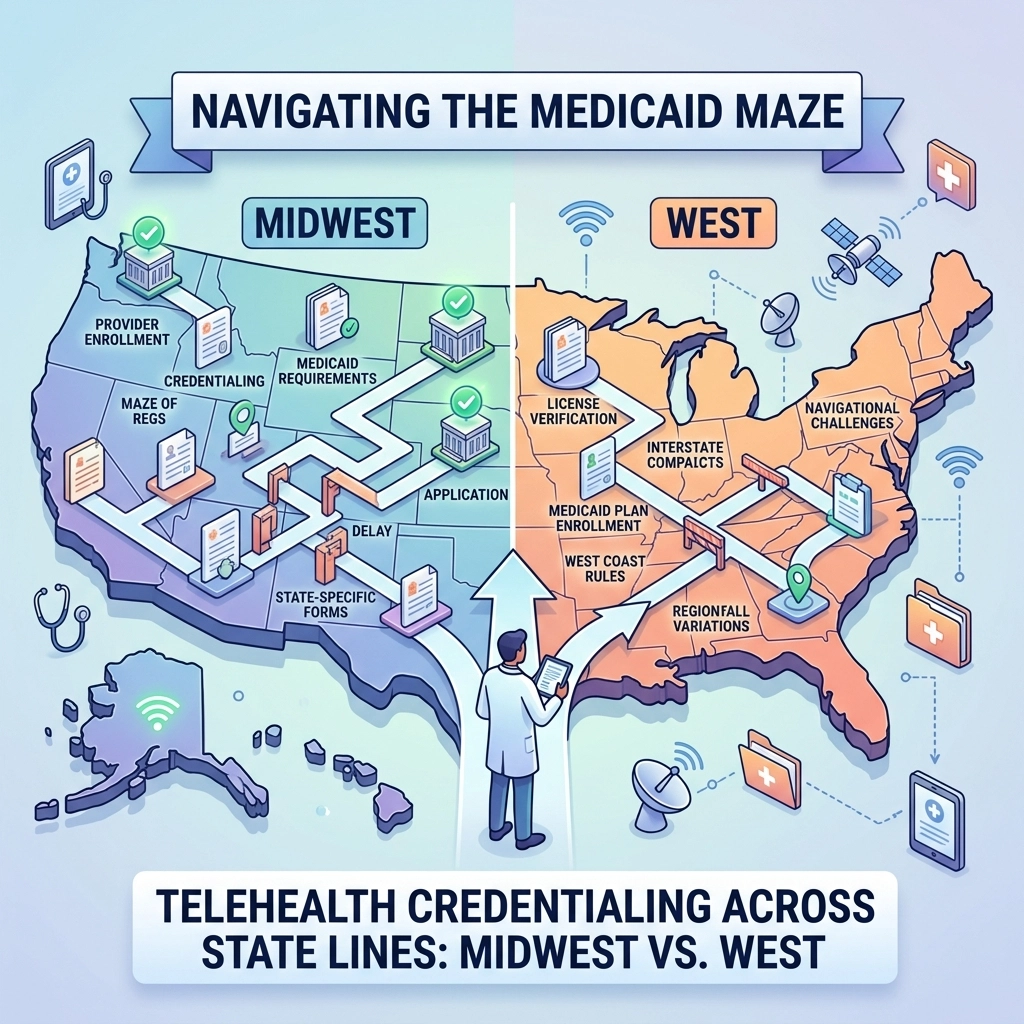
Telehealth Credentialing Across State Lines: Navigating the Midwest vs. West Medicaid Maze

Navigating medical provider enrollment services across state lines while building a reliable telehealth footprint feels like playing a high-stakes game of 5D chess. Your patients do not care about state borders. They care about access to care from their living rooms. But the moment those pixels cross a state line, you enter a regulatory minefield. If you think a single license is your "golden ticket" to a national telehealth model, you are in for a rude awakening. Medicaid programs in Indiana, Illinois, and Nevada are not just different; they are entirely different ecosystems with unique "gotchas" that will stall your revenue if you are not prepared. If your question is "Can I see Medicaid patients across state lines?" the answer is simple: yes, but only after you satisfy each state's licensing, enrollment, and verification rules. If your question is "How do I do it without delays?" the answer is even clearer: you need a state-by-state process that matches your provider type, service location, and payer requirements. Looking for professional provider credentialing services in the USA? 👉 Check our main service page here: veracityeg.com The Golden Rule of the Virtual Visit Before we dive into the regional trenches, let’s establish the foundational law of the land: The provider must be licensed in the state where the patient is physically located at the time of the encounter. This is non-negotiable. Whether you are treating a patient via a smartphone in a cornfield in Indiana or a high-rise in Las Vegas, your legal right to practice is dictated by the ground under the patient’s feet. Failing to secure the correct state-specific enrollment is the fastest way to trigger a claim denial or, worse, an OIG audit. While the Interstate Medical Licensure Compact (IMLC) offers a streamlined pathway for physicians, the Medicaid enrollment process remains a manual, state-by-state slog that requires precision and insider knowledge. Alt-tag: A map of the United States highlighting the Midwest and Western regions for telehealth expansion. 1. The Midwest vs. the West: Streamlining vs. Complexity For general provider enrollment services, the Indiana-Illinois-Nevada comparison tells you exactly what multi-state expansion looks like in practice. One state removes friction. One state slows you down with administrative precision. One state raises the verification bar for every applicant. If you are asking where enrollment is easiest, where it gets sticky, and where extra documentation is non-negotiable, this three-state comparison is the focal point. Indiana: The License-Only Advantage If you have not looked at Indiana lately, you are missing a rare win for administrative efficiency. As of July 1, 2024, Indiana officially removed the requirement for telehealth-specific certificates. That creates a cleaner path for physicians, advanced practice providers, therapists, and other eligible clinicians expanding telehealth services under Medicaid. This is the key Indiana takeaway: if you hold the proper Indiana license, you do not need a separate telehealth certificate to move forward. That is a real operational advantage for multi-state groups asking, "Can I enroll in Indiana without another telehealth approval layer?" The answer is yes, provided your license, ownership information, service location details, and enrollment file are complete. However, do not mistake "easier" for "automatic." You still must submit accurate provider data to the Indiana Health Coverage Programs (IHCP). A clean Indiana rule set does not forgive sloppy applications. Illinois: The Administrative Precision State Cross the border into Illinois, and the vibe shifts. Illinois is the state that forces you to respect process discipline. The core question here is not whether telehealth is possible. The real question is how cleanly your enrollment file matches across every data source. For most medical specialties, Illinois becomes difficult for three reasons: Application detail must align across systems. Provider records must match state and payer files exactly. Delays compound quickly when ownership, practice location, or rendering-provider data is inconsistent. Illinois Medicaid is notoriously meticulous. If your CAQH profile is not synchronized perfectly with your state application, your file will sit in "pending" purgatory for months. That problem is not specialty-specific. It affects primary care, specialty care, surgical groups, therapy practices, and multi-location organizations alike. 2. The West: The Land of Stringent Verification If the Midwest is characterized by shifting legislative sands, the West: specifically Nevada: is characterized by its rigorous verification walls. While Western states often have strong telehealth infrastructure, their "gatekeeper" mentality for Medicaid is significantly more intense than what you will find in the heartland. Nevada: The "Gotcha" State Nevada does not play games. If you are looking to expand your footprint here, prepare for a verification marathon. Nevada Medicaid requires more stringent primary source verification and provider qualification documentation than Indiana or Illinois for many enrollment scenarios. This is the big Nevada question: "Can I enroll as an out-of-state provider if I already bill Medicaid elsewhere?" Yes, but Nevada will still require its own documentation trail, validation standards, and closer review. That is the "gotcha" many groups miss. Prior enrollment success in another state does not buy you a shortcut in Nevada. Nevada is particularly focused on out-of-state telehealth providers. The state wants to confirm that you are not operating as a "ghost clinic" and that every provider meets Nevada-specific requirements for licensure, qualifications, service locations, and supporting records. For general medical provider enrollment services, that means your file must be audit-ready before submission, not cleaned up after the fact. Alt-tag: A comparison chart showing the different requirements for Medicaid enrollment in Indiana, Illinois, and Nevada. Comparing the "Gotchas" Feature Indiana Illinois Nevada Telehealth Certificate Removed (as of 7/1/2024); license-only path is the key advantage Not the main issue; administrative alignment is the real hurdle Stricter review depends on provider type and enrollment facts Verification Speed Moderate Slow and detail-heavy Very stringent and documentation-heavy Key "Gotcha" Valid state license is enough for the telehealth approval piece, but the enrollment file still must be complete Data mismatches stall applications fast High scrutiny on out-of-state providers and stronger primary source verification Enrollment Difficulty Lower Medium-High High 3. Can You Enroll in Multiple Medicaid States at
The Golden State Wall: Breaking Through Medicaid Provider Enrollment California

California’s healthcare landscape is a brutalist expanse, a monolithic structure where the barrier to entry is high and the margin for error is non-existent. Navigating Medicaid provider enrollment California is no longer a choice for organizations looking to capture a share of the nation’s largest state-funded market; it is a necessity that demands total operational alignment. Whether you are expanding from a base in Medicaid provider enrollment Texas or managing a nationwide footprint, the Golden State presents a regulatory wall that can either be scaled with precision or crashed against with devastating financial consequences. The Monolith: Understanding the Medi-Cal Scale California doesn't do things in half-measures. With over 15 million members, Medi-Cal is a titan. To provide services here, you aren't just filling out forms; you are entering a high-stakes ecosystem governed by the Department of Health Care Services (DHCS). The scale is so massive that the system itself feels industrial: cold, efficient when it works, and punishing when it doesn't. If you have navigated Medicaid provider enrollment Florida or Medicaid provider enrollment Ohio, you might think you understand the drill. You don't. California operates on a different frequency. The sheer volume of applications means that the DHCS does not have time for incomplete data or minor discrepancies. A single transposed digit in a NPI or an outdated address isn't just a "tweak": it is a catalyst for an immediate rejection that puts you back at the end of a very long, very dark line. The PAVE Portal: Your Industrial Gateway The Provider Application and Validation for Enrollment (PAVE) portal is the primary conduit for entry. Think of PAVE as the digital equivalent of a brutalist concrete fortress. It is designed to be the "single point of entry," but for the uninitiated, it often feels like a labyrinth of logic checks and document uploads. The DHCS moved to PAVE to streamline the process, yet the operational rigor required to manage a PAVE account is intense. Every provider type has specific requirements that must be met with surgical precision. Key challenges within the PAVE landscape include: Identity Verification: The system uses a multi-factor approach that can stall if the provider's underlying data in the NPPES or PECOS systems isn't perfectly mirrored. Document Integrity: Uploading blurry or poorly scanned credentials will result in an immediate "Deficiency Letter." Application Maintenance: Enrollment is not a "set it and forget it" task. You must manage revalidations and demographic updates with the same intensity as the initial application. For those used to the processes of Medicaid provider enrollment Pennsylvania, the PAVE portal’s rigid structure can be a shock to the system. There is no room for "close enough" here. Alt-text: A high-contrast, moody image of a massive concrete wall with a single, glowing digital screen embedded in it, representing the PAVE portal in a brutalist style. The Looming Deadline: June 2026 The clock is ticking in a way that many providers are choosing to ignore: at their own peril. As reported in this CMADocs update on DHCS enforcement of the Medi-Cal prescriber enrollment requirement beginning June 26, 2026 (https://www.cmadocs.org/newsroom/news/view/ArticleId/51130/DHCS-to-enforce-Medi-Cal-prescriber-enrollment-requirement-beginning-June-26-2026), a critical deadline is approaching for all prescribers. By June 26, 2026, all ordering, referring, and prescribing (ORP) physicians and other professionals must be fully enrolled in Medi-Cal. This is not a suggestion. This is a mandate. Failure to comply will result in denied pharmacy claims and a complete shutdown of your ability to serve the Medi-Cal population. The "Golden State Wall" will simply close its gates. If you think the system will be lenient because of patient care concerns, you haven't been paying attention to the shift toward strict regulatory enforcement. Looking for professional provider credentialing services in the USA? 👉 Check our main service page here: veracityeg.com The Operational Cost of Delay In a gritty, high-stakes market like California, time is a depleting resource. The high cost of delays isn't just a line item on a spreadsheet; it's a hole in your revenue cycle that can swallow an entire practice. While you wait for an enrollment specialist to figure out why a PAVE application was kicked back, your providers are seeing patients for free. The consequences of poor enrollment management are stark: Total Revenue Stoppage: Unlike some private payers that might allow for retroactive billing, Medi-Cal is notoriously rigid. If you aren't enrolled, you aren't getting paid. Administrative Burnout: Forcing your clinical staff to handle the industrial-strength bureaucracy of the DHCS is a recipe for turnover. Patient Attrition: When pharmacy claims are denied because a prescriber missed the June 2026 deadline, patients will find a provider who was prepared. Scaling your operations effectively requires a deep understanding of mastering multi-state Medicaid provider enrollment. You cannot treat California like a side project; it must be the focal point of your compliance strategy. Alt-text: A gritty, industrial office setting with high-contrast shadows and stacks of paper, symbolizing the administrative weight of Medicaid enrollment. Navigating the DHCS Regulatory Landscape The DHCS is the architect of the Golden State Wall. They set the rules, and those rules are enforced with industrial coldness. To survive, your organization must adopt a posture of proactive compliance. Effective April 1, 2026, the DHCS has even announced contingency plans for system outages, allowing for paper-based submissions if PAVE fails. However, relying on a paper fallback is not a strategy: it’s a desperate measure. The "Veracity Take" on this is simple: The state is preparing for a system-wide bottleneck as the June 2026 deadline approaches. If you wait until the last minute, you will be caught in the surge. You must view provider enrollment as the industrial backbone of your professional credibility. Without it, your high-end medical equipment and expert clinicians are just expensive decorations. The Veracity Blueprint for Success Breaking through the Golden State Wall requires more than just filling out forms. It requires a tactical approach to the DHCS and the PAVE system. Data Scrubbing: Before even touching the PAVE portal, every piece of provider data must be verified against federal and
The Keystone Burden: Medicaid Provider Enrollment Pennsylvania Explained

Navigating the healthcare landscape in the Commonwealth requires more than clinical expertise; it demands an iron will to withstand the industrial weight of administrative compliance. For practitioners and facilities looking to serve the state’s most vulnerable populations, Medicaid provider enrollment Pennsylvania stands as a formidable gatekeeper. This process is not a simple registration but a complex, multi-layered gauntlet that involves rigorous state-level scrutiny and the mastery of specialized digital systems. Without a strategic approach, your practice will stall before it even opens its doors to Medicaid patients, caught in a cycle of technical rejections and background check delays. Looking for professional provider credentialing services in the USA? 👉 Check our main service page here: veracityeg.com The PROMISe Portal: Pennsylvania’s Digital Monolith The heart of the Pennsylvania Medicaid machine is the PROMISe™ (Provider Reimbursement and Operations Management Information System) portal. This is the single point of entry for enrollment activity, but its utility is matched only by its complexity. It is where Pennsylvania’s Department of Human Services (DHS) drives the operational workflow behind enrollment actions and downstream billing administration. (See the official DHS PROMISe provider resources: https://www.pa.gov/agencies/dhs/resources/for-providers/promise/promise-provider-enrollment.) For a new provider, the PROMISe portal can feel like a brutalist structure: functional, yes, but cold and unforgiving. Every field must be populated with surgical precision. A single discrepancy between your NPI data and your Pennsylvania business registration will result in an immediate stall. The system is designed to filter out errors through automated rejection, often leaving providers wondering where the "crack in the foundation" actually lies. The Three Pillars of PROMISe Submissions New Enrollment: For those entering the Pennsylvania market for the first time or adding a new service location. Revalidation: A mandatory process occurring every five years to ensure your practice remains compliant with evolving state standards. Reactivation: Necessary for providers whose billing privileges have lapsed due to inactivity or missed revalidation windows. Alt-tag: A high-contrast, noir-style image of a glowing computer screen in a dark, industrial office setting, displaying a complex login portal representing PROMISe. The Scrutiny of DHS Background Check Requirements Pennsylvania is notorious for the depth of its background check requirements, particularly for those in the home health and behavioral health sectors. This is where the "Keystone Burden" becomes most palpable. The DHS does not simply take your word for your history; it demands a trifecta of clearances that can take weeks: or months: to clear. The Mandatory Clearances Act 34 (PA State Police Criminal Record Check): A baseline requirement for all individuals associated with the provider entity. Act 33 (PA Child Abuse History Clearance): Essential for any provider whose services might intersect with minors, a common requirement for multi-disciplinary practices. Act 73 (FBI Fingerprinting): This federal-level check often creates the longest bottleneck, requiring physical appointments and coordination with third-party vendors. The high cost of delays in these background checks is not just administrative; it is financial. While your background check sits in a queue at a state office, your revenue cycle remains at a standstill. You cannot bill for services provided until the enrollment is finalized, and retroactive billing is limited and difficult to secure. The 30-Day Expiration: The "Ticking Clock" Inside PROMISe PROMISe runs on deadlines, not sympathy. Incomplete or returned enrollment applications expire after 30 calendar days. Once that clock runs out, you are no longer “waiting”: you are restarting, re-uploading, and re-explaining the same facts under a new tracking record. That is how a clerical miss becomes a quarter of lost revenue. The Weight of "High-Risk" Classifications In the eyes of the Pennsylvania Department of Human Services, not all providers are created equal. Federal and state regulations dictate a Risk-Based Screening model that categorizes providers into "limited," "moderate," or "high" risk levels. If your practice falls into a high-risk classification: such as a newly enrolling home health agency or a supplier of durable medical equipment (DME): the level of scrutiny intensifies significantly. High-risk providers are subject to mandatory site visits and unannounced inspections. Furthermore, any provider with a history of payment suspensions, prior exclusions from federal programs, or qualifying overpayments within the last ten years is automatically flagged for maximum oversight. Here’s the detail teams miss until PROMISe forces it into the open: service locations are often flagged as “high-risk” at logon when PROMISe identifies outstanding provider overpayments tied to the enrollment record. The system does not “politely” wait for the end of your application. It triggers the moment you enter the building. Navigating a high-risk enrollment is like walking through a minefield in the dark. One misstep regarding your physical location’s compliance or your corporate structure can lead to an outright denial. This is where The Veracity Group provides its greatest value, acting as the industrial-grade spotlight that illuminates the path forward. We map the triggers that activate maximum oversight and keep your submission fortified against DHS pushback. Alt-tag: A moody, gritty noir image of a heavy iron door with "AUTHORIZED PERSONNEL ONLY" etched into it, symbolizing the barriers of high-risk provider enrollment. The MCO Disconnect: A Common Pitfall One of the most dangerous misconceptions in Medicaid provider enrollment Pennsylvania is the belief that state enrollment guarantees access to patients. It does not. Enrollment through the PROMISe portal only makes you "eligible" to participate in the Medicaid program. The Administrative Gauntlet: ACNs, Timely Filing, and the Paper Trail That Never Dies Even after enrollment clears, Pennsylvania’s workflow punishes messy documentation. Two PROMISe mechanics show up again and again when cash flow gets trapped: Attachment Control Number (ACN): When supporting documentation has to be tied to a claim action or an exception workflow, PROMISe uses an ACN as the tracking spine. If the ACN trail is wrong, the paperwork exists but effectively “doesn’t exist” in the system’s eyes. 180-day timely filing rule + exception request: Pennsylvania enforces a 180-day timely filing window for claims, and when you miss it, you must push an exception request through PROMISe’s rules and documentation requirements. This is not a simple “please reprocess” note. It is a controlled,
Sunshine and Shadows: The Reality of Medicaid Provider Enrollment Florida

Florida presents a stark dichotomy for healthcare providers: the external promise of the Sunshine State versus the cold, industrial reality of its administrative machinery. Navigating Medicaid provider enrollment Florida is rarely as bright as the postcards suggest; instead, it is a complex, brutalist structure of regulations, digital portals, and rigid compliance standards. Whether you are expanding from a successful Medicaid provider enrollment Texas operation or launching a new clinic in Miami, the transition into the Florida market requires a disciplined approach to overcome the heavy administrative weight that defines the Agency for Health Care Administration (AHCA) requirements. The Administrative Monolith: Understanding AHCA At the heart of Florida’s healthcare system stands the Agency for Health Care Administration (AHCA). To the uninitiated, AHCA functions as a gatekeeper with an uncompromising eye for detail. The enrollment process is not a mere formality; it is a rigorous vetting procedure designed to protect the state's Medicaid integrity. For providers, this translates into a multi-layered verification process that will make or break your ability to treat patients and receive reimbursement. The complexity of Florida’s system is intentional. It is built to filter out those who cannot meet the stringent operational standards required by the state. Every application submitted is scrutinized against the Florida Medicaid Management Information System (FMMIS) standards. If your practice is not fully operational before you begin the enrollment journey, you are already behind. AHCA mandates that clinics must be open and ready to provide services the moment the application is processed, creating a high-pressure environment where timing is everything. Image Description: A high-contrast, gritty noir image of a massive concrete government building with sharp angles and long shadows, symbolizing the industrial weight of healthcare administration. The Digital Labyrinth of the Florida Medicaid Management Information System The Florida Medicaid Management Information System (FMMIS) is the digital backbone of the state's provider network. While it serves as the portal for enrollment, it is often viewed by providers as a labyrinth of technical hurdles. The system demands a precise sequence of actions: determining provider types, creating secure portal accounts, and uploading a mountain of digitized documentation. One of the most significant challenges within FMMIS is the rigidity of the five-step enrollment pathway. Any deviation from the prescribed order: or a single missing document: can trigger a systemic rejection. This is not a system that allows for "placeholders." You must have your W-9 forms, professional licenses, and malpractice insurance perfectly aligned and ready for upload. The high cost of delays in this digital environment is measured in months, not days. An initial enrollment typically spans 30 to 90 days, but this timeline assumes a flawless submission. In the brutalist landscape of state bureaucracy, a "flawless submission" is a rarity for those without dedicated administrative support. Document misrouting or manual verification needs are common bottlenecks that extend the waiting period, leaving your revenue cycle in a state of purgatory. The Three Tiers of Participation In Florida, enrollment is not a one-size-fits-all designation. Providers must strategically choose their category within the provider enrollment framework. Understanding these tiers is essential for aligning your clinical goals with state reimbursement capabilities: Fully Enrolled Providers: These are the backbone of the system. Fully enrolled providers can bill for all covered services on a fee-for-service basis. This requires the highest level of scrutiny and documentation. Limited Enrolled Providers: This category is often utilized for specific programs or emergency services, offering a narrower scope of billing potential. Ordering or Referring (O/R) Providers: These providers do not bill for services directly but are essential for the continuum of care. Without an O/R enrollment, the prescriptions or referrals you write for Medicaid patients will be rejected at the pharmacy or specialist level. Failure to select the correct tier or understand the specific requirements for your provider type: such as the unique LCSW requirements for behavioral health or the surgical center compliance risks: leads to immediate administrative friction. As noted in our deep dive into behavioral health provider enrollment, the nuances of each specialty can add layers of complexity to an already somber process. Image Description: A moody, industrial close-up of a vintage typewriter and a stack of weathered files under a single harsh spotlight, representing the grit required for administrative compliance. The Heavy Weight of Compliance: Documentation and Background Checks Florida’s commitment to "Sunshine State" transparency does not extend to a lenient enrollment process. The state requires Level 2 criminal background screenings for all high-risk provider types. This industrial-strength vetting involves fingerprinting and a review of the AHCA background screening clearinghouse. Furthermore, the documentation burden is relentless. You must provide: True and accurate ownership disclosures. Verification of all professional licenses through the Florida Department of Health. Proof of operational status, including physical site inspections for certain provider categories. If your practice is involved in contracting, you know that the state’s requirements often overlap with those of Managed Care Organizations (MCOs). However, being enrolled in an MCO does not bypass the need for state-level enrollment. You must maintain a valid Medicaid ID to participate in any state-funded program. The Veracity Group: Your Anchor in the Storm In a landscape defined by brutalist architecture and gritty noir complexities, The Veracity Group acts as the anchor for your clinic. The administrative weight of Florida compliance is too heavy for most clinical teams to carry while simultaneously focusing on patient care. We provide the structural support needed to navigate the AHCA and FMMIS maze. We understand that enrollment matters for your bottom line. Our team handles the heavy lifting: from the initial FMMIS account setup to the final verification of your Medicaid ID. We treat the enrollment process as a high-stakes industrial project, ensuring that every "bolt" is tightened and every "beam" is in place. You can read more about how we manage these complexities in our weekend healthcare news recap. By partnering with us, you move away from the shadows of administrative uncertainty and toward a streamlined, professional submission. We act as your liaison with state agencies, mitigating the
The Lone Star Lockdown: Navigating Medicaid Provider Enrollment Texas

Navigating the administrative landscape of the South requires more than just clinical expertise; it demands a mastery of the Medicaid provider enrollment Texas framework, a system designed with rigid checkpoints and zero margin for error. For healthcare entities operating within the borders of the Lone Star State, the Texas Medicaid & Healthcare Partnership (TMHP) acts as the ultimate gatekeeper. Failure to sync your operational pace with their regulatory requirements does not just result in a paperwork delay: it triggers a total revenue lockdown. In an environment where reimbursement is the lifeblood of your practice, treating enrollment as a secondary task is a high-stakes gamble that most clinics eventually lose. The sheer scale of the Texas healthcare market creates a brutalist architecture of bureaucracy. Whether you are a solo practitioner or a multi-facility surgical center, your entry into this market is dictated by the Provider Enrollment and Management System (PEMS). This digital fortress is the only way in, and it is notoriously unforgiving. The PEMS Portal: A Digital Gauntlet The transition to the Provider Enrollment and Management System (PEMS) represents a fundamental shift in how Texas manages its healthcare workforce. Gone are the days of paper-trailing and loose deadlines. Today, PEMS serves as the singular point of entry for all providers seeking to participate in Texas Medicaid, the Children’s Health Insurance Program (CHIP), and other state-sponsored initiatives. PEMS is designed for technical precision. It requires you to upload exhaustive documentation, from valid state licenses to proof of Medicare enrollment where applicable. The system provides immediate feedback, but that feedback often takes the form of hard rejections that can set your revenue cycle back by months. Because Texas requires prerequisite enrollment in Medicaid before you can participate in managed care organizations (MCOs), a bottleneck at the PEMS level effectively freezes your ability to see a massive segment of the patient population. Alt Text: A high-contrast, gritty noir image of a massive industrial gate closing, symbolizing the rigid barriers of the PEMS portal and the "Lone Star Lockdown" of provider enrollment. The 5-Year Revalidation: A Looming Operational Threat Compliance is not a one-time event; it is a recurring cycle of survival. Under federal regulations (Title 42 CFR §455.414), most providers must complete a full revalidation of their enrollment every five years. In Texas, this process is handled through TMHP and is managed with zero leniency. If your practice misses the revalidation window, your billing privileges are terminated. There is no "grace period" that allows for continued billing while you fix the error. Once you are de-enrolled, the path to re-entry is identical to a new enrollment, meaning you will face the full weight of the PEMS gauntlet all over again while your accounts receivable stagnate. This cycle is the "silent driver" of financial instability for many Texas practices. The Veracity Group manages this operational rigor by maintaining a proactive stance on revalidation dates. We do not wait for the notification from TMHP; we anticipate the window, ensuring that your practice remains "active" and compliant long before the deadline approaches. This level of oversight is the difference between seamless continuity and a catastrophic break in service. Expanding the Frontier: Multi-State Complexity For growing healthcare organizations, the challenges of Texas are often just the beginning. Expanding across state lines introduces a fragmented reality where every jurisdiction operates under its own set of brutalist rules. If you find the Texas system demanding, the nuances of Medicaid provider enrollment Florida will present an entirely different set of administrative hurdles, often involving distinct background screening and site visit requirements. Similarly, the administrative weight of Medicaid provider enrollment Pennsylvania or the highly specific regulatory environment of Medicaid provider enrollment California requires a dedicated team that understands the local landscape. Even in the Midwest, the process for Medicaid provider enrollment Ohio demands a level of precision that can overwhelm internal staff who are already stretched thin by patient care. Managing a multi-state footprint requires a centralized strategy. You cannot afford to have different processes for different states. By partnering with The Veracity Group, you gain access to a unified management structure that masters the Mastering Multi-State Medicaid Provider Enrollment process, ensuring that your expansion is not throttled by state-specific red tape. Alt Text: A somber, brutalist architectural shot of multiple industrial towers, representing the complex and separate Medicaid systems of Texas, Florida, Ohio, Pennsylvania, and California. The Operational Rigor of TMHP Compliance The Texas Medicaid & Healthcare Partnership (TMHP) operates with an industrial-grade focus on compliance. To stay in their good graces, your practice must adhere to the Affordable Care Act (ACA) screening requirements, which categorize providers into "limited," "moderate," or "high" risk levels. Each level brings a heightened degree of scrutiny, including potential site visits and criminal background checks. Managing these requirements internally often leads to "enrollment fatigue." Your staff might miss a subtle update in the TMHP provider manual or fail to update a demographic change within the required timeframe. These minor oversights lead to denied claims and, eventually, a total suspension of payments. Looking for professional provider credentialing services in the USA? 👉 Check our main service page here: veracityeg.com At The Veracity Group, we treat provider enrollment as a mission-critical function. We understand that your NPI is more than just a number: it is the backbone of your professional credibility and your financial health. We navigate the TMHP help desks and the PEMS error codes so your clinicians can stay focused on the patients who need them. The High Cost of Administrative Delays Every day a provider is not enrolled is a day of lost revenue that can never be recovered. Retroactive billing is often limited and difficult to secure. In Texas, the gap between hiring a new physician and seeing their first Medicaid-reimbursed dollar can span several months if the enrollment is not handled with expert precision. Consider the impact on a surgery center or a high-volume behavioral health clinic. A single missing link in the Medicaid provider enrollment Texas chain can cause a
Medicaid Provider Enrollment: Keeping Your Clinic on Track

Navigating the healthcare landscape requires a solid plan, and at the heart of that plan for many clinics is medicaid provider enrollment. Successfully completing your medicaid provider enrollment ensures your facility remains accessible to millions of individuals relying on state-funded insurance programs. Without this critical link, your revenue cycle halts, and your ability to provide care to vulnerable populations evaporates. At The Veracity Group, we see this process as the silent driver of practice stability. It is the administrative backbone that allows your clinical team to focus on what they do best: treating patients. However, the path to approval is rarely a straight line. It is a complex web of federal mandates and state-specific hurdles that will disrupt your operations if handled incorrectly. The Regulatory Framework of Medicaid Enrollment While Medicaid is a state-administered program, the federal government sets the ground rules. Under 42 CFR Part 455, the Centers for Medicare & Medicaid Services (CMS) establishes minimum screening requirements that every state must follow. This federal oversight ensures that only qualified, legitimate providers enter the program. However, do not let the federal umbrella fool you into thinking the process is uniform. Every State Medicaid Agency (SMA) has the authority to impose more stringent requirements. What works for an application in one state will not necessarily pass in another. This variation makes mastering multi-state medicaid provider enrollment a specialized skill set. You must treat every state application as a unique project with its own set of rules, deadlines, and documentation standards. A vintage watercolor illustration depicting a simplified map of the United States with various medical symbols, representing the diverse state-by-state landscape of healthcare regulations. Why the Process is Essential for Your Revenue Cycle Enrollment is not a "nice-to-have" status; it is a mandatory prerequisite for reimbursement. In many states, such as New York, managed care plans will deny claims immediately if the provider is not fully enrolled with the state’s Medicaid program. This means that even if you have a contract with a private insurance carrier to see their Medicaid Managed Care patients, you still need to complete the state-level medicaid provider enrollment to actually receive payment. The financial consequences of a lapse are severe. Claim denials lead to "dark periods" where services are rendered but cannot be billed. For a high-volume clinic, a few weeks of non-enrollment can result in hundreds of thousands of dollars in lost revenue that may never be recovered. At Veracity, we emphasize that proactive management is the only way to avoid these pitfalls. The Core Components of an Application To keep your clinic on track, you must understand the documentation required. While specifics vary, the core elements remain constant across most jurisdictions. You is required to provide: Proof of Licensure: Current, active registration by the appropriate state agency is non-negotiable. Tax Identification: A verified Form W-9 that matches your IRS records. National Provider Identifier (NPI): An active NPI that is properly registered in the NPPES system. Disclosures of Ownership: You must disclose any individuals or corporations with a 5% or more ownership interest in your practice. Medicare Certification: For certain facility types, proof of Medicare participation is often a prerequisite. In states like Georgia, individual practitioner applications typically take about 15 business days to process. However, if you are an institutional provider or a facility involving rate settings, expect significantly longer delays. Site visits and deeper background checks are standard for these entities. A vintage watercolor medical illustration showing an organized stack of antique-style parchment documents and a traditional fountain pen, symbolizing the precision required in medical documentation. Understanding Risk Categories and Screening One of the most significant shifts in medicaid provider enrollment in recent years is the implementation of risk-based screening. CMS categorizes providers into three risk levels: limited, moderate, and high. Limited Risk: Usually includes individual practitioners, medical groups, and hospitals. Screening involves verifying licenses and checking debarment lists. Moderate Risk: Includes physical therapists and diagnostic centers. This level requires unscheduled site visits. High Risk: Includes newly enrolling home health agencies and DMEPOS (Durable Medical Equipment, Prosthetics, Orthotics, and Supplies) providers. Providers in this category must undergo fingerprint-based criminal background checks. If a provider has been excluded by the HHS-OIG within the last 10 years, the SMA is mandated to classify them as high-risk. This elevated scrutiny is designed to prevent fraud, but it also means your application will take longer and require more transparency. Understanding where your clinic falls on this spectrum is vital for setting realistic timelines for your provider enrollment goals. The Hidden Complexity of State-Specific Rules Every state has its own "flavor" of enrollment. For instance, in Missouri, ambulance services must submit specific state-issued Ground Ambulance Service licenses alongside their Medicare numbers. In Pennsylvania, out-of-state practitioners must provide documentation of participation in their home state's Medicaid program before they can see patients across state lines. These nuances are where most clinics fail. A single missing document or a misfiled form can reset your application clock to zero. This is particularly difficult for specialized practices. We have previously discussed why behavioral health provider enrollment is so hard, noting that the specific licensure requirements for LCSWs or addiction specialists often create additional layers of verification. A vintage watercolor illustration of a magnifying glass hovering over a detailed medical ledger, symbolizing the meticulous scrutiny of state-specific provider reviews. Maintaining Your Status: Revalidation and Updates Enrollment is not a one-and-done event. To stay on track, you must actively maintain your status. Most states require revalidation every three to five years. If you miss your revalidation window, your Medicaid ID will be deactivated, and your claims will stop paying immediately. Beyond formal revalidation, you have a continuous duty to report changes. If your clinic changes its address, adds a new owner, or updates its banking information, you must notify the SMA promptly. Failure to do so is often viewed as a compliance violation, which can trigger audits or even suspension from the program. Keeping your demographic updates current is just as important