A Guide to Choosing Healthcare Credentialing Vendors

Navigating the complexities of payer networks is the single most important hurdle for any growing medical practice. When you are looking for what are the top services to credential a provider quickly?, you are essentially searching for a partner who understands that speed and accuracy in enrollment are the lifeblood of your revenue cycle. Identifying who provides provider credentialing services in the US? is the first step toward securing your practice's financial future and ensuring your providers can begin seeing patients without administrative delay. The process of getting a practitioner linked to an insurance carrier: often referred to as provider enrollment: is a high-stakes administrative marathon. If a single application is sidelined due to a minor error, the high cost of delays manifests in thousands of dollars of lost potential revenue. To maintain a healthy bottom line, you must align with healthcare credentialing vendors who treat your enrollment timeline with the urgency it deserves. The Critical Role of Provider Enrollment Provider enrollment is the silent driver of your practice’s cash flow. It is the process of requesting participation in a health insurance network as a participating provider. Without successful enrollment, your claims will be rejected, and your providers will remain out-of-network, placing an unnecessary financial burden on both the practice and the patients. When you find companies offering outsourced provider credentialing services, you are looking for more than just data entry. You are seeking experts who can navigate the labyrinth of Medicare enrollment and private payer requirements across different states. The Veracity Group specializes in this high-level coordination, ensuring that your practice stays ahead of the curve. Alt Text: A professional 3D render of a digital shield and a medical cross, symbolizing the security and compliance of healthcare enrollment systems. Key Qualities of Top-Tier Enrollment Partners Choosing a vendor is not just about checking a box; it is about finding a strategic ally. As you look to find companies specializing in medical provider credentialing, evaluate potential partners based on these non-negotiable criteria: Multi-State Expertise: In an era of telehealth and multi-state medical groups, your vendor must be proficient in the specific regulations of every state where you operate. Mastering multi-state Medicaid provider enrollment requires a level of detail that generic services simply cannot match. Payer Relationship Depth: The best vendors maintain open lines of communication with major payers like UnitedHealthcare, Blue Cross Blue Shield, and Aetna. This insider knowledge allows them to bypass common bottlenecks. Real-Time Transparency: You should never be left wondering about the status of an application. A professional vendor provides a clear portal or regular reporting that shows exactly where each provider stands in the enrollment pipeline. Accuracy Guarantee: A single typo on a NPI or tax ID can reset the 90-day clock for an insurance company. Precision is the backbone of professional credibility in this industry. Why Outsourcing is the Standard for Modern Practices Many practices attempt to handle enrollment in-house, only to find their office managers overwhelmed by the sheer volume of paperwork and follow-up calls required. When you find companies specializing in medical provider credentialing, you reclaim your internal resources. Outsourcing to specialized healthcare credentialing vendors ensures that your enrollment tasks are managed by professionals whose sole focus is getting you paid. These specialists understand the nuances of the CAQH database, which is essential for the majority of commercial insurance enrollments. By leveraging an external team, you move the administrative burden off your desk and into the hands of experts who use proprietary systems to track every application detail. Looking for professional provider credentialing services in the USA? 👉 Check our main service page here: veracityeg.com Alt Text: A professional 3D render of interconnected gears and a stethoscope, representing the seamless integration of medical practice management and administrative support. Identifying Which Companies Specialize in Your Needs Not all vendors are created equal. Some focus on large hospital systems, while others are built for independent clinics or behavioral health groups. To determine which companies specialize in provider credentialing for healthcare professionals that match your specific model, you must ask the right questions: Do you have experience with my specific specialty? For example, behavioral health provider enrollment has unique requirements that differ significantly from orthopedic surgery. What is your average turnaround time? While no vendor can control the speed of an insurance company, they should have data on how quickly they submit clean applications. How do you handle re-enrollment and revalidation? Enrollment is not a one-time event. Payers require periodic revalidation to maintain active status. The Veracity Group excels in helping clinics with fast, accurate multi-state onboarding. Whether you are adding a single physician or launching a new multi-specialty facility, our team ensures the process is handled with surgical precision. The Impact of Efficient Enrollment on Patient Access Efficient enrollment is your passport to success in the modern healthcare market. When a provider is properly enrolled, they appear in the insurance company's directory. This is often the first place a patient looks when searching for a new doctor. If your enrollment is lagging, you are invisible to thousands of potential patients. Furthermore, delays in enrollment can lead to "held claims": services provided to patients that cannot be billed because the provider is not yet active in the system. This creates a massive backlog that can take months to clear, severely impacting your revenue cycle. Strategic Selection: Who Offers Provider Credentialing Services? When asking who offers provider credentialing services, the answer varies from solo consultants to massive tech firms. The "sweet spot" is a dedicated partner like The Veracity Group, which combines personalized service with high-tech efficiency. We understand that behind every application is a provider ready to work and a patient waiting for care. A professional enrollment partner will also assist with contracting, ensuring that once you are enrolled, the rates you receive are fair and reflective of your value in the market. This holistic approach to provider lifecycle management is what separates an average vendor from a top-tier partner. Alt Text: A professional 3D
Strategic Credentialing Support for Your Medical Practice

Managing a modern healthcare facility requires extreme precision, yet administrative bottlenecks frequently stall even the most ambitious growth plans. If you are currently asking, "Where can I find credentialing support for my practice?", you likely already recognize that manual processing is a liability. Securing the best services for doctor credentialing is not merely an administrative checkbox; it is a strategic imperative that ensures your revenue remains uninterrupted and your expansion remains viable. At The Veracity Group, we understand that delays are not just an inconvenience: they are a direct threat to your bottom line. The Administrative Backbone of Healthcare In the current healthcare landscape, credentialing is the silent driver of your professional credibility. It serves as the bridge between hiring a top-tier provider and actually generating revenue from their services. Without a robust system in place, your practice faces the high cost of delays, including thousands of dollars in lost billing for every week a provider remains "un-credentialed" with major payers. The process is inherently complex. It involves deep dives into professional history, primary source verification, and the meticulous management of expirations. For many practices, the burden of maintaining this data in-house leads to oversight and errors. This is where professional intervention becomes a necessity. Alt tag: A professional 3D render of a digital shield and medical symbols representing the security and integrity of medical credentialing data. Why Strategic Outsourcing is Essential Many practice managers begin their search by asking, "Where can I find provider credentialing service providers near me?" While local proximity was once a primary concern, the shift toward telehealth and multi-state medical groups has changed the requirements for excellence. You need a partner who understands the nuances of various state boards and insurance carriers across the country. The Veracity Group eliminates delays and supports multi-state growth. By centralizing your credentialing efforts, you gain a high-level view of your entire organization's compliance status. This perspective is vital for surgery centers and medical groups that are navigating complex regulatory environments. For instance, medical group enrollment for surgery centers involves specific compliance risks that a generalist might overlook. Evaluating the Market: What to Look For When you are identifying the top-rated provider credentialing service companies for medical practices?, your criteria must be rigorous. A "low-cost" vendor often results in higher costs later due to rejected applications or missed re-credentialing deadlines. You must prioritize accuracy, speed, and transparency. A high-tier service provider will offer: Primary Source Verification (PSV): Directly contacting institutions to verify credentials, ensuring compliance with National Committee for Quality Assurance (NCQA) standards. Proactive Monitoring: Notifying you months in advance of license or certification expirations. Carrier Relations: Established pathways with major payers to expedite the enrollment process. Multi-State Capability: The ability to move your providers into new markets without restarting the learning curve. Looking for professional provider credentialing services in the USA? 👉 Check our main service page here: veracityeg.com How to Choose a Provider Credentialing Service Provider? The decision-making process should be methodical. How to choose a provider credentialing service provider? Start by assessing their technology stack and their human expertise. While software can track dates, it cannot navigate the bureaucracy of a state Medicaid office or resolve a complex CAQH conflict. You must ask potential vendors about their experience with specialized fields. For example, behavioral health provider enrollment presents unique challenges that differ significantly from orthopedic or general practice requirements. Ensure your partner has a track record in your specific niche to avoid unnecessary delays. Alt tag: A 3D render of interconnected globes and data nodes, illustrating a seamless multi-state healthcare expansion network. The Consequences of Inaction The high cost of administrative stagnation is often felt too late. When a provider's credentials lapse, or an application is delayed by months, the practice must absorb the salary of that provider while being unable to bill for their work. This "credentialing gap" is a primary cause of cash flow instability in growing medical groups. Furthermore, the risk of claim denials increases exponentially without expert oversight. Payers like Medicare and Medicaid have stringent requirements for enrollment updates. If your practice data is out of sync, your claims will be rejected, leading to a massive backlog in your accounts receivable. Moving Beyond "Near Me" to "Best in Class" While the search for "providers near me" is a natural starting point, the most successful practices prioritize expertise over geography. The digital nature of modern healthcare means that the best support can come from a national leader like The Veracity Group. We provide the infrastructure needed to scale your operations from a single location to a multi-state powerhouse. Whether you are dealing with CAQH and Medicare enrollment or managing a rotating staff of gig-economy providers, your credentialing strategy must be dynamic. The "set it and forget it" approach no longer works in a landscape defined by rapid regulatory shifts and increasing payer scrutiny. Alt tag: A professional 3D render of a stylized hourglass filled with medical icons, representing the elimination of time-delays in healthcare administration. A Culture of Compliance and Speed Expert credentialing support transforms your practice from a reactive entity into a proactive one. Instead of scrambling to fix a provider's status after a denial, you operate with the confidence that every practitioner is fully authorized to provide care and receive payment. This level of organization is attractive to both investors and potential new hires, who want to join a practice that values professional standards. To maintain this edge, you must integrate monthly credential monitoring into your standard operating procedures. This ensures that no license expires and no certification goes unverified. It is the only way to safeguard your practice against the 7 common mistakes that frequently cost clinics their revenue. Conclusion The Veracity Group provides the strategic support necessary to navigate the maze of modern healthcare administration. We don't just process paperwork; we build the foundation for your practice’s long-term growth and stability. By eliminating the friction in provider enrollment, we allow you to focus on what truly matters: delivering high-quality
How to Credential a Provider with Medicaid

Navigating the complexities of state-funded healthcare requires a robust strategy for medical provider enrollment services to ensure your practice remains compliant and solvent. Whether you are managing a high-volume surgical center or focusing on Medicare and Medicaid enrollment for behavioral health providers, securing your Medicaid provider number is the essential first step toward treating one of the nation’s largest patient populations. This process is the backbone of professional credibility, acting as the gateway for providers to receive reimbursement for the vital services they offer to low-income individuals and families. Looking for professional provider credentialing services in the USA? 👉 Check our main service page here: veracityeg.com The High Cost of Administrative Delays In the modern healthcare landscape, you cannot afford to treat the Medicaid application as a secondary task. A single missing signature or an expired license can result in a months-long delay, effectively halting your revenue cycle and preventing patients from accessing necessary care. For many practices, the administrative burden of staying current with state-specific regulations is the silent driver of overhead costs. If your providers are not fully approved, you risk claim denials that are often impossible to overturn retroactively. You must treat the application process with the same precision you apply to clinical care. Phase 1: Establishing the Regulatory Foundation Before you even log into a state portal, you must ensure that the provider’s primary credentials are in perfect order. Medicaid agencies are notoriously rigorous regarding the baseline requirements. National Provider Identifier (NPI): Every provider must have a unique 10-digit NPI. You must distinguish between a Type 1 NPI (individual) and a Type 2 NPI (group/organization). If your provider is joining a group, both must be correctly registered and linked within the National Plan and Provider Enumeration System (NPPES). State Licensure: Ensure the provider holds an active, unrestricted license in the state where they will practice. Any history of disciplinary action will trigger an automatic manual review, lengthening the timeline significantly. Tax Identification Number (TIN): Whether you are a solo practitioner using a Social Security Number or a group using an Employer Identification Number (EIN), this data must match your IRS records exactly. Phase 2: Navigating the State-Specific Application Unlike federal programs, Medicaid is administered at the state level, meaning the requirements in Texas will differ significantly from those in New York. You must visit the specific state’s Department of Health or Medicaid portal to begin the process. Most states have transitioned to digital platforms, such as the Medi-Cal portal in California or the e-MedNY system in New York, to streamline submissions. During this phase, you will be required to provide: Personal and Professional Histories: This includes a full accounting of the provider’s education, residency, and fellowships. Practice Locations: You must list every physical location where the provider will see Medicaid patients. Failure to list a site can result in denials for services rendered at that location. Specialty-Specific Details: For example, behavioral health providers must often submit specific certifications or proof of supervision hours depending on their licensure level. If you are managing providers across multiple regions, mastering multi-state Medicaid provider enrollment is critical to avoid the common pitfalls of varying state mandates. Phase 3: The Mandatory Documentation Checklist The “paperwork trail” is where most applications fail. Medicaid agencies require a comprehensive digital packet of supporting documents. You should prepare a centralized file containing: Current State Medical License DEA and State Controlled Substance Certificates (where applicable) Professional Liability Insurance (Malpractice) Face Sheets Board Certifications Educational Diplomas and Training Certificates W-9 Forms Each document must be current. If a malpractice policy is set to expire within 30 days of your submission, the agency will likely reject the application or place it in a “pended” status until a new certificate is provided. You must be proactive in updating these documents before they reach their expiration date. Phase 4: Screening Levels and Risk Management Under the Affordable Care Act, Medicaid providers are categorized into three risk levels: Limited, Moderate, or High. Your risk level determines the intensity of the screening process. Limited Risk: Typically includes physician groups, individual practitioners, and medical clinics. Screening involves verifying licenses and checking federal databases for exclusions. Moderate Risk: Often includes physical therapists, oxygen suppliers, and certain imaging centers. This level requires “on-site” visits to ensure the facility is legitimate and operational. High Risk: Usually reserved for new home health agencies and DME (Durable Medical Equipment) suppliers. Providers in this category are subject to fingerprint-based criminal background checks. According to official CMS guidelines, these screenings are mandatory and cannot be waived. If your provider falls into the high-risk category, you must coordinate fingerprinting sessions immediately to prevent the application from stalling. Phase 5: Verification and On-Site Inspections Once submitted, the state agency vets the application against federal databases like the Office of Inspector General (OIG) Exclusions Database and the System for Award Management (SAM). This is to ensure the provider has not been barred from participating in federal healthcare programs. If an on-site inspection is required, an auditor will visit your practice to verify that the facility meets safety standards and is actually providing the services claimed. You must ensure that your office staff is prepared for an unannounced visit. The auditor will look for posted hours, patient record storage security, and the physical existence of medical equipment. Phase 6: The Provider Agreement and Effective Dates Upon successful verification, you will receive a Medicaid Provider Agreement. This is a legally binding document that outlines the terms of your participation, including reimbursement rates, audit rights, and compliance requirements. You must sign and return this agreement to finalize the process. The approval notice will include your unique Medicaid Provider Number (MPN) and, crucially, an effective date. In many states, you cannot bill for services provided before this date. However, some states allow for “retroactive enrollment” up to 90 days if certain conditions are met. You must verify your state’s specific policy to avoid losing revenue for services already rendered. Maintaining Your Enrollment Status Securing your Medicaid
How to Credential a Provider with Medicare

Securing your place within the federal healthcare network requires a meticulous approach to medical provider enrollment services. For many practices, achieving successful Medicare and Medicaid enrollment for behavioral health providers and other medical specialists is the definitive factor in ensuring long-term financial stability and patient access. Navigating the Centers for Medicare & Medicaid Services (CMS) framework is not merely a bureaucratic task; it is the backbone of your professional credibility and the primary driver of your practice’s revenue cycle. The Foundation of Medicare Participation To begin the process of credentialing a provider with Medicare, you must first ensure that the foundation is structurally sound. Medicare is the largest payer in the United States, and their standards for entry are rigorous. Before an application is even initiated, a provider must possess a valid National Provider Identifier (NPI). This ten-digit numerical identifier is mandated by HIPAA and is issued through the National Plan and Provider Enumeration System (NPPES). Without a properly configured NPI Type 1 (for individuals) or Type 2 (for organizations), the process stops before it begins. You must also ensure that the provider holds an active, unrestricted license in the state where they intend to practice. Medicare does not offer “conditional” approvals; you are either fully compliant with state regulations or you are ineligible for participation. Step 1: Determining the Correct Enrollment Path The complexity of Medicare enrollment often stems from the variety of forms and systems available. You must determine which version of the CMS-855 application applies to your specific situation. CMS-855I: Used for individual physicians and non-physician practitioners. CMS-855B: Used for provider organizations, such as group practices and clinics. CMS-855O: Used for providers who only order or certify services but do not bill Medicare directly. CMS-855R: Used to reassign Medicare benefits from an individual to an organization. Most modern practices utilize the Provider Enrollment, Chain, and Ownership System (PECOS). This electronic portal is the preferred method for submission because it includes built-in data validation that reduces the likelihood of simple clerical errors. While paper applications are still accepted by your Medicare Administrative Contractor (MAC), the processing time for digital submissions is significantly faster: often cutting the wait time from 65 days down to 30 days. Step 2: The Documentation Exhaustive List One of the primary reasons for application denial is incomplete documentation. You should prepare to gather approximately 30 distinct documents per provider to satisfy the MAC’s requirements. Missing a single signature or an outdated insurance certificate will lead to a “rejection” or a “request for information” (RFI), which resets your processing clock. Critical documents include: State Professional License: Must be current and without disciplinary markers. IRS Form CP-575: This confirms your Tax Identification Number (TIN) and legal business name. Medicare will not accept an application if the name on the IRS document does not perfectly match the name on the enrollment form. Professional Liability Insurance: A copy of the current policy declaration page showing appropriate coverage limits. Educational Credentials: Diplomas, board certifications, and residency completion certificates. EFT Authorization (CMS-588): Medicare strictly requires electronic funds transfers for all payments. You must provide a voided check or a bank letter to verify the account. For a deeper look into how these requirements intersect with other systems, you might find our guide on navigating the maze of CAQH and Medicare enrollment particularly useful. Step 3: Navigating the PECOS Submission When you log into PECOS, the system will guide you through a series of “topics.” You must be prepared to disclose information regarding ownership and control. Medicare is highly sensitive to the corporate structure of healthcare entities. You are required to list any individual or organization with a 5% or greater ownership interest, as well as managing employees (such as a CEO or Medical Director). Failure to disclose an owner or a managing employee who has a history of “adverse legal actions” can result in the immediate revocation of billing privileges or the denial of the application. The Veracity Group recommends a thorough internal audit of all stakeholders before the data is entered into the federal system to avoid unforeseen compliance risks. Step 4: Financial and Participation Agreements During the enrollment process, you must make a critical decision regarding your Participation Status. By filing the CMS-460 (Medicare Participating Physician or Supplier Agreement), you agree to always accept “assignment.” This means you will accept the Medicare-approved amount as full payment for covered services. While non-participating providers can still treat Medicare patients, they face a lower reimbursement rate and are subject to “limiting charges” on what they can bill the patient. Most providers find that the administrative simplicity and higher reimbursement of full participation outweigh the perceived flexibility of non-participation. Looking for professional provider credentialing services in the USA? 👉 Check our main service page here: veracityeg.com Step 5: MAC Review and Site Visits Once the application is submitted, it moves to your specific Medicare Administrative Contractor (MAC). The MAC acts as the gatekeeper for CMS in your region. During this phase, the MAC will verify every data point you submitted. They will cross-reference your NPI, your state licensing board, and the Office of Inspector General (OIG) exclusion list. For certain provider types, Medicare requires a site visit to prevent “shell” offices and fraudulent billing setups. If your specialty is flagged for a site visit, an inspector will arrive unannounced to verify that the practice is operational, has a visible sign, and possesses the necessary equipment to treat patients. You must be prepared for this inspection; if the inspector finds the office closed during posted business hours, your application will be denied immediately. Step 6: Receiving the PTAN Upon successful review, the MAC will issue two crucial identifiers: your Effective Date and your Provider Transaction Access Number (PTAN). While the NPI identifies you across all payers, the PTAN is specific to Medicare. It is the key that unlocks the ability to submit claims and check the status of payments. Your effective date is generally the date the MAC received the application that
How to Credential a Provider with BCBS

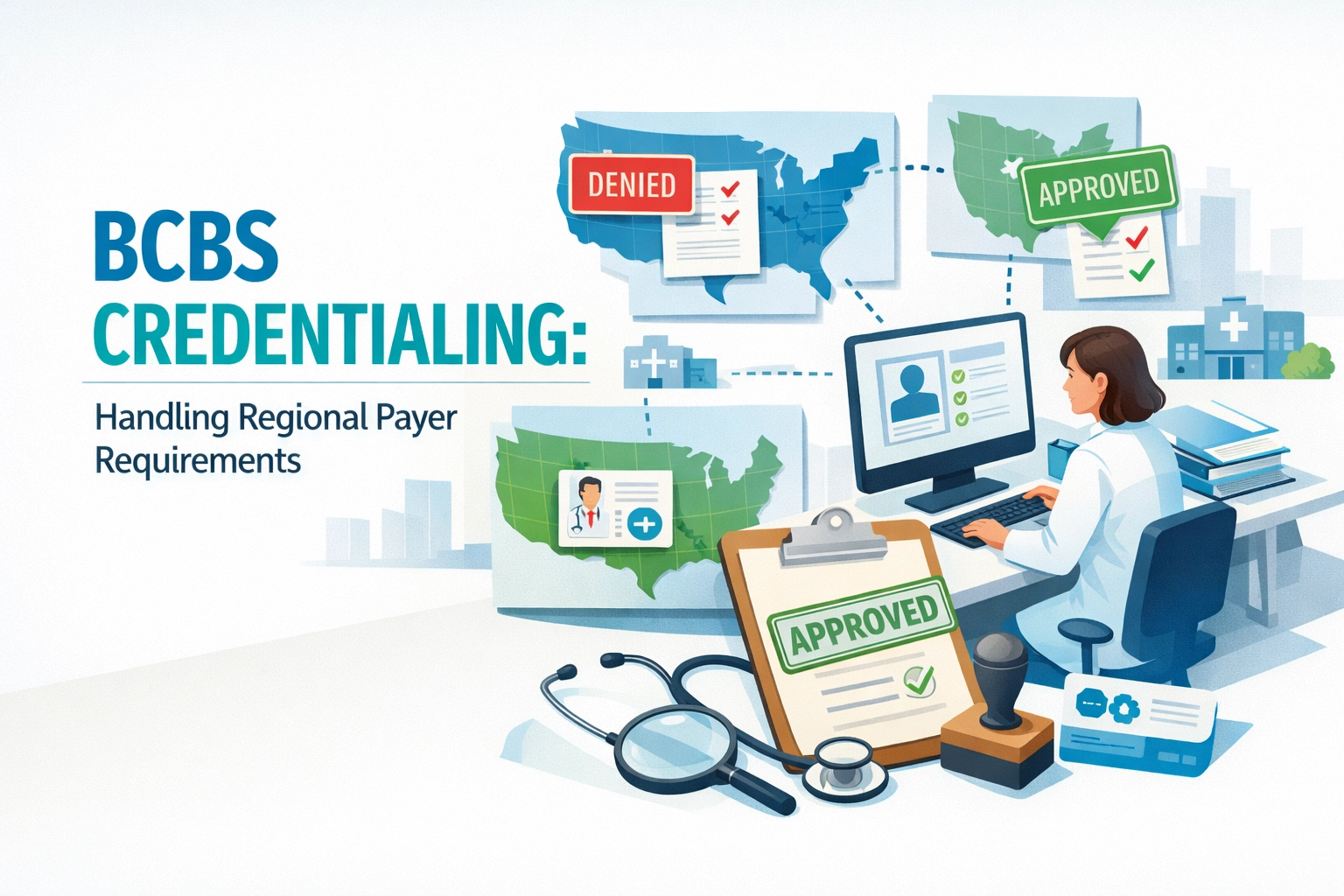
In the competitive landscape of modern healthcare, efficient medical provider enrollment services are the foundation of a sustainable revenue cycle. For organizations expanding their reach, mastering behavioral health provider enrollment across multiple jurisdictions is not just an administrative task; it is a strategic necessity. Navigating the Blue Cross Blue Shield (BCBS) network requires a sophisticated understanding of a decentralized system where each regional entity operates with its own specific set of mandates, timelines, and compliance thresholds. Looking for professional provider credentialing services in the USA?👉 Check our main service page here: veracityeg.com The Decentralized Architecture of Blue Cross Blue Shield The most critical factor to understand about BCBS is that it is not a monolithic entity. It is a federation of independent, locally operated companies. While they share a brand and certain overarching standards set by the Blue Cross Blue Shield Association, the actual execution of provider entry into their networks is strictly governed by regional boards. This independence means that the requirements you satisfy for BCBS of Texas will not necessarily mirror those of BCBS of Illinois or Anthem in California. Each plan maintains its own Medical Policy, its own Provider Manual, and its own unique application portal. For multi-state practices, this geographic fragmentation is the single greatest hurdle to achieving network participation. Failing to account for these regional nuances results in prolonged revenue gaps and administrative gridlock that can stall your practice's growth for months. Identifying Regional Nuances and Provisional Status Regional variations are often subtle but carry significant consequences. For instance, certain plans have adopted progressive measures to accelerate the onboarding of new providers. As of July 2023, Blue Cross Blue Shield of Montana began offering provisional status, which allows providers to participate in the network while their full file is under final review, provided they meet specific state licensure criteria. Conversely, other regional plans, such as those in the Northeast or Midwest, may have much more rigid "closed-door" policies for certain specialties or geographic areas already saturated with providers. You must identify if your target region is currently accepting new applications for your specific specialty. In many cases, behavioral health provider enrollment faces unique challenges depending on the state's current mental health parity laws and regional network adequacy requirements. For a deeper look into the complexities of the mental health sector, see our guide on why behavioral health provider enrollment is so hard. The Essential Documentation Framework While regional specifics vary, the core documentation required by BCBS plans remains the backbone of professional credibility. Your practice must maintain a centralized, digital repository of all provider credentials to ensure rapid submission once a regional window opens. The standard list of requirements includes: Current State Medical License: Must be active and unrestricted in the state where the provider will practice. DEA Registration: Required for providers prescribing controlled substances, with an address matching the practice location. Board Certification Status: BCBS plans increasingly require board eligibility or certification for most specialties. Professional Liability Insurance: Certificates must show adequate coverage limits, typically $1M/$3M, depending on the region. Five-Year Work History: A comprehensive CV with no gaps; any gap exceeding six months must be explained in writing. NPI (National Provider Identifier): Both Type 1 (Individual) and Type 2 (Group) must be correctly registered. Managing the CAQH ProView Integration The vast majority of BCBS plans utilize the CAQH ProView database as their primary source of truth. However, simply having a profile is insufficient. To satisfy BCBS regional requirements, your CAQH profile must be 100% complete and re-attested every 120 days. If your CAQH data is outdated or if a plan does not have authorization to access your file, the application will stall indefinitely. You must ensure that each specific BCBS regional plan is granted permission within the CAQH portal to view your data. This is a common point of failure for many practices that assume a global "grant all" setting covers every newly formed regional subsidiary or specific Medicaid-managed care line of business. Strategic Prioritization for Multi-State Entities When expanding across state lines, you cannot treat every application with equal urgency. You must prioritize based on projected patient volume and revenue potential. Tier 1: High-volume regions where existing patient demand is high. Tier 2: Expansion regions with upcoming start dates. Tier 3: Maintenance regions where providers are already active but require updates. Establish a master tracking system that records the submission date, the regional tracking number, and the name of the designated network representative. Without this level of granular oversight, your files will disappear into the administrative "black hole" that often characterizes large payer organizations. Navigating Timelines and Follow-Up Protocols The typical window for BCBS network entry is 45 to 90 days. However, this is an optimistic estimate that assumes a "clean file" submission. In reality, regional backlogs can extend this to six months or more. You must implement a rigorous follow-up schedule. We recommend a "2-2-2" approach: follow up two weeks after submission to confirm receipt, every two weeks thereafter to check status, and then daily once the file moves to the final "Contracting" phase. Use official channels, such as the Montana Credentialing Status Checker or the specific portal for your region, to maintain a written record of all communication. For medical groups managing multiple providers, the risk of a single expired license or a missed re-attestation can trigger a mass de-enrollment across the entire group. This is why professional provider enrollment management is vital to the health of your practice. Consequence of Non-Compliance The high cost of delays in BCBS network participation is measured in lost revenue and patient attrition. If a provider is seeing patients before the effective date listed by the regional BCBS plan, those claims will be denied. Most BCBS plans do not offer retroactivity; if the provider is not effective until the 15th of the month, any services rendered on the 14th are non-reimbursable. This "silent driver" of lost profit can decimate the first-quarter earnings of a new clinic or a newly hired provider. Leveraging The
How to Credential a Provider

Navigating the complexities of medical provider enrollment services is the backbone of a successful practice, especially when managing specialized tracks like behavioral health provider enrollment. In the modern healthcare landscape, obtaining “in-network” status is not merely an administrative hurdle; it is your practice’s passport to financial viability and patient trust. Without a streamlined approach to insurance credentialing, your facility remains invisible to the vast majority of insured patients, effectively throttling your revenue cycle before it even begins. The process of credentialing a provider with insurance companies is a meticulous journey that demands precision, persistence, and an authoritative grasp of payer requirements. Whether you are a solo practitioner or a growing multi-specialty group, the steps you take today determine your ability to collect reimbursement tomorrow. Looking for professional provider credentialing services in the USA? 👉 Check our main service page here: veracityeg.com The High Cost of Administrative Delay Precision is the silent driver of a profitable practice. Every day a provider sits in “pending” status is a day of lost revenue and interrupted patient care. Incomplete applications are the most common cause of multi-month delays. When an insurer identifies a gap in your work history or a missing signature on a W9, they do not simply call you to clarify; they often move the entire file to the bottom of the stack or reject it outright. The consequence-driven reality of the industry is simple: if the data is not perfect, the application is stagnant. This administrative bottleneck can make or break a new clinic’s first year. For many, the answer lies in professional provider enrollment strategies that treat every application with the urgency it deserves. Phase 1: Building the Documentation Fortress Before you ever log into a payer portal, you must compile a comprehensive digital library of your credentials. Think of this as the “backbone of professional credibility.” You will need to gather and verify the following: Updated Curriculum Vitae (CV): This must account for every month of your career since medical or professional school. Any gaps longer than 30 days must be explained in writing. Active State Licenses: Ensure all licenses are current and clear of any disciplinary actions. DEA and CDS Certifications: Required for providers with prescribing authority. Board Certifications: Documentation of your specialty status. Malpractice Insurance: A current Certificate of Insurance (COI) showing adequate coverage limits. NPI Information: Your Type 1 (Individual) and/or Type 2 (Group) National Provider Identifier. Phase 2: The CAQH Universal Standard In the United States, the Council for Affordable Quality Healthcare (CAQH) acts as the central clearinghouse for provider data. Most major commercial payers use the CAQH ProView system to pull the information they need for credentialing. If your profile is not current, your application will fail. Maintaining a robust CAQH profile is a non-negotiable requirement. You must re-attest to your data every 90 days to keep it active. Failing to do so is a leading cause of providers being dropped from insurance panels. For a deeper dive into the technical nuances of this platform, you can explore our guide on navigating the CAQH maze. Phase 3: Strategic Payer Selection and Panel Openings Not every insurance company is accepting new providers at all times. Before investing hours into an application, your practice must conduct market research. Contact the provider relations department of the payers you wish to join to verify if their “panel is open” for your specific specialty and geographic location. In certain high-competition areas or over-saturated specialties, payers may deny your initial request to join. When this happens, you must be prepared to submit a Letter of Interest (LOI) that highlights your unique value proposition: such as evening hours, multi-lingual staff, or specialized procedures. This is particularly relevant in the mental health space, as many clinicians find that behavioral health provider enrollment requires more nuanced advocacy than general medicine. Phase 4: The Verification and CVO Review Once your application is submitted, it enters the verification phase. Insurance companies often utilize a Credentials Verification Organization (CVO) to perform primary source verification. This means they will contact your medical school, your previous employers, and your malpractice carrier directly to ensure everything you’ve submitted is 100% accurate. During this 60-to-120-day window, you must remain proactive. Do not assume that “no news is good news.” You must follow up with payer credentialing hotlines every 15 to 20 days to ensure your file has not stalled. Always request a “tracking number” or “reference ID” for every interaction to maintain a clear audit trail. Phase 5: Contract Execution and the Fee Schedule The final hurdle is the contract itself. Once you are approved, the payer will send a participation agreement. You must review the fee schedule before signing. Many providers make the mistake of assuming all contracts are standard, but the reimbursement rates offered can vary significantly. If the proposed rates do not sustain your practice’s overhead, this is the time to negotiate. While massive payers like Blue Cross Blue Shield or Aetna often have “take it or leave it” structures for solo providers, larger groups or specialized facilities may have more leverage. At The Veracity Group, we emphasize that your signature on a contract is a long-term commitment to a specific revenue model. Maintenance: The Silent Driver of Longevity Credentialing is not a “one and done” task. It is a continuous cycle of updates and re-credentialing. Every time you move offices, change your phone number, or renew your malpractice insurance, the payers must be notified immediately. Failure to update demographics can lead to claim denials and the removal of your practice from the online “Find a Doctor” directories. Effective monthly credential monitoring is essential to avoid the serious consequences of an expired license or an outdated CAQH profile. Your professional standing depends on your ability to remain compliant with every payer’s evolving standards. The Professional Path Forward The path to full provider enrollment is fraught with administrative landmines. However, when managed with the precision of an expert insider, it becomes a predictable process rather than a
How to Enroll a Provider With Health Plans: Step‑by‑Step

1. Gather All Provider Documents Payers are rejecting more applications due to missing or outdated documents. Ensure everything is current before submitting. 2. Update and Attest CAQH Commercial payers rely heavily on CAQH for verification. To meet 2026 standards: A single mismatch can delay enrollment by weeks. For a deeper look at why CAQH is now the primary source of truth for commercial payers—and how expired attestations quietly shut down your revenue—read our full breakdown here: CAQH Provider Enrollment Guide 3. Submit Enrollment Applications to Each Payer Medicare (PECOS) Medicaid (State‑Specific) Each state has its own portal, requirements, and timelines. Processing time: 60–120+ days. Some states require fingerprinting or background checks. Commercial Payers Includes BCBS, Aetna, Cigna, UHC, Humana, etc. Most require: 4. Track Application Status Weekly Payers lose documents. Systems glitch. Follow‑ups are essential. Track: Applications with errors take 3× longer to process. 5. Complete Contracting & Fee Schedule Review Once credentialed, the provider moves into contracting. Review: Skipping contract review leads to years of underpayment. 6. Confirm Network Effective Dates Enrollment is not complete until the payer confirms: Never bill before the effective date—claims may be permanently denied. 7. Add Provider to Billing System & Clearinghouse Finalize setup by: This step connects enrollment to actual revenue flow. Common Enrollment Mistakes to Avoid How Long Does Payer Enrollment Take? Payer Type Typical Timeline Medicare 30–90 days Medicaid 60–120+ days Commercial 60–150 days CAQH Setup 1–2 weeks Timelines are increasing due to stricter validation and digital verification requirements. Final Takeaway Provider enrollment is now one of the most important revenue‑cycle steps in healthcare. Clean documents, accurate CAQH, payer‑specific applications, and consistent follow‑ups are the keys to avoiding delays and protecting cash flow. For a deeper breakdown of why enrollment and credentialing must be treated as two separate workflows in 2026, read our full guide here: Provider Enrollment vs. Credentialing — Why Enrollment Needs Its Own Playbook in 2026 ProviderEnrollment #PayerEnrollment #CAQH #Credentialing #Contracting #RevenueCycle #HealthcareOperations #PracticeManagement #MedicalBilling #MedicareEnrollment #MedicaidEnrollment #CommercialPayers #PECOS #HealthcareAdministration #ProviderOnboarding #ProviderEnrollmentProcess #CAQHAttestation #PayerEnrollmentTimelines #HealthcareDataAccuracy #EnrollmentAndCredentialing #PayerSetupWorkflow #MedicalPracticeRevenue #ProviderActivationSteps #HealthcareEnrollmentManagement #VeracityEnrollmentSupport
The Hidden Source of Most Provider Enrollment Delays: NPI & Payer Setup

Most provider enrollment delays don’t start with the payer. They start with the data behind the application : specifically your NPI, your provider setup, and your payer setup. These three elements form the backbone of every provider enrollment and credentialing workflow, yet they’re the most overlooked parts of the entire process. If you’ve ever wondered why your insurance provider enrollment stalls even when your documents are complete, the answer is almost always the same: the payer can’t load your record because the foundational data doesn’t match. Let’s break down why this happens and how to fix it. NPI Enrollment: The First Point of Failure Your NPI file is the source of truth for every payer.If your NPI enrollment contains outdated taxonomy codes, incorrect practice locations, or mismatched ownership details, every downstream process inherits the error. Payers cross‑check your NPI against: CAQH IRS records NPPES State licensure EFT/ERA documentation Group affiliations If anything is inconsistent, the payer pauses the application : often without telling you why. NPI issues don’t look like denials.They look like silence. Provider Setup: The Most Misunderstood Step in Provider Enrollment Most practices think “provider setup” is just entering a name and NPI into a system.It’s not.It’s the structural definition of how the provider exists inside your organization. A clean provider setup includes: Correct taxonomy Accurate specialties Linked service locations Proper group affiliations Matching practice structure across systems If your provider setup is wrong, payers can’t map the provider to the group.If they can’t map the provider, they can’t complete provider enrollment.If they can’t complete provider enrollment, they can’t load the provider into the network. This is why setup errors create long, quiet delays. Payer Setup: The Step That Determines Whether Claims Will Ever Pay Even when provider enrollment is approved, claims won’t pay unless the payer setup is correct.This is the part most practices discover too late : usually after the first batch of claims rejects. A clean payer setup ensures: The provider is linked to the correct group The taxonomy matches the NPI file The service locations are active The billing structure is recognized The provider is loaded into the payer’s directory If any of these elements are missing, the payer can’t activate the provider : even if provider enrollment is complete. This is why practices say, “We’re enrolled, but we still can’t bill.”Provider enrollment isn’t the finish line.Payer setup is. Why Insurance Provider Enrollment Depends on All Three Provider enrollment is the operational workflow that gets your provider and group loaded, linked, and active with each payer so you can bill without disruption. When your NPI enrollment, provider setup, and payer setup do not match, the payer cannot build or activate your record—and your revenue stalls. Payers rely on your NPI enrollment, provider setup, and payer setup to validate: Who you are Where you practice How you bill How you’re structured How you should be loaded into the network If any of these elements are misaligned, insurance provider enrollment stalls : not because the payer is slow, but because the data doesn’t support activation. Provider enrollment is an infrastructure process.If your setup is not clean, the payer cannot turn the lights on for billing. How to Fix Setup‑Driven Delays Before They Start 1. Audit Your NPI EnrollmentConfirm that taxonomy, addresses, and ownership details match your current structure in NPPES and across your internal systems so payer validation does not stall (NPPES). 2. Standardize Provider SetupCreate a template for every new provider so nothing is missed, and keep your identifiers current to prevent downstream mismatches. Use this quick, practical checklist to keep the basics clean: NPI Management. 3. Align Payer Setup With Your NPIIf the payer setup doesn’t match the NPI file, the application will stall. 4. Treat Setup as a Pre‑Provider Enrollment StepProvider enrollment should never begin until setup is complete. The Bottom Line Most provider enrollment delays aren’t payer delays at all.They’re setup delays. When your NPI enrollment, provider setup, and payer setup are aligned, provider enrollment becomes predictable. When they’re not, the process becomes a maze of silent stalls and unexplained slowdowns. Clean setup creates clean provider enrollment. This is exactly why demographic update delays are so costly: they break the very foundation your billing relies on. Clean provider enrollment creates clean billing.Clean billing creates clean revenue. That’s the operational chain ; and it always starts with setup. #Veracity #ProviderEnrollment #PayerEnrollment #NPIEnrollment #NPI #NPPES #ProviderOnboarding #PayerSetup #EnrollmentOperations #RevenueCycleManagement #ClaimsManagement #DenialPrevention #HealthcareCompliance #HealthcareOperations #PracticeManagement #MedicalGroupManagement #MultiStateEnrollment #ProviderDataManagement #HealthcareAdministration #MedicalBilling #EFTandERA #TaxonomyCodes #ProviderDirectory #CleanClaims #AuditReady
Navigating the Maze: A Deep Dive into CAQH and Medicare Enrollment

Let’s be honest: you didn’t go through years of medical school or administrative training because you had a burning passion for filling out 50-page digital forms. Yet, here you are, staring at a computer screen, wondering why Medicare provider enrollment feels like trying to solve a Rubik’s Cube in the dark. The reality is that provider enrollment is the silent driver of your practice’s financial health. If you aren’t enrolled, you aren’t getting paid. It is the gatekeeper between the care you provide and the reimbursement you deserve. Two of the biggest hurdles in this journey are the CAQH ProView system and the federal Medicare enrollment process. At The Veracity Group, we see providers treat these as “one-and-done” administrative tasks, but that mindset leads to “Return to Provider” (RTP) notices and months of lost revenue. This is a technical deep-dive into how these systems work, how they stay aligned, and why professional medical provider enrollment services are no longer a luxury: they are a necessity for survival. The CAQH ProView: Your Professional Passport Think of CAQH (Council for Affordable Quality Healthcare) as your digital passport. It is a centralized database where you store your professional life story. Most commercial payers and even some Medicare Advantage plans use CAQH ProView to pull the data they need to verify who you are. However, CAQH is not a “set it and forget it” platform. It is a living document. The most common reason for a breakdown in the enrollment chain is a lapsed CAQH attestation. The 120-Day Heartbeat Every 120 days, you must log in and attest that your information is still accurate. If you miss this window, your profile becomes “inactive.” When a payer tries to pull your data for a revalidation or a new contract, they see a closed door. This leads to immediate suspension of payments. For many practices, this “minor” oversight results in a cash-flow nightmare that takes months to fix. The Documentation Standard To navigate CAQH successfully, you need your “go-bag” of documents ready. This isn’t just a list; it’s a high-stakes inventory: IRS Form W-9: Must be the most recent version and match your tax filings exactly. State Medical Licenses: You need every license for every state where you intend to practice. Malpractice Insurance: Your COI (Certificate of Insurance) must have an expiration date at least 60 days in the future. DEA and CDS Certificates: Often overlooked until the last second. Alt-tag: A checklist of required documents for CAQH and Medicare provider enrollment showing licenses, W-9, and insurance forms. Medicare Provider Enrollment: The PECOS Beast While CAQH handles the commercial and “universal” side of things, Medicare provider enrollment is a different beast entirely. It lives within the PECOS (Provider Enrollment, Chain, and Ownership System). Unlike the relatively user-friendly CAQH, PECOS is a complex web of forms (the 855 series). Depending on your practice type, you might be looking at: 855I: For individual physicians and non-physician practitioners. 855B: For clinics, group practices, and certain other suppliers. 855R: For reassignment of Medicare benefits. The complexity of these forms is why so many providers turn to specialized Medicare enrollment services. One wrong checkbox on an 855I can trigger a rejection that sends you to the back of a 60-90 day processing line. Why the “Effective Date” Matters In the world of Medicare, the effective date is everything. Medicare generally does not allow for backdating beyond 30 days from the date the application was submitted. If you start seeing patients on January 1st but don’t submit your PECOS application until March 1st, those January and February claims are effectively “charity care.” You will not see a dime for them. The Distinction: CAQH vs. PECOS (They’re Separate) You might be wondering: “If I have CAQH, why do I need PECOS?” Or vice versa. Here is the technical reality: CAQH and PECOS are independent systems. CAQH has no bearing on PECOS, and PECOS does not pull data from CAQH. PECOS is the CMS system that governs Medicare enrollment, while CAQH is a separate, payer-facing data repository used primarily across the commercial market. Many Medicare Advantage plans: which are private insurance companies managing Medicare benefits: rely heavily on CAQH data to complete their specific enrollment processes. If your CAQH profile is a mess, your Medicare Advantage enrollment will stall, even if your traditional Medicare PECOS file is spotless. What matters operationally is consistency. You must keep your practice identifiers and demographics consistent across CAQH, PECOS, and the NPI registry. Your address, legal business name, and taxonomy must align everywhere you report them. Discrepancies across these systems are a primary reason applications and roster updates get flagged and delayed. Alt-tag: A technical diagram showing the data flow between CAQH, PECOS, and NPI registries to illustrate the enrollment synchronization process. Enrollment vs. Credentialing: Know the Difference It is vital to understand that The Veracity Group specializes in provider enrollment, which is a distinct and separate process from credentialing. Credentialing is the “background check” phase. It is the primary source verification of your education, training, and experience. Provider Enrollment is the “contracting and linking” phase. This is the process of getting you a Provider Transaction Access Number (PTAN), linking you to a group NPI, and ensuring the payer’s system is set up to actually cut a check to your bank account. You can be fully “credentialed” by a hospital board but still be “unenrolled” with a payer. In that scenario, you can legally perform the surgery, but the insurance company won’t pay the bill. This is why strict compliance in enrollment is the backbone of professional credibility. The High Cost of the DIY Approach We often hear from office managers who tried to handle the “maze” themselves. They describe a cycle of submitting forms, waiting 45 days, receiving a rejection for a “missing signature” or “inconsistent address,” and starting over. When you factor in the hourly wage of your staff and the opportunity cost of delayed reimbursements, the “free” DIY method becomes the most expensive mistake
The Full Provider Onboarding Lifecycle: From NPI to First Paid Claim

Most practices think onboarding ends when a provider is “enrolled.” It doesn’t. Provider enrollment comes before credentialing, and both sit inside a long, interconnected chain : if any link breaks, the provider can’t bill. This Q&A walks through the entire process from start to finish, explaining what actually happens behind the scenes and why clean sequencing is the difference between a 45‑day activation and a 6‑month stall. Q: What is the full provider onboarding lifecycle? A: The lifecycle has five distinct phases, each dependent on the one before it: NPI & Data Setup Provider Enrollment Provider Enrollment‑Led Credentialing (performed by payers) Contracting Payer Setup & Activation If any phase is incomplete or mismatched, the provider is not billable. Q: What happens in Phase 1 : NPI & Data Setup? A: This is the foundation of everything that follows. It includes: Type 1 NPI for the provider Type 2 NPI for the organization Correct taxonomy Clean W‑9 Practice locations Ownership details CAQH setup and attestation If these elements don’t match across systems, enrollment stalls before it even begins. Discrepancies at this stage are the primary cause of downstream delays. To prevent these bottlenecks, savvy practices prioritize CAQH, NPI, and Data Integrity: The Hidden Factors That Make or Break Provider Enrollment as the non-negotiable first step in their onboarding strategy. Q: What happens in Phase 2 : Provider Enrollment? A: Enrollment is the administrative submission of the provider’s data to each payer. This includes: NPI CAQH W‑9 License Malpractice Practice locations Ownership Taxonomy Reassignments (Medicare) Enrollment creates the provider’s record inside the payer’s system. Q: What happens in Phase 3 : Provider Enrollment‑Led Credentialing? A: Provider enrollment comes first, and it drives the credentialing handoff. Then credentialing is performed by the payer, not your practice. It includes: Primary source verification Sanctions/exclusions checks Work history review Education and training verification Malpractice review Committee review (if required) Provider enrollment positions the file correctly inside the payer’s system; credentialing verifies qualifications. Credentialing does not activate billing. Q: What happens in Phase 4 : Contracting? A: Contracting determines: Network participation Rates Effective dates Reimbursement structure Provider type eligibility Some payers contract before credentialing. Some contract after. Some do both simultaneously. Contracting is the most misunderstood step : and the most critical for revenue. Q: What happens in Phase 5 : Payer Setup & Activation? A: This is the final step before billing. It includes: Loading the provider into the payer’s claims system Linking the provider to the group Updating directories Activating the provider for billing Confirming effective dates This is where most practices get blindsided. Provider enrollment + credentialing approval ≠ activation. Only payer setup makes the provider billable. Q: Why do providers get enrolled and credentialed but still can’t bill? A: Because provider enrollment and credentialing are not the finish line. Billing only works after: Provider Enrollment Credentialing Contracting Payer setup If any step is incomplete, claims reject. Q: What causes the biggest delays in the onboarding lifecycle? A: CAQH not attested NPI mismatch Wrong taxonomy Incorrect W‑9 Missing reassignment (Medicare) Medicaid ownership issues Payer sequencing errors Inconsistent addresses Missing documents Poor follow‑up Most delays are preventable with clean data and structured workflows. Q: How long should the full lifecycle take? A: With clean data and proper sequencing: Medicare: 30–45 days Commercial: 90-120 days Medicaid: 60–120+ days (state‑dependent) A realistic full lifecycle timeline is 90–120 days from start to activation. Q: Who can manage the entire lifecycle end‑to‑end? The Veracity Group Veracity manages every phase of the onboarding lifecycle: NPI alignment CAQH Provider enrollment Provider enrollment‑led credentialing coordination Contracting Payer setup Revalidations Ongoing maintenance The workflow is built to eliminate the mismatches, sequencing errors, and follow‑up gaps that cause most onboarding delays. The Bottom Line Provider onboarding is not one process : it’s five. When those five phases are aligned, providers become billable quickly and predictably. When they aren’t, everything slows down. Clean data → clean provider enrollment → clean credentialing → clean contracting → clean activation. That’s the lifecycle. And when it’s managed correctly, revenue flows faster. #Veracity #ProviderEnrollment #PayerEnrollment #Credentialing #Contracting #PayerSetup #EnrollmentLifecycle #ProviderOnboarding #HealthcareOperations #OperationalExcellence #PracticeManagement #MedicalPracticeManagement #RevenueCycle #RevenueProtection #HealthcareAdministration #HealthcareManagement #HealthcareConsulting #MedicalBilling #RCM #DenialManagement #PayerProcesses #CAQH #NPIEnrollment #DataAccuracy #MultiLocationPractice #ProviderOnboarding #HealthcareIndustry #HealthcareLeaders #HealthSystems #HealthcareBusiness #HealthcareSolutions