How to Credential a Provider in Delaware: Small State, Big Commercial Payer Complexity

Delaware may be the second-smallest state in the union, but when it comes to provider enrollment, its commercial payer landscape is a high-stakes minefield of mandatory registrations and complex logic. For any practice manager or physician looking to secure professional credentialing services, navigating the "First State" requires more than just a standard application; it demands a deep understanding of how state-level mandates and private payer technologies intersect. While the physical geography is limited, the regulatory hurdles are expansive, particularly with the recent enforcement of federal mandates and the shifting timelines of major insurance platforms. Looking for professional provider credentialing services in the USA? 👉 Check our main service page here: veracityeg.com The Delaware Paradox: Why "Small" Doesn't Mean "Simple" In many states, the size of the healthcare market dictates the level of administrative burden. Delaware flips this script. Because it serves as a corporate hub and sits within a dense Mid-Atlantic corridor, its healthcare network is tightly integrated and strictly monitored. The "Small State, Big Complexity" paradox exists because Delaware’s tightly integrated payer ecosystem often results in earlier or stricter adoption of federal compliance standards and payer technologies. The backbone of this complexity is the Delaware Medical Assistance Program (DMAP). Unlike some states where Medicaid enrollment is only necessary if you intend to see a high volume of low-income patients, Delaware has made state-level registration a prerequisite for virtually any form of reimbursement within its borders. If you are not in the state’s system, you are essentially invisible to the payers that matter most. The DMAP Mandate: Your Entry Point via the Gainwell Portal The most critical step in your Delaware enrollment journey is mandatory registration with DMAP. This must be completed via the Gainwell portal, the state’s designated technology partner for Medicaid management. This isn't just for "Medicaid providers" in the traditional sense. Under current regulations, all providers, including those who only participate in Managed Care Organization (MCO) networks, must have an active DMAP ID. The Gainwell portal is known for its rigid data requirements. You must register every National Provider Identifier (NPI) and, more importantly, every single service location where you provide care. Failing to list a secondary satellite office in the Gainwell system will result in immediate claim denials from commercial MCOs, even if your primary location is approved. At The Veracity Group, we consistently see credentialing delays stemming from providers who assumed their CAQH profile would automatically update the state's Medicaid database. In Delaware, that assumption is a recipe for a revenue freeze. Alt: A cinematic navy and amber digital map of Delaware showing healthcare provider data connections, payer platform nodes, and synchronized enrollment workflows. The 21st Century Cures Act: The Revenue Blockade The enforcement of the 21st Century Cures Act in Delaware has fundamentally changed the stakes for provider panels. Under CMS screening rules strengthened by the 21st Century Cures Act, Medicaid MCO providers must be enrolled with the State Medicaid Agency. In Delaware, this means that if you are out of compliance with DMAP, your contracts with payers like Highmark Health Options or AmeriHealth Caritas are effectively null and void for reimbursement purposes. This creates a "Revenue Blockade." You might hold a valid contract with a commercial payer, but MCOs are prohibited from reimbursing providers who are not enrolled with DMAP, effectively creating a revenue blockade. This is particularly dangerous during recredentialing cycles. If your information is not perfectly aligned during a state audit, you risk a "Stay of Enrollment," which freezes your ability to bill until the data mismatch is corrected. Proactive demographic updates are the only way to bypass this blockade. Highmark Delaware and the CertifyOS Delay Highmark Delaware remains the dominant force in the state’s commercial landscape. Traditionally, Highmark has relied on legacy systems for its provider data, but the company recently announced a major shift to the CertifyOS platform. This platform is designed to automate much of the primary source verification process, theoretically speeding up the time-to-revenue for new providers. However, the rollout of CertifyOS has been anything but smooth. Industry reports indicate that Highmark’s transition to CertifyOS, originally targeted for early 2026, has experienced delays. This delay has created a massive administrative vacuum. Providers caught in the transition period are facing extended processing times as Highmark balances its old manual workflows with the requirements of the upcoming automated system. If you are applying to Highmark Delaware right now, you must be prepared for a hybrid experience. You will still need a pristine CAQH profile to feed the existing systems, and many major payers now enforce a 120-day CAQH re-attestation cycle, especially those using automated API pulls. If your CAQH profile drops to "Inactive" because you missed that re-attestation window, some payers using automated CAQH API pulls will suspend or deny claims — including telehealth — if a provider’s CAQH profile becomes inactive. You must also ensure your data is "CertifyOS-ready": meaning your NPI, DEA, and state licenses must match exactly across all federal and state databases. Any discrepancy will trigger a "flag and freeze" response, stalling your application indefinitely. Navigating Aetna and Highmark Health Options Aetna, specifically through Highmark Health Options, represents a significant portion of the Delaware provider panel. Because Highmark Health Options functions as a Medicaid MCO, the link back to DMAP is absolute. You cannot bypass the state portal to get into the Aetna network in Delaware. For institutional providers, the migration to CMS-855A records within the modernized PECOS 2.0 system adds another layer of complexity. Delaware's payers are increasingly cross-referencing federal PECOS data with state DMAP data in real-time, and PECOS 2.0 now uses automated real-time data matching with IRS and NPPES records. That means even small errors carry serious consequences. If your "Suite" number is listed at the federal level but omitted at the state level, the system logic will flag the mismatch as a potential compliance risk. More importantly, PECOS 2.0 flags mismatches for manual review, which can delay enrollment and cause downstream billing freezes when payers cross‑reference federal data. This level
What the OBBBA Medicaid Cuts Mean for Your Provider Panel: An Enrollment Survival Guide

The projected shifts in Medicaid eligibility requirements are the primary threat to provider panel stability through 2027, making provider enrollment a critical focal point for any practice looking to survive the next budget cycle. What many in the industry have nicknamed the One Big Beautiful Bill Act (OBBBA) represents a collection of state‑level policy trends and projected Medicaid tightening scenarios emerging between 2025 and 2027. 2026 is the critical preparation year, and some states are targeting 2027 for implementing proposed work‑requirement waivers. For healthcare administrators, that means preparing now for a landscape defined by "Medicaid churn" and tightening Medicaid enrollment trends. Looking for professional provider credentialing services in the USA? 👉 Check our main service page here: veracityeg.com For the modern healthcare administrator, what many in the industry have nicknamed the One Big Beautiful Bill Act (OBBBA) represents more than just a policy talking point; it reflects a fundamental restructuring of how patients access care and how providers get paid across multiple states. With state‑level eligibility tightening and waiver activity accelerating, the administrative burden of managing a provider panel is about to skyrocket. If your practice is not proactive, the "silent driver" of revenue loss: procedural disenrollment: will hollow out your patient base before the year is through. The Six-Month Redetermination Trap The era of the "set it and forget it" Medicaid panel is over. One of the most aggressive shifts tied to what many in the industry have nicknamed the One Big Beautiful Bill Act (OBBBA) is the move toward six-month eligibility redeterminations as a state‑level trend and in some Section 1115 waiver discussions. Historically, many states operated on a 12-month cycle, giving both patients and providers a year of relative stability. Under this structure, states may require more frequent income verification for expansion adults. The operational burden is immediate and unforgiving: by doubling the frequency of redeterminations, the system creates twice as many opportunities for administrative errors. For your practice, this means: Increased Churn: Patients who are technically eligible but fail to navigate the paperwork will drop off your roster. Eligibility Gaps: A patient who was covered in January may be uninsured by July, even if their financial situation hasn't changed. Administrative Churn Becomes the Main Threat: For the expansion population ages 19-64, the leading driver of enrollment loss is projected to be administrative churn: losing coverage due to paperwork or verification failures despite still being eligible. Retroactive Denial Risk: Some states are pursuing waivers to reduce retroactive coverage windows to one month, which weakens the "safety net" that previously protected your revenue for services rendered while an application was pending. To manage this, your front office must verify eligibility at every single encounter. Relying on a verification done thirty days ago is no longer a viable business strategy; it is a gamble with your practice's bottom line. Alt Tag: A professional tech-forward dashboard visualizing Medicaid eligibility trends and enrollment churn in navy and amber tones. The 80-Hour Hurdle: Section 1115 Waivers and Work Requirements We are seeing a massive state-level push for work requirements, often facilitated through Section 1115 waivers. Several states are pursuing 80-hour work or community engagement requirements through Section 1115 waiver proposals. This isn't just a social policy issue; it is a provider enrollment nightmare. When a patient loses coverage due to a failure to report hours, they are often purged from your panel immediately. This creates a "yo-yo" effect where patients cycle in and out of coverage, leading to fragmented care and a chaotic billing cycle. The high cost of delays in identifying these transitions cannot be overstated. When a patient’s status changes, your internal rosters must reflect that change instantly to avoid the revenue risk of credentialing delays and enrollment mismatches. Data mismatches in PECOS 2.0 and state Medicaid systems can trigger enrollment freezes. The Critical Importance of CAQH and NPPES Alignment In this high-volatility environment, your internal data is your only shield. The OBBBA trends emphasize real-time cross-referencing between federal and state systems. Modernized systems like PECOS 2.0 and updated state Medicaid portals already enforce strict data‑matching rules, which amplify the effects of state‑level eligibility tightening. If your provider's information in CAQH or the NPPES system is even slightly out of sync with your state's Medicaid portal, the system will flag the mismatch and halt the flow of funds. Maintaining CAQH and NPPES alignment is no longer a "periodic task": it is the backbone of professional credibility and fiscal health. Veracity recommends a monthly deep-dive audit of all provider profiles to ensure that "Suite 101" isn't listed as "Ste. 101" in one system and "Room 101" in another. In 2026 and 2027, these tiny discrepancies are what trigger the automated freezes that stall your provider enrollment progress. Alt Tag: A cinematic healthcare administration interface showing secure provider data synchronization in navy and amber tones. State Budget Shock and the Rural Buffer The OBBBA is not hitting every state equally. For healthcare administrators managing multi-state operations or monitoring referral patterns across state lines, the budget picture matters because state funding stress directly affects enrollment volatility, eligibility processing speed, and continuity of coverage. Some states are projected to face significant Medicaid budget pressure depending on their expansion populations and fiscal structures. That level of reduction creates serious downstream pressure on eligibility operations and increases the likelihood of patient movement on and off coverage. Some states with large rural populations may experience different impacts depending on their funding structures and supplemental rural support programs. That does not eliminate operational risk, but it does create meaningful variation in how enrollment disruption shows up across rural markets. For your practice, the takeaway is straightforward: Do not treat Medicaid disruption as uniform across states. Prioritize enrollment monitoring in high-loss states first. Expect rural market behavior to track differently based on state funding structures and rural support programs. Administrative Survival: An Action Plan for 2027 To navigate the OBBBA Medicaid cuts and the resulting panel instability, your practice must shift from a reactive to a proactive stance.
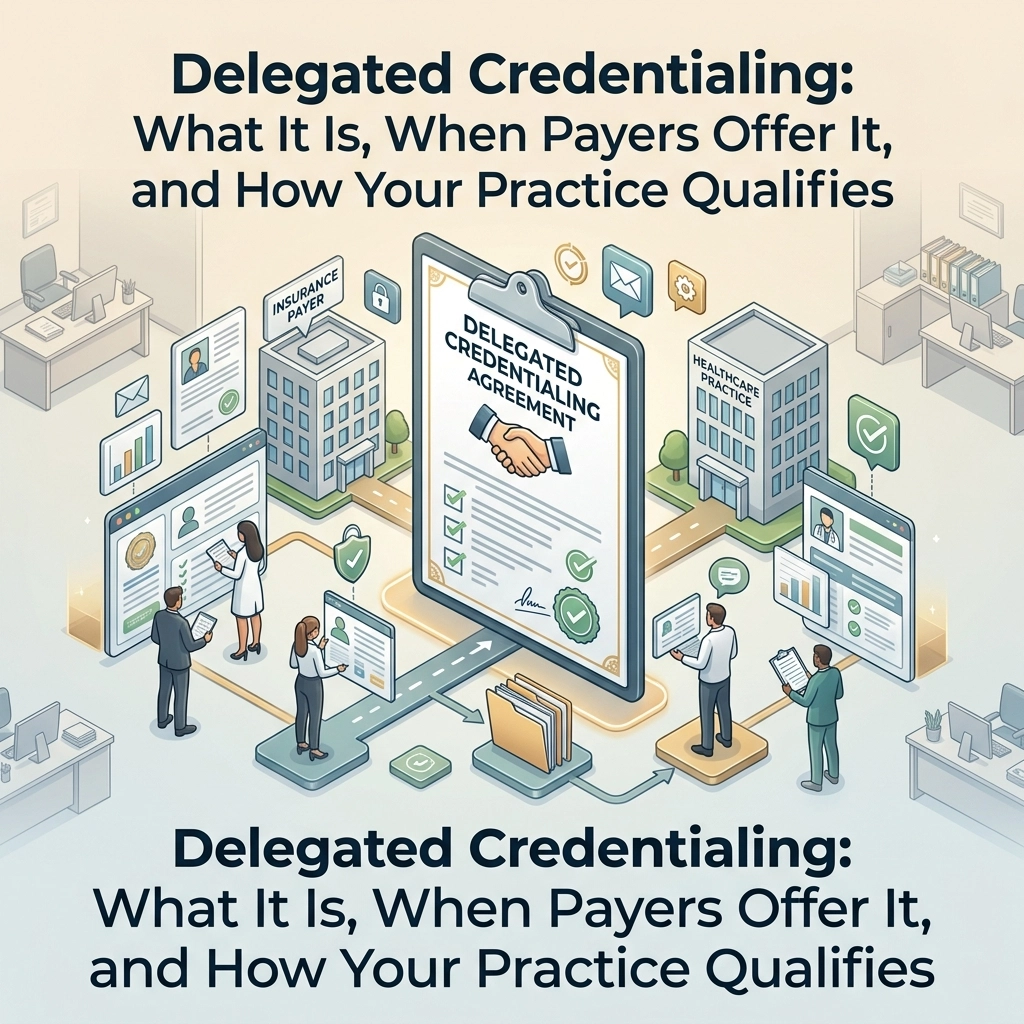
Delegated Credentialing: What It Is, When Payers Offer It, and How Your Practice Qualifies

For large healthcare organizations, the traditional provider enrollment timeline is often the primary bottleneck to revenue generation. Waiting for a payer committee to meet: a process that frequently stretches beyond 90 days: is no longer a sustainable business model in 2026. Medical credentialing shouldn't be a hurdle that keeps your providers on the sidelines while your overhead continues to climb. Delegated credentialing offers a sophisticated alternative, allowing your practice to reduce standard committee wait times and take greater control over your onboarding schedule. Looking for professional provider credentialing services in the USA? 👉 Check our main service page here: veracityeg.com The Fast Track: Defining Delegated Credentialing In a standard arrangement, the payer holds all the cards. They perform the verification, they review the files, and they decide when a provider is "active." Delegated credentialing flips this script. It is a formal arrangement where a health plan transfers the responsibility for verifying provider qualifications to the practice or a third-party entity. When you operate under a delegation agreement, you are no longer submitting individual applications and waiting for a response. Instead, your practice performs the heavy lifting of primary source verification (PSV). Once your internal committee approves a provider, you simply add them to a "roster" that is sent to the payer. In most cases, the payer accepts your roster as the final word, allowing that provider to begin seeing patients and billing for services almost immediately. This is the ultimate "passport to success" for high-growth groups that cannot afford three months of lost billing for every new hire. Alt Tag: Isometric 3D illustration of a digital fast-track lane for healthcare provider data, cinematic navy and amber tones. When Do Payers Offer Delegation? Payers do not hand out delegation agreements to every practice that asks. It is an earned status that requires a high level of trust and administrative maturity. Generally, a payer will offer delegation when your practice reaches a specific provider volume threshold: often 50 or more providers: and demonstrates a flawless track record of data accuracy. Payers are looking for partners who can reduce their own administrative burden. If your practice has the infrastructure to manage the complex requirements of the National Committee for Quality Assurance (NCQA) and federal mandates, you become an asset to the payer. They offer delegation because it streamlines their operations, provided they are confident in your ability to maintain their standards. You can read more about how to navigate these payer relationships in our Payer Gridlock Report 2026. How Your Practice Qualifies: The Infrastructure Check Qualifying for delegation is an intensive process that involves a "credentialing audit" of your internal policies and procedures. To move from a standard enrollment model to a delegated one, your practice must prove it can handle the following: 1. The 120-Day NCQA Verification Window In 2026, many organizations treat a 120-day primary source verification (PSV) window as a current industry standard and a standard compliance benchmark for delegated review readiness. In practice, that means documents such as medical licenses, DEA registrations, or board certifications are commonly expected to be verified at the source within 120 days of the credentialing decision. If your data falls outside that timeframe, it will raise audit concerns and weaken your delegated readiness. This shift from the older 180-day benchmark demands faster internal processing speed and tighter integration with medical licensing and CSR updates. 2. Monthly OIG and SAM Monitoring Compliance is non-negotiable. To maintain delegated status, your practice will perform monthly monitoring of the Office of Inspector General (OIG) List of Excluded Individuals/Entities (LEIE) and the System for Award Management (SAM) exclusions. Across the market, a 30-day monitoring cadence functions as a standard compliance benchmark for exclusion screening programs. If a provider on your roster appears on one of these lists and you fail to identify it on a timely monthly cycle, you risk serious audit findings, loss of payer confidence, and significant compliance exposure. 3. Professional Liability Documentation You must maintain meticulous records of malpractice history and current coverage levels. Payers will audit these files to ensure every provider on your roster meets the minimum coverage requirements specified in your payer contracts. Utilizing Modern Payer Tools: UHC Onboard Pro Even with delegation, the method of delivery matters. Leading payers have introduced technology to facilitate bulk enrollment. For example, UnitedHealthcare’s Onboard Pro has been observed to offer bulk submission functionality for large groups. Available tools like this are designed to reduce repetitive data entry and support higher-volume roster activity. Utilizing these tech-forward tools is the "silent driver" of efficiency in 2026. It eliminates the manual entry of demographic data and reduces the likelihood of clerical errors that lead to claim denials. If your practice is not leveraging available bulk tools, you are leaving money on the table through administrative inefficiency. Alt Tag: Clean editorial graphic showing a cinematic navy dashboard with amber highlights, representing a bulk provider enrollment interface. The Consequences of Compliance Failure Delegation is not a "set it and forget it" status. It is a massive responsibility that carries a high cost of failure. Payers perform annual or semi-annual audits of your files. If an auditor finds that you missed a current 120-day PSV benchmark or failed to maintain monthly OIG screening, they can issue corrective action demands, suspend delegated activity, or revoke delegation based on the agreement terms. The "backbone of professional credibility" in a delegated environment is your Policy and Procedure (P&P) manual. Your P&Ps must be living documents that reflect current NCQA-aligned standards and payer expectations. When delegation is revoked, your practice is forced back into the standard 90-day committee wait for all new providers, which can cause a catastrophic interruption in your revenue cycle. Why the Shift to Delegation is Essential in 2026 The healthcare landscape in 2026 is defined by consolidation and rapid expansion. If your practice is acquiring new locations or hiring specialists at a high rate, the standard provider enrollment process is your greatest enemy. Delegated credentialing allows you to: Secure Faster Effective
Telehealth Credentialing in 2026: What Payers Now Require Separately for Virtual Care

Billing telehealth claims without current telehealth-related attestations is now a common driver of virtual care denials. If your practice relies on virtual visits, understanding that provider enrollment and specialized credentialing services are no longer "one-size-fits-all" is the only way to protect your revenue stream in 2026. The days of assuming an in-person approval automatically covers a video visit are over; payers have increasingly moved telehealth into its own siloed compliance category. The CAQH "Telehealth Participation" Standard For years, CAQH was a static repository. In 2026, it is the silent driver of your reimbursement success. Most commercial payers, including major plans like Elevance, use the "Telehealth Participation" field and related disclosures as an industry-standard filter during claims review and provider file validation. If this field is left incomplete or unsupported by a disclosed remote practice address, your claims are far more likely to hit a "provider not eligible for service location" denial before a human ever reviews the file. The high cost of delays often stems from a simple oversight: failing to list the specific technological platforms used for virtual care. Those telehealth disclosures now function as common payer triggers during audits, roster checks, and service-location validation. You must ensure your CAQH profile is not just "complete" but specifically tailored to reflect your virtual footprint. Updating your CAQH profile is no longer a quarterly chore: it is a weekly necessity for any practice operating across state lines. Anticipated Medicare Telehealth Policy Shifts for Therapists The regulatory landscape continues to shift through observed Medicare telehealth transitions in 2026. Rather than treating one date as a universal federal cutoff across every therapy setting, practices should recognize a broader tightening in how Medicare telehealth eligibility is interpreted for certain provider types and services. Specifically, Physical Therapists (PT), Occupational Therapists (OT), and Speech-Language Pathologists (SLP) face increased scrutiny around which telehealth services remain reimbursable under Part B and under what conditions. While the flexibilities of the early 2020s were broad, the 2026 framework demands tighter validation of therapist enrollment data and billable telehealth status. If you are a therapy practice manager, you must audit your Medicare enrollment records to ensure your providers remain aligned with current billing and enrollment expectations for telehealth services. Failure to do so creates serious recoupment and denial exposure when claims are submitted under outdated assumptions. Looking for professional provider credentialing services in the USA? 👉 Check our main service page here: veracityeg.com Behavioral Health and the 6-Month In-Person Policy Trend Behavioral health remains the most utilized telehealth specialty, yet it faces the strictest enrollment scrutiny in 2026. The 6-month in-person visit requirement stands as a key policy trend and a standard requirement that is being enforced more consistently in behavioral health telehealth workflows. In practice, this means payers and programs increasingly expect documentation of an in-person clinical encounter within the six months prior to certain telehealth mental health services, with ongoing in-person touchpoints remaining an important compliance expectation. From an enrollment perspective, this means payers are looking for a linked physical location in your provider enrollment file. If a provider is enrolled as "virtual-only" but treats patients in arrangements where an in-person touchpoint is expected, the claims are far more likely to be denied or flagged. You must maintain a "hybrid" enrollment status to bridge the gap between virtual convenience and regulatory requirements. Decoding the 2026 Place of Service (POS) Codes The backbone of professional credibility in virtual care lies in your billing accuracy. Payers are using POS codes to cross-reference your enrollment data. If your enrollment file says you work out of a clinic, but your claim says the patient is at home, a red flag is raised. POS 02: Used when the patient is at a location other than their home when receiving telehealth services. POS 10: Used when the patient is in their own home during the telehealth encounter. Furthermore, the application of Modifier 95 (synchronous telemedicine) or Modifier GQ (asynchronous telecommunications) must match the "Modality Capability" section of your enrollment profile. In 2026, Elevance and other major commercial plans increasingly use automated edits and review logic to ensure that the modifiers used on claims align with the "Telehealth Technology" disclosures made during the contracting process. These checks operate as common payer triggers, not as a single universal rule applied identically across all plans. The Reality of Multi-State Licensing If you are expanding your virtual reach, your enrollment strategy must be your "passport to success." In 2026, the Interstate Medical Licensure Compact (IMLC) and similar compacts for nurses and therapists have streamlined the process, but they have not eliminated the enrollment burden. You still must enroll in each state's Medicaid program and with each state's commercial payer chapters separately. A provider licensed in ten states via the compact still needs ten separate enrollment submissions to Medicare and commercial payers to actually get paid. This is where medical licensing and CSR/DEA registration become critical components of your virtual care infrastructure. Without state-specific enrollment, your license is merely a piece of paper, not a license to bill. Monthly Monitoring: The NCQA 2025/2026 Standard Payers have adopted the latest NCQA standards which mandate monthly monitoring of provider status. For telehealth providers, this includes checking: OIG and SAM.gov exclusions: Essential for all federal programs. Multi-state license standing: If a license is sanctioned in one state, payers will often suspend your telehealth enrollment in all other states. Malpractice coverage: Your policy must explicitly state that it covers "Telehealth" or "Virtual Care" across all states where you are enrolled. The serious consequences of a gap in monitoring can lead to a practice-wide "blackout" where all virtual care claims are suspended pending a full re-credentialing audit. This is why demographic updates must be processed the moment a provider changes their software platform or remote office location. Urgent Steps for Your Practice Today To prevent a total collapse of your virtual care revenue, your practice must act immediately. The 2026 landscape does not reward "catching up" later. Audit CAQH Profiles: Ensure the "Telehealth Participation"
What Triggers a Payer Enrollment Audit : and How to Avoid One

An NPI mismatch is a leading trigger associated with payer enrollment audits in 2026. As the healthcare landscape becomes increasingly digitized, the margin for administrative error has narrowed. Federal agencies and private payers use increasingly sophisticated data-validation tools to identify discrepancies across enrollment records and claims activity. If your practice is operating on "stale" data, you are not just at risk for a claim denial: you are increasing the likelihood of a comprehensive payer enrollment review that can disrupt your revenue cycle. Looking for professional provider credentialing services in the USA?👉 Check our main service page here: veracityeg.com At The Veracity Group, we have observed heightened audit and review activity throughout the first half of 2026. The shift is clear: according to observed industry trends and payer reporting patterns, payers such as UnitedHealthcare, Aetna, and Cigna are relying more heavily on data comparison and exception-based review workflows. They are cross-referencing internal claims data against enrollment and identity records with increasing precision. If your provider enrollment records do not align across every platform, the file can be flagged for an "integrity review" or manual follow-up. The 58% Inaccuracy Trap: Why the OIG is Watching The Office of Inspector General (OIG) previously noted a staggering 58% inaccuracy rate in federal provider identity databases. In response, CMS has tightened the screws on data synchronization. In 2026, the discrepancy between your NPPES (National Plan and Provider Enumeration System) profile and your PECOS (Provider Enrollment, Chain, and Ownership System) record is the leading "silent trigger" for audits. When these two systems are out of sync, they can signal weak internal controls and elevate scrutiny during enrollment review. This is more than a clerical error; it is often treated as a compliance concern. Payers and regulators use basic identity-data consistency as a baseline indicator of whether your organization is maintaining reliable administrative documentation. The NPI Mismatch: Type 1 vs. Type 2 Red Flags The most common technical trigger involves the misuse of NPI Type 1 (Individual) and NPI Type 2 (Organizational) identifiers. We frequently see practices submit claims using a provider's individual NPI where the group's organizational NPI is required: or vice versa. In the 2026 audit environment, payers use automated rules to identify these mismatches quickly. If your payer enrollment file lists a provider at Location A under a specific Tax ID, but the claim comes in with an NPI associated with Location B, the discrepancy can do more than deny the claim; it can trigger broader review of your enrollment history. This is why demographic updates are no longer a "when we get to it" task: they are a weekly necessity. Visual Description: A forensic, high-contrast image in cinematic navy and amber tones showing a digital magnifying glass hovering over a complex grid of NPI numbers and provider data points. The Standard 30-Day Reporting Window: A Major Compliance Risk Failure to report location changes within a standard 30-day reporting window is a major audit risk factor in 2026. CMS and major private payers closely monitor for "ghost locations": addresses listed in directories where the provider no longer practices. If a patient attempts to schedule an appointment at a location listed in the directory and finds the provider has moved, and that patient files a complaint, an audit risk escalates sharply. Based on observed industry reports and directory-accuracy enforcement trends, UnitedHealthcare and Aetna have applied increased scrutiny to provider directory verification. If your practice has added a new suite, closed a satellite office, or moved across the street, and that change was not reflected in your provider enrollment files within the payer's required timeframe, you are increasing your exposure under payer contract terms. Stale CAQH Profiles: The Gateway to Revenue Disruption Your CAQH profile is the backbone of your professional credibility with private payers. However, many practices treat CAQH as a "set it and forget it" platform. In 2026, a stale CAQH profile: one that has not been re-attested or updated with current malpractice insurance, DEA certifications, or state licenses: is a serious risk factor for payment disruption, manual review, or audit escalation. Payers are now performing "cross-system data scrubs." They compare your CAQH data to state licensing boards and other available verification sources. If a mismatch occurs, the payer will often initiate an audit or manual review to determine whether claims were paid based on inconsistent provider data. To avoid this, you must understand what every practice manager needs to know about CAQH updates. Forensic Scrutiny from the "Big Three": UHC, Aetna, and Cigna In 2026, observed industry trends indicate that the "Big Three" private payers are placing greater attention on administrative outliers during audit and enrollment review activity. They are not just looking for fraud; they are also looking for data inconsistencies that create network and payment risk. UnitedHealthcare: Industry reports suggest increased scrutiny when billing patterns do not align with an enrolled specialty or expected scope of practice. Aetna: Observed payer behavior indicates a strong focus on "network integrity," including address-standardization and directory-accuracy issues. Cigna: Industry reports indicate heightened attention to provider directory fields such as practice status and panel availability when those fields affect member access data. This level of scrutiny makes it imperative to stay informed on Medicare and Medicaid enrollment trends for 2026, as private payers often mirror broader federal data-integrity priorities. Visual Description: A tech-forward, cinematic image in amber and deep navy showing a stylized dashboard of healthcare audit "red flags" and flashing warning symbols over a map of provider networks. How to Build an "Audit-Proof" Enrollment Strategy Survival in the 2026 healthcare market requires a proactive, defensive stance. You cannot afford to wait for a letter from a payer to realize your data is compromised. Synchronize NPPES and PECOS: Ensure your legal name, Tax ID, and primary practice location match exactly across both federal databases. Even a missing "Suite" number or a hyphen in a name can trigger a manual review flag. Conduct a 90-Day Data Scrub: Every quarter, perform a comprehensive review of all provider