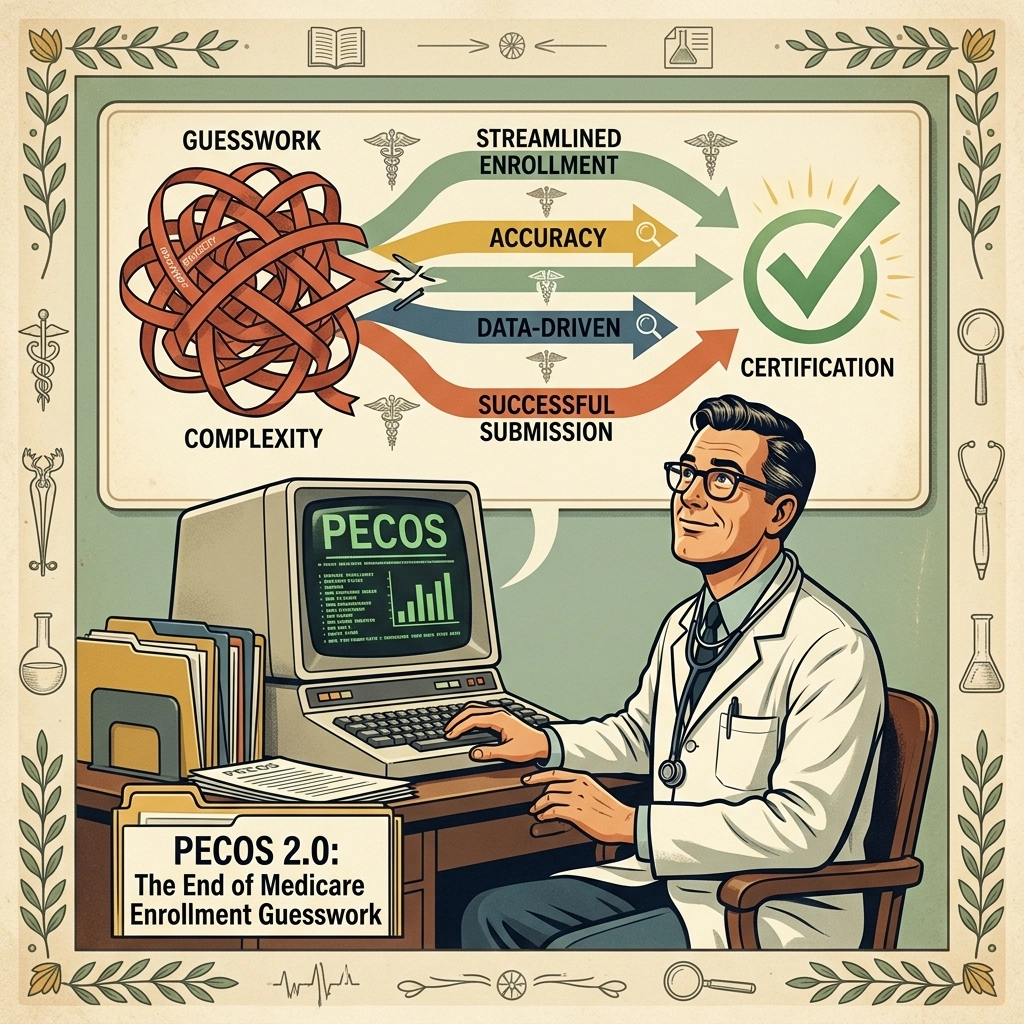
PECOS 2.0: The End of Medicare Enrollment Guesswork

Navigating Medicare enrollment has historically been a trial by fire for practice managers and administrators. For years, the Provider Enrollment, Chain, and Ownership System (PECOS) functioned as a fragmented, opaque database that left many users guessing whether their applications would be approved or cast into a "black hole" of administrative delay. The launch of PECOS 2.0 marks a definitive end to that era of ambiguity. By shifting from a simple data repository to a high-precision, real-time validation engine, CMS is forcing a higher standard of data integrity on every organization. Relying on outdated provider enrollment services and manual entry methods is no longer a viable strategy for maintaining your facility’s cash flow. Looking for professional provider credentialing services in the USA? 👉 Check our main service page here: veracityeg.com The Structural Rebuild: Beyond the Interface It is a mistake to view PECOS 2.0 as a simple cosmetic update or a "facelift" of the existing user interface. This is a foundational structural rebuild. The legacy system was built on siloed data: separate buckets for enrollment, NPI records, and tax information that rarely communicated with each other in real time. This lack of integration allowed minor discrepancies to sit undetected for months, only to surface as a claim denial or an enrollment rejection long after the provider had started seeing patients. PECOS 2.0 changes the math. It is now an integrated ecosystem designed for speed and surgical precision. The system logic has been completely rewritten to prevent the submission of flawed data before it even reaches a human reviewer at a Medicare Administrative Contractor (MAC). This transition moves the "burden of proof" from the government to your front office. If your data is not perfectly aligned across federal systems, PECOS 2.0 will immediately flag the mismatch and may freeze the application until corrected. Real-Time Validation: The New Compliance Standard The most significant operational shift in PECOS 2.0 is the automated cross-referencing engine. In the legacy system, you could submit an application with an address that didn't quite match the IRS or the USPS database, and it might slide through. PECOS 2.0 performs instant checks against multiple federal databases, including: IRS: Real-time verification of Taxpayer Identification Numbers (TIN) and legal business names. NPPES: Immediate logic checks against National Provider Identifier (NPI) records to ensure taxonomies and addresses align. OIG & SAM.gov: Automated screening against exclusion lists to prevent sanctioned individuals or entities from participating in the program. Caption: PECOS 2.0 utilizes a centralized logic engine to cross-reference federal databases in real-time. This automated validation means that data precision is the only way forward. If you list a suite number as "Ste 200" in PECOS but the NPI registry lists it as "Suite 200," the system may trigger a logic error. These "tiny" mismatches are no longer trivial; they are structural barriers to your revenue cycle. The "Stay of Enrollment" Risk: Consequences of Inaccuracy In the past, a mistake on an application usually resulted in a "Return for Correction" (RFC) or a simple rejection that allowed you to fix the error and resubmit. Under the new CMS framework, the stakes are significantly higher. CMS has introduced the "Stay of Enrollment" as a preliminary sanction for providers who fail to maintain accurate data. A Stay of Enrollment is a temporary pause in a provider's Medicare billing privileges. A Stay of Enrollment occurs when CMS places your enrollment under review due to unresolved discrepancies or unreported changes—not every mismatch triggers a stay, but PECOS 2.0 makes these reviews far more common. Unlike a standard rejection, a stay can have immediate financial consequences, as it effectively freezes your ability to be reimbursed for services rendered during that period. The logic is simple: CMS expects your digital footprint to be identical across every federal platform. If your Medicare-Medicaid linkage is inconsistent, the "guesswork" is over: the system simply stops the clock on your payments. Multi-State Workflows: A Win for Large Groups For regional health systems and multi-state groups, the legacy PECOS system was an administrative nightmare. Updating a single piece of information, such as an authorized official or a corporate address, required logging into multiple MAC jurisdictions and filing separate applications for each. PECOS 2.0 introduces the multi-state workflow, allowing you to update multiple MAC jurisdictions in a single application. This is a massive win for efficiency, but it comes with a catch. Because a single application now affects your enrollment status across several states, an error in that one application now has a multi-state impact. If you are managing a large group, you must centralize your data management. The ability to push updates across the country with one click is a powerful tool, but it also creates a single point of failure. If the data you push is incorrect, you have just compromised your multi-state enrollment in one fell swoop. Institutional Requirements: The CMS-855A Migration Institutional providers: hospitals, SNFs, and HHAs: face the most complex transition. The CMS-855A migration within PECOS 2.0 is designed to handle the intricate ownership and financial data required for institutional enrollment. This includes the mandatory reporting of beneficial ownership, a requirement that has become increasingly scrutinized by the Department of Health and Human Services (HHS). The new system requires institutions to provide a level of transparency that many are not prepared for. Every individual with a 5% or greater ownership stake, as well as all officers and directors, must be accurately documented and verified against federal records. This is no longer a "fill-in-the-blank" exercise; it is a compliance audit performed in real-time. Caption: The institutional enrollment dashboard provides a more transparent view of ownership and financial data requirements. Your PECOS 2.0 Action Plan To survive this transition, your organization must move from a reactive posture to a proactive one. You cannot wait for a revalidation notice to find out your data is broken. You must take the following steps immediately: 1. The Multi-Platform Data Scrub Perform a comprehensive audit of your current data. Your PECOS records must be perfectly synced with
Nephrology Credentialing: Navigating the ESRD Certification Maze

Medicare certification for an End-Stage Renal Disease (ESRD) facility is a grueling institutional gatekeeping process that functions entirely outside the standard practitioner enrollment workflows. If you treat this process like a basic physician setup, your facility will face indefinite payment delays and potential regulatory rejection before the first dialysis chair is even occupied. Managing provider enrollment services in this niche requires a granular understanding of institutional health care law and the specific Medicare enrollment triggers that separate successful clinics from those that stall out in the application phase. Looking for professional provider credentialing services in the USA? 👉 Check our main service page here: veracityeg.com The Institutional Shift: Mastering the CMS-855A Most practice managers are accustomed to the CMS-855I or CMS-855B forms for individual and group enrollments. Nephrology practices opening a dialysis unit must abandon that mindset. An ESRD facility is classified as an "Institutional Provider," necessitating the use of the CMS-855A application. This form is significantly more invasive and technical than its counterparts. The CMS-855A requires exhaustive disclosures regarding ownership, management, and "chain of command" structures. For a nephrology practice, this means every physician owner and administrative stakeholder must be vetted against federal databases. Errors on the 855A are the primary cause of "return to sender" notifications from Medicare Administrative Contractors (MACs). Unlike a simple typo on a 1500 form, a mistake here resets your timeline back to day zero. The complexity of the 855A is the backbone of professional credibility in this field. You are not just enrolling a doctor; you are certifying a miniature hospital environment. This includes providing proof of specialized equipment, water treatment systems, and the specific clinical leadership required under federal law. The Role of the 18 ESRD Networks You cannot operate a dialysis center in a vacuum. The United States is divided into 18 ESRD Networks, which act as regional extensions of CMS. Every new facility must establish a relationship with their respective Network before Medicare will finalize certification. These Networks are responsible for data collection, quality improvement, and grievance processing. Navigating the ESRD Network requirements is often where independent practices stumble. You must demonstrate that your facility is capable of reporting data through the End-Stage Renal Disease Quality Reporting System (EQRS), formerly known as CROWNWeb. If your administrative team does not understand the technical requirements for EQRS reporting, your Medicare enrollment will remain in a "pending" state indefinitely. ESRD Networks verify your facility’s readiness to participate in EQRS and quality programs, but final certification is granted by CMS following the state survey. The 90-Day Survey Clock: A High-Stakes Deadline Once your CMS-855A is deemed "complete" by the MAC, the clock starts. This is a critical inflection point in the process. Generally, the state survey agency or an accrediting organization (like The Joint Commission or ACHC) must conduct an initial Medicare certification survey. Once the MAC deems the 855A complete, the state survey agency is notified to schedule the initial certification survey. Many states aim to initiate the initial certification survey within roughly 90 days after the MAC deems the 855A complete, but the actual timeline varies by jurisdiction and surveyor availability. This is a "make or break" window. If your facility is not physically ready, or if your clinical policies are not finalized when the surveyors arrive, you risk a denial of certification. During this period, you must maintain a "survey-ready" state at all times. Surveyors must observe active treatments, so the facility must be operational and treating patients at the time of survey. Some states expect a small number of patients to demonstrate workflow, but CMS does not mandate a specific national minimum. However, you cannot bill Medicare for these treatments until the certification is officially granted. This creates a significant "burnout" period for facility cash flow that must be planned for in the initial business model. Many practices find themselves in payer gridlock because they underestimated the time between the 855A submission and the actual survey date. Deciphering the Conditions for Coverage (CfCs) and V-Tags The most technical hurdle in nephrology credentialing is ensuring compliance with the Conditions for Coverage (CfCs). These are the federal health and safety standards that every dialysis facility must meet to participate in Medicare. To simplify the auditing process, CMS uses "V-tags": a numbering system that surveyors use to cite deficiencies. For dialysis safety, the V-tags (V110-V148) are the focus. These tags cover everything from: Water Quality (V110-V120): Ensuring the dialysis water treatment system meets AAMI standards. Infection Control (V122-V130): Specific protocols for catheter care and hand hygiene. Physical Environment (V140-V148): Fire safety and equipment maintenance. If your facility receives a "Condition-level" deficiency (a serious failure to meet a CfC), your certification will be denied. This is why the administrative side of nephrology is so underserved. Most consultants understand general compliance, but few understand the specific engineering requirements of a dialysis water room or the precise documentation required for a multidisciplinary team (MDT) meeting. The Administrative Expert: A Niche Requirement Nephrology remains one of the most underserved areas for administrative experts. The intersection of institutional enrollment, state licensure, and clinical safety standards creates a barrier to entry that many generalist practice managers cannot overcome. The high cost of delays in this sector is staggering. A single month of delayed certification can cost a new six-station dialysis unit upwards of $100,000 in lost revenue, while fixed costs for specialized staff and equipment continue to accrue. This is why having a specialist handle the enrollment tips and execution is not a luxury: it is a survival strategy. Managing Revalidation and Ongoing Compliance Certification is not a "one and done" event. ESRD facilities are subject to revalidation cycles that are more frequent and intense than standard medical groups. Furthermore, any change in ownership (CHOW) or change in location requires a full update of the CMS-855A and, in many cases, a new survey. You must treat your enrollment record as a living document. Any update to your Medical Director: a role that is federally mandated for ESRD facilities:
ASC Credentialing: The “Ghost Clinic” Trap of Facility vs. Individual Enrollment

Opening the doors of an Ambulatory Surgical Center (ASC) without a completed facility enrollment is effectively operating a "Ghost Clinic": a fully staffed facility that performs surgeries but cannot collect a single dollar in facility fees. When managing a new surgical facility, provider enrollment and medical credentialing represent the two pillars of your revenue cycle that must move in parallel to avoid a total financial standstill. Many administrators fall into the trap of focusing exclusively on the surgeons, ensuring every doctor is linked to the practice, while the facility itself remains a phantom in the eyes of the Centers for Medicare & Medicaid Services (CMS) and commercial payers. The financial fallout is absolute. If you perform a procedure in an ASC and the facility enrollment is not active, every claim submitted with Place of Service (POS) 24 will be rejected. Professional fees may still pay, but the facility fee is effectively a 100% revenue block until the ASC is enrolled. The Fatal Misconception: Surgeon Enrollment is Not Facility Enrollment A common mistake in independent medical practices is the assumption that if the surgeon is enrolled, the facility is covered. This logic applies to some office-based procedures (POS 11), but it fails entirely in the ASC environment. An ASC is classified as a "Supplier" under Medicare guidelines, and it follows a completely different track than the individual physicians who operate within it. Individual physicians utilize the NPI Type 1, which identifies them as a person. The ASC must obtain and maintain an NPI Type 2, which identifies it as a legal organizational entity. These are not interchangeable. Even if your surgeons have decades of history with Medicare, their individual status does not transfer to your new facility. You are building a new entity from the ground up in the eyes of the federal government and private insurance companies. The separation of these tracks means that you must manage two simultaneous enrollment lifecycles. While you are ensuring your surgeons are correctly linked to your Tax ID, you must also be neck-deep in the CMS-855B application process for the facility itself. Failure to recognize this distinction leads to the "Ghost Clinic" trap: you have the staff, you have the equipment, and you have the patients, but you do not have a recognized facility to bill the facility fees. The 180-Day Timeline and the Cost of Procrastination The timeline for ASC facility enrollment is notoriously long. 180 days is a realistic planning horizon for standalone ASCs, depending on survey, accreditation, and MAC/CMS processing times. If you wait until your facility is physically ready to begin the provider enrollment process for the entity, you are already six months behind. During this time, your overhead remains constant: rent, utilities, specialized staff, and equipment leases must be paid. Without the ability to bill for the facility fee, your burn rate will quickly outpace your capital reserves. The PECOS (Provider Enrollment, Chain, and Ownership System) is the digital gatekeeper for this process. Navigating PECOS for a facility is significantly more complex than for an individual. It requires detailed disclosures of ownership, managing control, and any adverse legal actions. Any error in the CMS-855B submission can reset your timeline, pushing your "go-live" date for billing even further into the future. You can find more details on how these timelines impact your revenue as we outline in our payer gridlock analyses. Navigating the CMS-855B for Standalone ASCs The CMS-855B is the "Medicare Enrollment Application for Clinics/Group Practices and Certain Other Suppliers." For a standalone ASC, this form is your lifeline. It is where you define your facility as a Medicare-participating supplier. Key sections of the CMS-855B that demand absolute accuracy include: Section 2: Identifying Information. You must ensure the legal business name and Tax Identification Number (TIN) exactly match your IRS documentation and your NPI Type 2 record in the NPPES (National Plan and Provider Enumeration System). Section 4: Physical Location. The physical address of the ASC must be verified. Medicare will not enroll a "shell" office. Section 5: Ownership and Control. You must disclose every individual or entity with 5% or more ownership. This is often where applications get flagged for additional scrutiny. Mistakes in these sections lead to credentialing delays that can paralyze a new practice. If the information on your CMS-855B does not perfectly align with your state license and your accreditation certificates, the application will be returned. Every day spent correcting a typo or clarifying an ownership structure is a day your ASC is performing "free" surgeries because the facility fee is unbillable. The POS 24 Rejection Trap When you bill for a procedure performed in an ASC, the claim form requires a Place of Service (POS) code. For ASCs, this code is 24. When a payer receives a claim with POS 24, their system immediately checks for a corresponding facility enrollment linked to the billing NPI. If the surgeon (NPI Type 1) is enrolled but the ASC (NPI Type 2) is not, the payer’s system sees a mismatch. It recognizes the doctor but does not recognize the "location" as an authorized surgical site. Consequently, the claim for the professional fee might be paid, but the claim for the facility fee: the code that covers the $2,000 to $10,000+ for the room, the nursing staff, and the supplies: will be rejected instantly. This is the core of the "Ghost Clinic" trap. You may see some revenue coming in from the professional fees, which gives a false sense of security. However, the facility itself is hemorrhaging money because the high-dollar facility fees are being left on the table. Without an active facility enrollment, in many cases you will not be able to obtain payment for facility fees rendered before the effective date, especially given Medicare’s effective date and timely filing rules. To prevent this, ensure your provider enrollment strategy covers both the individual and the entity from day one. Looking for professional provider credentialing services in the USA? 👉 Check our main service page here: veracityeg.com