Veracity upscaled revised

Dermatology Credentialing: Mohs Surgery Scrutiny and the Medical-Aesthetic Split

Kj3bom3B7vY

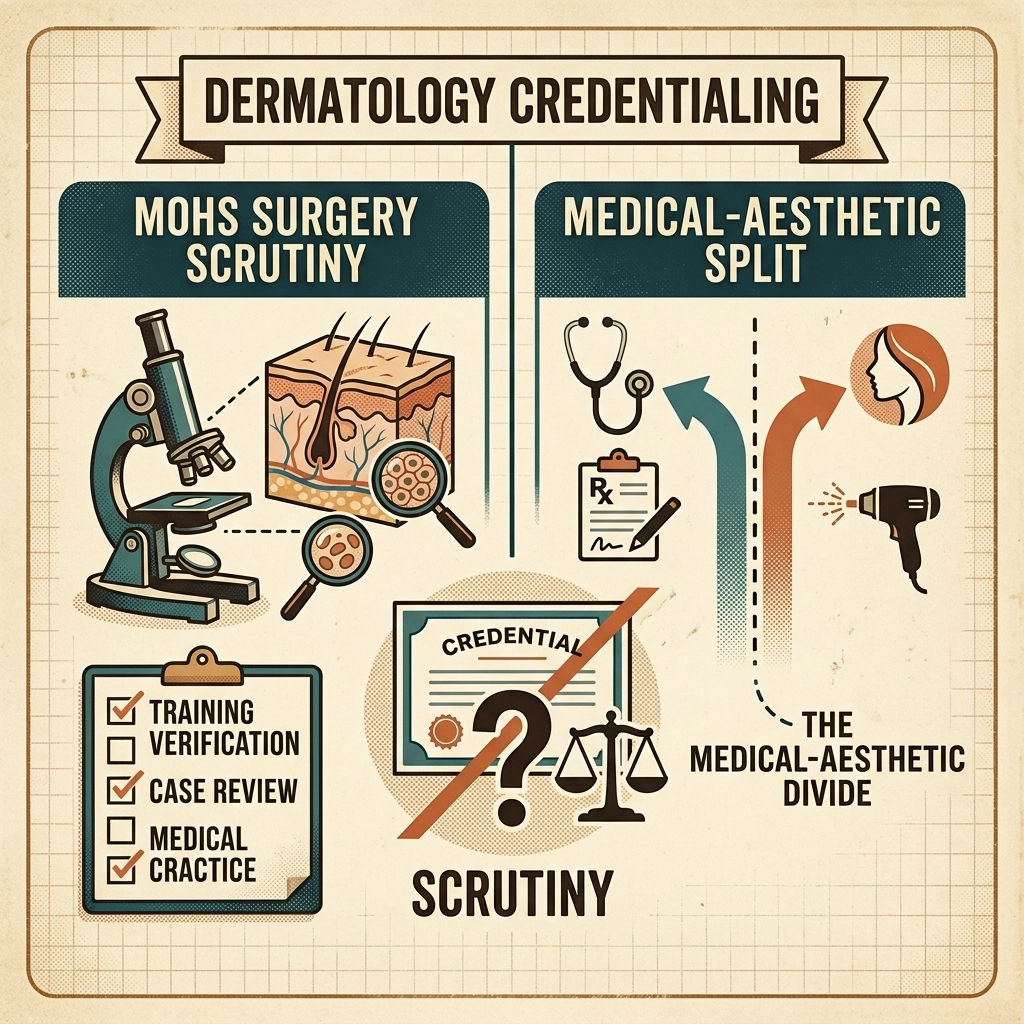
Payers are increasingly using the new Micrographic Surgery and Dermatologic Oncology (MSDO) board certification as a hard gatekeeper for Mohs surgery reimbursement, effectively de-credentialing non-fellowship-trained dermatologists from high-complexity surgical panels. For independent practices, navigating these provider enrollment services is no longer a matter of simple paperwork; it is a defensive maneuver against a declining Medicare conversion factor and heightened audit activity. Utilizing professional enrollment services ensures that your practice maintains access to lucrative surgical CPT codes while commercial carriers tighten their definitions of what constitutes a "qualified" surgeon. Looking for professional provider credentialing services in the USA? 👉 Check our main service page here: veracityeg.com The MSDO Board Certification Gatekeeper The American Board of Dermatology (ABD) introduced the Micrographic Surgery and Dermatologic Oncology (MSDO) subspecialty certification to establish a clear distinction between surgeons who completed an ACGME-accredited fellowship and those who learned the technique through weekend courses or on-the-job training. While the American Board of Dermatology initially allowed a "practice pathway" for experienced surgeons to sit for the exam, that window is closing. Commercial payers like UnitedHealthcare and Aetna are now auditing their dermatology panels to verify MDS/MSDO status. If your provider performs Mohs surgery but lacks this specific subspecialty designation, you face a high risk of being moved to "general dermatology" status. This status change often results in the silent denial of Mohs-specific CPT codes (17311–17315), as the system flags the provider as unqualified to perform the service. This "credentialing-based denial" is a growing trend identified in our Payer Gridlock Report 2026, where administrative barriers are used to suppress surgical spend. Mohs Billing Scrutiny: CPT 17311-17315 and the $32.35 Factor The financial pressure on dermatology practices is intensifying due to the 2025 Medicare conversion factor drop to $32.35. With the base reimbursement for surgical services shrinking, practices cannot afford the common "technical denials" associated with Mohs billing. Payers are specifically scrutinizing the number of "stages" billed per session. CPT 17311 (first stage, head, neck, hands, feet) and 17313 (first stage, trunk, arms, legs) are the anchors of Mohs revenue. However, if a provider consistently bills more than two stages (CPT 17312 or 17314) or multiple tissue blocks (CPT 17315), it triggers a predictive analytics flag in the payer's system. Independent practices must verify that their providers are not only credentialed for these codes but that their board certifications align exactly with the taxonomy codes listed in the NPPES (National Plan and Provider Enumeration System). A mismatch between your CAQH profile and your Medicare enrollment record regarding MSDO status will result in suspended payments. Understanding these Medicare and Medicaid enrollment trends for clinics in 2026 is critical for maintaining cash flow in a high-overhead surgical environment. The Medical-Aesthetic Split and LCD A53883 A significant shift is occurring where payers are bifurcating dermatology panels into "Medical" and "Aesthetic" categories. This split is driven by Local Coverage Determination (LCD) A53883, which outlines strict medical necessity criteria for the removal of benign and premalignant lesions. If your practice heavily promotes Botox, fillers, and laser treatments on its website, payers may classify your facility as an "Aesthetic Center" rather than a medical clinic during the re-credentialing cycle. This classification makes it difficult to join narrow networks for medical dermatology. Key points of friction include: Panel Closures: Many "medical-only" networks are closing to new providers who do not demonstrate a high volume of medical pathology (ICD-10 codes for skin cancer vs. cosmetic concerns). Facility Requirements: Payers are verifying that Mohs suites meet specific laboratory standards (CLIA certification) before allowing enrollment on surgical panels. Marketing Audit: Carriers now use AI to scrape practice websites. If medical dermatology is buried under "Anti-Aging" menus, expect a "non-essential" designation for your medical panels. Modifier 25 and Same-Day E/M Scrutiny The use of Modifier 25 (Significant, separately identifiable E/M service by the same physician on the same day of the procedure) is under a microscope. In dermatology, it is common to evaluate a new lesion and perform a biopsy or Mohs surgery on the same day. However, the Office of Inspector General (OIG) and private payers are aggressively auditing these claims. The Veracity Group has observed that practices with a Modifier 25 utilization rate exceeding the 75th percentile for their geographic region are being hit with "pre-payment reviews." This means every claim is manually reviewed before a cent is paid, creating a 60-to-90-day revenue lag. To mitigate this, Practice Managers must ensure that the documentation clearly supports a "separate and significant" evaluation. If the E/M is merely the "consent process" for the Mohs surgery, Modifier 25 is inappropriate. Enrollment in the CMS Quality Payment Program (QPP) further complicates this, as data on these modifiers is used to score your practice’s efficiency and cost-effectiveness. Mid-Level Supervision and the 2025 Mandates The role of Physician Assistants (PAs) and Nurse Practitioners (NPs) in dermatology is also facing new credentialing hurdles. For 2026, many commercial payers are moving away from "incident-to" billing models in favor of direct billing for mid-levels. This requires every PA and NP to be individually credentialed with every payer. If a mid-level performs a procedure under a physician's NPI, and the payer's policy requires direct enrollment, the claim is fraudulent. Furthermore, supervision requirements are tightening. You must be able to prove that the supervising physician was "immediately available" in the office suite when the mid-level performed a procedure. Verifying that your mid-levels have their own CAQH profiles and are linked correctly to your group's tax ID is a foundational step to avoid clawbacks during a post-payment audit. Practical Steps for Practice Managers Audit CAQH Profiles: Immediately check if your Mohs surgeons are listed with the MDS/MSDO subspecialty taxonomy. If they passed the board exam, this must be updated to avoid being down-leveled to general dermatology. Review LCD A53883: Compare your provider’s documentation for benign lesion removal against the medical necessity requirements in this LCD to prevent "cosmetic" denials for medical procedures. Update NPPES: Ensure the taxonomy codes in the NPI registry match the services being billed. A surgeon billing

Urgent Care Enrollment: Managing Group Contracts and the High Cost of Out-of-Network Penalties

BdQIYdDIZpM

Elevance Health (Anthem) has announced a planned 10% reimbursement reduction for out‑of‑network providers in several states beginning January 1, 2026. For independent urgent care centers, this policy shift is not a minor administrative update; it is a direct threat to the bottom line that demands immediate provider enrollment and strategic group contracting adjustments. In states where Elevance has a major footprint—such as Georgia, Indiana, Kentucky, and several others—the cost of administrative inertia is now quantifiable. Looking for professional provider credentialing services in the USA? 👉 Check our main service page here: veracityeg.com The Elevance Planned Reimbursement Reduction: A Financial Tsunami This planned reimbursement reduction is calculated against the allowed amount for out-of-network claims, effectively widening the gap between cost of care and realized revenue. If your urgent care center currently relies on out-of-network status while waiting for "the right time" to join a panel, that time has passed. The financial impact is compounded when you consider that Elevance Health often processes these claims at a percentage of the current Medicare Physician Fee Schedule. Losing an additional 10% on top of an already discounted rate will push many walk-in clinics into the red. Practice Managers must realize that this announced policy update applies to the rendering provider’s status at the time of service. If a patient is seen by a Physician Assistant (PA) or Nurse Practitioner (NP) who is not fully loaded into the Elevance system under your group contract, the claim will trigger the planned reimbursement reduction. This requires a level of precision in group enrollment that most independent practices are not currently equipped to handle. The NPI Distinction: Type 1 vs. Type 2 One of the most common points of failure in urgent care administration is the misunderstanding of NPI (National Provider Identifier) classifications. Every urgent care facility must maintain a clear distinction between NPI Type 1 and NPI Type 2 to ensure clean claim submission and contract alignment. NPI Type 1 (Individual): This is assigned to the specific provider (MD, DO, PA, NP). It follows the provider regardless of where they work. NPI Type 2 (Organizational): This is assigned to the legal business entity or the specific location of the urgent care. In a group contract environment, the Type 2 NPI acts as the anchor. All contracts are negotiated and held at the Type 2 level. However, for a claim to be paid correctly, the individual provider’s Type 1 NPI must be linked to the group’s Type 2 NPI within the payer’s internal database. If this linkage is missing, even if the group is "in-network," the individual provider is seen as "out-of-network," triggering the planned reimbursement reduction under Elevance’s announced policy update. Adding Mid-Levels to the Walk-In Panel Urgent care centers live and die by their mid-level providers. NPs and PAs provide the majority of the clinical volume in the walk-in setting. However, many payers, including Anthem and UnitedHealthcare, have specific requirements for adding these providers to a facility contract. You cannot simply hire a PA on Monday and have them see patients on Tuesday without risking total claim denials or a planned reimbursement reduction. To avoid the out-of-network trap, you must add mid-levels to your "walk-in panel" immediately upon hire. This process involves updating your CAQH (Council for Affordable Quality Healthcare) profiles and submitting a formal addition request to the payer. Most major payers now require mid-levels to be enrolled at the group level, often utilizing the same fee schedule as the physicians, though sometimes reimbursed at 85% of the physician rate. Failing to manage this specific enrollment detail results in "Provider Not Found" denials, which are increasingly difficult to overturn in the current payer gridlock environment. The 180-Day Reality Check There is a dangerous misconception that enrollment is a quick fix. It is not. There is a massive discrepancy between the timeline for clinical credentialing and the timeline for payer enrollment. Credentialing: Verifying a provider’s background, education, and license typically takes 30-60 days. Enrollment: The process of the payer physically loading that provider into their system and linking them to your group contract takes 120-180 days. If you are opening a new location or hiring a new provider to meet the January 1, 2026, Elevance deadline, you must start the process no later than July 2025. Waiting until the fourth quarter of 2025 guarantees that you will be subject to the planned reimbursement reduction for the first several months of the new year. Payers like Aetna and Cigna are also tightening their windows, often refusing to backdate effective dates, meaning every day your application sits in a "pending" queue is lost revenue that you will never recover. You can read more about the high cost of enrollment delays on our dedicated resource page. Group vs. Individual Enrollment Challenges Independent practices often struggle with whether to enroll providers individually or under a group umbrella. For urgent care, group enrollment is the only viable path for scalability. When you enroll as a group, you are contracting the entity. This allows for easier "add-on" processes for new hires. However, if your Type 2 NPI data is not perfectly synchronized with your IRS Form W-9 and your CP-575 (Letter of TIN Verification), the enrollment will fail. Payers use automated systems to scrub data. A single character difference in a business name: for example, "Veracity Group" vs. "The Veracity Group": will trigger an immediate rejection in the PECOS (Provider Enrollment, Chain, and Ownership System) or other payer portals. Practical Action Plan for Practice Managers To protect your revenue from the 2026 Elevance announced policy update and general out-of-network risks, your administration must execute the following steps: Audit Your Current Roster: Export a list of all NPI Type 1s working under your Type 2 NPI. Cross-reference this with your current Anthem/Elevance provider portal. If a provider is not listed as 'Active/In-Network,' you face a planned 10% reimbursement reduction starting January 1. Clean Up CAQH: Ensure all providers have a CAQH ProView profile that is updated and re-attested within the last 90