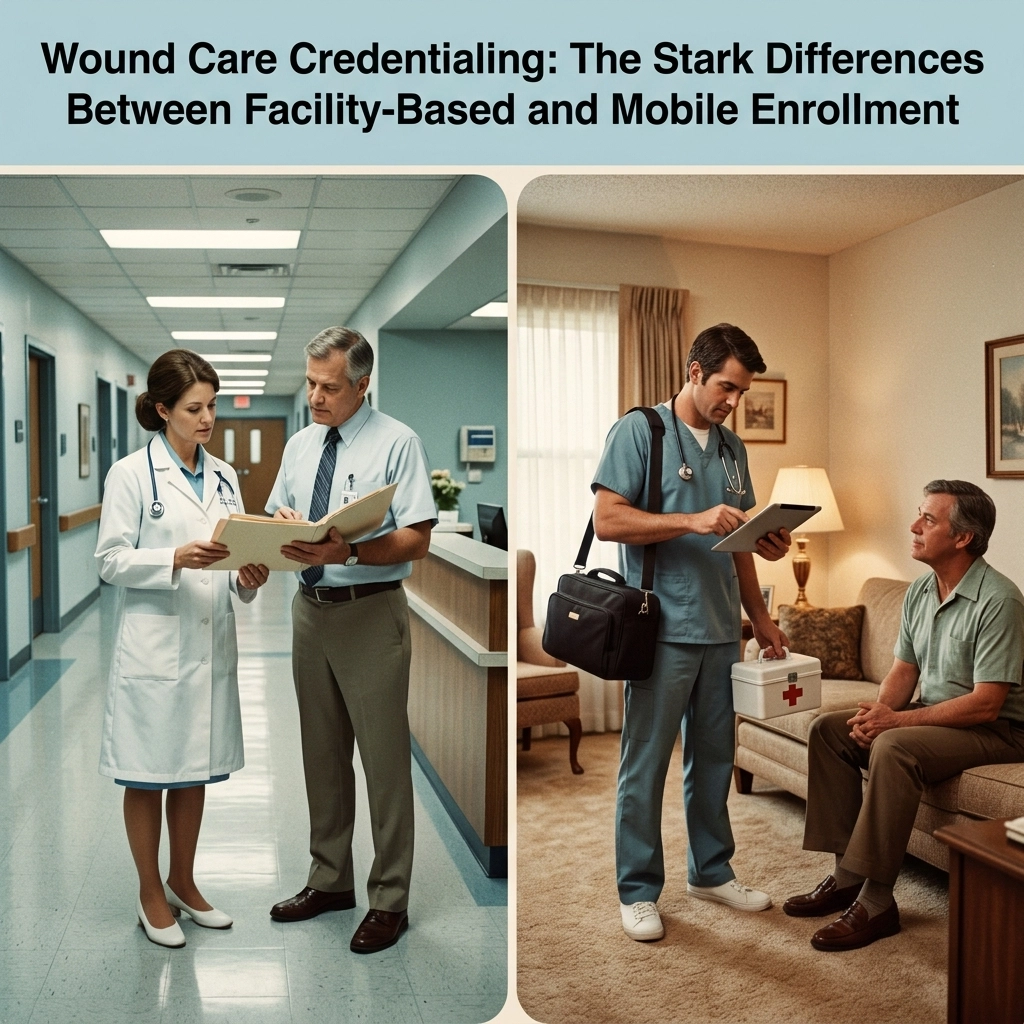
Wound Care Credentialing: The Stark Differences Between Facility-Based and Mobile Enrollment

The landscape of modern medicine is shifting beneath our feet, moving away from the centralized clinic model and into the living rooms of patients across the country. As this evolution accelerates, understanding the nuances of wound care credentialing and the specific hurdles of mobile wound care enrollment is no longer optional for practice owners; it is a prerequisite for survival. While the clinical goal remains the same: healing complex wounds: the administrative pathways to reimbursement for facility-based versus mobile providers are vastly different, often leading to costly delays for those who treat them as identical processes. Looking for professional provider credentialing services in the USA? 👉 Check our main service page here: veracityeg.com The Rise of the Mobile Wound Care Frontier Wound care is a multi-billion dollar sector, and the mobile segment is currently the fastest-growing sub-specialty. Patients with chronic ulcers, diabetic foot complications, or post-surgical issues often face mobility challenges that make traditional outpatient visits a logistical nightmare. Consequently, the industry is seeing a surge in "practices on wheels." However, this rapid growth has outpaced the understanding of payer requirements. When you transition from a facility-based model to a mobile model, you aren't just changing your commute; you are changing your entire legal and administrative profile in the eyes of insurance carriers. Payers like Medicare and major commercial insurers have established rigid frameworks for facility-based wound care, but their rules for mobile entities are frequently more restrictive and require a higher level of scrutiny. Facility-Based Enrollment: The Traditional Anchor In a traditional facility-based wound care setting, the provider is tied to a brick-and-mortar location: typically an outpatient hospital department (HOPD) or a private physician office. Fixed Site Requirements: Payers require a physical site visit, specialized equipment logs, and proof of a safe clinical environment. The enrollment process typically requires attestation of compliance with applicable OSHA and ADA requirements, while CMS site visits generally check for visible operational indicators and practice-location legitimacy rather than performing a full OSHA or ADA audit. Standardized Payer Contracts: Most payers have "standard" contracts for physical clinics. These are the traditional pathways that have existed for decades, making the enrollment process relatively predictable, provided your documentation is in order. Revenue Cycle Stability: Because the Place of Service (POS) is constant (usually POS 11 for a clinic or POS 22 for an outpatient hospital), billing is streamlined. However, even in this traditional model, credentialing delays can paralyze revenue. If a provider joins a facility but isn't properly linked to the group’s Tax ID and NPI, the facility will face immediate claim denials for services rendered. Alt Tag: A professional medical office setting illustrating traditional facility-based wound care infrastructure. Mobile Wound Care Enrollment: Navigating the "Base of Operations" Mobile enrollment is a different beast entirely. Payers are often skeptical of mobile entities because they lack a traditional "controlled" environment. To successfully navigate mobile wound care enrollment, you must satisfy specific criteria that facility-based providers never have to consider. 1. The Legal Entity and Type 2 NPI You cannot simply operate a mobile wound care business under your individual Social Security Number and expect to get paid by major carriers. You must establish a formal legal entity (LLC, PLLC, or PC) and obtain an Employer Identification Number (EIN) from the IRS. Furthermore, while the individual clinician needs a Type 1 NPI, the business entity itself requires a Type 2 NPI. This dual-layer identification is a common point of failure in the enrollment process. 2. The "Base of Operations" Dilemma Even though you are mobile, every payer requires a physical address for their records. This is your "Base of Operations." For many mobile providers, this is a home office or a small administrative suite. However, some payers have specific rules against using residential addresses for business enrollment. Navigating this requires a deep understanding of provider enrollment nuances across different geographic regions and payer types. 3. CAQH Profile Management Your CAQH profile is the backbone of your professional credibility. For mobile providers, the "Practice Location" section of CAQH must be handled with extreme care. You must list your base of operations but also correctly indicate that you are a mobile provider who renders services at the patient's location. Failure to sync your CAQH data with your Medicare PECOS enrollment often results in a rejection or denial of your application. The Place of Service (POS) Trap The single biggest difference between facility-based and mobile wound care lies in the Place of Service (POS) codes. According to the Centers for Medicare & Medicaid Services (CMS), using the wrong POS code is considered a billing error at best and fraudulent at worst. Facility-Based: Typically uses POS 11 (Office) or POS 22 (On Campus-Outpatient Hospital). Mobile Wound Care: Must often use POS 12 (Home), POS 31 (Skilled Nursing Facility), or POS 32 (Nursing Facility). Many mobile providers mistakenly bill under POS 11 because that is what their billing software defaults to, or because they believe their administrative office counts as the "office." This is a high-stakes mistake. Payers pay different rates based on the POS. If you bill POS 11 for a service actually rendered in a patient’s home (POS 12), you are technically misrepresenting the site of service, which can trigger an audit and lead to the clawback of thousands of dollars in payments. Alt Tag: A map showing different patient locations (home, nursing home, clinic) highlighting the complexity of Place of Service codes in mobile wound care. Why Payers Are Tightening the Screws As documented in our latest Payer Gridlock Report 2026, insurance companies are becoming increasingly "selective" about which mobile providers they allow into their networks. Because mobile wound care involves high-value procedures: such as surgical debridement (CPT 11042-11045) and the application of expensive skin substitutes (Q-codes): payers use the enrollment process as a gatekeeping mechanism. They are looking for any reason to deny an application. Common triggers for denial in mobile wound care enrollment include: Inconsistent addresses between IRS records, NPI registries, and state licenses. Lack of a "brick-and-mortar"
Physical Medicine and Rehabilitation (PM&R) Credentialing: Navigating Payer Panel Access and Prior Auth Hurdles

For a physiatrist, the ability to restore function and improve quality of life for patients is the ultimate goal. However, before you can even schedule a single session of gait training or evaluate a complex spinal cord injury, you face an administrative gauntlet. PM&R credentialing is the silent driver of your practice’s financial health, serving as the passport to success in a competitive healthcare landscape. Without secured payer panel access, your specialized rehabilitation services are effectively locked behind a door you cannot open. In the world of Physical Medicine and Rehabilitation, the administrative burden is uniquely heavy. You aren't just dealing with standard office visits; you are managing multidisciplinary teams, durable medical equipment (DME) requirements, and intensive therapy protocols. At The Veracity Group, we see many practices hit a "revenue wall" when they add new rehab services, only to realize that their providers aren't correctly linked to the necessary payer panels. This oversight leads to a catastrophic cascade of prior authorization denials and mounting claim holds. Looking for professional provider credentialing services in the USA? 👉 Check our main service page here: veracityeg.com The Invisible Barrier: Why Payer Panel Access Dictates Prior Auth Most PM&R practices view prior authorization as a clinical hurdle: a matter of proving medical necessity for a patient’s rehabilitation plan. While clinical documentation is vital, a high-probability reason for a prior authorization "auto-denial" has nothing to do with the patient’s condition. It has everything to do with your rehabilitation services enrollment status. If a provider is not fully credentialed and correctly linked to the specific payer panel, many insurance companies’ systems may not even allow the prior authorization request to be initiated. You cannot get approval for a treatment if the payer doesn’t officially recognize you as an authorized provider in their network. This creates a paralysis in patient care where your therapists are ready to work, the patient is waiting for treatment, but the administrative system is at a standstill. Alt-tag: A professional medical office setting showing the administrative process of payer panel management for rehabilitation providers. The High Cost of Gridlock When your PM&R credentialing lags, the financial consequences are immediate and severe. Major commercial payers, including UnitedHealthcare and Aetna, are notorious for placing "holds" on claims while the linking process is finalized. These delays will result in revenue gaps lasting anywhere from 90 to 150 days. According to our latest Payer Gridlock Report 2026, the rehabilitation sector has seen a 15% increase in panel closures over the last year. This means that simply "applying" is no longer enough. You must actively manage the enrollment lifecycle to ensure you aren't stuck in a pending status while your overhead continues to climb. The Specifics: PM&R and Rehabilitation Nuances PM&R isn't a "one-size-fits-all" specialty. Your rehabilitation services enrollment must account for several specific factors that other specialties often overlook: Functional Outcome Documentation: Payers now frequently require specific proof of your practice’s ability to track functional outcomes (such as FIM scores or other validated scales) before granting access to premium rehab panels. Multidisciplinary Linking: In a PM&R setting, you often have a mix of MDs/DOs, Physical Therapists, and Occupational Therapists. Ensuring that every NPI is correctly linked to the group’s Tax ID (TIN) is the backbone of professional credibility. Medicare Part B and DMEPOS: Many PM&R practices provide orthotics or specialized equipment. This requires specialized Medicare enrollment through the PECOS system, with DMEPOS focused on supplier standards and applicable state licensure. DEA/CSR registration is a prescribing requirement, not a DMEPOS enrollment requirement, though prescribing workflows still demand close medical licensing and DEA/CSR oversight. Managing the Enrollment Lifecycle with Veracity At The Veracity Group, we don't just "submit paperwork." We manage the entire lifecycle of your enrollment to ensure your practice remains operational and profitable. Our process is designed to bypass the common credentialing delays that plague modern healthcare. 1. Proactive Data Reconciliation Provider demographic data is fluid; research indicates that roughly 2–3% of provider information changes every single month. We maintain a single source of truth for your practice, ensuring that your CAQH profile is never the reason for a rejected application. 2. Aggressive Payer Follow-up We do not wait for payers to contact us. Veracity’s team performs regular, systematic "touches" on every pending application. We understand the internal mechanics of the major payers and know exactly who to call when an application is stuck in the "black hole" of a payer’s credentialing department. 3. Contractual Alignment Securing payer panel access is only half the battle. You must ensure that your contracts reflect the specialized nature of PM&R. We assist with contracting strategies that ensure your rehabilitation codes (such as the 97000 series CPT codes) are reimbursed at the appropriate specialist rates rather than generic primary care rates. Alt-tag: A digital dashboard displaying the lifecycle management of a provider enrollment application with Veracity's tracking tools. The 6-Month Rule: Planning for Success If you are planning to add new rehab services or bring on a new physiatrist, you must start the process at least six months in advance. Waiting until the provider’s start date to begin PM&R credentialing is a recipe for disaster. Consider this scenario: You hire a top-tier PM&R specialist. They start on June 1st. If you haven't initiated the provider enrollment process by January, that provider will likely be unable to see insured patients or obtain prior authorizations for half the year. The loss of revenue from a single uncredentialed provider can easily exceed six figures in just a few months. Looking for professional provider credentialing services in the USA? 👉 Check our main service page here: veracityeg.com Actionable Steps for Your PM&R Practice To avoid the pitfalls of the current payer landscape, you must take a disciplined approach to your administrative operations: Audit Your NPIs: Ensure every provider in your group is correctly linked to your TIN across all major payers. Centralize Documentation: Keep digital copies of all state licenses, DEA registrations, and malpractice face sheets in a central, secure location. Monitor Panel
Enrollment Matters: Weekend Healthcare News Update

Staying ahead of the curve in provider enrollment is the only way to ensure your medical billing cycle remains uninterrupted in an increasingly volatile regulatory environment. At The Veracity Group, we know that your Sunday morning should be about recharging, but the healthcare world doesn’t hit the pause button. This weekend, several high-impact updates from major federal agencies and industry watchdogs have surfaced, signaling a massive shift in how clinics must handle their administrative back-end. If you aren't paying attention to the movement within the CMS Newsroom or the latest reports from KFF, you are leaving your revenue at the mercy of bureaucratic friction. CMS PECOS 2.0: The Digital Overhaul Gathers Steam As reported by CMS Newsroom, the transition toward the fully integrated PECOS 2.0 is no longer a "future project": PECOS modernization is underway and increasingly affecting all providers seeking to maintain Medicare participation. CMS recently released updated guidance regarding the consolidation of enrollment applications. The goal is to create a single, intuitive interface that tracks a provider from their initial application through every subsequent revalidation and change of information. While CMS markets this as a "streamlined experience," the technical reality for many multi-state groups is a steep learning curve. The new system requires a higher degree of data precision than the legacy platform. Specifically, the logic checks within the new portal are designed to flag and reject mismatches more aggressively between the National Provider Identifier (NPI) registry and the enrollment record. The Veracity Take The "silent driver" of revenue growth is often just having your paperwork in order. The shift to PECOS 2.0 will be the primary hurdle for clinics in 2026. If your staff treats these digital updates as "business as usual," you are inviting a total stop-payment on your Medicare claims. This isn't just a technical update; it’s a gatekeeping mechanism. The Veracity Group recommends an immediate audit of your current PECOS records. Ensure that your "Authorized Official" and "Delegated Official" roles are correctly assigned before legacy access points are expected to be phased out. A delay in accessing the new portal during a revalidation window will lead to deactivation. Remember, once you are deactivated, the road back to "active" status is paved with lost revenue and manual appeals. A Memphis Design style illustration showing interconnected geometric shapes, representing the complex web of digital provider data. Medicaid Redeterminations and the "Ghost Provider" Crisis According to a breaking report by KFF Health News, the "unwinding" of Medicaid continuous enrollment has created a secondary crisis: the rise of "ghost providers." As millions of patients lose coverage, state agencies are also purging provider directories at an unprecedented rate. KFF notes that providers who have not submitted a claim in over 12 months, or those with outdated enrollment addresses, are being purged from state systems with limited notice. This purge is an attempt by states to clean up their data, but the consequence-driven reality is that legitimate, active providers are finding their Medicaid enrollment terminated overnight. For clinics serving vulnerable populations, this means services rendered on Monday might be unbillable by Tuesday. The Veracity Take This is the backbone of professional credibility. You cannot afford to appear as a "ghost" in the eyes of the state. The practical consequence for your clinic is simple: if you are not actively monitoring your state's Medicaid portal, you are flying blind. We are seeing a surge in "Enrollment Denied" notices simply because a provider moved suites within the same building and didn't update their enrollment file. To navigate these choppy waters, you must treat your enrollment data as a living document. You can find more strategies on maintaining your status in our guide on enrollment tips. The high cost of delays in Medicaid re-enrollment can often exceed the cost of the actual medical care provided. Do not wait for a claim denial to check your status. Site-Neutral Payments: The New Enrollment Trigger As reported by Modern Healthcare, the federal government is doubling down on site-neutral payment policies. Recent discussions highlight the requirement for hospital-owned clinics and independent groups to demonstrate specific "site of service" designations through their enrollment profiles to qualify for certain reimbursement tiers. This move aims to equalize payments for the same service, regardless of whether it’s performed in a hospital outpatient department or a standalone clinic. However, the administrative burden falls squarely on the provider's enrollment team. To receive the correct payment rate, the enrollment file must perfectly align with the facility’s NPI and the billing codes being utilized. The Veracity Take This policy change is a passport to success for independent clinics that can prove they offer high-value care at a lower cost. But here is the catch: if your enrollment profile does not clearly designate your facility type under the new CMS definitions, you may be assigned a lower reimbursement rate if your facility type is not correctly designated. The Veracity Group sees this as a make-or-break moment for facility enrollment. It’s no longer enough to just "be" enrolled; you must be enrolled under the correct classification. For practices expanding their footprint or acquiring new locations, this means the enrollment process must begin months before the first patient walks through the door. A Cyberpunk style digital interface showing glowing data streams and healthcare icons, symbolizing the high-tech nature of modern provider enrollment. The Ripple Effect: Why "Wait and See" is a Failed Strategy In the world of healthcare, the phrase "wait and see" is the most expensive sentence a clinic owner can say. The news from this weekend highlights a clear trend: enrollment is becoming more technical, more frequent, and more punitive. Whether it is the PECOS 2.0 transition or the aggressive auditing of Medicaid directories, the "set it and forget it" mentality of a decade ago is dead. When your enrollment data is fragmented across different payers, you create "friction points" that slow down your cash flow. Consider the impact of a single provider's enrollment lapse: Claim Denials: Immediate rejection of all services. Patient Dissatisfaction: Patients