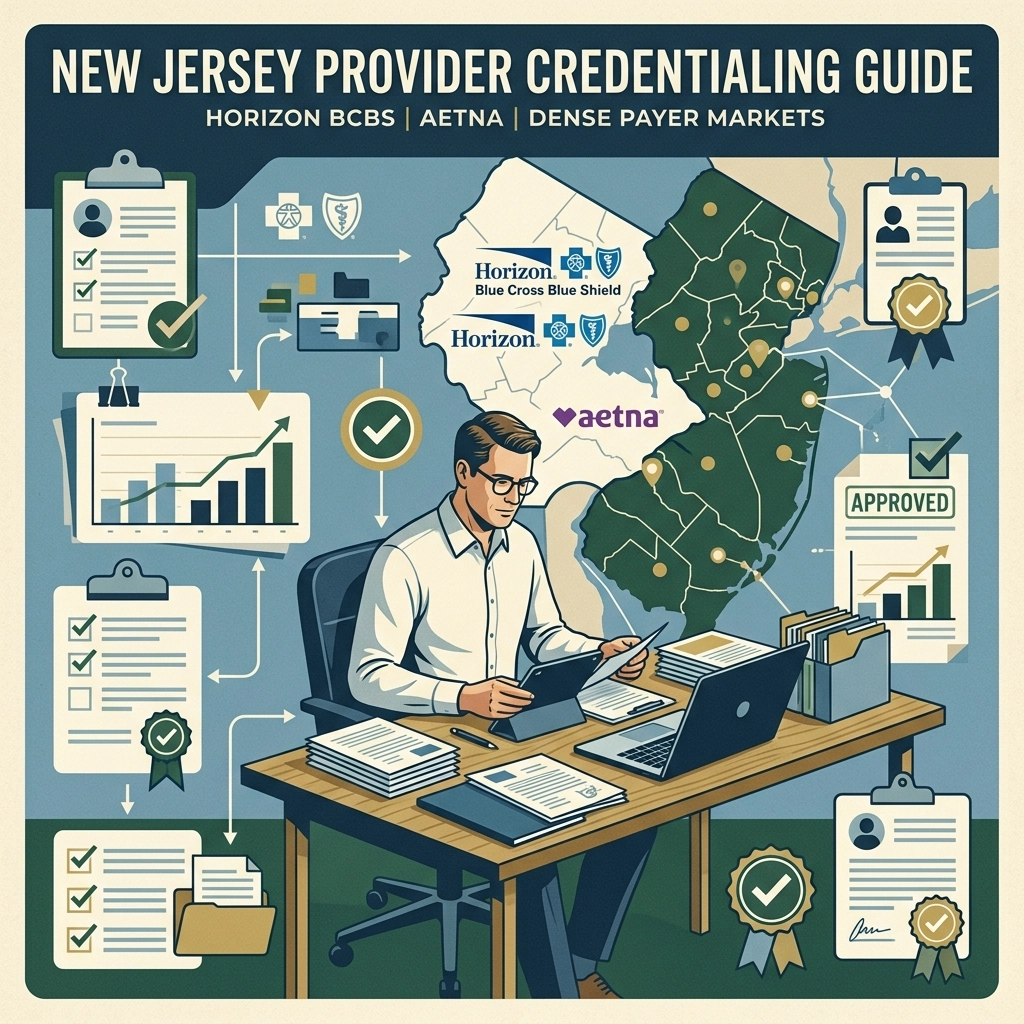
How to Credential a Provider in New Jersey: Horizon BCBS, Aetna, and Dense Payer Markets

Navigating the healthcare landscape in the Garden State is no small feat in 2026. If you are looking to expand your practice, mastering provider enrollment in New Jersey is the ultimate passport to success. The market here is a dense, competitive payer market, requiring a sophisticated approach to credentialing services to ensure your revenue stream remains uninterrupted and your providers are ready to see patients without delay. Looking for professional provider credentialing services in the USA? 👉 Check our main service page here: veracityeg.com The New Jersey Landscape: A Dense and Competitive Arena New Jersey remains one of the most complex and saturated payer markets in the United States. With a high concentration of specialized medical centers and a massive population density, the "Payer Gridlock" is a very real phenomenon. In this environment, your data accuracy isn't just a clerical requirement, it is the backbone of professional credibility. In a market this competitive, payers are looking for any reason to push back an application. Whether you are a solo practitioner in Jersey City or managing a multi-specialty group in Cherry Hill, you are competing for the attention of provider relations departments that are often overwhelmed. Understanding the nuances of the major players, specifically Horizon Blue Cross Blue Shield of New Jersey (BCBSNJ) and Aetna, is critical to staying ahead of the curve. Alt-tag: A modern, sleek healthcare administration office in New Jersey featuring high-tech workstations and professional staff collaborating. Horizon BCBS: The Medversant and CAQH Connection Horizon BCBS is the dominant force in the New Jersey market. To get your providers in-network, you must respect their specific ecosystem. Unlike some states where a simple application suffices, Horizon utilizes a dual-layered approach involving CAQH ProView and a third-party PSV vendor. 1. The Application Foundation First, your provider's CAQH profile must be pristine. This is the silent driver of your enrollment success. Every document, from your medical licensing to your malpractice insurance face sheet, must be current and authorized for release to Horizon. 2. The Medversant Factor Horizon uses a third-party PSV vendor, and industry sources identify Medversant as a common partner. This means you aren't just dealing with Horizon; you are dealing with a third-party gatekeeper. Any discrepancy between your CAQH data and the verification workflow will trigger a manual review, adding weeks to your timeline. 3. The Submission Process Once your data is synchronized, you must submit the appropriate application package to the Newark headquarters. Horizon offers specialized tracks for MDs, DOs, and allied health professionals. The process typically takes 30–90 days from the date all required information is received. Some payers may reject applications submitted too far in advance; practices should confirm Horizon’s current timing rules before filing for a future effective date. Aetna: Navigating Timelines and the Enrollment Distinction Aetna operates with a different rhythm than Horizon. In the New Jersey market, Aetna is known for its rigorous standards and a slightly longer lead time. If you underestimate that pace, your practice will feel it in delayed billing, delayed directory accuracy, and delayed revenue. The 90-120 Day Reality In 2026, a 90 to 120 day timeline for Aetna in New Jersey is a common industry observation. This longer lead time reflects the volume of providers in the NJ/NY metropolitan area and the realities of a dense, competitive payer market. You must account for this "holding pattern" when hiring new staff or opening a new location. Strategic Use of Availity Aetna processes most enrollment functions through Availity, consistent with their national workflow. If your practice isn't leveraging Availity's electronic submission tools, you are essentially working with one hand tied behind your back. This portal supports status visibility that is vital for preventing the high cost of delays. Alt-tag: A professional dashboard displaying healthcare analytics and provider enrollment tracking on a modern computer screen. The Importance of Data Accuracy in High-Volume Markets In a dense payer market like New Jersey, there is zero margin for error. A single typo in an NPI number or an outdated demographic update can lead to a "rejection at the gate." This doesn't just delay your start date; it can lead to a cascade of denied claims that will haunt your revenue cycle for months. At The Veracity Group, we see this daily. Practices attempt to handle their own provider enrollment and find themselves stuck in a loop of resubmissions because they missed a single checkbox on a 40-page application. In NJ, the payers are looking for "clean" files. If your file is messy, it goes to the bottom of the pile. The Consequences of Poor Planning What happens when you don't act proactively? The consequences are severe: Revenue Stagnation: New providers cannot bill for their services, leading to thousands of dollars in lost potential income. Patient Frustration: Patients who find your provider in a directory only to be told you are "out-of-network" will likely take their business elsewhere. Administrative Burnout: Your office staff will spend hundreds of hours on hold with provider relations, taking them away from patient care. As reported in our Payer Gridlock Report 2026, Veracity Group internal analysis shows that the average New Jersey practice loses over $25,000 per provider due to avoidable enrollment delays. This is an unnecessary tax on your growth. Why Outsource Your New Jersey Enrollment? The Veracity Group functions as your expert partner in this complex environment. We understand the specific requirements for contracting in New Jersey and how to navigate the regional nuances of Horizon and Aetna. We don't just fill out forms; we manage the entire lifecycle of the application. Proactive Follow-up: We don't wait for the payer to call us. We proactively monitor the status of every application via Availity and Medversant. Data Integrity: Our team performs a 20-point audit on your CAQH profile before any submission. Contract Analysis: We ensure your contracts are negotiated to reflect the true value of your services in the NJ market. Alt-tag: Two healthcare executives in a modern, glass-walled office in New Jersey discussing contract strategies with
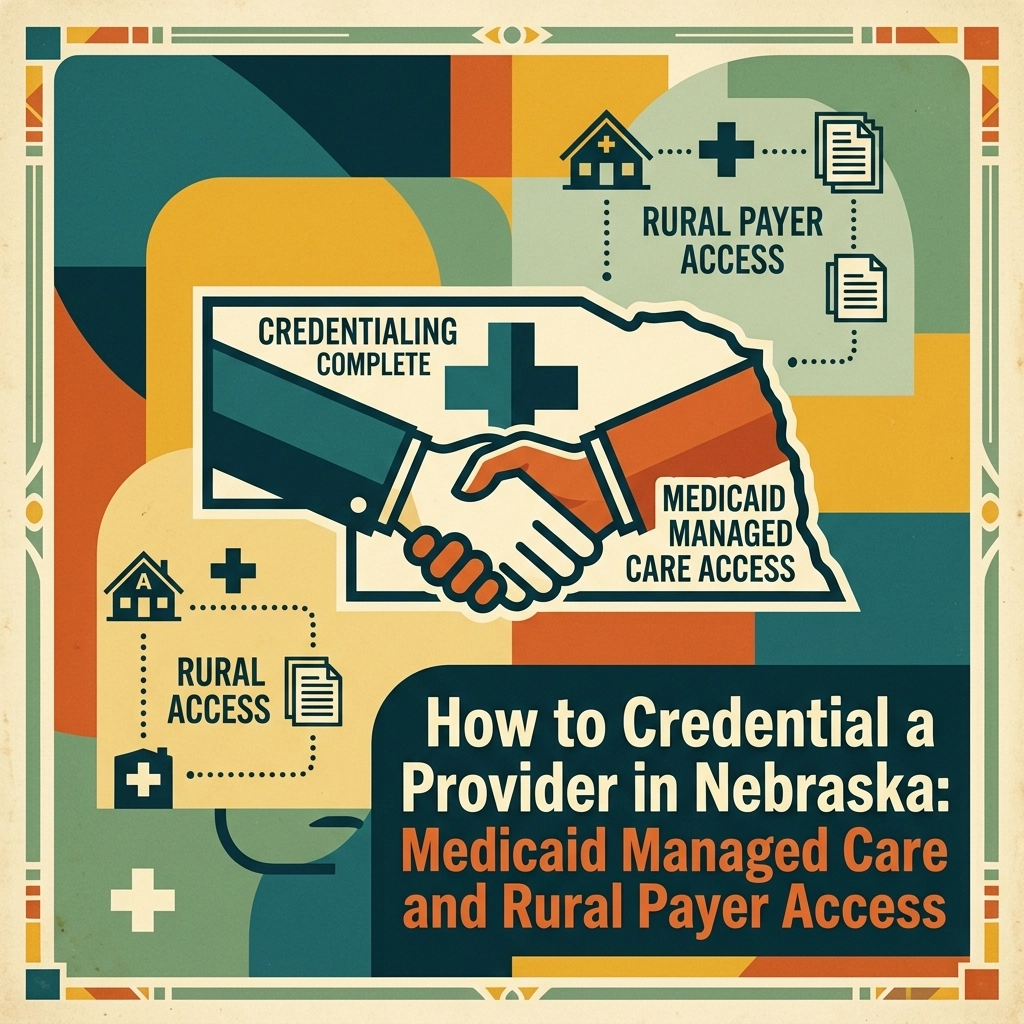
How to Credential a Provider in Nebraska: Medicaid Managed Care and Rural Payer Access

Navigating the healthcare landscape in the Cornhusker State requires more than just clinical expertise; it demands a sophisticated strategy for provider enrollment and a deep understanding of the regulatory shifts that have reshaped the region. By early 2025, Nebraska had streamlined its approach to Heritage Health, but the high stakes of credentialing services remain a critical barrier for practices aiming to capture rural payer access. If your practice isn't perfectly aligned with the Nebraska Department of Health and Human Services (DHHS) requirements, you aren't just facing paperwork: you are looking at a de facto shutdown of your Medicaid revenue stream. The reality is that Nebraska’s rural geography creates a unique "payer vacuum" where Medicaid Managed Care (MCO) dominance is absolute. To thrive here, you must master the electronic gates of Maximus and the centralized scrutiny of Verisys. Failure to do so will result in credentialing delays that can leave your providers sidelined and your balance sheets in the red for months. The Heritage Health Ecosystem: Understanding the Players In Nebraska, Medicaid is managed through the Heritage Health program. This integrated delivery system combines physical health, behavioral health, and pharmacy services into a single package for members. For you, the provider, this means your enrollment journey is tied to three primary Managed Care Organizations: Nebraska Total Care, Molina Healthcare, and UnitedHealthcare Community Plan. The "old way" of submitting three different stacks of paper to three different insurance giants is dead. In its place is a highly centralized, data-driven machine. Since the major overhaul in early 2025, Nebraska has moved toward a unified verification model. If you are not utilizing these centralized tools correctly, you are essentially working with an outdated map in a new territory. Alt-tag: A clean, modern 2026 corporate office setting with professional staff analyzing Nebraska healthcare data on high-tech monitors. Step 1: The Maximus Gatekeeper and the PDMS Portal Your journey begins with the Provider Data Management System (PDMS). In Nebraska, provider enrollment is funneled through Maximus, the state’s dedicated enrollment contractor. You cannot bypass this step. Think of Maximus as the foundation of your professional house; without an active Medicaid ID issued through the PDMS, no MCO will even look at your file. The Maximus Checklist for 2025: Electronic Submission: Effective June 1, 2025, enrollment through the PDMS became electronic-only. As practical guidance, you should treat paper submissions as an administrative dead end and route everything through the portal to avoid preventable delays and headaches. Disclosure of Ownership: You must disclose every individual with a 5% or greater interest in your entity. This requirement aligns with federal CMS screening rules, and it is where many practices trip up and trigger preventable denials. Site Visits: Depending on your provider type: especially for high-risk categories like DME or home health: site visits are required under federal CMS screening rules that Nebraska applies through its enrollment process. Application Fee: Ensure your current-year fee is paid when applicable, because application fees for certain provider types also track federal CMS screening requirements and will leave your file in "pending" purgatory if missed. Looking for professional provider credentialing services in the USA? 👉 Check our main service page here: veracityeg.com Step 2: Centralized Verification via Verisys Once you have cleared the state-level hurdle with Maximus, you enter the realm of the Centralized Verification Organization (CVO). Starting in January 2025, Nebraska moved all MCO-specific credentialing to Verisys. This is a massive win for efficiency, provided you know how to leverage it. Instead of proving your residency, board certification, and malpractice history three separate times, you do it once through the Verisys platform. Verisys acts as the "source of truth." They perform Primary Source Verification (PSV) on your medical education, state licenses, and National Practitioner Data Bank (NPDB) history. They are looking for even the slightest discrepancy. A single mismatched date on your work history can trigger a manual review that adds weeks to your timeline. Alt-tag: A sophisticated 2026 data interface showing a streamlined provider verification dashboard with green checkmarks indicating successful Primary Source Verification. Rural Payer Access: The Nebraska Advantage Nebraska is a state of vast distances and critical needs. For providers, this means that "Rural Payer Access" isn't just a buzzword: it’s a leverage point. As an industry observation, rural network pressure gives providers in underserved areas more strategic importance because the MCOs must maintain adequate coverage in the Panhandle and other hard-to-staff regions. By securing your enrollment in these areas, you position your practice as an essential part of the Nebraska healthcare infrastructure. However, rural access comes with its own operational wrinkles. As strategic context, organizations structured as Rural Emergency Hospitals (REH) or Federally Qualified Health Centers (FQHCs) usually face more complex enrollment paths than a standard private practice because of site configurations, service lines, and payer record alignment. You must ensure your medical licensing and DEA registrations are meticulously updated to reflect every site where you provide care. The High Cost of Credentialing Delays In the current economic climate, you cannot afford to have a provider on staff who isn't generating revenue. We see it every day: a practice hires a top-tier surgeon or an LCSW for their mental health clinic, only to realize sixty days later that the provider isn't yet "par" with UnitedHealthcare or Molina. The consequences are devastating: Revenue Forfeiture: In most cases, you cannot retroactively bill for services rendered before your enrollment effective date. Every patient seen is essentially "charity care." Patient Dissatisfaction: Patients in rural Nebraska talk. If they receive a "denied" notice because their provider isn't in-network, your reputation takes a hit that marketing can't fix. Compliance Risks: Seeing Medicaid patients while your enrollment is in a "pending" or "expired" status can trigger audits and even accusations of fraudulent billing. To avoid these pitfalls, you must start the re-credentialing process early. Nebraska Total Care and its peers require a full re-verification every three years. If you wait for the "6-month warning" from Verisys, you are already behind. You should be auditing your CAQH
Can a Solo Physician Negotiate a Better Rate with United Healthcare?

For the modern solo practitioner, navigating the complexities of provider enrollment services often feels like a one-way conversation where the payer holds all the cards. When dealing with massive health plans like United Healthcare (UHC), the sheer scale of the organization can be intimidating. Many physicians believe that because they lack the volume of a multi-specialty group or a hospital system, they must simply sign whatever contract is placed in front of them. This assumption is not only incorrect; it is a direct threat to the financial viability of your practice. The truth is that while United Healthcare is indeed the largest commercial payer in the United States, your solo practice is the backbone of professional credibility within their network. You provide the localized, high-quality care that keeps their members satisfied and their costs manageable. Negotiating a better rate is not just a "nice to have", it is a business necessity in an era of rising overhead and stagnant reimbursements. The Myth of the "Take It or Leave It" Contract The most common hurdle solo physicians face is a psychological one. There is a prevailing myth in the industry that solo providers have zero leverage. You may have heard stories of providers being told that their rates are "standard" or "non-negotiable." In reality, healthcare contracting is a negotiation, and across the industry, the payer's initial offer is commonly treated as a starting point rather than the final word, even though that should be understood as an industry inference rather than documented UHC policy. United Healthcare relies on a robust network of independent physicians to maintain geographic adequacy requirements mandated by state and federal regulators. If UHC loses too many solo practitioners in a specific zip code, they risk non-compliance with network adequacy standards. This is your passport to success in a negotiation. You are not just a provider; you are a critical component of their regulatory compliance. Benchmarking: Your Data-Driven Strategy You cannot walk into a negotiation with a giant like UHC armed only with a "feeling" that you are underpaid. Success requires a clinical, data-driven approach. You must begin by benchmarking your current rates against the CMS Physician Fee Schedule. Benchmarking against Medicare is standard industry practice when evaluating commercial payer rates, even though UHC does not formally document a Medicare-based pricing formula in its public provider guides. If your current contract is paying you 80% or 90% of Medicare, you are effectively subsidizing the insurer's profits with your labor. A successful negotiation starts by identifying exactly where your top ten most-billed CPT codes sit relative to Medicare and other local competitors. To gain a clearer picture of how your practice compares to broader industry shifts, reviewing our guide on health plans will help you understand the landscape before you make your move. Why United Healthcare Needs Your Solo Practice Payers are currently experiencing a dynamic shift. They are beginning to realize that the massive consolidation of physicians into large hospital systems actually drives up costs for the insurer. Large systems have the muscle to demand competitive commercial rates because of their scale. In contrast, industry observers often view an independent solo physician as a cost-effective partner for the insurer. When you approach UHC, emphasize these three pillars of value: Access and Availability: Do you offer same-day appointments? Do you have a specialized niche that is underserved in your area? Quality Metrics: Can you demonstrate lower ER utilization rates for your patient panel? High patient satisfaction scores are a silent driver of contract value. Cost Efficiency: You provide high-level care without the "facility fees" associated with hospital-owned practices. This saves the payer money on every single claim. By framing the conversation around how you save them money, you shift the perspective from a "rate hike" to a "value-based adjustment." The Formal Proposal: Steps to Engagement Negotiating with UHC is not about a quick phone call to a customer service line. It is a formal process that requires a professional presentation. At The Veracity Group, we see the most success when providers follow a structured pathway. 1. Identify Your Provider Contact Pathway UHC offers regional contact pathways through its provider resources, and those routes are your gateway to the right conversation. You must establish the appropriate contact pathway before you ever mention rates. If you don't know where to start, you can use the UnitedHealthcare Provider Portal to find the best regional contact route. 2. The Value Proposition Letter Prepare a formal proposal that outlines why your practice deserves an adjustment. This letter should be devoid of emotion and filled with facts. Include your NPI, your geographic service area, and a list of the specific CPT codes you are targeting for an increase. 3. Analyze the "Wash" Be wary of payers offering an increase in one area while simultaneously decreasing rates in another. This "shell game" is common. If UHC offers you a 5% increase on your evaluation and management (E/M) codes but cuts your procedural codes by 10%, you might actually lose money. You must perform a weighted analysis based on your actual billing volume to ensure the net impact is positive. Navigating the Risks of Negotiation There is an inherent risk in any negotiation. The real issue is not that asking for a rate review automatically creates conflict; it is that contract discussions must stay professional, strategic, and supported by clear data during renewal cycles. This is exactly why preparation and disciplined communication matter. The "take it or leave it" attitude often stems from a lack of competition in the payer market. However, with the right enrollment tips, you can position your practice so that UHC views you as an indispensable asset rather than an interchangeable line item. If you are a solo practitioner in a saturated market with dozens of other providers in your same specialty within a five-mile radius, your leverage is lower. In this case, your strategy must focus on clinical differentiation, what do you do that the doctor across the street doesn't? The