Operational Rigor for Independent Practices: The Veracity Group Service Stack

Revenue leakage in an independent practice is rarely the result of poor clinical care; it is almost always the result of administrative friction. When a new provider joins your team in a state like Indiana, the clock begins ticking on a fiscal countdown that determines whether that hire is an asset or a liability for the first two quarters. Implementing robust provider enrollment and credentialing services is the only way to stop the bleeding before it begins. If your practice operates without a rigorous framework for data management and payer relations, you are effectively volunteering to provide free labor for months on end. Looking for professional provider credentialing services in the USA? 👉 Check our main service page here: veracityeg.com The 90-Day Revenue Wall The financial health of your practice depends on a 90-day timeline. This is the window where most administrative failures occur. From the moment a contract is signed, the race to secure effective dates begins. If your provider is seeing patients but isn't yet loaded into the payer’s system, those claims will sit in limbo or face immediate denial. We see this most frequently with major payers like Anthem. Because Anthem maintains significant market share in various regions, being "out" for even a few weeks can derail your monthly projections. The Veracity Group treats this 90-day window as a hard deadline. We do not wait for payers to send reminders. We push the file through the system using a persistent, data-driven approach that ignores the standard "wait and see" mentality that plagues many in-house billing departments. You can read more about the high cost of credentialing delays and how they impact your bottom line. Provider Enrollment: Beyond the Paperwork Enrollment is the foundation of your revenue cycle. It is not merely filling out forms; it is the strategic mapping of your providers to the correct tax IDs and NPIs within the payer databases. Mistakes here are correctable, but the correction process is slow, resource-intensive, and financially damaging. Fixing a bad enrollment record often takes weeks or months, and the revenue disruption during that gap is costly. The Veracity Group manages provider enrollment by establishing a clean data trail. We ensure that every location, every specialty, and every sub-specialty is accurately reflected. This prevents the "not found" errors that lead to patient frustration and uncollectible balances. When you hire us, we act as the aggressive intermediary between your practice and the insurance giants. We speak their language, we know their portals, and we know exactly which buttons to push when a file gets stuck in the black hole of "initial review." Credentialing and the CAQH Requirement CAQH is the backbone of professional credibility in the modern medical office. If your CAQH profile is incomplete, outdated, or contains conflicting information, your credentialing will stall. There is no middle ground. Many practices treat CAQH as a "set it and forget it" task, but the reality is that regular attestations and document updates are mandatory. Our team takes full ownership of your CAQH profile. We ensure that every certification, every insurance policy, and every work history detail is verified and uploaded. This level of operational rigor ensures that when a payer like UnitedHealthcare or Aetna goes to pull your data, they find a perfect file. Perfection in the data stage leads to speed in the approval stage. We eliminate the back-and-forth requests for "missing information" that typically add weeks to the process. Medical Licensing and DEA Registration You cannot practice medicine without a license, and you cannot prescribe controlled substances without a DEA registration. While these seem like basic requirements, the administrative burden of maintaining them across multiple providers can be overwhelming. Each state has its own quirks: especially when dealing with the Indiana Professional Licensing Agency (IPLA) or similar bodies. The Veracity Group handles medical licensing and DEA registration with a focus on expiration management. We don’t just help you get the license; we ensure you never lose it due to an administrative oversight. We track the renewals, handle the fees, and manage the communication with the boards. This allows your providers to focus on patients while we handle the regulatory gatekeeping. Payer Contract Analysis and Negotiation Getting into a network is only half the battle. The other half is ensuring that the rates you are paid are actually sustainable for your business. Many independent practices sign the first "standard" contract put in front of them by Anthem or Cigna, not realizing they have just locked themselves into rates that haven't been updated in years. Our payer contract analysis and negotiation service is designed to identify these discrepancies. We look at your top-billed codes and compare them against the proposed fee schedules. If the math doesn't work, we tell you. If there is room for negotiation based on your patient volume or specialty, we lead that charge. You should never be the lowest-paid provider in your zip code simply because you didn't have the data to ask for more. For a deeper dive into how this affects your long-term strategy, check our guide on contracting and negotiations. The Veracity Service Stack: A Comprehensive Approach When you look at our full list of services, you see a stack designed for total practice protection. We are not a "temp agency" for paperwork. We are an operational partner. Our stack includes: Initial Credentialing: Getting your providers into the system fast. Re-credentialing: Maintaining your status without interruptions. Medicare/Medicaid Enrollment: Managing the complex CMS requirements via PECOS. Demographic Updates: Ensuring your directory information is accurate so patients can find you. Ongoing Monitoring: Constant surveillance of license expirations and OIG sanctions. This integrated approach means that no part of the provider's professional identity falls through the cracks. If a provider's license is due for renewal, we already have it on our dashboard. If a payer is lagging on a contract update, we are already on the phone with their provider relations representative. Why Operational Rigor is Non-Negotiable The healthcare industry does not reward "trying hard."
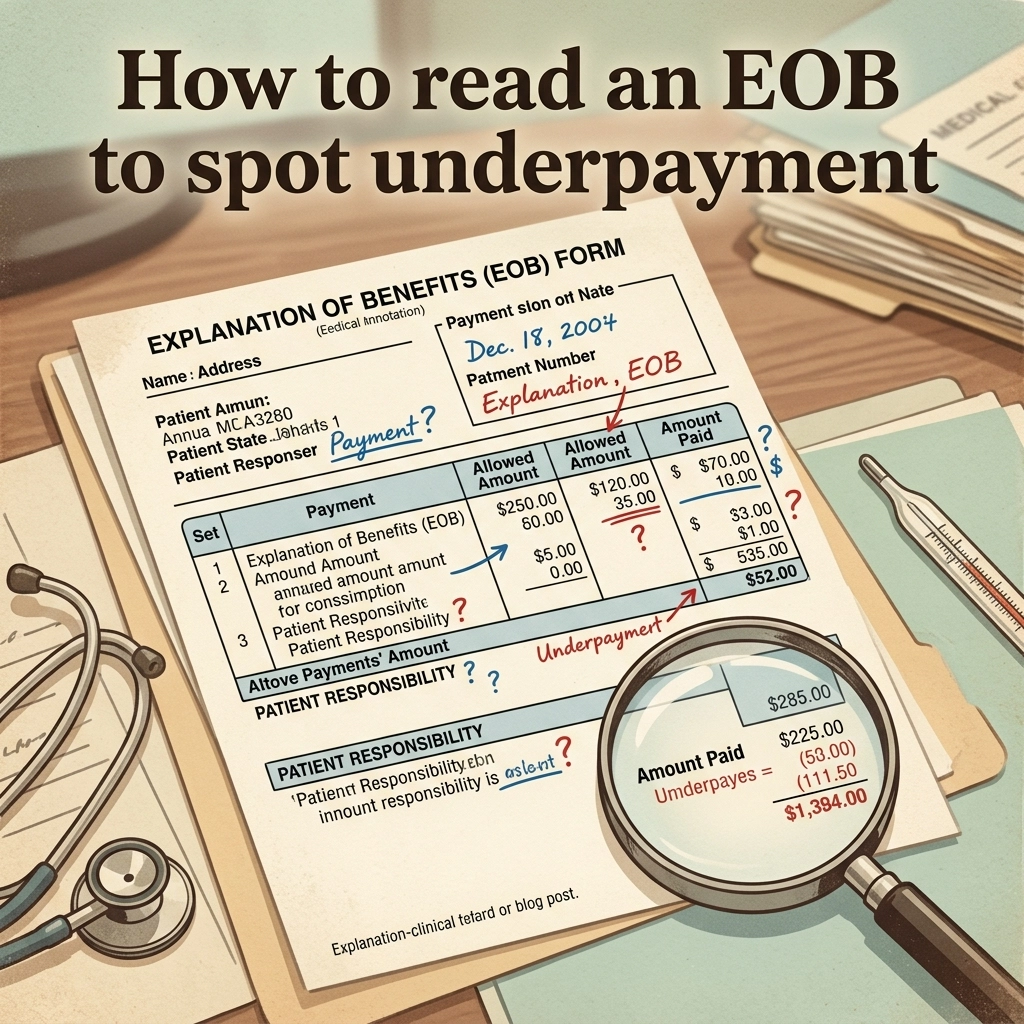
How to read an explanation of benefits (EOB) to spot underpayment

Every dollar left on the table is a direct contribution to an insurance company’s bottom line at the expense of your practice's survival. When a claim is processed, the Explanation of Benefits (EOB) is the only document that tells the true story of how your provider enrollment and physician credentialing efforts are translating into actual revenue. If you aren't auditing these documents with a microscopic lens, you are almost certainly being underpaid. Looking for professional provider credentialing services in the USA? 👉 Check our main service page here: veracityeg.com The High Cost of EOB Illiteracy An EOB is the post-game film of a medical claim. It details what you charged, what the payer decided was "fair," and what they actually sent to your bank account. The complexity is intentional. Payers like Aetna and Cigna rely on claim editing software and dense Claim Adjustment Reason Codes (CARC) to support lower initial payments. That includes standard industry logic such as NCCI edits, Medically Unlikely Edits (MUEs), and payer-specific bundling logic. These edits do not explicitly override your contract, but they are designed to reduce payment by default unless your practice identifies the issue and challenges it. Ignoring these discrepancies doesn't just lose you a few dollars today; it creates a precedent of accepted underpayment that can hollow out your revenue cycle. If your provider enrollment wasn't handled with precision, the payer might be processing your claims at an "out-of-network" rate or under an old, less favorable contract version without you even realizing it. This is why staying updated on payer gridlock trends in 2026 is vital for any practice manager who wants to keep the lights on. Billed vs. Allowed vs. Paid: The Critical Trio To spot an underpayment, you must distinguish between three primary figures. Billed Amount: This is your "sticker price." It is what you charge for the service. While this number is often high to ensure you capture the maximum possible reimbursement, it is rarely what you get paid. Allowed Amount: This is the most important number on the page. It is the maximum amount the insurance company will cover for a specific service based on your contract. If your contract says a Level 3 office visit is worth $75, but the "Allowed" column says $60, you have an immediate contractual underpayment. Paid Amount: This is the actual check or EFT amount. This equals the Allowed Amount minus the patient responsibility (copay, coinsurance, or deductible). If you see an encounter where you billed $150, the payer allowed $75, but only paid $40, you need to verify if that remaining $35 is truly shifted to the patient’s deductible. If the EOB shows a $35 adjustment without a corresponding patient responsibility code, that is money stolen from your practice. Alt tag: A detailed breakdown of EOB columns showing Billed, Allowed, and Paid amounts for a medical claim audit. Decoding the CARC Codes: The Payer’s Secret Language The "Reason Code" column is where payers hide their justifications for underpayment. You must memorize the most common Claim Adjustment Reason Codes (CARC) to fight back effectively. CO45 (Contractual Obligation): This is the most common code. it represents the difference between your billed amount and the contracted allowed amount. However, payers often hide "silent PPO" discounts or unauthorized fee schedule cuts under CO45. If the CO45 adjustment is larger than what your contract stipulates, it is an underpayment. CO97 (Procedure is bundled): This code claims the service is not separately payable because it’s included in another service. Payers often apply claim editing logic here, including NCCI-style bundling edits, MUE-related limitations, or their own proprietary bundling rules. These edits do not formally replace the payment terms in your contract, but they routinely reduce reimbursement by default unless your practice audits the EOB and disputes the application when it is wrong. CO4 (Inconsistent Coding): This indicates the payer believes the procedure code is inconsistent with the modifier used or the patient’s gender/age. Often, this is a sign that your enrollment and credentialing data might be out of sync with the payer’s records. For a full list of standardized codes, you can refer to the official X12 CARC database, which provides the technical definitions used across the industry. The $75 Encounter Scenario Let’s look at a concrete example. Imagine you have a contract with Aetna that specifies a $75 reimbursement for a specific CPT code. You submit a claim for $120. The EOB returns: Billed: $120 Allowed: $55 Adjustments: $65 (Code CO45) Paid: $55 In this scenario, you have been underpaid by $20 per encounter. If you see 10 patients a day with this code, that is $1,000 a week missing from your pocket. The reason? The payer may have updated their internal fee schedule without notifying you, or they may be applying a "multiple procedure discount" incorrectly. Without comparing the "Allowed" amount to your physical contract, you would simply assume $55 is the correct rate. Why Enrollment Errors Lead to EOB Nightmares A significant portion of underpayments isn't due to malicious intent by the payer, but rather "administrative friction" caused by poor data management. If your Tax ID or NPI isn't linked correctly to the specific contract version in the payer's system, the EOB will reflect a default, lower rate. We often see Veracity clients who are being paid 20% less than their peers simply because their CAQH profile wasn't updated, leading the payer to drop them into a "standard" tier rather than a "preferred" tier. Your EOB is the first place these mistakes become visible. If you see "Out of Network" or "Reduced Rate" flags on an EOB for a payer you know you are contracted with, you have an enrollment emergency on your hands. Alt tag: A medical practice manager reviewing a stack of EOBs with a red pen, highlighting discrepancies in payment codes. The Dispute Window: Why Speed is Your Only Ally Every payer has a strictly defined "timely filing" and "dispute window." For many, you only have 60 to 90 days from
Signs your payer contract is underperforming : and what to do about it

Your billing system shows a "Paid" status, but your practice is still losing money. Most practice owners equate a processed claim with a successful transaction, yet this line of thinking is exactly why so many provider enrollment files lead to stagnant revenue. If you haven't scrutinized your payer contract in the last 24 months, you are likely subsidizing the insurance carrier’s bottom line with your own overhead. The Medicare Benchmark Trap The most immediate sign of an underperforming contract is a rate that hovers at or below the 100% Medicare threshold. In competitive markets like Indiana, we frequently see legacy contracts where providers are being reimbursed at 95-98% of Medicare. While this might have felt "market standard" five years ago, it is a mathematical failure in the current economy. When Anthem or other major carriers keep you tethered to a percentage of Medicare that doesn't account for the rising cost of labor and medical supplies, they are effectively giving themselves an annual discount. You must benchmark every single one of your top 20 CPT codes against the current year's CMS Physician Fee Schedule. If your commercial rates aren't at least 120% to 140% of Medicare for your primary service lines, you are leaving six figures on the table. Invisible Revenue Killers: Recoupment and Filing Deadlines An underperforming contract isn't just about the base rate; it is about the "gotcha" clauses buried in the fine print that allow payers to claw back money months or years after the service was rendered. Vague Recoupment Windows Check your contract for recoupment or "look-back" periods. If your contract allows a payer to initiate a recoupment two years after a claim was paid, you are operating under a constant financial threat. Expertly negotiated commercial contracts limit this window to 12 months or less, ensuring that once your books are closed for the fiscal year, they stay closed. Medicaid recoupment periods are different because many state programs have longer review and recovery windows set by statute or regulation. ERISA plan overpayment disputes also follow federal rules that do not always mirror standard commercial contract norms, so you must evaluate those provisions under the governing plan and federal framework rather than assuming a market-standard limit applies. Aggressive Filing Deadlines Timely filing limits are another silent driver of revenue loss. If your contract mandates a 60-day filing window while the payer has 180 days to respond, the playing field is tilted against you. High-performing contracts align these deadlines or provide the provider with a wider window to account for the administrative delays inherent in modern billing. You can see how these administrative hurdles compound in our Payer Gridlock Report 2026. The High Cost of Silence The greatest expense in healthcare isn't malpractice insurance or payroll; it is the cost of not negotiating. Payers rely on "evergreen clauses" that automatically renew your existing rates every year without adjustment. If you don't send a formal notice of intent to renegotiate, you are essentially telling the payer that you are happy with a "pay cut" via inflation. For a mid-sized group, the difference between a contract paying 98% of Medicare and one paying 115% can represent $200,000 to $500,000 in annual net income. This is money that should be used for staff retention, new technology, or clinical expansion. Instead, it stays in the payer’s reserves because the practice didn't initiate a contract analysis and renegotiation strategy. Understanding the 180-Day Timeline You cannot fix a broken contract in a month. If your contract is underperforming, you must commit to a 180-day timeline for a successful turnaround. This window accounts for the data gathering, the initial proposal, the inevitable "no" from the payer, and the subsequent rounds of back-and-forth required to reach a favorable outcome. Days 1-30: Data extraction. You must know your volume by payer and your weighted average reimbursement. Days 31-60: Benchmarking and Proposal. Draft a direct, data-driven proposal that highlights your value to the network (e.g., specialized services, geographic coverage in underserved parts of Indiana). Days 61-150: Active Negotiation. This is where most practices fail. They send a letter, get a form-letter rejection, and stop. You must be prepared to escalate to provider relations managers and higher-level executives. Days 151-180: Implementation. Once the new rates are signed, they must be loaded into the payer’s system correctly. Failure to monitor the implementation phase is a common pitfall. Payers often "forget" to update the fee schedule in their adjudication engine, leading to continued underpayments despite a new signature. Unilateral Amendments and "Silent" Payer Shifts If you receive a "notice of amendment" in the mail and toss it in a drawer, you are likely agreeing to a rate reduction. Payers like Anthem frequently use unilateral amendment clauses to change the terms of your agreement without requiring a new signature. You must review every piece of correspondence from your payers. These amendments often change the "Provider Manual," which is incorporated into your contract by reference. By changing the manual, they change your contract. If your contract doesn't have language that allows you to "opt-out" or triggers a negotiation period upon a material change, your contract is underperforming. Actionable Step: Conduct a "Top 10" Audit Today The path to better reimbursement starts with a single spreadsheet. Do not try to audit every code at once; that leads to analysis paralysis. Your Practical Task: Identify your top 10 most frequently billed CPT codes. Pull the actual reimbursement amounts from your three largest commercial payers for these codes. Compare these figures to the current Medicare Fee Schedule. If the commercial rate is less than 115% of Medicare, or if the rate hasn't changed since 2022, you have an underperformance problem that requires immediate professional intervention. The Veracity Group sees this pattern across the country: practices work harder every year to see more patients, only to have their margins squeezed by outdated contracts. Negotiating isn't being "difficult": it is a core requirement of running a solvent healthcare business. If you aren't at the table, you are on