Veracity upscaled revised

What Documents Do I Need to Get Credentialed With Insurance? (A Complete Checklist)

LBl8DxZvSG

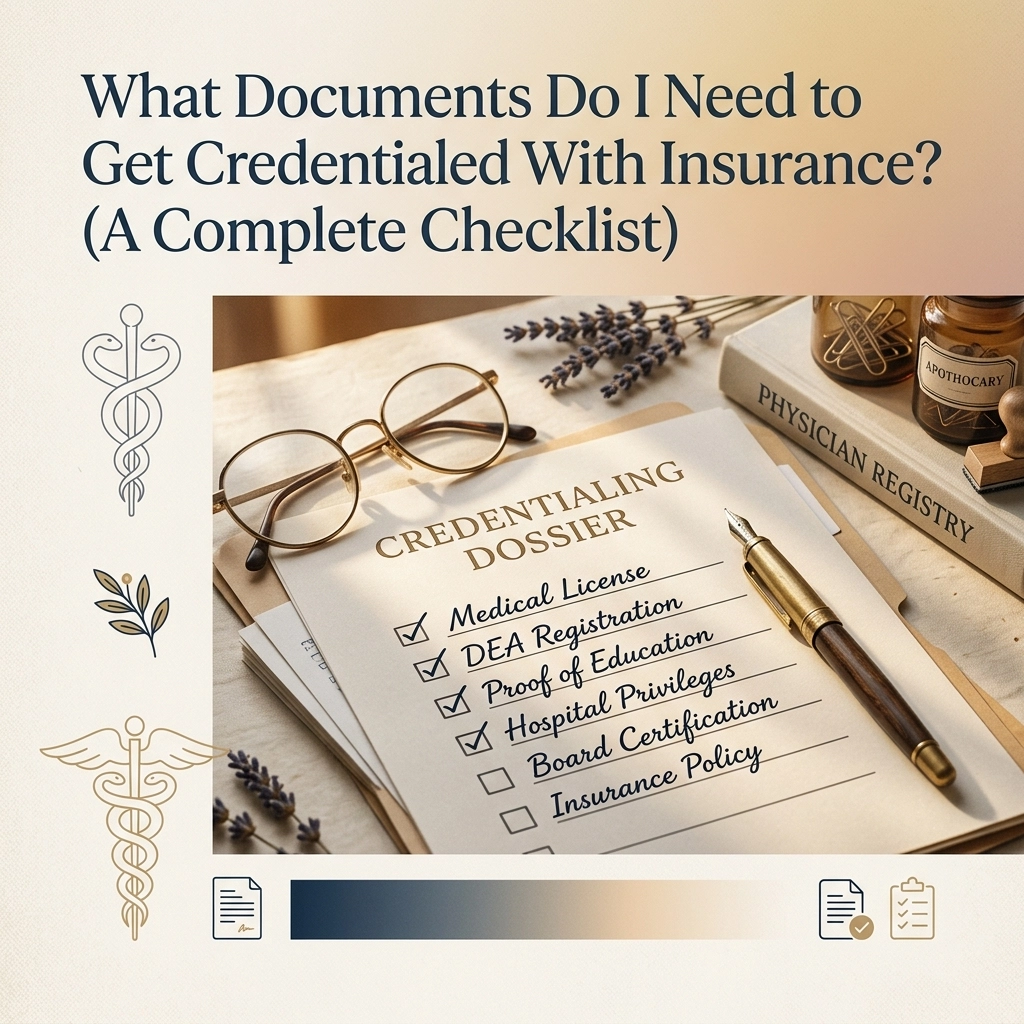
Navigating the provider enrollment services landscape requires more than just clinical expertise; it demands an airtight insurance credentialing process that leaves zero room for administrative error. For healthcare administrators and practice owners, documentation is the backbone of professional credibility and the literal passport to reimbursement. When a single date is missing or a document is expired, the entire revenue cycle grinds to a halt. In the high-stakes world of payer enrollment, being "mostly prepared" is the same as being completely unprepared. Looking for professional provider credentialing services in the USA?👉 Check our main service page here: veracityeg.com The High Cost of Administrative Friction The enrollment process is notoriously unforgiving. Payers do not view a missing document as a minor oversight; they view it as a reason to pend your application, pushing your start date back by weeks or even months. These credentialing delays are silent revenue killers that create massive bottlenecks for new providers joining a group. To ensure your practice remains financially healthy and your providers are ready to see patients on day one, you must approach documentation with surgical precision. This is not a task for the disorganized. It is a rigorous compliance exercise that determines how quickly you can turn clinical encounters into deposited checks. Alt text: A professional healthcare administrator organizing a comprehensive digital folder of provider documents for insurance enrollment. The Definitive Documentation Checklist To move through the enrollment pipeline efficiently, you must have the following documents digitized, organized, and ready for submission. Any discrepancy between these documents will trigger a manual review, leading to further delays. 1. Core Provider Identifiers NPI Confirmation: You must provide the official notification from the National Plan and Provider Enumeration System (NPPES). This confirms your Type 1 (Individual) and/or Type 2 (Organizational) NPI numbers. Tax ID / W-9: A current, signed W-9 form is non-negotiable. It must match the legal business name registered with the IRS. Discrepancies here are a primary cause for application rejection. CAQH ID and Login: Your CAQH profile is the central hub for most payers. You must ensure your profile is not only active but fully attested with the most recent versions of all documents. 2. State and Federal Authorizations State Medical Licenses: You must include every active license for each state where you intend to practice. Ensure the expiration dates are well into the future; submitting a license that expires in 30 days will cause an immediate pend. DEA and State-Controlled Substance Certificates: If your specialty requires prescribing controlled substances, these certificates are mandatory. If you are a specialist who does not require a DEA, you must provide a written explanation or waiver as required by specific payers. Learn more about medical licensing requirements to ensure you are fully compliant. Board Certifications: Provide proof of current board status. If you are board-eligible but not yet certified, you must provide the specific timeline and letters from the board confirming your status. 3. Education and Training History Educational Diplomas: Copies of your medical school diplomas are required. If the diploma is in a foreign language, a certified translation must be included. Training Certificates: This includes internships, residencies, and fellowships. There must be a clear, documented path from graduation to current practice. Hospital Privilege Letters: Current hospital affiliations and admitting privileges must be documented. If you do not have admitting privileges, you must have a formal "Hospitalist Agreement" in place to cover your patients. 4. Professional Liability and Peer Review Malpractice Insurance Face Sheet: This is the Certificate of Insurance (COI) showing your name, policy numbers, effective dates, and coverage limits (typically $1M/$3M, though this varies by state and payer). Comprehensive CV: Your CV must be in MM/YYYY format. Payers are hyper-focused on "gapless" histories. Any gap in employment or education exceeding 30 days must be explained in writing. A fragmented CV is an automatic red flag for auditors. Peer References: Most payers require at least three peer references from providers in your same specialty who have worked with you within the last 12 to 24 months. These cannot be relatives or subordinates. Alt text: A detailed checklist showing the various medical licenses and certifications required for the provider enrollment process. Why the "Gapless" CV is Your Most Critical Asset The curriculum vitae is often where the enrollment process fails. In the eyes of an insurance auditor, an unexplained 60-day gap between residency and your first job is a period of "unmonitored activity" that poses a risk. To satisfy the stringent requirements of provider enrollment, your CV must be an unbroken chain of dates. If you took time off for travel, family, or studying for boards, you must list that time as "Sabbatical" or "Personal Leave" with the corresponding MM/YYYY dates. Transparency is the only way to bypass the manual review triggers that stall applications. Practice-Level Documentation Requirements Beyond the individual provider’s credentials, the facility or practice itself must be validated. This is especially true for groups and new practice start-ups. Individual-Level Documentation Requirements These documents are required for the individual provider and should be collected separately from the group or facility file. If even one provider-level item is missing, outdated, or inconsistent with the application, that provider’s enrollment will stop cold. Current State Medical License Current DEA Registration Certificate Malpractice Liability Insurance Certificate – current Medical School Diploma Internship/Residency/Fellowship Diplomas/Certifications (if applicable) Board Certification Certificate Driver’s License – current ECFMG Certificate (if applicable) Copies of any lawsuit/malpractice claim paperwork Updated CV (Must include Month/Year for all employment and education, and any gaps > 6 months must be explained) Group-Level Documentation Requirements These documents are required for the group/facility entity itself, not just the individual provider. If these entity-level items are missing, unsigned, expired, or inconsistent with the group’s legal and tax records, the entire enrollment file will stall. Completed and signed W-9 Copy of IRS Letter CP575 or 147C Voided business check (must be a color copy) Business License for each practice location Signed & dated Lease General Liability Certificate Articles of Incorporation Copy of

How much does it cost to hire a credentialing company?

LeSo 9El6LI

Starting a medical practice or bringing a new provider on board is an exhilarating milestone, but that excitement usually hits a brick wall the moment the paperwork starts piling up. If you are currently shopping for provider enrollment services, you already know that the market is flooded with options. When searching for credentialing services usa, the price quotes you receive can feel like they are coming from different planets: some offer "budget" data entry for a few hundred dollars, while others quote several thousand. The truth is, hiring a professional firm isn't just about paying someone to fill out forms; it is an investment in your practice’s cash flow. At The Veracity Group, we believe in radical transparency. You need to know exactly where your money is going and, more importantly, what kind of return you should expect on that investment. Looking for professional provider credentialing services in the USA? 👉 Check our main service page here: veracityeg.com Breaking Down the Common Pricing Models There is no "one-size-fits-all" price tag in this industry because every practice has different needs. A solo pediatric therapist in Kansas has vastly different requirements than a multi-state telehealth group. Generally, you will encounter three primary pricing structures: 1. The Per-Payer (A La Carte) Model This is the model Veracity uses, and it is built for practices that want clean, targeted enrollment without paying for padded flat fees. You pay for each insurance company (payer) your provider actually needs, which means you are paying for exactly what you need instead of absorbing the cost of a bundled package that includes networks you may never use. Typical Veracity Cost: Around $175 per payer, per provider. Best For: Practices that want a cost-effective, scalable enrollment process with clear line-of-sight into what they are buying. What You Get: The same aggressive follow-up, persistent payer communication, and operational rigor you would expect from any premium service. This is not a stripped-down, “good luck out there” option. Veracity drives the file from submission through approval with the same discipline we bring to every engagement. Why It Wins on Cost: For most clinics, this is almost always the more affordable route. A per-payer model stays efficient unless a provider is enrolling with an unusually high number of payers—typically 25 or more—where a bundled arrangement starts to look more competitive. 2. The Annual Maintenance Flat-Fee Model Once you are in the system, you have to stay there. At Veracity, we do not charge monthly maintenance. Instead, we use a flat annual fee of $350 per provider for ongoing maintenance tasks. Veracity Cost: $350 per provider, annually. What It Covers: Demographic updates, CAQH maintenance, attestations, and similar ongoing maintenance tasks that keep provider records current and active. Best For: Established practices that want to offload the "busy work" to prevent license expiration horror stories. Alt-tag: A professional infographic showing the main pricing models for provider enrollment services, including Per-Payer and Annual Maintenance Flat Fee. The "Hidden Costs" of the DIY Approach Many practice managers or owners look at a $3,000 service fee and think, "I can just have my front desk person do this in their spare time." This is often the most expensive mistake a clinic can make. The "free" DIY route carries heavy hidden costs that never show up on a ledger until it's too late. The High Risk of Error Industry experience consistently shows that a large majority of non-professional submissions contain errors or missing information. A single typo in an NPI number or a missing signature on a peer reference letter can result in a "pended" or denied application. In many cases, the payer won't even tell you it’s denied; they just stop processing it. To avoid these pitfalls, it’s vital to understand the ultimate guide to avoiding the errors that kill medical practices. Administrative Burnout Your staff is already stretched thin. Asking an office manager to spend four hours on hold with a Medicare representative is a recipe for burnout and high turnover. When your team is miserable, patient care suffers, and the "saved" money evaporates through the cost of hiring and training new staff. Denied Claims and "Ghosting" If a provider sees a patient before their enrollment is finalized, those claims will be denied. Often, these denials cannot be appealed. If your provider is seeing 15 patients a day at an average reimbursement of $150, that is $2,250 in lost revenue per day. A week of delays costs you more than our entire service fee. Alt-tag: A stressed office manager looking at a stack of insurance paperwork, symbolizing the hidden cost of administrative burnout in medical practices. The ROI of Speed: Why Faster Onboarding is a Strategic Win At Veracity, we don’t just look at the cost of the service; we look at the Return on Investment (ROI). Our goal is to get your providers "billable" as fast as humanly possible. Consider a hypothetical scenario: A new specialist joins your clinic. DIY Timeline: 150–180 days (due to errors and slow follow-up). Veracity Timeline: 90–120 days (due to expert clean-claim submission and aggressive follow-up). By shaving 60 days off the enrollment process, Veracity is effectively handing you two months of additional revenue that would have otherwise been lost to the bureaucratic void. For a high-volume specialist, this can represent $100,000 or more in practice income. Suddenly, a few thousand dollars in service fees looks like the best bargain in healthcare. This speed is especially critical for multi-state telehealth groups, where the complexity of navigating different state boards and payer requirements can multiply the risk of delays. We utilize proven enrollment hacks that keep the process moving even when payers are dragging their feet. Position Yourself for 2026: More Than Just Data Entry If you think of a provider enrollment company as a data entry service, you are missing the forest for the trees. The landscape is shifting. With AI-powered systems and constant CAQH updates, staying compliant requires a strategic partner. Veracity acts as your external enrollment department. We