Veracity upscaled revised

What is the difference between credentialing and provider enrollment?

YTIZ Imv40i

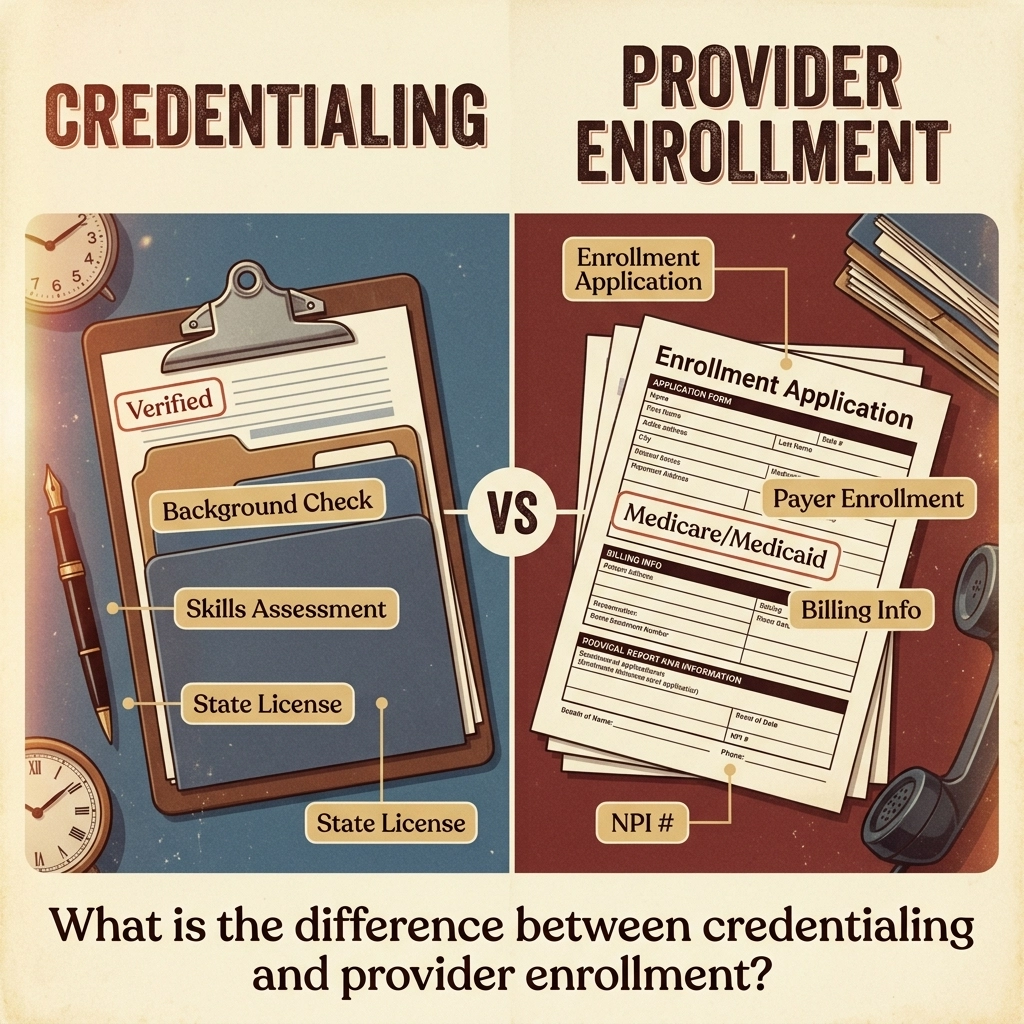
Navigating the administrative labyrinth of the healthcare industry requires more than clinical expertise; it demands an ironclad grasp of the revenue cycle's foundational pillars. For many new practice owners and seasoned administrators alike, the terms "credentialing" and "provider enrollment" are often used interchangeably, yet they represent two distinct, critical phases of your operational lifecycle. Misunderstanding the nuances between medical credentialing and provider enrollment services is a recipe for administrative chaos, leading to significant revenue leakage and stalled practice growth. Looking for professional provider credentialing services in the USA? 👉 Check our main service page here: veracityeg.com At The Veracity Group, we see firsthand how the "blurring" of these two concepts creates bottlenecks. To achieve operational rigor, you must view credentialing as your internal foundation and provider enrollment as your external gateway. One proves you are who you say you are; the other ensures you get paid for what you do. Credentialing: The Backbone of Professional Credibility Credentialing is the investigative process of verifying a healthcare provider’s qualifications, experience, and professional standing. Think of it as the rigorous background check that serves as the backbone of professional credibility. This process is non-negotiable and must be completed with surgical precision before a provider can even think about seeing a patient or billing an insurance company. During credentialing, the focus is entirely on the individual provider. You are proving to a governing body, hospital, or insurance panel that the provider meets the specific clinical standards required to practice medicine. This involves Primary Source Verification (PSV), where every claim made on a CV is verified directly with the issuing institution. The Components of a Robust Credentialing File To maintain compliance and protect your practice from liability, a credentialing file must include: Education and Training: Verification of medical school graduation, internships, residencies, and fellowships. Licensure: Confirmation of active state medical licenses and any history of disciplinary actions. Board Certifications: Proof that the provider is certified in their specific area of expertise. Work History: A comprehensive review of the last 5–10 years of professional activity, including explanations for any gaps. Malpractice History: A deep dive into the provider’s claims history and current insurance coverage. DEA and CSR: Verification of the provider's authority to prescribe controlled substances, which often requires medical licensing, CSR, and DEA management. Failure to maintain meticulous credentialing records does more than just slow you down; it invites legal risk. If a provider is not properly credentialed, your practice may be held liable for "negligent credentialing" should a malpractice suit arise. Furthermore, organizations like the National Committee for Quality Assurance (NCQA) set strict standards for this process, and failing to meet them can result in the loss of accreditation. Provider Enrollment: The Passport to Reimbursement While credentialing verifies clinical competency, provider enrollment is the technical and administrative process of requesting participation in a health insurance plan's network. If credentialing is the background check, enrollment is the passport to reimbursement. Enrollment is the mechanism that links a credentialed provider to your practice's Tax Identification Number (TIN) and ensures that the payer’s system recognizes the provider as an authorized billing entity. Without successful enrollment, your claims will be rejected as "provider not recognized," regardless of how talented the clinician is. The Enrollment Lifecycle Provider enrollment is payer-specific and highly variable. You do not "enroll" once; you must enroll with every single payer you intend to bill, from Medicare and Medicaid to private carriers like Aetna, Blue Cross Blue Shield, and UnitedHealthcare. The process involves: Application Submission: Completing the specific, often lengthy, forms required by each payer. Contracting: Negotiating or accepting the payer's fee schedule. This is where contract analysis and renegotiation become vital to ensuring your practice remains profitable. Directory Listing: Ensuring the provider is listed in the payer’s online and paper directories so patients can find you. Effective Dates: Securing an official "effective date" from the payer, before which no services will be reimbursed. Why the Distinction Matters for Your Revenue Cycle The distinction between these two processes is most visible when things go wrong. If you treat enrollment as an afterthought to credentialing, you will face the high cost of delays. For example, a provider might be fully credentialed through CAQH, but if they aren't properly linked to your practice group through an enrollment application, the payer will still deny your claims. We often see practices lose hundreds of thousands of dollars because they assumed a provider’s "active" status with a previous employer followed them to the new practice. It does not. Enrollment is tied to the specific location and tax entity where the services are performed. The Interdependence of Credentialing and Enrollment You cannot have one without the other. Credentialing is the prerequisite. A payer will not even look at an enrollment application until the provider's credentialing file is complete and verified. If you attempt to start the provider enrollment process with incomplete or expired credentials: such as an outdated license or an expired malpractice policy: the payer will reject the application immediately. This resets your timeline, often pushing your go-live date back by 90 to 120 days. Operational Rigor: Managing the Timeline Understanding the difference also helps you manage expectations regarding the timeline. Credentialing typically takes 30 to 60 days, depending on how quickly third parties (like universities) respond to verification requests. Provider Enrollment can take anywhere from 90 to 180 days. Payers are notorious for administrative backlogs and "lost" applications. When you add a new provider to your team, you must start the process early. Relying on "standard" timelines is a gamble you cannot afford to take. You must implement a proactive strategy that accounts for credentialing delays and payer-specific nuances. The "Veracity Take" on Strategic Management At Veracity, we believe that tracking these two workflows requires a sophisticated, tech-enabled approach. Manual spreadsheets are no longer sufficient for modern practices. You need a system that flags expiring credentials before they impact your enrollment status. Furthermore, you must recognize that contracting is the final hurdle of the enrollment phase. It is

Can a provider see patients before credentialing is complete?

CHXrrzLS6og

The question of whether a new provider can begin seeing patients before their paperwork is finalized is one of the most pressing concerns for growing practices. The short answer is yes, a provider can legally see patients, but doing so without a fully executed provider enrollment strategy is a high-stakes gamble that often leads to significant financial loss. Relying on premium credentialing services to navigate this period is not just a luxury; it is a fundamental requirement for maintaining the fiscal health of your medical group. The Financial Reality: The Denial Dead-End When a provider sees a patient before they are fully loaded into a payer’s system, the practice is essentially providing free healthcare. Insurance carriers will deny claims submitted for services rendered by a provider who is not yet "active" in their system. These are not just simple administrative delays; many of these denials are permanent and uncollectible. For a new practice or an expanding group, the revenue disruption caused by seeing patients too early is often more damaging than keeping the provider on the sidelines for an extra two weeks. If you submit a claim and it is denied due to lack of credentialing, you cannot simply "fix" it later once the approval comes through: unless the payer allows for a specific retroactive effective date. Most private payers do not offer this luxury. They establish the effective date as the day the contract is signed or the day the application was fully processed, and any service provided before that date is non-reimbursable. Looking for professional provider credentialing services in the USA? 👉 Check our main service page here: veracityeg.com The Legal and Liability Minefield Beyond the immediate loss of revenue, seeing patients before the completion of the process introduces malpractice and compliance risks. Many professional liability insurance policies require a provider to be fully credentialed at the facility or within the group before coverage is active. If a clinical adverse event occurs while a provider is in "administrative limbo," your practice faces a catastrophic legal exposure that could have been avoided. Furthermore, state medical boards and regulatory bodies expect a high level of transparency. While it is not "illegal" in the criminal sense to treat a patient as a licensed professional, it is a violation of most managed care contracts. Violating these contracts can lead to termination from the payer network, putting your entire organization's reputation at risk. Understanding the Exceptions: When Can You Bill? While the general rule is "Wait until it's official," there are specific, narrow exceptions that healthcare organizations use to mitigate the cost of a new hire. These are not universal and require precise execution to avoid audits. 1. The Medicare 30-Day Retro-Billing Rule One of the few areas of leniency comes from the Centers for Medicare & Medicaid Services (CMS). Medicare allows for a limited retroactive billing period. Generally, a provider can bill for services rendered up to 30 days prior to the date their enrollment application was received by the Medicare Administrative Contractor (MAC), provided all other requirements were met. However, this is a narrow window and requires that the application was submitted correctly the first time. Any errors in the initial submission can void this benefit. 2. Locum Tenens Arrangements If you are bringing in a provider to temporarily replace a physician who is on leave (vacation, illness, or maternity), you may be able to utilize Locum Tenens billing. Under this arrangement, you bill under the NPI of the absent physician for a limited time (usually up to 60 days). This is a strictly regulated process and cannot be used to simply "fill a gap" for a new permanent hire who is still waiting on their paperwork. 3. "Incident-To" Billing In some outpatient settings, a new provider might see patients "incident-to" a supervising physician. This is one of the most common ways practices try to generate revenue during credentialing delays. However, the requirements for incident-to billing are incredibly stringent. The supervising physician must be in the office suite, the patient must be an established patient with an existing plan of care, and the supervisor must be actively involved in the treatment. Many private payers have moved away from allowing incident-to billing for new physicians, reserving it strictly for mid-level providers like PAs and NPs. 4. The Self-Pay or Out-of-Network Model The only "risk-free" way to see patients before the process is complete is to treat the provider as Out-of-Network or strictly Self-Pay. You must inform the patient in writing that the provider is not yet participating with their insurance and that the patient will be responsible for the full cost of the visit. In a competitive market, this is often a poor patient-experience move, but it is the only way to ensure the provider's time is compensated without risking insurance fraud or a certain denial. The Silent Driver of Practice Failure: Administrative Inertia Many clinics suffer from the "we’ll just start them and see what happens" mentality. This is a primary driver of practice failure. When you hire a new provider, you are making a massive investment in their salary, benefits, and overhead. To let that investment sit idle is painful, but to let that investment generate denied claims is worse. Strategic provider enrollment is the backbone of professional credibility. By ensuring that all medical licensing, CSR, and DEA requirements are handled months in advance, you eliminate the need to look for loopholes. How to Prevent the "Credentialing Gap" The Veracity Group emphasizes a proactive approach to prevent these revenue-draining scenarios. The goal is to align the provider’s start date with their "effective date" across all major payers. Start 90 to 120 Days in Advance: The process for major payers like UnitedHealthcare, Blue Cross Blue Shield, and Aetna is notorious for taking three to four months. Audit Your Contracts: Before the provider starts, perform a contract analysis to understand each payer's specific rules on retroactive billing and effective dates. Maintain a Clean CAQH Profile: Ensure the provider's CAQH profile is

The Veracity Weekend Update: Navigating the New Medicaid Work Rule Landscape

O5EdgtOziFg

Happy Saturday, Veracity family. As we move further into April 2026, the healthcare landscape is shifting beneath our feet, specifically regarding the federal Medicaid landscape. For those of us focused on provider enrollment and the complexities of medical licensing, staying ahead of legislative shifts isn’t just a hobby: it is a survival strategy. As recently reported by KFF Health News, a significant wave of changes is approaching as we get closer to new federal Medicaid community engagement requirements. The federal government has targeted January 1, 2027, as the implementation date, according to current policy proposals and reporting. What started as a conversation in the 2025 budget reconciliation bill (H.R. 1) has now crystallized into a complex administrative hurdle that will impact your clinic’s revenue cycle and patient stability. Today, we are breaking down the shift toward stricter three-month work requirements and what the "bureaucratic churn" means for your practice. The 80-Hour Threshold: A New Baseline for Eligibility The core of the new federal mandate is straightforward but administratively heavy: adults ages 19–64 enrolled in ACA Medicaid expansion programs must document at least 80 hours per month of qualifying activities. These activities generally include paid employment, job training, community service, or at least half-time school enrollment. While the federal baseline allows for a look-back period, several states are already signaling they will take the more aggressive route. In our experience, when a state has the option to tighten the belt on eligibility, they often do so to manage budgetary constraints. Several states — including Indiana, Missouri, Idaho, and Kentucky — have signaled interest in adopting stricter three‑month verification windows, and some have already begun implementing them. The Three-Month Squeeze in Indiana and Beyond Indiana led the charge by signing stricter requirements into law in early 2025, and others have quickly followed suit. For a patient to remain eligible in these states, they cannot simply show a recent pay stub from the last few weeks; they must demonstrate a consistent three-month track record of compliance before their enrollment or redetermination is finalized. This "three-month squeeze" creates a significant barrier for seasonal workers, those in the "gig economy," and individuals with fluctuating health conditions that might not qualify them for a full "medically frail" exemption but still impede consistent 80-hour work weeks. For your clinic, this means the patient you treated yesterday may suddenly become "uninsured" tomorrow, not because their income changed, but because their documentation history failed to meet a stricter verification threshold. Alt text: A vibrant, caricature-style illustration of a healthcare administrator navigating a maze of paperwork labeled "Indiana," "Missouri," and "Kentucky," with a bright digital clock counting down to 2027. The Risk of "Bureaucratic Churn" The term "bureaucratic churn" is something every clinic manager needs to memorize. Churn happens when eligible individuals lose their coverage because of administrative hurdles rather than a change in their actual eligibility status. According to KFF Health News, the Congressional Budget Office has estimated that up to 6 million people could lose health insurance coverage nationwide due to these new rules. In our experience, the vast majority of these losses are not due to people refusing to work; they are due to the high cost of delays in paperwork processing and the sheer complexity of reporting 80 hours of monthly activity to a state portal that may or may not be user-friendly. When patients lose coverage, the impact on your revenue cycle is immediate. Claims are denied, patient balances skyrocket, and the administrative burden of helping a patient "re-enroll" falls squarely on your front-office staff. State Spotlight: Missouri and Kentucky Missouri and Kentucky are particularly important to watch because they represent different approaches to the Medicaid expansion population. In Missouri, the push for stricter work requirements follows years of legislative debate surrounding expansion. If you are operating a practice in the Show-Me State, you must be prepared for a heightened level of scrutiny during patient intake. We’ve detailed the specific nuances of the local landscape in our Missouri Medicaid Guide, which highlights why keeping your provider enrollment data current is the first step in surviving these shifts. Similarly, Kentucky has had a long, "on-again, off-again" relationship with work requirements. With the federal mandate now providing a more structured framework, Kentucky is expected to be among the most rigorous in its enforcement posture. For more on the specific challenges facing Bluegrass State providers, check out our Kentucky Medicaid Enrollment Guide. The Veracity Take: Why This Matters for Enrollment You might be wondering, "If this is about patient eligibility, why is an enrollment company talking about it?" The answer is simple: Enrollment and eligibility are two sides of the same coin. When Medicaid programs become more complex for patients, they simultaneously become more complex for providers. Strict Taxonomy Alignment: States implementing work rules often tighten their provider verification processes at the same time to ensure that "work-related" health visits are coded perfectly. Payment Holds: As churn increases, plans like Anthem or UnitedHealthcare can place temporary payment holds on claims if the patient's "community engagement" status is in a pending state. Credentialing Continuity: If your providers are not fully credentialed and linked to the correct state-specific Medicaid IDs, you have zero recourse when a patient’s coverage is contested. Looking for professional provider credentialing services in the USA? 👉 Check our main service page here: veracityeg.com Preparing Your Practice for 2027 To mitigate the risk of revenue loss from the 3-month Medicaid work rules, your practice must be proactive. Waiting until the 2027 implementation period to adjust your workflows is a recipe for a financial bottleneck. Audit Your Patient Population: Identify what percentage of your current patient base falls into the ACA expansion group (non-disabled adults 19-64). These are the patients at highest risk for churn. Enhance Communication: Start educating patients now about the importance of maintaining their 80-hour monthly documentation. Verify Weekly: In our experience, monthly eligibility checks are no longer enough. Moving to a weekly or even "at-time-of-service" verification process is becoming the new industry standard.