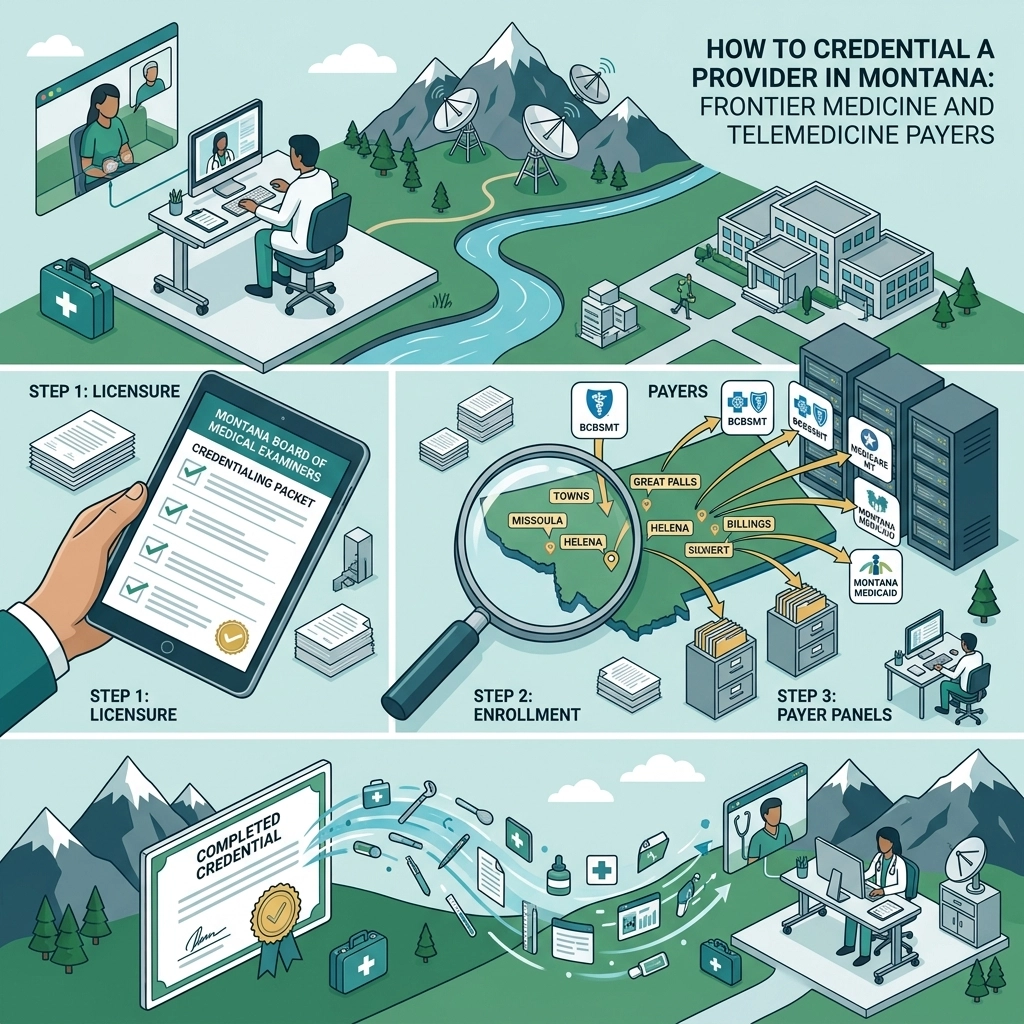
How to credential a provider in Montana: frontier medicine and telemedicine payers

Navigating the healthcare landscape in the "Big Sky Country" requires more than just a map; it requires a deep understanding of the unique regulatory environment that governs Montana Healthcare Programs. For organizations expanding into the Treasure State, the provider enrollment process is the primary gatekeeper to accessing a patient base that is often geographically isolated. Montana presents a distinct set of challenges: frontier medicine, vast distances, and a reliance on telemedicine: that make a standard approach to administrative onboarding insufficient. If you are not prepared for the specific documentation rigors and 2026 compliance updates, your revenue cycle in Montana will stall before it even begins. Looking for professional provider credentialing services in the USA? 👉 Check our main service page here: veracityeg.com The Frontier Medicine Reality: Credentialing by Proxy Montana is home to some of the most remote "frontier" counties in the lower 48 states. In these areas, healthcare delivery often relies on Critical Access Hospitals (CAHs) and small rural clinics that do not have the administrative bandwidth to process massive volumes of applications. To combat this, Montana leverage’s a regulatory shortcut known as "Credentialing by Proxy." For remote hospitals, this is a strategic lifeline. It allows a community hospital to rely on the decisions made by a distant-site hospital (typically a larger hub in Billings, Missoula, or even out-of-state) when bringing on telemedicine specialists. Instead of the rural facility performing an exhaustive primary source verification from scratch, they can accept the credentialing data of the "sending" facility. However, this is not an automatic pass. To utilize proxy processes, there must be a written agreement in place that meets CMS and Montana state standards. Without this contract, your practitioners are practicing without proper authorization, creating a massive compliance liability that can lead to immediate claim denials. Mastering the MHCP Portal (medicaidprovider.mt.gov) The Montana Healthcare Programs (MHCP) portal is the central nervous system for state-level enrollment. Unlike states that allow for loose interpretations of data, Montana Medicaid is notoriously strict regarding documentation accuracy. When utilizing the medicaidprovider.mt.gov portal, you must ensure that every piece of data: from the NPI to the taxonomy codes: aligns perfectly with the provider’s state license. In 2026, the portal has integrated more rigorous automated checks. If your provider's physical practice address does not match the USPS verified database or if there is a discrepancy in the CAQH profile, the system will trigger a manual review, adding weeks or even months to your timeline. For groups operating across multiple regions, mastering multi-state Medicaid provider enrollment is essential, as Montana’s requirements often overlap with neighbor states like Wyoming or North Dakota, yet require specific Montana-only supplemental forms. The IMLC: Your Passport to Telemedicine Success For telemedicine models, the Interstate Medical Licensure Compact (IMLC) is the gold standard for rapid entry into the Montana market. As a member state, Montana allows physicians who hold a Letter of Qualification from their home state to obtain a Montana license in a fraction of the traditional time. The IMLC is the backbone of professional mobility in frontier medicine. It allows specialized neurologists, psychiatrists, and cardiologists to provide care to patients in Havre or Miles City without the traditional six-month wait for state board approval. If your organization is not utilizing the IMLC, you are voluntarily choosing a path of administrative friction that your competitors have already bypassed. 2026 Telemedicine Payer Rules: The Shift to Audio-Only In 2026, Montana Medicaid and several commercial payers continue to support audio-only telehealth coverage, reflecting the realities of frontier broadband limitations. Recognizing that many frontier residents live in "digital deserts" without reliable high-speed internet for video conferencing, Montana Medicaid and several major commercial payers provide ongoing coverage for audio-only telehealth, particularly for frontier regions with limited broadband access. This update aligns with Medicare’s 2026 standards, ensuring that providers are reimbursed at the same rate as in-person or video-based visits for specific diagnostic and evaluation codes. From an enrollment perspective, this means your provider contracts must specifically reflect telehealth capabilities. If a provider is not correctly designated as a "telehealth-eligible" practitioner during the initial enrollment phase, the payer’s system will auto-reject audio-only claims as "non-covered services." Prescribing Barriers: The "Good Faith Exam" One of the most significant hurdles for telemedicine providers in Montana is the "Good Faith Exam" requirement. Montana law is stringent regarding the establishment of a provider-patient relationship before certain medications can be prescribed. To prescribe controlled substances via telemedicine, Montana requires an in-person examination or a real-time audio-visual examination to establish a valid provider-patient relationship before prescribing. Simply filling out a questionnaire is not enough. For your telemedicine practice to remain compliant, your clinical protocols must be documented and submitted during the payer enrollment process to prove that your providers are following these prescribing guardrails. Full Practice Authority for Montana NPs Montana is a full-practice authority state for Nurse Practitioners (NPs). This means that NPs in Montana do not require a collaborative agreement with a physician to diagnose, treat, or prescribe. This autonomy has a massive impact on your enrollment strategy. Because NPs can function as independent primary care providers, the enrollment process is often faster and less complex than in states requiring physician oversight documents. Impact on Enrollment: You can enroll NPs as lead providers in rural clinics, significantly lowering the cost of care delivery. Payer Acceptance: Most Montana payers, including regional giants like Blue Cross Blue Shield of Montana, treat NPs with parity regarding panel inclusion. By empowering your mid-level providers, you create a more agile healthcare delivery model that can respond to the needs of frontier populations without being tethered to a physician's availability. 2026 Standards for Monthly Monitoring Compliance in 2026 has shifted from annual checks to continuous, monthly monitoring. Montana has aligned its state standards with federal OIG requirements, necessitating monthly checks against: SAM (System for Award Management) OIG LEIE (List of Excluded Individuals/Entities) Montana State Sanction Lists Failure to perform these monthly checks is a high-stakes gamble. If a provider on your roster appears on a sanction list
How to credential a provider in Idaho: rural expansion and Medicaid enrollment gaps

Navigating the healthcare landscape in the Gem State requires a precise understanding of the shifting regulatory environment. As Idaho continues to experience a massive influx of new residents and a significant surge in Medicaid participants, the demand for streamlined provider enrollment and robust credentialing solutions has never been higher. For practices looking to capture the expanding market in Boise or reach underserved populations in the Panhandle, understanding the nuances of the Idaho Department of Health and Welfare (IDHW) is the first step toward long-term operational success. Looking for professional provider credentialing services in the USA? 👉 Check our main service page here: veracityeg.com The Idaho Medicaid Surge: Why Speed Matters Now The implementation of Medicaid expansion in Idaho has fundamentally altered the state’s healthcare delivery model. By closing the coverage gap for those earning between 100% and 138% of the federal poverty level, the state has added over 90,000 enrollees to the system. This expansion acts as a silent driver for practice growth, but it also creates a bottleneck at the administrative level. If your practice is not positioned to handle this surge, you face the high cost of delays. In Idaho, the enrollment process is not just a formality; it is the backbone of professional credibility and the only pathway to reimbursement for a massive segment of the population. Whether you are a solo practitioner or a large multi-specialty group, your ability to navigate the Gainwell portal will determine your financial health in this expanding market. Mastering the Gainwell Portal and the TPA Requirement The primary gateway for all Idaho Medicaid activity is the Gainwell Technologies portal, located at idmedicaid.com. Unlike some states that allow for a variety of submission methods, Idaho is strictly digital and highly structured. Before you can even begin an application, you must establish a Trading Partner Account (TPA). This is not merely a login; it is a formal registration that identifies your entity to the state’s Medicaid Enterprise System (MES). The TPA requirement is often the first hurdle where providers stumble. Without a correctly configured TPA, your application remains invisible to the system. Alt Tag: A professional administrative environment showing a digital interface for healthcare provider enrollment portals. Essential Idaho-Specific Documentation To move through the Gainwell system successfully, you must have your documentation prepared with surgical precision. Idaho requires: The Medicaid Provider Enrollment Agreement: A legally binding document that outlines your compliance with state and federal regulations. W-9 Form: This must be current and match the exact legal name and Tax ID associated with your NPI. Specific Taxonomy Codes: Idaho is notoriously strict about taxonomy alignment. If your provider type does not perfectly match your chosen taxonomy code, the system will trigger an automatic rejection. The Receipt-Based Effective Date: No Retroactive Magic One of the most critical aspects of Idaho’s system is its stance on effective dates. Many states allow for a "look-back" period or retroactive effective dates based on when services began. Idaho generally uses a receipt-based effective date and rarely grants retroactive enrollment unless the delay was state-caused. In Idaho, your effective date is typically receipt-based. This means your enrollment starts the very day a complete and error-free application hits the Gainwell system. If you submit an application today, but it is rejected due to a missing signature or a mismatched taxonomy code, you lose those days of potential reimbursement. The clock only starts ticking once the state confirms the application is 100% compliant. Retroactive relief is not the standard path. It is rare and generally tied to state-caused delays, which creates a high-stakes environment where errors result in permanent revenue loss. For more on managing these risks, explore our insights on mastering multi-state Medicaid provider enrollment. Behavioral Health Nuances and the Magellan Transition The behavioral health landscape in Idaho is currently undergoing a significant transformation. Historically managed through various channels, Behavioral Health (BH) services are now heavily centralized. Medicaid enrollment always goes through the Gainwell portal. Magellan Healthcare, which administers the Idaho Behavioral Health Plan (IBHP), handles network contracting, participation, authorizations, and BH plan operations, but it does not process the actual Medicaid enrollment. This distinction creates confusion for many mental health practitioners, including LCSWs and psychologists. If you are a BH provider, you must handle both pieces correctly: Gainwell for core Medicaid enrollment and Magellan for IBHP network participation and plan operations. Failing to bridge the gap between Gainwell enrollment and Magellan participation will result in a total cessation of payments. Our team has detailed why behavioral health provider enrollment is so hard and how to navigate these specific challenges. Alt Tag: A behavioral health specialist reviewing complex medical billing and enrollment documentation in a modern office. Solving Rural Logistics with the "Provider Bridge" Idaho’s geography presents a unique challenge for healthcare access. From the remote corners of the Salmon River Mountains to the agricultural hubs in the Magic Valley, rural expansion is the state’s top priority. In emergency staffing discussions, some providers encounter Provider Bridge as part of the conversation. Provider Bridge is a national emergency licensure portability platform created by the Federation of State Medical Boards (FSMB) that Idaho participates in. It is not an Idaho-specific program, and it is not a routine shortcut for standard provider enrollment. Its purpose is to support emergency response mobility, not to replace the normal Medicaid enrollment or payer onboarding process. That distinction matters. If your practice is using locums or temporary coverage for rural clinics, Provider Bridge may help in qualifying emergency scenarios, but it does not let you skip the state’s standard administrative steps. This is particularly relevant for practices involved in the gig economy or using part-time providers to cover rural clinics. Taxonomy Strictness: Preventing Billing Rejections In Idaho, the alignment between your provider type and your taxonomy code is the "silent driver" of clean claims. The state’s system is programmed to cross-reference these codes against the National Plan and Provider Enumeration System (NPPES) data. If a provider is listed as a General Practitioner but submits a taxonomy
Why was my provider credentialing application denied , and how to fix it

A denied application is more than a clerical error; it is a direct hit to your revenue stream. In the high-stakes world of provider enrollment, a single oversight can sideline a practitioner for months. Whether you are struggling with a missed CAQH attestation or a complex data mismatch, understanding the "why" behind the denial is the only way to safeguard your practice's financial health. When a payer rejects your submission, they rarely provide a comprehensive roadmap for recovery. At The Veracity Group, we see these "mid-crisis" scenarios daily, and the path to resolution requires a mixture of forensic data auditing and aggressive follow-up. The Top Denial Culprits: The Usual Suspects Most denials do not stem from a provider's lack of qualification. Instead, they are the result of administrative friction. Payers are looking for any reason to push your file to the bottom of the pile, and incomplete data is the easiest excuse. If a single field on a 40-page application is left blank, or if a signature is dated rather than "live," the entire packet is often discarded without a second look. Expired documents are the second most common trigger. Payers utilize automated systems to scan for expiration dates on DEA registrations, state medical licenses, and malpractice insurance certificates. Many payers treat any document that expires during the review window as effectively invalid, which can result in denial or restart of the process. You must ensure that every document uploaded has at least six months of remaining validity to survive the processing window. Perhaps the most frustrating denial reason is the "Work History Gap." As of 2026, payer scrutiny regarding professional timelines has reached an all-time high. Any gap in a CV exceeding six months is now a red flag. If you took time off for family, travel, or even a delayed start at a new facility, you must provide a written, signed explanation for that specific period. Gaps over six months are heavily scrutinized and often trigger pends or requests for written explanation. The CAQH 120-Day Trap The Council for Affordable Quality Healthcare (CAQH) remains the backbone of professional credibility for most commercial payers. However, many practices fall into the CAQH 120-Day Trap. Every four months, you are required to re-attest that your information is current. Missing this window does not just result in a "reminder" email; lapsed attestation can lead to deactivation, network pauses, or claim denials with some payers. When a payer attempts to pull your data for a semi-annual re-credentialing event and finds an un-attested profile, they may terminate your contract or move your providers to "out-of-network" status without warning. This "silent driver" of revenue loss is completely avoidable. You can manage this more effectively by navigating the maze of CAQH and setting internal triggers that precede the CAQH deadline. Data Mismatches: The Digital Disconnect Inconsistencies between different national databases are now a primary cause for enrollment delays. Payers perform a "triangulation" check between CAQH, the NPPES (National Plan and Provider Enumeration System), and PECOS (Provider Enrollment, Chain, and Ownership System). If your practice address is listed as "Suite 200" on NPPES but "Suite 200-A" on your PECOS profile, the automated logic used by major insurers like UnitedHealthcare or Aetna will flag it as a mismatch. These data discrepancies regarding Tax IDs, NPIs, and service locations suggest a lack of administrative control and often require a full re-submission. You must synchronize your demographic updates across all platforms simultaneously to maintain a "clean" digital identity. New 2026 Denial Drivers: What Has Changed? The landscape of provider enrollment shifted significantly in early 2026. Based on 2026 trend-level observations, two major factors are increasingly driving denials in ways that were less common three years ago: Continuous Monitoring Detections: Payers have moved away from "point-in-time" checks. They now increasingly employ AI-driven continuous monitoring tools that scan for monthly sanction hits. If a provider is flagged on an OIG or SAM list, even for a minor administrative issue, the payer can deny any pending enrollment applications. Shortened NCQA Windows: The National Committee for Quality Assurance (NCQA) has tightened the verification window. Some payers now operate on a 120-day cycle from the moment the application is "started" to the moment it must be "approved." If the process drags on due to missing info, some files auto-close, and you must start from scratch. Actionable Solutions: How to Fix a Denial Mid-Crisis If you are staring at a denial letter, you do not have time for theoretical fixes. You need an operational overhaul. Here is how you turn the tide: Implement a "Pre-Submission Audit" Never hit "send" based on a provider's word. You must perform a 100% completion audit. This means a dedicated staff member (not the one who filled out the form) verifies that every date matches the CV, every license is attached, and every "yes/no" question is answered. This is the only way to ensure your provider enrollment packet is bulletproof. The 90-Day "Look-Ahead" Calendar Stop reacting to expirations. Your practice management or enrollment software must be set with a 90-day look-ahead. If a DEA license expires in June, the renewal process and the subsequent update to the payers must begin in March. Waiting until the month of expiration is a recipe for a lapse in payment. Quarterly CAQH Attestation Huddles Do not leave CAQH to chance. Schedule a quarterly huddle specifically for CAQH updates. During this time, you review every active provider, confirm their attestation status, and ensure any new practice locations or phone numbers are mirrored exactly as they appear on your billing headers. The 15/30/45-Day Follow-Up Rule Silence from a payer is never good news. Implement the 15/30/45-day rule: Day 15: Call to confirm the application was received and is "in process" without missing items. Day 30: Verify that the file has moved to the "Initial Review" or "Credentialing Committee" stage. Day 45: Escalate to a provider relations representative if the file has not reached the final approval phase. The High Cost of Delays Every day a provider
How long does provider credentialing take in 2026?

Navigating the complexities of provider enrollment and securing efficient credentialing services remains the most critical hurdle for healthcare organizations in 2026. If you are adding a new physician to your group or launching a new clinic, the timeline between hiring and seeing the first reimbursed patient is often longer than expected. In the current landscape, speed is no longer just a luxury: it is a financial imperative. Looking for professional provider credentialing services in the USA? 👉 Check our main service page here: veracityeg.com In 2026, the industry has seen a massive shift toward digital integration, yet the "human element" of verification still creates significant bottlenecks. Understanding the current benchmarks is the only way to protect your revenue stream and ensure that your providers are authorized to deliver care without delay. The 2026 Standard: A Payer-by-Payer Breakdown Timelines have shifted slightly over the last few years as payers have integrated more AI-driven verification tools, but administrative backlogs remain. On average, we see the following ranges for a clean application: Medicare: 30 to 45 days. While the PECOS system is faster than ever, the verification of secondary documentation can still trigger delays. Medicaid: 60 to 120 days. These are typical ranges we see, with state-run programs continuing to vary wildly, some adopting automated "fast-track" systems and others lagging behind with manual reviews. Commercial Payers: 90 to 120+ days. These are typical ranges we see, as major carriers like Aetna, BCBS, and UnitedHealthcare are increasingly rigorous and often require extensive contracting negotiations that extend the process beyond basic verification. The reality is that these numbers represent the "best-case" scenario. If an application is incomplete or if there are gaps in a provider’s work history, these timelines can easily double. The "NCQA Compression": New Regulatory Realities One of the most significant changes we are navigating in 2026 is what industry insiders call the "NCQA Compression." The National Committee for Quality Assurance (NCQA) has updated its standards to shorten the verification window. Previously, verification data was considered valid for up to 180 days. Today, that window has been compressed to 120 days, and for many Certified Verification Organizations (CVOs), the window is as tight as 90 days. What does this mean for your practice? It means there is zero room for error. If a primary source verification (PSV) expires because a payer sat on an application for too long, the entire process must restart. This regulatory shift places a heavy burden on your administrative team to ensure that demographic updates and CAQH profiles are managed with surgical precision. The Financial Stakes: Calculating the Cost of Delay Delays in the credentialing process are not just administrative nuisances; they are direct hits to your bottom line. In 2026, the estimated revenue loss for a single sidelined provider ranges from $1,000 to $5,000 per day. Consider a scenario where a new specialty surgeon is hired but cannot bill for 120 days. At a conservative estimate of $3,000 in daily billable revenue, your organization is looking at a $360,000 loss. This "silent killer" of clinical revenue is why many organizations are moving away from manual tracking and toward professional provider enrollment management. When you factor in the overhead of the provider’s salary, benefits, and the administrative cost of the credentialing team, the true cost of a 30-day delay can be catastrophic for smaller groups or surgery centers. Using an industry estimate, that 30-day delay often lands in the $35,000 to $50,000 range before downstream scheduling disruption is even counted. Geographic Variability and the "Island Effect" Where you practice matters just as much as what you practice. We are currently seeing a massive disparity in Turnaround Time (TAT) based on geography. In high-volume, tech-forward states like Texas or Florida, some payers have optimized their workflows to achieve a 40-day turnaround. Conversely, in what we call the "Island Effect" areas: not just literal islands like Hawaii, but also rural regions with limited payer competition: timelines are stretching to 190+ days. The lack of administrative resources in these regions, combined with a lower volume of applications that prevents payers from justifying automation, creates a perfect storm for delays. If you are operating in multiple states, you cannot expect a uniform timeline. Mastering multi-state Medicaid enrollment requires a tailored strategy for every single jurisdiction. From Periodic Checks to Continuous Monitoring The days of "set it and forget it" are officially over. In 2026, NCQA-accredited programs and many major payers have shifted toward Continuous Monitoring. Instead of checking a provider’s status every two or three years during re-credentialing, many organizations now perform monthly status checks. This includes real-time monitoring of: OIG (Office of Inspector General) Exclusions SAM (System for Award Management) Debarments State Licensing Boards DEA Registrations Failure to catch a license lapse or an exclusion within a 30-day window can result in massive fines and the clawback of all payments made during the period of non-compliance. This shift to continuous monitoring is one of the primary reasons the initial credentialing process has become so data-intensive; payers are building the foundation for a permanent, real-time link to the provider’s professional standing. The Role of AI and Automation You may have heard that AI is "fixing" healthcare administration. While it is true that modern systems are beginning to chip away at manual bottlenecks, the 2026 reality is a hybrid model. AI is excellent at Primary Source Verification: it can ping state boards and universities in seconds: but it still struggles with the nuanced requirements of behavioral health enrollment. Automation has reduced the time it takes to "package" an application, but the "payer-side" review still often involves a human looking at a screen. As the industry adopts more AI tools, we expect timelines to stabilize, but the complexity of the data required is increasing simultaneously, effectively neutralizing some of the speed gains. Best Practices: The 4-6 Month Rule Because of the "NCQA Compression" and the variability in payer response times, The Veracity Group recommends a strict 4-6 month lead time. If you plan for