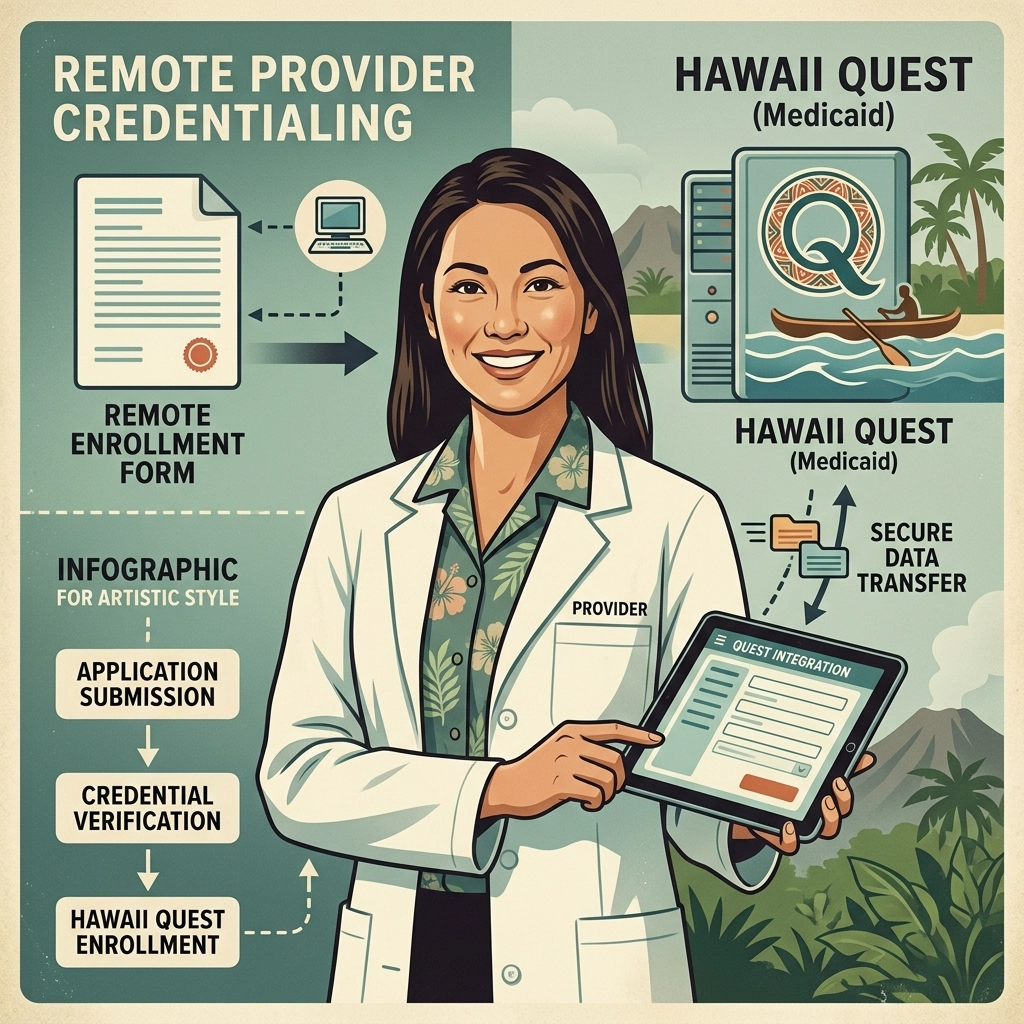
How to credential a provider in Hawaii: remote enrollment and QUEST integration

Navigating the complexities of Hawaii credentialing requires more than just a standard checklist; it demands a deep understanding of the QUEST integration framework and the logistical hurdles unique to the islands. For healthcare organizations expanding into the 50th state, the "island effect" is a tangible barrier where geographic isolation and specific state mandates can stall a provider’s ability to see patients for months. You must treat Hawaii not as just another state in a multi-state rollout, but as a specialized ecosystem with its own digital gateway and stringent compliance timelines. Looking for professional provider credentialing services in the USA? 👉 Check our main service page here: veracityeg.com The Digital Gateway: Mastering the HOKU Portal The Hawaii Online Knowledge Utility (HOKU) is the definitive entry point for all providers seeking to participate in the state’s Medicaid program. Managed by the Med-QUEST Division (MQD), HOKU is a mandatory portal that centralizes enrollment. You cannot bypass this system; it is the backbone of professional credibility for any practitioner operating in Hawaii. When you begin the process in HOKU, you are not merely filling out a digital form: you are establishing a provider's legal standing with the Department of Human Services (DHS). The system is designed to streamline the verification of licensure, certifications, and exclusion statuses. However, the complexity of the data entry means that HOKU will flag discrepancies, which often leads to delays or requests for correction, creating a cycle of "churn" that delays reimbursement. To succeed, you must ensure that every piece of data: from the NPI to the primary practice location: matches exactly across all state and federal databases. In Hawaii, where provider shortages are acute, the efficiency of your HOKU submission determines how quickly you can address the healthcare needs of the local community. The Complexity of Form DHS 1139 and its Appendices While HOKU is the portal, Form DHS 1139 is the administrative engine of Hawaii provider enrollment. This is where most organizations stumble. Unlike standard Medicaid forms in other states, Hawaii’s requirements are segmented into a dizzying array of attachments and appendices that must be meticulously completed based on the provider’s specialty and practice structure. Several appendices are required depending on provider type, ownership structure, and specialty: Appendices A-F: These cover basic provider agreements, disclosure of ownership, and financial interest. Appendices L-Q: These are often specialty-specific or related to civil rights compliance and electronic funds transfer (EFT) authorizations. Failure to include the correct appendix for a specific provider type: such as an LCSW or a Board Certified Behavior Analyst (BCBA): is a guaranteed way to trigger a 30-to-60-day delay. You must view Form DHS 1139 as a legal document that requires the same level of scrutiny as a high-stakes contract. At The Veracity Group, we emphasize that precision in these appendices is the only way to avoid the administrative "black hole" of the Med-QUEST review process. Leveraging CAQH ProView and Act 192 Compliance Hawaii has integrated CAQH ProView into its regulatory landscape through Act 192. This legislation was designed to simplify the process, but it introduces a strict 90-day verification timeline for Hawaii health plans. Under Act 192, health plans are required to complete the verification of a provider’s credentials within 90 days of receiving a "complete" application. However, the definition of a "complete" application is where many practices fail. To ensure your 90-day clock actually starts, your CAQH profile must be: Fully Attested: The provider must re-attest every 120 days. Global Authorization: Hawaii health plans must be granted explicit permission to view the data. Document Centric: All current licenses, DEA certificates, and malpractice face sheets must be uploaded and legible. If you are managing a multi-state Medicaid enrollment, do not assume your standard CAQH setup is sufficient for Hawaii. The state’s auditors frequently cross-reference CAQH data against the HOKU portal. Any misalignment between these two systems will halt your progress. Remote Enrollment Strategies: Bypassing the Island Effect The "island effect" refers to the logistical delays inherent in traditional mail-based processes between the mainland and Hawaii. For remote enrollment, you must move beyond the mailbox. Remote enrollment is a necessity, not just a convenience. The Med-QUEST Division has opened specific digital channels to facilitate faster processing. You should leverage the following contact methods to bypass geographic hurdles: Direct Email: Use HCSBInquiries@dhs.hawaii.gov for status updates and specific technical questions regarding HOKU. Fax Utilization: Despite being an older technology, faxing remains a critical backup for submitting supplemental documentation that the portal may fail to ingest correctly. By treating these digital and telephonic channels as your primary communication tools, you eliminate the three-to-five-day transit time for physical mail, which can be the difference between a provider being "active" for the first of the month or waiting another 30 days for a new cycle. Behavioral Health and the DC:0-5 Framework Hawaii’s recent Section 1115 renewal has placed a significant emphasis on behavioral health and early childhood intervention. If you are enrolling providers in these fields, you must be aware of the DC:0-5 framework. This is the diagnostic classification of mental health and developmental disorders of infancy and early childhood. Some QUEST programs, especially those serving infants and young children, emphasize DC:0-5 competency. Furthermore, the state is pushing for culturally appropriate care requirements. This means your enrollment documentation may need to reflect the provider's ability to serve Hawaii’s diverse population, including Native Hawaiians and Pacific Islanders. For those in the mental health space, the challenges of behavioral health enrollment are amplified in Hawaii. You must ensure that practitioners like Licensed Marriage and Family Therapists (LMFT) or Psychiatrists have their specific certifications properly mapped to the Hawaii-specific taxonomy codes within HOKU. The High Cost of QUEST Churn "Churn" occurs when providers or members cycle in and out of the QUEST program due to administrative errors or missed re-validation deadlines. In Hawaii, the impact of churn is devastating to a clinic’s bottom line. When a provider is suspended because their DHS 1139 data became stale, every claim submitted during that period will be denied.
How to credential a provider in South Carolina: payer delays and Healthy Connections

Navigating the landscape of provider enrollment and Medicaid participation in the Palmetto State requires more than just administrative effort; it demands extreme operational rigor. In South Carolina, the Medicaid program, known as Healthy Connections, is managed by the South Carolina Department of Health and Human Services (SCDHHS). For many practices, the process of medical credentialing becomes a bottleneck that halts revenue and delays patient care. If you are not prepared for the specific nuances of the South Carolina portal and the strict screening requirements enforced by the state, your application will face indefinite delays or outright rejection. The complexity of South Carolina’s system is often underestimated. Between the risk-based screening levels and the unforgiving timelines for document submission, there is no room for error. At The Veracity Group, we see many providers struggle with the "in-process" window or lose weeks of progress because of a missing Reference ID. Understanding these mechanics is not just a benefit: it is a necessity for your practice’s financial survival. Looking for professional provider credentialing services in the USA? 👉 Check our main service page here: veracityeg.com The Front Door: Navigating the Healthy Connections Portal The journey begins at the Healthy Connections Provider Enrollment Portal. This is the centralized hub for all enrollment, revalidation, and demographic updates. While many states still rely on fragmented systems, South Carolina has consolidated its process, which is both a blessing and a curse. The system is highly automated, meaning that if you do not follow the exact logic of the portal, your application is dead on arrival. When you begin an application, the system generates a Reference ID. This is perhaps the most critical piece of data in your entire enrollment packet. In South Carolina, this ID acts as your "passport" through the administrative maze. You must include this Reference ID on every single supporting document you fax or upload. Without it, the SCDHHS imaging system cannot link your documents to your digital application, and your file will sit in a "pending" status until the system eventually purges it. The 30-Day "In-Process" Clock One of the most common pitfalls for providers is the 30-day "in-process" application window. Once you initiate an application in the portal, you have exactly 30 days to complete it and submit all required documentation. If you fail to hit the "Submit" button or if your faxes aren't received and matched within this timeframe, the system will delete your application. This is a hard stop. There are no extensions. If your application is purged, you must start the entire process from scratch, losing any progress you made on primary source verification or site visit scheduling. This is why we emphasize a "document-first" strategy: gather every license, certification, and insurance document before you even log into the portal. For more on the risks of administrative delays, see our deep dive into mastering multi-state Medicaid provider enrollment. Risk-Based Screening: High-Stakes Compliance SCDHHS utilizes a risk-based screening model to determine the level of scrutiny an application receives. Every provider type is categorized into one of three levels: Limited, Moderate, or High. Limited Risk: This category typically includes physicians, medical groups, and hospitals. Screening involves verifying licenses and checking federal databases for exclusions. Moderate Risk: This includes physical therapists and community mental health centers. In addition to limited-risk checks, these providers are subject to unannounced site visits. Some behavioral health entities may fall into moderate or high risk depending on structure. High Risk: This category includes new Home Health Agencies and Durable Medical Equipment (DME) suppliers. As of August 15, 2022, all providers classified as High Risk must undergo fingerprint-based criminal background checks. This requirement applies to any individual with a 5% or more direct or indirect ownership interest in the provider organization. Failing to coordinate these background checks quickly is a leading cause of payer delays in South Carolina. If you are operating in the behavioral health space, you already know that behavioral health provider enrollment is notoriously difficult, but the added layer of South Carolina’s high-risk screening makes it even more complex. Navigating Bottlenecks and Payer Delays Even with a perfect application, you will encounter delays. South Carolina can be subject to CMS-directed moratoriums, which can temporarily freeze enrollment for certain provider types if a high risk of fraud is identified in a specific region. Additionally, unannounced site visits can occur at any time during the enrollment process for moderate and high-risk categories. If a state inspector arrives and your office is closed or you cannot produce the required documentation on the spot, a failed site visit can result in denial of the application. The "silent killer" of South Carolina enrollment is the 5-year revalidation requirement. Every five years (and every three years for DME providers), you must re-verify your entire enrollment. Many practices treat revalidation as a minor update, but SCDHHS treats it with the same rigor as a brand-new application. Missing a revalidation notice: which is often sent only to the "Mail To" address in the portal: will result in your Medicaid ID being deactivated. Deactivation can result in cessation of payments. The Financial Safety Net: Retroactive Enrollment While the delays can be frustrating, South Carolina does offer a small measure of relief through retroactive enrollment. Healthy Connections allows for a 90-day look-back period. This means your enrollment date can be set up to 90 days prior to the date SCDHHS received your application, provided the provider was fully licensed and meeting all requirements during that time. However, do not rely on this as a safety net. Retroactive enrollment is not guaranteed if there are gaps in licensure or if your application is rejected and resubmitted. The date is tied to the date of receipt of a complete application. If your application is sent back for corrections, that 90-day window shifts forward, potentially leaving you with thousands of dollars in unbillable claims. Strategies for Speed: The Provider Service Center When your application is stuck in the "black hole" of state processing, you must be proactive.