Veracity upscaled revised

Credentialing in Missouri: Medicaid Managed Care and Closing Rural Health Gaps

Hqdn5zlFD v

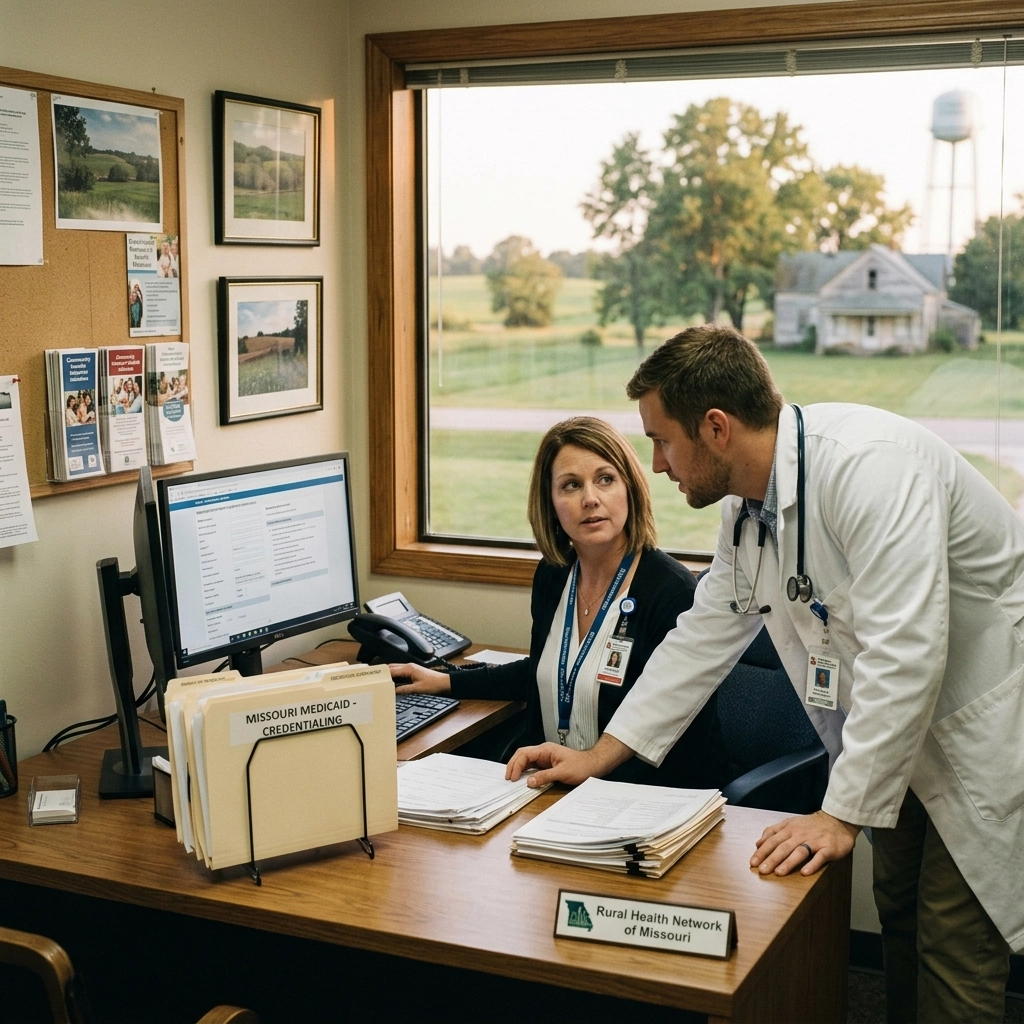
Missouri is currently navigating a pivotal shift in its healthcare landscape. Missouri has been awarded $216M in Year 1 Rural Health Transformation funding as part of a 2026–2030 federal initiative. For clinics and health systems to survive this transition, securing top-tier medical provider enrollment services is no longer optional. As a premier provider of provider credentialing services in the usa, The Veracity Group sees firsthand how administrative readiness dictates financial solvency. This isn't just about paperwork; it's about the survival of rural access points across the Show-Me State. Looking for professional provider credentialing services in the USA? 👉 Check our main service page here: veracityeg.com The $216M Transformation: A New Era for Missouri Health By 2026, Missouri has moved from planning into active rollout of its Rural Health Transformation initiative. This massive investment aims to stabilize a system that has historically struggled with hospital closures and provider shortages. The state has committed to launching 30 community health hubs strategically placed to serve the most vulnerable populations. These hubs are the backbone of professional credibility for the region. However, a hub is only as effective as its enrolled providers. If a clinic is part of this $216M rollout but fails to manage its enrollment, it cannot draw down the federal and state funds allocated for its operation. This creates a "funding ghost" where a facility exists on paper but remains financially paralyzed. For providers operating near our home base in Arkansas, the cross-border implications are significant. Missouri’s reform mimics many of the regional shifts we see in the Ozarks, requiring a sophisticated approach to mastering multi-state medicaid provider enrollment. The ToRCH Model: Transforming Rural Community Health At the center of Missouri’s strategy is the ToRCH (Transformation of Rural Community Health) model. ToRCH moves beyond traditional fee-for-service by emphasizing integrated care and payment reform. It combines primary care, behavioral health, and social determinants of health into a single delivery stream. For a provider to participate in ToRCH, their enrollment status must be impeccable. The model relies on a "hub-and-spoke" architecture. If the primary hub encounters an enrollment lapse, every "spoke" (specialist or satellite clinic) associated with that hub faces reimbursement delays. Key Technical Requirements for ToRCH Participation: NPI Alignment: Ensuring every provider's National Provider Identifier is correctly linked to the specific rural health hub taxonomy. State-Specific Licensure: For behavioral health providers, such as LCSWs and LPCs, Missouri requires strict adherence to MO HealthNet’s specialized enrollment categories. Site Visit Compliance: Rural community hubs often trigger mandatory site visits under Medicaid managed care regulations. Failure to prepare for these is a fast track to application denial. MO HealthNet and the Shift to Outcome-Based Payments Missouri’s Medicaid program, MO HealthNet, is no longer just paying for volume. MO HealthNet is incorporating more outcome-based elements into managed care contracts. This means your reimbursement is tied to patient health metrics and quality of care. However, there is a catch: you cannot report outcomes if you aren't enrolled in the system correctly. Managed Care Organizations (MCOs) like Healthy Blue, Home State Health, and UnitedHealthcare Community Plan use automated systems to filter claims. If a provider's data in the MMAC (Missouri Medicaid Audit & Compliance) system is even slightly outdated, the claim is rejected before the "outcome" is even measured. The high cost of delays in this environment is staggering. In a cut environment, providers with incomplete or inaccurate enrollment are especially vulnerable to revenue loss. They lack the administrative "passport" needed to access the remaining pools of incentive funding. Closing the 'Medical Provider Enrollment Services' Gap The most significant threat to Missouri’s rural health recovery is the administrative gap. While the state is building the buildings and buying the equipment, many clinics are neglecting the "silent driver" of their revenue cycle: the enrollment of their staff. Rural clinics often lack the dedicated HR or credentialing staff found in large urban systems like those in St. Louis or Kansas City. This results in: Expired CAQH Profiles: Which can lead to claim holds, network issues, or de-facto loss of active status with some MCOs. Mismanaged Demographic Updates: If a clinic moves or adds a new telehealth service, failing to update this via demographic updates can stop payments for months. Missed Incentive Programs: Missouri offers specific financial bonuses for providers meeting rural health targets. These are only available to those whose enrollment files are 100% compliant. At The Veracity Group, we advocate for a proactive stance. You must treat your enrollment as a critical asset, not a secondary chore. Navigating Medicaid Managed Care Contracts To participate in the MO HealthNet network, you must navigate periodic re-enrollment and revalidation cycles. According to the Missouri Department of Social Services, failing to respond to a re-validation request within the stated deadline can result in suspension of the provider’s Medicaid ID. For multi-state groups, this is even more complex. A provider practicing in both Arkansas and Missouri must maintain two distinct sets of state-specific enrollment requirements, even if the MCO (like UnitedHealthcare) is the same in both states. Common Pitfalls in Missouri Medicaid Enrollment: Incomplete Disclosure of Ownership: Missouri is aggressive in auditing the ownership interest of medical groups to prevent fraud. Mismatched Taxonomy Codes: A rural health clinic (RHC) must use specific billing codes that differ from standard private practices. Delayed DEA Updates: For providers prescribing controlled substances in rural areas, any delay in linking a new DEA certificate to the MO HealthNet profile will result in rejected pharmacy claims for their patients. Why Accuracy is the Backbone of Rural Health The $216M grant is a ticking clock. These funds are designed to build a self-sustaining system by 2030. If your clinic or practice is not fully enrolled and optimized by then, you will find yourself on the outside of a closed system. Accurate enrollment is the only way to ensure your participation in state provider incentive programs. These programs are designed to reward providers who stay in rural areas, but they require rigorous data validation. If the state cannot verify your hours,

Credentialing in Ohio: Navigating ODM and Medicaid Complexity in 2026

TukFXJvLhrm

Ohio’s healthcare landscape is undergoing its most significant transformation in a decade. As of April 2026, navigating the medical provider enrollment services landscape requires more than just administrative diligence; it demands a strategic mastery of the Ohio Department of Medicaid (ODM) ecosystem. For practices eyeing expansion, particularly those moving between Indiana and Ohio, understanding multi-state Medicaid provider enrollment is the only way to safeguard your revenue stream and ensure uninterrupted patient care. Looking for professional provider credentialing services in the USA? 👉 Check our main service page here: veracityeg.com The 2026 Landscape: Next Generation MyCare Rollout January 1, 2026, marked a pivotal shift for Ohio healthcare with the full implementation of the Next Generation MyCare program. This initiative isn't just a minor update; it is a complete overhaul of how managed care is coordinated for Ohioans. For your practice, this means the days of juggling disparate requirements for multiple Managed Care Organizations (MCOs) are over, but the stakes for accuracy have never been higher. The Next Generation MyCare program is designed to streamline the member experience, but the backend complexity for providers is immense. If your data is not perfectly synchronized within the state’s repository, you are effectively invisible to the network. This rollout emphasizes a holistic approach to patient care, but it relies entirely on the centralized credentialing framework that ODM has spent years perfecting. Failure to adapt to this new model results in immediate administrative friction and delayed reimbursements. The "One Front Door": PNM and OMES The backbone of Ohio’s modern system is the Provider Network Management (PNM) portal, which serves as the "one front door" to the Ohio Medicaid Enterprise System (OMES). This centralized system replaced the aging MITS portal, and in 2026, it is the absolute authority for provider data in the state. When you utilize the PNM portal, you are entering a high-stakes digital environment. This system is designed to feed accurate data to all MCOs simultaneously. However, this "single source of truth" means that a single error in your PNM profile propagates across every payer in the state. The Veracity Group specializes in managing this "front door" entry, ensuring that every field: from NPI numbers to service locations: is validated before submission. The High Cost of EDI Rejections: 824 and 277CA In the current 2026 environment, technical proficiency is just as important as clinical excellence. The integration of OMES has introduced a rigorous validation process for electronic data interchange (EDI). If your provider data in the PNM portal does not match your claims data exactly, the system will trigger 824 Application Advice denials or 277CA Claim Acknowledgment rejections. 824 Denials: These indicate that while the system received your transaction, it found errors that prevent it from being processed. This is often the result of mismatched provider IDs or outdated demographic information. 277CA Rejections: These are even more critical, as they represent a rejection at the clearinghouse or payer gateway level. If your provider setup isn't finalized in the PNM, your claims won't even make it to the adjudication phase. These rejections are the silent killers of practice cash flow. They don't just delay payment; they create an administrative loop that can take weeks to resolve. Working with an expert partner to manage your provider enrollment ensures that these technical hurdles are cleared before the first claim is ever sent. Centralized Credentialing: A Strategic Mandate Ohio has successfully transitioned to a centralized credentialing model. This means that providers no longer need to submit separate applications to every MCO they wish to join. You verify your credentials once with ODM, and that information is shared across the board. While this sounds simpler, it places an enormous burden on the initial application and maintenance. The CAQH ProView portal remains a critical component of this process. In 2026, ODM requires that providers attest to their CAQH profile every 120 days. If your attestation lapses, or if there is a discrepancy between your CAQH data and your PNM profile, your "One Front Door" access will be restricted. Maintaining this synchronicity is a full-time job. For groups managing multiple practitioners, the risk of one provider’s oversight causing a compliance risk for the entire facility is a reality you must address proactively. Navigating the Multi-State Expansion Ohio is a massive healthcare market, and for our partners in Indiana, it represents the most logical path for growth. However, the rules in Columbus are not the rules in Indianapolis. Ohio’s reliance on the OMES "One Front Door" is distinct from Indiana’s processes. Expanding your footprint requires a partner who understands the nuances of multi-state Medicaid provider enrollment. The Veracity Group acts as the bridge for clinics moving across state lines. We ensure that your group’s tax ID is recognized, your providers are linked correctly to your new Ohio locations, and your contracting is handled with the precision required to avoid the 277CA rejections that plague unprepared practices. The Importance of PNM Data Integrity Data integrity in the PNM portal is not a "set it and forget it" task. In 2026, the ODM is performing more frequent audits of provider data. This includes: Service Location Accuracy: Ensuring that every site where a provider sees Medicaid patients is registered and active. License Verification: Automated checks against the Ohio eLicense portal. Insurance Coverage: Verifying that professional liability insurance meets the state-mandated minimums and is currently active. If any of these elements fail an automated check, the PNM system may move your status to "Pending" or "Suspended," leading to an immediate halt in claim payments. Proactive demographic updates are the only way to prevent these interruptions. Why The Veracity Group is Your Essential Partner The complexity of the Ohio Medicaid system in 2026 is designed to filter out providers who cannot maintain high administrative standards. For a growing clinic, this complexity is a barrier to entry. The Veracity Group removes that barrier. We provide the expertise needed to navigate the PNM portal, manage the CAQH lifecycle, and interpret the technical jargon of 824 and 277CA errors.

The “Closure Wave”: Navigating the 2026 Healthcare Shake-up

XnE0gdjVIrB

The healthcare landscape in 2026 is experiencing a seismic shift known as the “Closure Wave,” a period of unprecedented volatility. In early 2026, multiple hospitals and health systems announced the closure of critical units, placing even more pressure on efficient medical provider enrollment services to ensure continuity of care and financial viability. As systems consolidate and migrate to leaner models, managing provider enrollment becomes the primary operational lever for maintaining revenue streams during high-stakes transitions. This is not a theoretical downturn; it is a structural realignment. According to recent industry data, the "perfect storm" of policy-driven disruptions, aggressive funding cuts, and soaring labor expenses has forced a record number of hospitals to truncate their operations. The most visible casualties are labor and delivery (L&D) and pediatric units, which are increasingly viewed as high-cost, high-risk centers that struggling systems can no longer sustain in their traditional formats. The Anatomy of the 2026 Closure Wave As reported by Modern Healthcare, ongoing federal budget pressures and proposed changes to programs like 340B are adding financial strain to an already unstable operating environment. These financial pressures are hitting home now. In early 2026, multiple hospitals and health systems announced the closure of critical units, primarily in rural and mid-sized markets. When a hospital closes its maternity ward or pediatric wing, the impact radiates through the entire community. However, from an operational perspective, these closures are often a precursor to a larger strategic pivot: the hub-and-spoke model. Systems are abandoning the "everything under one roof" approach in favor of centralized inpatient hubs and decentralized outpatient spokes. Why Maternity and Pediatrics Are the First to Go The closure of maternity units and pediatric services is driven by three inescapable factors: Low Reimbursement Rates: Medicaid covers nearly half of all births in the United States, yet reimbursement rates often fail to cover the actual cost of labor, delivery, and neonatal care. Staffing Shortages: The "growing pandemic of healthcare provider shortages" has made it nearly impossible to staff 24/7 specialized units without relying on expensive locum tenens providers. High Malpractice Premiums: The liability costs associated with obstetrics and pediatrics continue to climb, making these units the first to be cut during a budget squeeze. For The Veracity Group, we see this as a pivot point. When you close a unit, you don't necessarily lose the providers; you relocate them. But if those providers are not correctly enrolled at their new "spoke" locations, you are essentially providing care for free. The Shift to the "Hub-and-Spoke" Model As inpatient beds vanish, they are being replaced by specialized outpatient clinics and ambulatory surgery centers (ASCs). This "hub-and-spoke" architecture allows systems to lower overhead while maintaining a footprint in the community. However, the success of this transition depends entirely on your ability to move providers between locations without a lapse in billing. Transitioning a team of 20 pediatricians from a shuttered hospital wing to three different outpatient clinics requires a massive administrative effort. Each physician must be enrolled with every payer at every new location. This includes updating NPI (National Provider Identifier) records, linking new Tax IDs, and ensuring that CAQH profiles are meticulously updated. Without a robust strategy for medical provider enrollment services, your new "spokes" will fail to generate revenue from day one. The Veracity Take: The Enrollment Crisis Behind the Closure Wave At The Veracity Group, we have observed that the "Closure Wave" is often followed by an "Enrollment Bottleneck." Health systems are moving quickly to shut down unprofitable units, but they are moving far too slowly to enroll the providers in their new environments. The consequence is simple: A provider who can see patients but cannot bill for them is a liability, not an asset. In the current 2026 climate, payers are more aggressive than ever. KFF Health News has highlighted that insurers are increasingly using AI to "algorithmically" deny claims. If a provider’s enrollment data doesn't match the service location perfectly, those AI filters will flag and deny the claim instantly. You cannot afford to have "dirty" data in a system that is looking for reasons to withhold payment. To navigate this, you must treat provider enrollment as a frontline strategic function rather than a back-office administrative task. This means initiating the enrollment process at least 90 to 120 days before a unit is scheduled to close. Looking for professional provider credentialing services in the USA? 👉 Check our main service page here: veracityeg.com Operational Risks of Service Shuttering When you announce the closure of a service line, the clock starts ticking. Beyond the public relations fallout and patient care coordination, you face significant compliance and revenue risks. Provider Attrition: If your enrollment process is slow, your top-tier providers may feel the instability and jump to competitors who have their administrative act together. Network Fragmentation: As systems drop Medicare Advantage (MA) plans—a trend where Modern Healthcare has reported that a significant share of health systems are considering scaling back or exiting certain Medicare Advantage contracts—the enrollment requirements for the remaining plans become even more stringent. Credentialing Gaps: Moving a provider from a hospital-based setting to a private outpatient setting often triggers a re-evaluation of their credentials by payers. If a provider’s file is missing even one update, the entire enrollment process can grind to a halt. For a deeper look at how these delays impact specific sectors, read our analysis on why behavioral health provider enrollment is so hard, which mirrors many of the challenges currently seen in the pediatric and maternity "Closure Wave." Mastering the Transition: A Checklist for Health Systems If your organization is currently facing a service closure or a transition to an outpatient model, you must follow a disciplined enrollment roadmap. 1. Conduct a "Provider Audit" Before the closure, identify every provider impacted. This isn't just doctors; it’s PAs, NPs, and therapists. You need a comprehensive list of their current enrollment statuses and a clear map of where they are going. 2. Prioritize High-Volume Payers Focus your medical provider enrollment services on