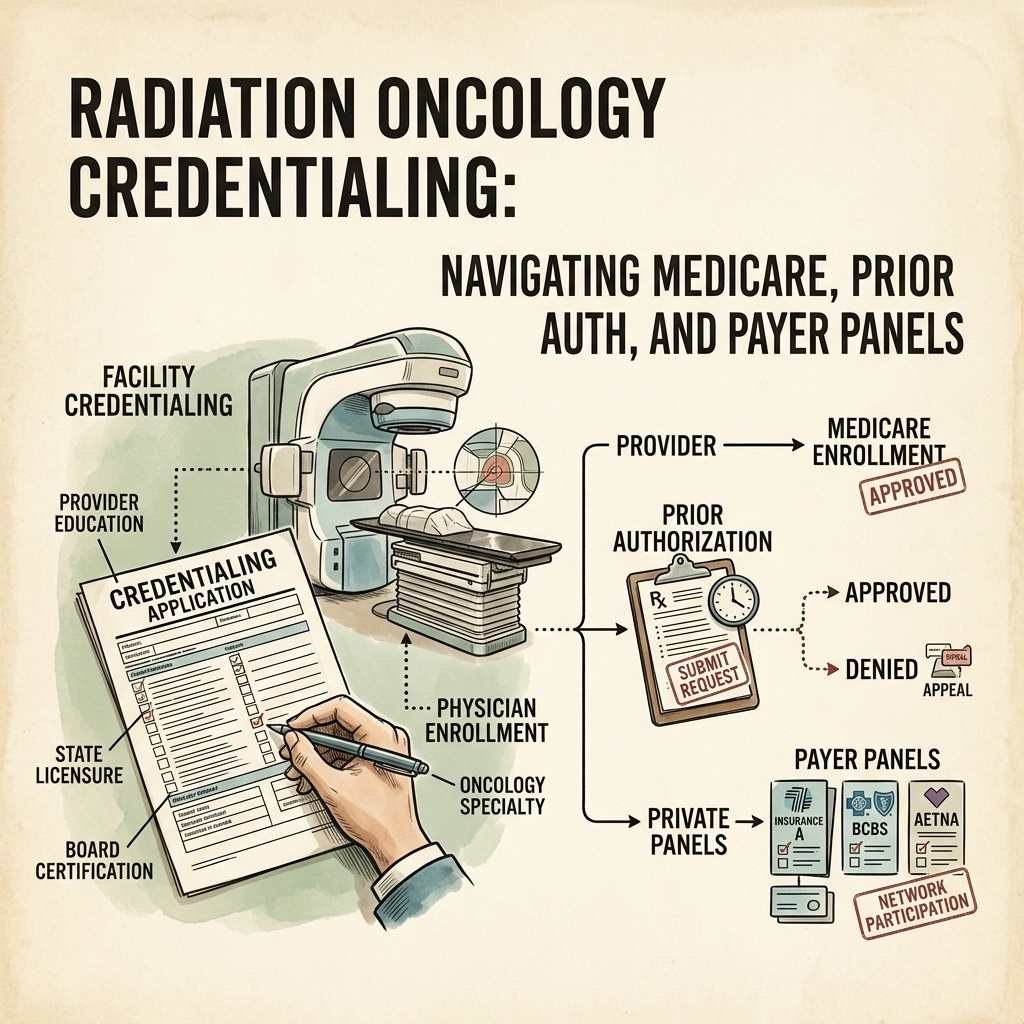
Radiation Oncology Credentialing: Navigating Medicare, Prior Auth, and Payer Panels

Securing your place in the healthcare market requires more than clinical expertise; it demands a flawlessly executed strategy for provider enrollment services. For radiation oncology practices, where the cost of technology and treatment is exceptionally high, the speed and accuracy of your Medicare enrollment determine your practice's financial viability. In an era where a single administrative oversight can lead to months of lost revenue, the "wait and see" approach is no longer an option. You must treat your enrollment and payer panel participation as the backbone of your professional credibility and the primary driver of your cash flow. Radiation oncology is uniquely positioned at the intersection of high-complexity care and high-stakes administrative scrutiny. Because treatments like Intensity-Modulated Radiation Therapy (IMRT) and Stereotactic Body Radiation Therapy (SBRT) involve significant reimbursement amounts, payers: specifically Medicare and private insurers: subject these claims to rigorous verification. If your providers are not correctly enrolled or if your facility’s demographic data is outdated, claims may be rejected at the clearinghouse level before they ever reach a payer reviewer. The Foundation of Revenue: Medicare Enrollment for Radiation Oncology Medicare is the largest payer for most radiation oncology practices, making your Medicare enrollment the most critical step in your setup. Whether you are an independent center or part of a larger hospital group, you must navigate the complexities of the PECOS (Provider Enrollment, Chain, and Ownership System) with absolute precision. For radiation oncologists, the enrollment process involves specific nuances that other specialties rarely encounter. CMS requires detailed information regarding the supervision of diagnostic and therapeutic services. You must clearly define whether your services are provided in a "freestanding" center (Global billing) or a hospital-based environment (Technical and Professional splits). Misclassifying your practice type on the CMS-855B or CMS-855I forms will typically result in claim denials for specialized codes like 77301 (IMRT planning) or 77412 (Radiation treatment delivery). The Veracity Group has a long-standing history of managing these complexities. Our successful track record with radiation oncology clients in Arkansas demonstrates our ability to navigate the specific regional requirements of Medicare Administrative Contractors (MACs). In Arkansas, ensuring that all local coverage determinations (LCDs) are met during the enrollment phase is the difference between a thriving practice and one mired in red tape. The Prior Authorization Barrier: A Growing Challenge Even after successful enrollment, the battle for reimbursement continues in the form of prior authorization (PA). While traditional Medicare often does not require PA for most radiation services, the rise of Medicare Advantage (MA) plans has fundamentally shifted the landscape. These private plans frequently require pre-approval for advanced techniques such as Proton Therapy, SRS/SBRT, and IMRT. UnitedHealthcare has announced ongoing updates to radiation oncology prior authorization requirements, including changes scheduled for 2026. However, simplified does not mean optional. Providers must remain vigilant because: Workflow Disruptions: Each Medicare Advantage plan maintains its own specific workflows and documentation requirements. Turnaround Times: As noted by industry standards, organizations like Blue Cross and Blue Shield typically process Medicare requests within 14 calendar days. If your enrollment isn't current, these 14 days can easily turn into 30 or 60. Clinical Documentation: Payers require exhaustive proof of medical necessity. If your provider’s credentials are not properly linked to the specific location where the service is rendered, the PA will be denied, regardless of the clinical data provided. The high cost of delays in radiation oncology is staggering. A single treatment course can represent tens of thousands of dollars. When your team is forced to delay a cancer patient’s treatment because of a "pending" status on a payer panel, the consequences are both financial and ethical. You must ensure your contracting is finalized well before you schedule your first patient. Navigating Payer Panels and Network Participation Being "on the panel" is your passport to success. For a radiation oncology clinic, the goal is not just to be enrolled, but to be in-network with the payers that dominate your local demographic. If your practice is located in a region where a specific commercial payer holds 40% of the market share, your absence from that panel is a catastrophic financial leak. Joining these panels is not a one-time event; it is a continuous cycle of maintenance. You must keep your CAQH profile updated with the latest board certifications, liability insurance, and hospital affiliations. Any lapse in your CAQH data can trigger suspension or interruption of claims processing, leading to a sudden and unexplained halt in payments. Looking for professional provider credentialing services in the USA? 👉 Check our main service page here: veracityeg.com The Arkansas Advantage: A Case Study in Authority The Veracity Group’s experience in the Arkansas market provides us with a unique perspective on the regional hurdles of radiation oncology. We have mastered the art of balancing national CMS standards with local payer expectations. Arkansas healthcare providers face specific challenges regarding rural access and multi-site billing. If your radiation oncologist travels between multiple clinics, their demographic updates must be handled with surgical precision. Each location must be properly "linked" to the provider’s NPI (National Provider Identifier) to ensure that billing for both the professional and technical components is seamless. Failure to manage this "linkage" is a leading cause of claim "scrubbing" errors in multi-site oncology groups. Consequences of Administrative Neglect What happens when you ignore the complexities of enrollment? The scenario is predictable but avoidable: Revenue Stagnation: Claims are held in "pending" status for months while you scramble to provide "missing" enrollment data. Patient Dissatisfaction: Patients are forced to find other facilities when they discover you are out-of-network, damaging your reputation in the community. Audit Triggers: Frequent billing errors caused by incorrect enrollment data can increase the likelihood of payer audits, leading to potential fines and "takebacks" of previously paid funds. To avoid these pitfalls, you must treat your provider enrollment as a core clinical function, not a back-office afterthought. Strategic Steps for Radiation Oncology Practices To maintain a competitive edge, your practice must implement the following best practices: Start Early: Begin the enrollment process at least
Telehealth Credentialing for Psychologists: The PSYPACT Revolution and Evolving Payer Rules

The demand for behavioral health services is at an all-time high, creating a critical need for streamlined provider enrollment and robust medical credentialing systems that allow psychologists to reach patients across state lines. As the mental health crisis intensifies, the traditional barriers to care: primarily state-specific licensure: are being dismantled by the Psychology Interjurisdictional Compact (PSYPACT). For practice owners and healthcare administrators, understanding this revolution is no longer optional; it is the backbone of professional credibility and a mandatory requirement for maintaining a competitive, revenue-generating practice in 2026. The PSYPACT Revolution: A New Era of Mobility The Psychology Interjurisdictional Compact (PSYPACT) is a multi-state agreement designed to facilitate the practice of telepsychology and the temporary in-person, face-to-face practice of psychology across state boundaries. Before the widespread adoption of this compact, a psychologist wishing to treat a patient in another state was forced to navigate a labyrinth of individual state board applications, paying multiple fees and waiting months for approval. Today, PSYPACT provides a passport to success for clinicians. By obtaining the proper credentials through the Association of State and Provincial Psychology Boards (ASPPB), a psychologist licensed in one compact state can legally provide services to patients in any other participating state. This is not a "free pass"; it is a rigorous, standardized verification process that ensures high-level care while eliminating the redundant administrative burden of multiple full state licenses. Looking for professional provider credentialing services in the USA? 👉 Check our main service page here: veracityeg.com The Two-Credential Requirement To leverage the power of PSYPACT, psychologists must secure two specific credentials. Failure to maintain both results in an immediate loss of interjurisdictional authority, which can lead to serious legal and financial consequences for your practice. The E.Passport: Issued by the ASPPB, this certificate confirms your educational background, active licensure status, and adherence to strict conduct standards. You must hold a doctoral degree in psychology from an APA/CPA-accredited program and have passed the EPPP (Examination for Professional Practice in Psychology) with a score that meets the compact's standards. Authority to Practice Interjurisdictional Telepsychology (APIT): Once the E.Passport is secured, the PSYPACT Commission issues the APIT. This is your official authorization to deliver services. Alt Text: Infographic showing the two-step PSYPACT authorization process: E.Passport and APIT certificates. Maintaining these credentials requires more than just a one-time application. You are required to complete three hours of continuing education annually specifically related to the use of technology in psychology. Without these credits, your authorization expires, and any services provided across state lines constitutes practice outside PSYPACT authority and may violate state law: a risk no medical group can afford. The Evolving Payer Landscape Since COVID-19 While PSYPACT simplifies the legal right to practice, the payer rules for psychologists have undergone a massive, often confusing transformation since the COVID-19 pandemic. During the public health emergency, payers relaxed many restrictions on telehealth. However, we are now in a post-emergency era where "temporary" rules have either become permanent or have been replaced by stricter, more complex requirements. Many commercial payers and Medicaid programs require specific modifiers (such as 95 or GT) and place of service (POS) codes (like 02 for telehealth provided outside the home or 10 for telehealth provided in the patient’s home) to process claims correctly. For psychologists, utilizing codes such as 90834 (Psychotherapy, 45 minutes) or 90837 (Psychotherapy, 60 minutes) via telehealth requires precise alignment with the payer’s current policy. The high cost of delays in updating your enrollment files with payers is staggering. If a psychologist is authorized by PSYPACT to treat a patient in a neighboring state but has not updated their provider enrollment profile with that patient's specific insurance plan for that specific jurisdiction, the claim is likely to be denied or underpaid. This is the silent driver of revenue leakage in modern behavioral health practices. Why Enrollment is More Than Just Licensure A common misconception among practice owners is that PSYPACT authorization automatically grants "in-network" status in other states. This is a dangerous assumption. Credentialing and enrollment are two different beasts. While PSYPACT handles the regulatory side, you must still navigate the individual requirements of insurance panels. Alt Text: A psychologist working from a home office using a secure telehealth platform on a laptop. Payer networks are often restricted by geography. Just because you are in-network with Blue Cross Blue Shield in Texas does not mean you are automatically in-network for a patient in Illinois, even if you have PSYPACT authorization. You must often complete additional multi-state Medicaid enrollment or commercial contracting updates to ensure you are reimbursed at the appropriate rate. The behavioral health provider enrollment process is notoriously difficult because of the high volume of providers and the specialized nature of the services. Payers frequently "close" panels to new behavioral health providers, but having a PSYPACT-authorized clinician can sometimes serve as leverage to enter these closed markets, provided the enrollment paperwork is handled with surgical precision. The Strain on Behavioral Health Systems The current strain on our healthcare system is undeniable. Patients are waiting weeks or months for appointments. Telehealth is the primary solution to this bottleneck, but it only works if the providers are properly enrolled. When a practice fails to manage its CAQH profiles or neglects demographic updates, it creates a barrier to care that is just as physical as a locked clinic door. For healthcare administrators, the mission is clear: you must treat your enrollment data as a live, breathing asset. This involves: Regularly auditing CAQH for accuracy. Ensuring the NPI (National Provider Identifier) registry reflects the correct taxonomy and address data for telehealth services. Monitoring the expiration dates of the E.Passport and APIT with the same intensity as a primary state license. The Veracity Group specializes in navigating these complexities. We understand that for a psychologist, the goal is patient care, not paperwork. By leveraging our services, practices can ensure that their clinicians remain compliant across all jurisdictions without the administrative headache. Strategies for Multi-State Success To thrive in the PSYPACT era, your
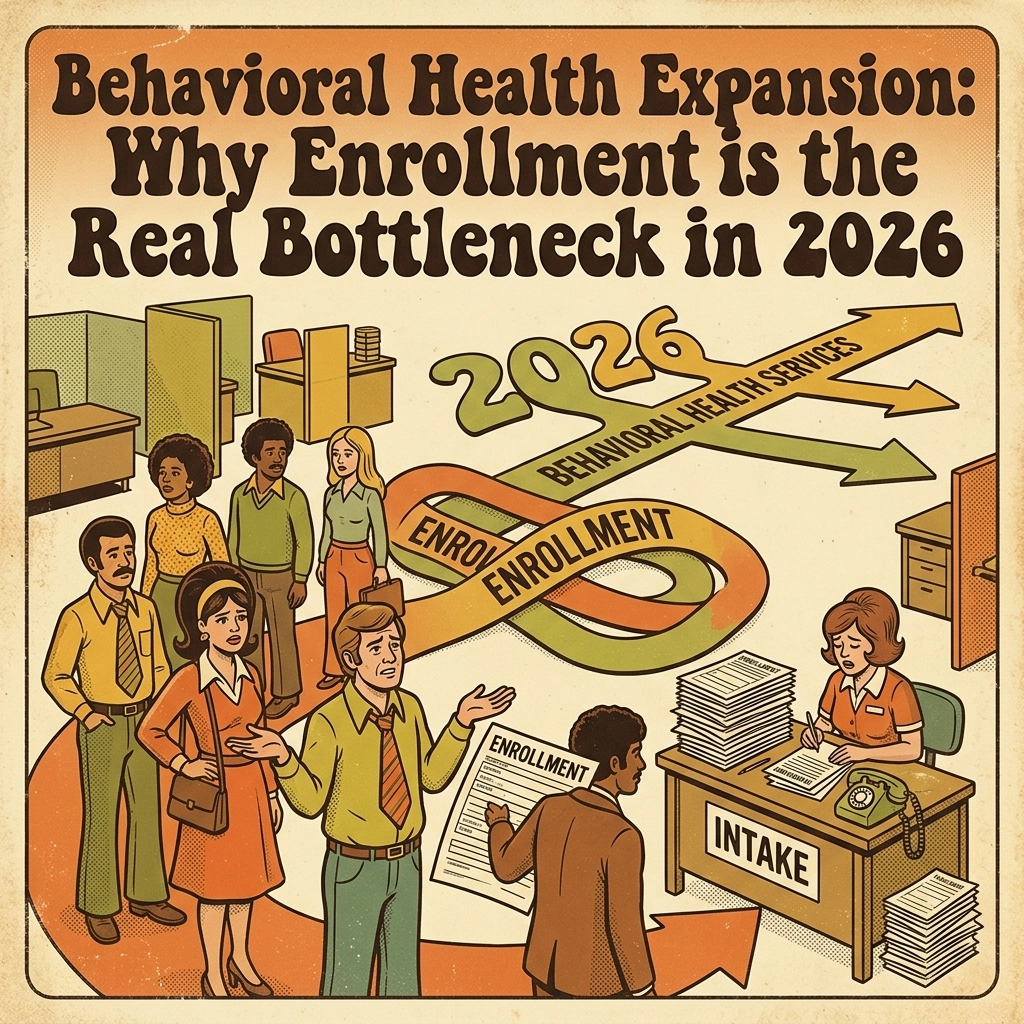
Behavioral Health Expansion: Why Enrollment is the Real Bottleneck in 2026

The demand for mental health support has reached a fever pitch, forcing health systems to move quickly to scale their outpatient capabilities. However, even aggressive recruitment strategies are hitting a brick wall. As your organization hires more Licensed Clinical Social Workers (LCSWs), Marriage and Family Therapists (MFTs), and Psychiatrists, serious operational pressure builds in the back office. By 2026, behavioral health provider enrollment has become a major bottleneck. It prevents patient access and threatens the financial stability of expansion projects. Working with experienced medical provider enrollment services helps ensure that "hired" actually means "billing." The Eroding Safety Net: A Summary of the Crisis The landscape of American mental healthcare is shifting beneath our feet. As reported by Modern Healthcare, health system leaders fear they cannot move quickly enough to respond to an eroding behavioral health safety net as outpatient services face significant strain. Many traditional "safety net" programs are under pressure from staffing shortages and inadequate funding, leaving hospital Emergency Departments (EDs) as the default—and most expensive—entry point for patients in crisis. The report highlights that while systems are pushing to expand, the infrastructure to support these new providers is often an afterthought. It isn't just about finding the talent anymore; it is about the slow process of getting those professionals into payer networks so they can actually treat the patients waiting in line. The Veracity Take: Why Hiring is Only Half the Battle At The Veracity Group, we see this play out daily. A health system successfully recruits a dozen new therapists to staff a new community clinic, only to realize sixty days later that none of them can see patients because their Medicare or Medicaid applications are still "In Process." This is the Credentialing Trap. When you hire a provider but fail to navigate the behavioral health enrollment landscape with precision, you create a massive revenue leak. Those providers sit on the payroll, unable to generate a single dollar in billable claims. Meanwhile, your ED remains overcrowded with behavioral health patients who could have been seen in an outpatient setting if your enrollment timeline matched your recruitment timeline. In our client work at The Veracity Group, we typically see enrollment delays translate into an estimated $5,000–$15,000 per month in lost revenue per provider. Alt Tag: A busy hospital administrative office focusing on provider enrollment documentation and digital screens showing PECOS and CAQH portals. The 2026 Realities: PECOS Migration and the AWS Factor If you think enrollment was difficult in 2024 or 2025, the 2026 technical landscape has introduced a new layer of complexity. The PECOS migration to AWS introduced scheduled downtime and a defined transition window in 2026, requiring teams to plan around system availability and updated security protocols so applications do not stall. Furthermore, scrutiny remains high regarding behavioral health application data because CMS and payers continue tightening validation and documentation review. That pressure is real, but it is best understood as part of broader data-accuracy and compliance expectations rather than a specialty-specific anomaly unique to 2026. In practical terms, CAQH remains a critical operational profile that must stay complete, current, and aligned with each payer submission. If your LCSWs or MFTs have inconsistent documentation, mismatched practice details, or stale attestations, their applications will be delayed or sent back for correction. Enrollment Purgatory: The Impact on Patient Care When a health system gets stuck in enrollment purgatory, the ripple effects are felt throughout the entire community. Extended ED Stays: Patients in psychiatric crisis often sit in ED beds for days because outpatient clinics cannot "accept" them until the providers are fully enrolled with the patient's specific insurance plan. Provider Burnout: New hires want to work. When they spend their first three months doing "administrative tasks" or shadowing other providers because they can't bill, their engagement drops. Revenue Loss: In the behavioral health world, volume is key. Missing out on billing codes like 90837 (Psychotherapy, 60 min) or 90791 (Psychiatric diagnostic evaluation) for dozens of providers simultaneously creates serious financial pressure. For larger systems or high-volume behavioral health programs, this can lead to a multi-million dollar deficit in a single fiscal year. You can read more about the nuances of this process in our behavioral health provider enrollment beginner’s guide. Strategic Fast-Tracking: How to Deploy Providers Immediately To survive the 2026 expansion boom, health systems must treat enrollment as a frontline clinical priority, not a back-office clerical one. Here is how The Veracity Group helps systems bypass the bottleneck: Pre-Onboarding Enrollment: We don't wait for the provider's first day. We start the CAQH and PECOS process the moment the contract is signed. Multi-State Medicaid Mastery: For systems operating across state lines, we navigate the disparate requirements of multi-state Medicaid provider enrollment, which is notoriously difficult for behavioral health. Payer Relations and Contracting: We don't just submit forms; we follow up. We have the relationships with payer representatives to push applications through the "black hole" of the approval process. Alt Tag: An infographic showing the timeline of provider recruitment vs. the accelerated timeline of professional enrollment services. Preventing Further Strain on the Safety Net As outpatient services continue to face significant strain, the health systems that thrive will be those that adapt their administrative speed to match the clinical need. It is a tragedy when a patient is denied care not because there isn't a doctor available, but because a piece of digital paperwork hasn't been processed. The Veracity Group acts as the bridge between your recruitment efforts and your revenue cycle. By offloading the burden of provider enrollment to experts who understand the 2026 technical landscape, you strengthen your ability to keep behavioral health expansion moving and connect care to the patients who need it most. Looking for professional provider credentialing services in the USA? 👉 Check our main service page here: veracityeg.com Conclusion: Don't Let Paperwork Dictate Your Growth In 2026, expansion is mandatory for health systems looking to address the mental health access crisis, but success is not guaranteed. The technical hurdles of the PECOS