Veracity upscaled revised

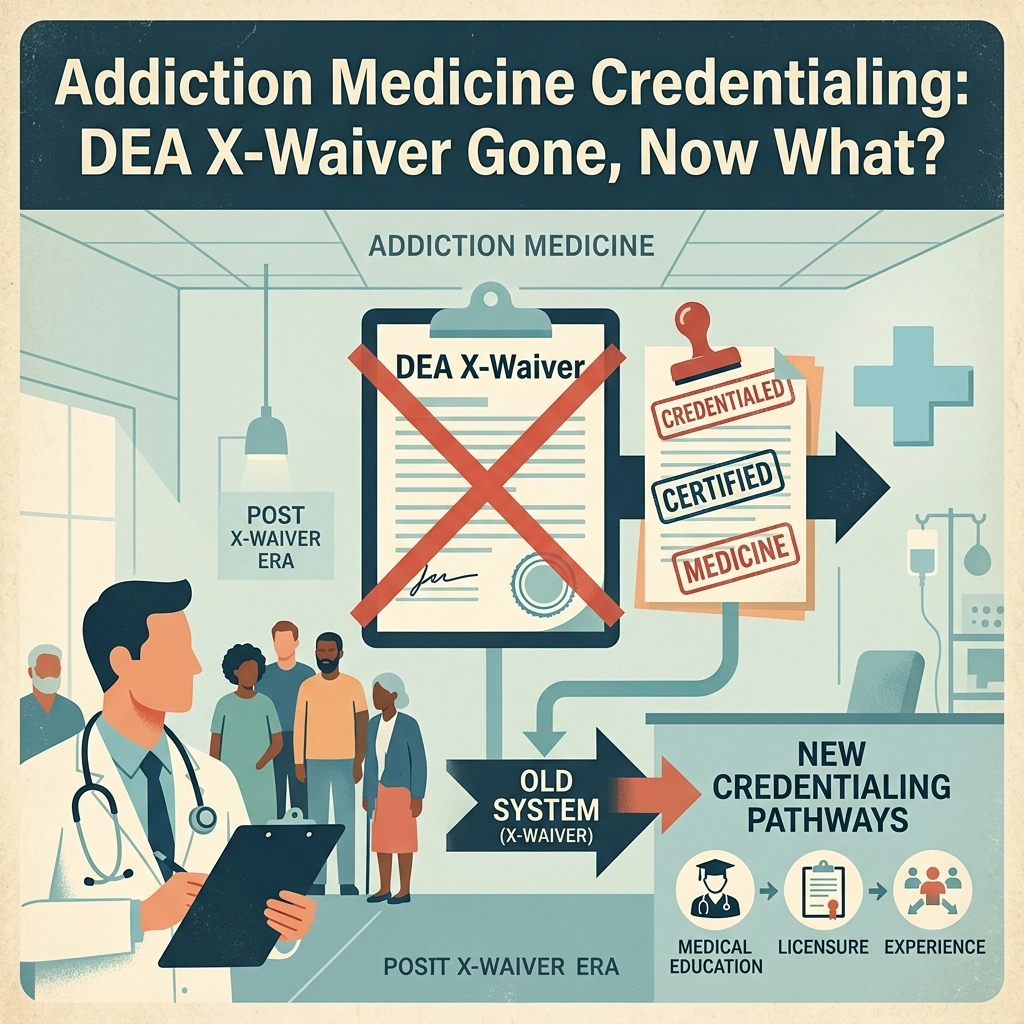
Addiction Medicine Credentialing: DEA X-Waiver Gone, Now What?

NvA EGRnvb

The landscape of Medication-Assisted Treatment (MAT) shifted beneath our feet following the elimination of the DATA-Waiver, commonly known as the X-waiver. For years, the X-waiver acted as a regulatory bottleneck, restricting the number of providers who could prescribe buprenorphine and creating a complex layer of medical credentialing that many found prohibitive. Today, in 2026, we are operating in a post-waiver environment where provider enrollment for addiction medicine has been streamlined at the federal level, yet significant administrative hurdles remain at the payer and state levels. The removal of the X-waiver was intended to expand access to life-saving treatment for Opioid Use Disorder (OUD), but simply having the legal authority to prescribe does not automatically translate into a seamless billing experience. If you are launching a new MAT program or adding addiction specialists to your group, you must understand that the "X" may be gone, but the scrutiny from insurance panels has only intensified. The End of the X-Waiver: What Actually Changed? Effective January 12, 2023, the Substance Abuse and Mental Health Services Administration (SAMHSA) and the DEA officially stopped requiring the specialized waiver to prescribe buprenorphine. This change, spurred by the Consolidated Appropriations Act of 2023, removed the cap on the number of patients a single provider can treat and eliminated the need for a separate DEA registration number starting with the letter "X." For your practice, this means: Standard DEA Authority is Sufficient: Any provider with a valid DEA registration that includes Schedule III authority can now prescribe buprenorphine for OUD. No More Patient Caps: The previous 30, 100, and 275-patient limits are a thing of the past. Your capacity is now dictated by your clinical bandwidth, not a federal ceiling. Simplified DEA Forms: You no longer have to submit a Notice of Intent (NOI) to SAMHSA to start treating patients with MAT. While these changes are a massive win for public health, they have created a "Wild West" atmosphere for provider enrollment. Payers are now looking for other ways to verify that a provider is actually qualified to manage these high-risk patients. The Mandatory 8-Hour Training: The New Bar for Enrollment While the X-waiver is dead, its ghost lives on in the form of the MATE (Medication Access and Training Expansion) Act. As of June 2023, all DEA-registered practitioners must complete at least eight hours of training on the treatment and management of patients with opioid or other substance use disorders. This is a one-time requirement tied to the first DEA application or first DEA renewal submitted after June 2023. If a provider completed the training in 2023, that provider does not repeat it for a 2026 renewal. Your job in 2026 is to ensure the documentation remains valid, accessible, and present in the provider’s CAQH profile and payer files. To satisfy this requirement for your next medical credentialing cycle, you must demonstrate one of the following: Board Certification: Being board-certified in addiction medicine or addiction psychiatry from the American Board of Medical Specialties (ABMS) or the American Osteopathic Association (AOA). Recent Graduation: Having graduated in good standing from a medical, dental, PA, or NP school within the last five years, with that five-year window measured specifically from the date of the provider’s DEA application or DEA renewal, and having completed at least eight hours of OUD curriculum. Accredited Training: Completion of eight hours of training from organizations like the American Society of Addiction Medicine (ASAM) or the American Academy of Addiction Psychiatry (AAAP). At the federal level, the DEA uses a self-attestation checkbox during the registration process. That does not satisfy payer operations in 2026. At The Veracity Group, we frequently see enrollment applications stalled because a provider checked "yes" to having the training but failed to upload the actual certificate of completion to their CAQH 2 portal. In 2026, major payers and CAQH treat the physical upload of the training certificate as a mandatory field, and they will not take your word for it; they want the paper trail. The Payer Enrollment Trap: Why Your Taxonomy Code Is Your New X-Number In the absence of the X-waiver, insurance companies are relying heavily on NPI taxonomy codes to identify which providers in a group are eligible to bill for MAT-related services. If your provider is a Family Medicine physician but is providing addiction treatment, their enrollment must reflect the correct sub-specialty or secondary taxonomy. If your taxonomy codes are outdated or generic, you will face: Automatic Claim Denials: Payers may flag MAT services as "outside the scope of practice" for a generalist. Lower Reimbursement Rates: Some contracts offer specific rates for addiction specialists that general practitioners cannot access without the correct enrollment data. Directory Inaccuracies: Patients searching for MAT providers through their insurance portal won't find you, leading to a direct loss in patient volume. We recommend a thorough review of your demographic updates to ensure that every provider offering MAT is correctly identified in the NPPES and payer databases. This is especially vital for behavioral health provider enrollment, which you can learn more about in our beginner’s guide. State Laws vs. Federal Freedom: The Compliance Gap It is a common misconception that federal law supersedes all state-level restrictions regarding MAT. While the DEA removed the X-waiver, roughly 15–18 states still maintain their own "mini-waivers," additional registrations, specific administrative code requirements, or strict collaborative and supervision ratio rules for Nurse Practitioners (NPs) and Physician Assistants (PAs) who prescribe buprenorphine. For example, a state can allow an NP to prescribe buprenorphine federally, but that same state can still require a separate state registration, a physician collaboration document, or a stricter supervision ratio before the mid-level prescriber is treated as fully compliant for Medicaid or commercial panel participation. Failing to have this documentation on file during the contracting phase leads to denials, enrollment holds, or outright rejection from state Medicaid panels. If you are operating in multiple states, you are navigating a minefield of conflicting regulations. We detail these complexities in our post on mastering multi-state Medicaid provider

Credentialing a New Hospitalist Program: Tips for Fast Panel Access

QD4nECmtEO0

Launching a new hospitalist program is a high-stakes race against the clock where provider enrollment services and efficient medical group enrollment serve as the primary engine for financial viability. In the fast-paced environment of inpatient medicine, every day a physician or advanced practice provider (APP) is unable to bill represents a direct hit to your bottom line. Hospital medicine groups launch frequently to meet the demands of surging patient volumes, yet many find their revenue cycles paralyzed because they underestimated the complexity of securing payer panel access. The reality of 2026 is that payers are more stringent than ever, and administrative bottlenecks are the "silent killers" of new clinical initiatives. To ensure your hospitalist program is a financial success from day one, you must treat the enrollment process with the same clinical urgency as an acute code. This guide provides the blueprint for bypassing common delays and securing the fast panel access your program requires. The High Cost of Onboarding Delays In a hospital setting, the financial impact of a provider who cannot bill is staggering. A single hospitalist can generate significant daily revenue; when that provider is seeing patients but is not yet enrolled with major payers like Medicare, Medicaid, or UnitedHealthcare, your group is essentially providing free labor. These "revenue leaks" are often permanent, as retroactive billing has strict limits and varies wildly by payer. In 2026, 69% of health systems report losses of $1,000 to $5,000 per provider per day due to onboarding delays, and 1 in 5 hospital leaders report annual losses exceeding $1 million. Those numbers make one point clear: delayed enrollment is not an administrative nuisance. It is a direct threat to margin, staffing stability, and launch performance. Alt: A graphical representation of revenue loss due to provider onboarding delays in a hospitalist program. The risk is not just financial: it is operational. If your new hospitalists cannot bill, the burden of "billable" patients falls on a smaller subset of the team, leading to burnout and high turnover in a specialty that is already facing a national shortage. You will face these consequences if you treat enrollment as an afterthought rather than a primary launch requirement. The Pre-Hire Credentialing Strategy: Parallel Processing One of the most frequent mistakes hospitalist groups make is waiting for a signed employment contract before beginning the enrollment process. In the modern healthcare landscape, this sequential approach is obsolete. To achieve fast panel access, you must implement parallel processing. As soon as a candidate reaches the final interview stage or a Letter of Intent (LOI) is issued, the information-gathering phase should begin. Waiting until the provider's first day on the job to start their CAQH profile or NPI updates is a recipe for a 90-day revenue gap. Start Before the "Start Date" Professional hospitalist groups now use "Pre-Application Packets" during the recruitment phase. This allows you to verify that the provider’s data is accurate and that their AMA Physician Profile is up to date before they even step onto the hospital floor. If a provider has a history of malpractice claims or disciplinary actions, you need to know this immediately, as these factors will trigger manual reviews by payers, extending the enrollment timeline by months. Building the Hospitalist Portfolio: The Essential Checklist A "90% complete" application is often treated as "0% complete" by major health plans. Incomplete submissions are discarded or moved to the bottom of the pile, causing preventable delays. Your program needs a standardized digital repository for every provider. Alt: A checklist of required documentation for hospital medicine providers including DEA, NPI, and board certifications. Your documentation suite must include: State-Specific Licensure: Ensure the license is active and reflects the correct practice location. DEA Registration: For hospitalists, the DEA must reflect the state where they are practicing. If they are moving from out of state, this update is a critical path item. Board Certification: Evidence of Internal Medicine, Family Medicine, or Pediatric board eligibility or certification. Complete Peer References: Payers often require three references from the same specialty who have worked with the provider within the last 24 months. Claims History: A full five-to-ten-year malpractice claims history, even if there are zero claims. Work History: A CV that accounts for every month since medical school graduation. Gaps of more than 30 days must be explained. Looking for professional provider credentialing services in the USA? 👉 Check our main service page here: veracityeg.com Navigating the Medicare PECOS and Medicaid Maze For hospitalists, Medicare and Medicaid represent a massive portion of the payer mix. Navigating the Medicare enrollment process requires precision. One of the most common "traps" for new programs is understanding how group enrollment and reassignment now function inside Medicare paperwork. As of 2026, the CMS-855R form has been discontinued, and reassignment of benefits is now merged into the CMS-855I form. That change means your intake workflow, document review, and physician signature process must reflect the updated Medicare structure from the start. If you are launching a brand-new group, you must first secure your group NPI and Medicare group number before you can reassign individual providers to it. This two-step process can take 60 to 120 days. If you haven't accounted for this lead time, your entire team will be seeing Medicare patients with no way to submit a claim. Critical PECOS System Migration Notice Starting April 20, 2026, PECOS is migrating to the CMS AWS Cloud. CMS has also scheduled a system outage on May 2-3, 2026. Your enrollment and IT teams must plan around that blackout window to avoid stalled submissions, missed signatures, and delayed application tracking. IP allowlists must be updated by May 4, 2026 so your organization can maintain access after the migration. If your team ignores this deadline, PECOS access disruptions will slow your Medicare enrollment pipeline at exactly the wrong moment. Multi-State Challenges If your hospitalist group operates near state lines or utilizes telehealth for night coverage, you are likely dealing with multi-state Medicaid enrollment. Each state has different rules regarding site-of-service

Ophthalmology Credentialing vs. Optometry: What’s Different and Why It Matters

Y1gXqh6 Dz6

Navigating the complexities of medical provider enrollment and healthcare payer enrollment is a full-time job that often leaves administrative staff feeling like they are walking through a fog. One of the most common points of friction we see at The Veracity Group is the confusion between enrolling an ophthalmologist versus an optometrist. To the untrained eye, they both deal with vision, so the paperwork should be the same, right? Wrong. Treating these two distinct professions as identical during the enrollment process is a recipe for immediate claim denials, delayed revenue, and significant compliance risks. Precision in your data entry is the backbone of professional credibility. If your admin team conflates an MD with an OD, you aren't just making a "typo": you are misrepresenting a provider’s scope of practice to a payer. In 2026, where AI-driven payer audits are more aggressive than ever, these mistakes are caught in milliseconds. Understanding the fundamental differences in how these providers are enrolled is not just a "nice to have" skill; it is a vital component of your practice’s financial health. The Core Identity Crisis: MD vs. OD The most significant difference lies in the educational pathway and the resulting legal scope of practice. Ophthalmologists are medical doctors (MDs or DOs) who have completed medical school, a residency, and often a multi-year fellowship. They are surgeons. Optometrists (ODs) are doctors of optometry who provide primary vision care, ranging from sight testing and correction to the diagnosis and management of vision changes. When you begin the enrollment process, the National Provider Identifier (NPI) and the associated Taxonomy Codes act as the digital DNA for these providers. Ophthalmology Taxonomy: 207W00000X Optometry Taxonomy: 152W00000X Using the wrong code will result in an automatic rejection of your healthcare payer enrollment application. Payers use these codes to determine which fee schedules apply and which procedures the provider is authorized to bill. If an optometrist is enrolled under an ophthalmology taxonomy, they may be erroneously cleared to bill for routine cataract surgery (CPT 66984) or even complex cataract surgery (CPT 66982) that they are not licensed to perform. CPT 66984 is the standard routine cataract surgery code, while CPT 66982 is the complex cataract surgery code. When the audit hits: and it will: the financial consequences for the practice will be devastating. Payer Panels: The Vision vs. Medical Divide One of the biggest hurdles in eye care enrollment is the "carve-out" system. Most healthcare providers deal with a single medical panel. Eye care providers, however, live in a dual world of Vision Plans (like VSP, EyeMed, and Davis Vision) and Medical Plans (like BlueCross BlueShield, UnitedHealthcare, and Aetna). For an ophthalmologist, the primary focus is almost always the medical panel. They are treating medical conditions like glaucoma, macular degeneration, and diabetic retinopathy. While some ophthalmologists participate in vision plans for routine exams, many do not. Optometrists, conversely, must be enrolled in both. If an OD is only on the vision panel, they cannot bill for a medical office visit when a patient presents with a "red eye" or a foreign body. This is a common enrollment trap. If your admin staff skips the medical enrollment for your ODs, you are effectively leaving thousands of dollars on the table and forcing patients to pay out-of-pocket for medical eye issues, which damages your patient retention. For more on navigating these complex payer structures, check out our guide on navigating the maze of CAQH and Medicare enrollment. Medicare Enrollment: Specialty 18 vs. Specialty 41 Medicare is the "gold standard" of enrollment, and they do not tolerate ambiguity. When enrolling through PECOS, the specialty designation is the most critical field. Specialty 18: Ophthalmology Specialty 41: Optometry As of 2026, Medicare has updated its reimbursement protocols for certain diagnostic tests. Ophthalmologists, as surgical specialists, often have broader access to "incident to" billing and specific surgical modifiers. Optometrists have high-value roles in Medicare, particularly in post-operative care for cataract patients (using the -55 modifier), but the enrollment must be perfectly synced with their state’s Scope of Practice (SOP) laws. In states like Oklahoma, Kentucky, and Louisiana, optometrists have expanded surgical authority (including certain laser procedures). If your practice is in one of these "expanded scope" states, your enrollment team must ensure that the provider’s CAQH profile and payer contracts reflect these specific competencies. Failure to do so will result in "unauthorized service" denials, even if the state law says they can do it. The High Cost of Administrative Delays Speed is revenue. When a new ophthalmologist joins your group, every day they aren't linked to your Group NPI is a day of lost surgical revenue. Because ophthalmology often involves high-dollar procedures and expensive injectable drugs (like those used for wet AMD), the "hold" on billing while waiting for enrollment can reach six figures in just a few weeks. Administrative staff often underestimate the time required for Ophthalmology enrollment because they assume it’s a standard "physician" application. However, because ophthalmologists are often sub-specialists (Retina, Cornea, Oculoplastics), payers may require additional board certification verification and fellowship documentation. If your staff treats an Oculoplastic Surgeon’s enrollment with the same level of detail as a general OD, the application will be kicked back for "missing sub-specialty credentials." You can learn more about the risks of medical group enrollment and how to mitigate them by reading our article on medical group enrollment for surgery centers. State Licensure and the 2026 Landscape The legislative landscape for eye care is shifting rapidly. In 2026, several more states are expected to join the list of those allowing "Advanced Procedures" for optometrists. This means your enrollment strategy must be proactive. When The Veracity Group manages your enrollment, we don't just look at what your provider can bill today; we look at the legislative trajectory of your state. If your OD is about to be granted laser privileges, their payer contracts need to be updated before the first patient walks through the door. Waiting until after the law changes to update your enrollment is a