PA Credentialing: Solving Panel Access and Payer Quirks for Physician Assistants

Navigating the complexities of provider enrollment is a non-negotiable requirement for modern healthcare practices, yet medical credentialing for Physician Assistants (PAs) remains one of the most misunderstood areas of revenue cycle management. While PAs are the backbone of clinical efficiency, their path to full billing privileges is often obstructed by "silent stalls," payer-specific quirks, and panel access barriers that can leave your practice footing the bill for a provider who cannot legally generate revenue. In the fast-paced environment of 2026, you cannot afford to treat PA credentialing as a back-office afterthought. It is the passport to success for your revenue cycle. When a PA is not correctly linked to your Tax ID or their supervising agreement is outdated, the result is not just a delay: it is a guaranteed denial. The Panel Access Problem: Why PAs Get Blocked One of the most frustrating hurdles for Physician Assistants is the "closed panel" phenomenon. You may hire a highly qualified PA-C, only to find that a major commercial payer claims their panel is full and refuses to add new providers. This is often a administrative deflection rather than a hard clinical reality. For PAs, panel access is the gatekeeper of patient volume. If your PA is not on the panel, they cannot see patients from that payer’s network, or worse, they see them and the claims are processed at out-of-network rates: leaving the patient with an unexpected bill and your practice with a reputational hit. To overcome this, you must demonstrate a "need-based" argument or ensure that the PA is properly linked as a sub-provider under the group’s existing contract. At The Veracity Group, we navigate these barriers by ensuring every application is framed to highlight the PA's role in expanding access to care, which is a powerful lever in negotiations with payer network managers. The Supervising Physician Loophole Unlike physicians, PA credentialing is inherently tethered to a Supervising Physician (SP) Agreement. This is where many practices fail. Payers require absolute synchronicity between the SP agreement on file and the data entered into CAQH. If the names, license numbers, or effective dates on the SP agreement do not mirror the application exactly, the payer will trigger a "silent stall." They won’t always call you to tell you there is a discrepancy; they will simply let the application sit in a pending queue until it eventually expires. Key Requirements for PA Supervision Documentation: Current Signatures: Ensure the agreement is signed by both the PA and the SP within the required timeframe. Mirroring Data: Every detail in the agreement must match the demographic updates provided to the insurance companies. Scope of Practice: Clearly define the PA’s scope as it relates to the specialty (e.g., specific surgical assisting duties or prescribing authorities). Treat these agreements as living documents. When an SP leaves the practice or a new one is added, you must update every payer immediately. Failing to do so is a primary cause of "provider not eligible" denials. Payer-Specific Quirks: A State-by-State Minefield Payer requirements are not universal; they are a patchwork of state regulations and internal corporate policies. Navigating this maze requires insider knowledge of how specific payers operate. The Maryland CareFirst Challenge In Maryland, CareFirst BlueCross BlueShield utilizes CAQH for the initial credentialing phase, but the actual contracting process remains a manual, archaic system. There is no reliable portal tracking for the contract execution phase. If you aren’t aggressively following up with a dedicated representative, your PA might be "credentialed" but still unable to bill because the contract was never linked to their NPI. The Washington "Portal Mirage" In Washington state, providers often show as "active" or "credentialed" in payer portals weeks before the contracts are actually executed. Billing against this status is a trap. You will receive a flurry of denials because the back-end financial systems haven’t caught up to the front-end directory. You must wait for the countersigned contract before you flip the switch on billing. The Pennsylvania PROMISe ID If your practice operates in Pennsylvania, you know that Medicaid enrollment is a different beast. PAs must obtain a PROMISe ID. However, having this ID is only the first step. Each Managed Care Organization (MCO): such as UPMC, Keystone First, or Health Partners: manages its own credentialing and contracting independently. A PA enrolled with the state is not automatically enrolled with the MCOs. This multi-step process is why mastering multi-state Medicaid provider enrollment is critical for regional practices. Why Incorrect Denials Happen (And How to Stop Them) The most common reason for PA claim denials is the failure to link the NPI and TIN (Tax Identification Number) correctly. Even if the PA is credentialed, if the payer's system doesn't "see" that the PA belongs to your specific group at your specific location, the claim will fail. Common "Quirks" That Lead to Denials: Missing Modifiers: Some payers require specific modifiers for PA-provided services (such as -AS for surgical assists). If your billing software isn't configured for these payer-specific rules, the claims are dead on arrival. Incomplete CAQH Re-attestations: CAQH requires re-attestation every 90 days. If your PA misses this window, their status goes "inactive," and payers will immediately stop processing their claims. PECOS Delays: Medicare enrollment via the PECOS system is generally faster, but any error in the initial submission can lead to a 60-day lockout. Strategic sequencing is required: submit to PECOS first to establish the provider’s "baseline" before moving to commercial and Medicaid applications. The High Cost of DIY Credentialing Many practice managers attempt to handle PA credentialing in-house, viewing it as a simple administrative task. This is a high-risk gamble. The administrative burden of tracking five different portals, following up with ten different payers, and maintaining CAQH compliance for multiple providers is a full-time job. When you manage this internally, the "silent stalls" mentioned earlier go unnoticed for months. Every month a PA is unable to bill represents thousands of dollars in lost revenue. Credentialing is the silent driver of your practice’s cash flow; if the engine
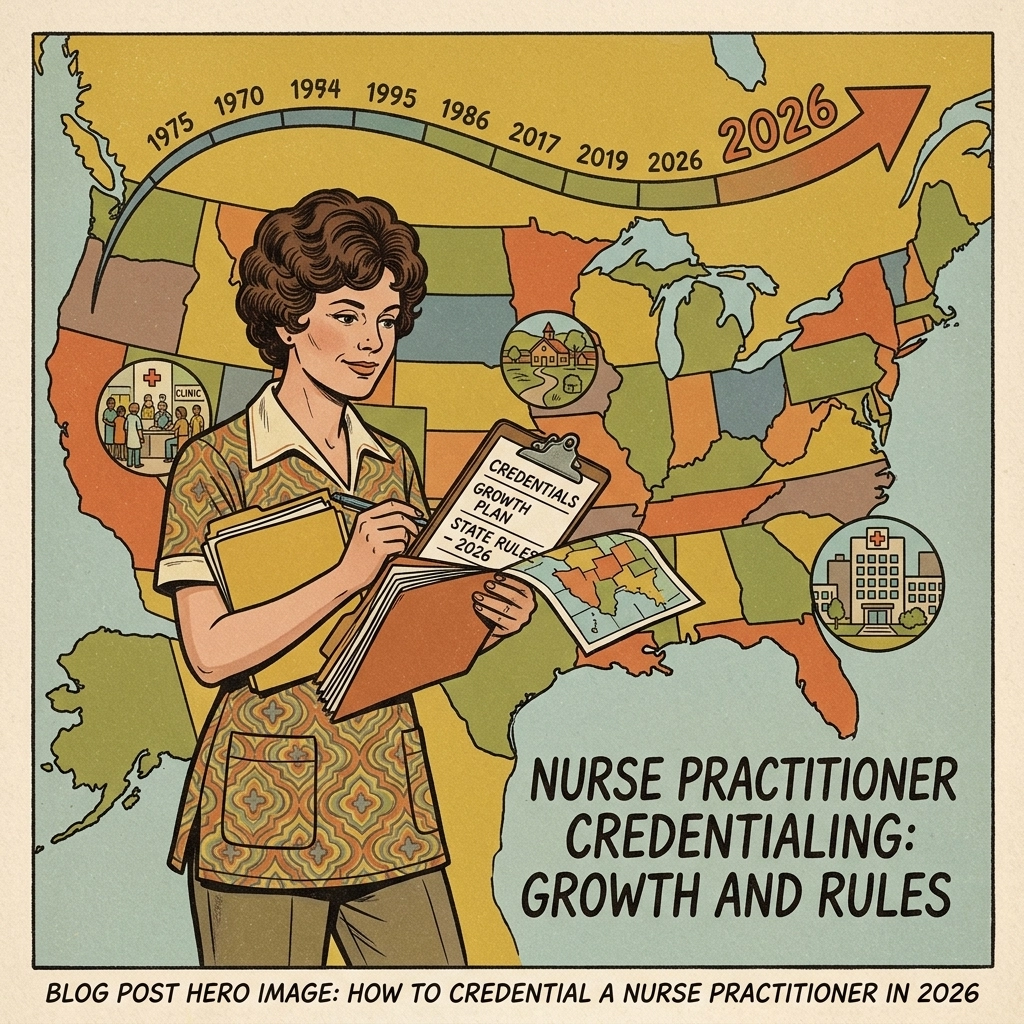
How to Credential a Nurse Practitioner in 2026: Navigating Growth and State Rules

The healthcare landscape in 2026 is moving faster than ever, and at the center of this evolution is the Nurse Practitioner (NP). As physician shortages persist, NPs have become the backbone of modern clinical operations. However, scaling your practice by adding these versatile providers requires a mastery of provider enrollment services and medical credentialing to ensure your revenue cycle remains uninterrupted. If you aren't prepared for the shifting state regulations and updated filing requirements of 2026, your newest hire will become a financial liability rather than an asset. Looking for professional provider credentialing services in the USA? 👉 Check our main service page here: veracityeg.com The 2026 NP Surge: Why the Stakes are Higher Nurse Practitioners are the fastest-growing provider type in the United States. By 2026, the volume of NPs entering the workforce has reached record highs, driven by expanded educational programs and a desperate need for primary care and behavioral health access. For your practice, this growth is a massive opportunity: but only if you can get them on-boarded and billing quickly. A delay in enrollment doesn't just mean a few weeks of "waiting." It means denied claims, patient frustration, and a provider who is sitting idle while your overhead costs continue to climb. At The Veracity Group, we see practices lose tens of thousands of dollars because they underestimated the complexity of multi-state rules or missed a single deadline in the CAQH portal. Navigating the Multi-State Maze: Full, Reduced, and Restricted Authority The biggest hurdle in 2026 is the lack of uniformity across state lines. As of this year, 26 states grant NPs Full Practice Authority (FPA). In these jurisdictions, NPs can evaluate, diagnose, and treat patients without physician oversight. However, if you are operating a multi-state practice or a telehealth platform, you must understand the nuances of the other 24 states: Reduced Practice States: These states require a regulated collaborative agreement with a physician in order for the NP to participate in at least one element of practice. Restricted Practice States: These states require NPs to work with a physician throughout their entire careers for patient care. The Veracity Group Advantage: We specialize in navigating these complexities. When we handle contracting for your team, we don't just file paperwork; we verify that your NPs have the correct Collaborative Practice Agreements (CPA) in place to satisfy specific state board requirements. Without this, your enrollment application will be rejected before it even hits a reviewer’s desk. The Step-by-Step Blueprint for NP Enrollment in 2026 The process is a marathon, not a sprint. Follow these nine critical steps to ensure your NP is ready to bill on day one. 1. Secure National Board Certification (The 5-Year Rule) As of January 1, 2026, the American Nurses Credentialing Center (ANCC) enforces a strict requirement: APRN certification candidates must apply within five years of degree conferral. If your candidate has delayed their certification, this could stall their entire career path. Verify their board certification (ANCC or AANPCB) immediately. 2. Obtain State Licensure and NPI You cannot move forward without an active RN and NP license in the state where the provider will practice. Simultaneously, ensure they have a Type 1 NPI via the National Plan and Provider Enumeration System (NPPES). If you are an organization, you will also need your Type 2 NPI linked correctly. 3. The CAQH Provider Data Portal (Formerly ProView) As of late 2025, CAQH has fully transitioned to the CAQH Provider Data Portal. This is the centralized "passport" for provider data. Incomplete profiles are the #1 cause of enrollment stagnation. Critical Action: You must mark the profile as "Authorized to Release." The 120-Day Rule: You must reattest every 120 business days. If you miss this window, the profile expires, and the insurance payers lose access, leading to an immediate suspension of billing privileges. 4. Medicare Enrollment via PECOS Medicare enrollment is the heavy hitter. In 2026, most individual NPs file the CMS-855I application. Urgent Deadline: The current CMS-855I form has an OMB expiration date of May 1, 2026. Using an outdated form after this date will result in an automatic rejection. We recommend using the PECOS online system rather than paper, as it cuts processing time from 60+ days down to approximately 45 days. 5. Commercial Payer Submissions Once CAQH is authorized and Medicare is pending, you must hit the commercial payers (UnitedHealthcare, Aetna, Cigna, Blue Cross Blue Shield, etc.). Each payer has a unique portal and specific requirements for NPs, especially regarding their "scope of practice" in restricted states. 6. DEA and Malpractice Insurance NPs must have their own DEA registration if they are prescribing controlled substances (this typically takes 4–6 weeks). Furthermore, you must provide a current malpractice insurance certificate that explicitly names the NP and covers the specific state of practice. 7. Primary Source Verification (PSV) The payers will not take your word for it. They will contact the NP's school, the state board, and the National Practitioner Data Bank (NPDB). They also check the OIG exclusion list and the SAM database to ensure the provider hasn't been barred from federal programs. 8. Hospital Privileges (If Applicable) If your NP is working in a surgical or acute care setting, hospital privileging is a separate, equally grueling process. Check out our guide on medical group enrollment for surgery centers for more on these specific risks. 9. Final Approval and Effective Dates Once the payer completes their review, you receive a "Welcome Letter" and an effective date. Do not see patients under that payer before this date, or you will be providing free care. Common Pitfalls: The High Cost of "Doing it Later" In the world of provider enrollment, "later" means "lost revenue." Many practices try to handle this in-house, only to realize that their office manager is overwhelmed by the 50+ pages of Medicare documentation or the constant reattestation reminders from CAQH. The "Gap" Hazard: If an NP starts working on June 1st but isn't enrolled until August 1st, you have two months of salary
Credentialing for Anesthesiologists: What Payers Actually Require in 2026

Maintaining a high-performing anesthesia department or private group in 2026 requires more than just clinical excellence; it demands an aggressive approach to provider enrollment and administrative precision. As the healthcare landscape shifts toward more stringent data validation, ensuring your medical group enrollment remains compliant is the only way to safeguard your revenue stream. For anesthesiologists and Certified Registered Nurse Anesthetists (CRNAs), the margin for error has narrowed significantly as payers increasingly leverage automated audits and advanced analytics to flag documentation inconsistencies. Looking for professional provider credentialing services in the USA? 👉 Check our main service page here: veracityeg.com The High Stakes of Anesthesia Revenue Cycles Anesthesia is unique because it is the backbone of the surgical suite. If your anesthesiologist is not fully loaded into a payer’s system, the entire surgical encounter: from the facility fee to the surgeon's bill: can be thrown into a state of administrative limbo. In 2026, payers have moved beyond simple "paperwork." They are looking for a comprehensive digital profile that proves every provider on the team is qualified to handle high-risk procedures. The financial consequences of a single missed update are staggering. A delay in enrolling a new CRNA or MD can result in significant revenue disruptions, as providers often cannot bill for services until their enrollment is fully processed and active in the payer's system. In an environment where specialized CPT codes like 00100 through 01999 require precise billing logic, the 2026 coding landscape is even tighter. Official 2026 updates include revised descriptors for Head and Neck codes 00100–00222, new Thorax codes 00300–00474, and modified base units for Spine codes 00600–00670. Payers will not hesitate to reject a claim if your coding, modifiers, and provider file do not line up with the exact service performed. In 2026, anesthesia RCM requires specialty-specific logic because generic systems routinely fail to apply granular rules for units, time reporting, concurrency, and modifier sequencing, and that failure creates significant revenue leakage. Alt text: A professional administrative environment focusing on high-stakes medical documentation for anesthesia groups. Core Documentation Required by Payers in 2026 Payers such as Blue Cross Blue Shield, UnitedHealthcare, and Aetna have synchronized their requirements with federal standards, yet they maintain individual nuances that The Veracity Group navigates daily. To survive a 2026 audit, your providers must have the following documentation verified and ready: State Medical Licensure: You must possess current, unrestricted licenses in every state where you practice. With the rise of multi-state groups, maintaining a clean record across borders is non-negotiable. Board Certification: Payers now demand active status from the American Board of Anesthesiology (ABA) or the American Board of Physician Specialties (ABPS). For CRNAs, the National Board of Certification and Recertification for Nurse Anesthetists (NBCRNA) must be current. ACLS/PALS and DEA Registration: Advanced Cardiac Life Support and Pediatric Advanced Life Support certifications are mandatory for anesthesia providers. Furthermore, your DEA registration must reflect the correct address for every location where you administer controlled substances. 10-Year Work History: Any gap in employment exceeding 30 days must be explained in writing. Payers view unexplained gaps as red flags for potential malpractice or disciplinary issues. Malpractice History: Detailed loss runs for the last 10 years are required. Even a settled claim with no admission of guilt must be documented with a formal explanation. Payer-Specific Requirements and the "Team Care" Model The complexity increases when billing for the anesthesia care team model. In 2026, modifier logic must be exact. QK reports medical direction of two to four concurrent cases, QY reports medical direction of one case, QX reports the CRNA service under medical direction, QZ reports an independent CRNA service without medical direction, and AD reports medical supervision of more than four concurrent cases. Whether you are utilizing medical direction or medical supervision, payers require both the anesthesiologist and the CRNA to be fully enrolled and linked to the same group NPI. As of the April 2026 Blue Cross NC update effective April 3, 2026, billing multiple anesthesia modifiers on the same claim line is considered inappropriate and will be denied because those modifiers are mutually exclusive, with the sole exception of Modifier QS where applicable. Blue Cross NC also requires performance modifiers that identify the provider and level of involvement—AA, QK, QY, QX, QZ, or AD—to appear in the first modifier position. Physical status modifiers P1–P6 must follow in subsequent modifier positions, not lead the claim line. That sequencing rule is not cosmetic. It is a front-end claims logic issue that directly affects adjudication. Just as important, QK and QX reimbursement splits correctly only when both claims are submitted and paired correctly. In the standard team care model, each side is typically reimbursed at 50% of the allowable amount only when the physician and CRNA claims align on the same case, the same time record, and the correct modifier combination. If one side is missing, mismatched, or filed with the wrong modifier, the claim becomes a revenue leak disguised as a routine billing error. Blue Cross NC also flags conflicting involvement levels reported by the same provider on the same day. If the same rendering provider is reported as personally performed, medically directing, and supervising in conflicting ways, the claim will be denied because those levels of involvement are not interchangeable. Medicare and Medicaid CMS remains the most rigorous gatekeeper. In 2026, the PECOS system requires bi-annual revalidation for many anesthesia groups. If your Medicaid enrollment is not handled with the same level of care, you face immediate exclusion from managed care plans that rely on state-level data. Navigating the maze of CAQH and Medicare enrollment is a primary driver of success for modern practices. CMS also continues to define anesthesia time with very little room for interpretation. Under Medicare rules, time begins when the anesthesia provider starts preparing the patient in the procedure area or equivalent setting and ends when personal attendance is no longer required. That definition makes sloppy time capture a serious compliance issue. Rounding every case to exactly 15-minute increments is an