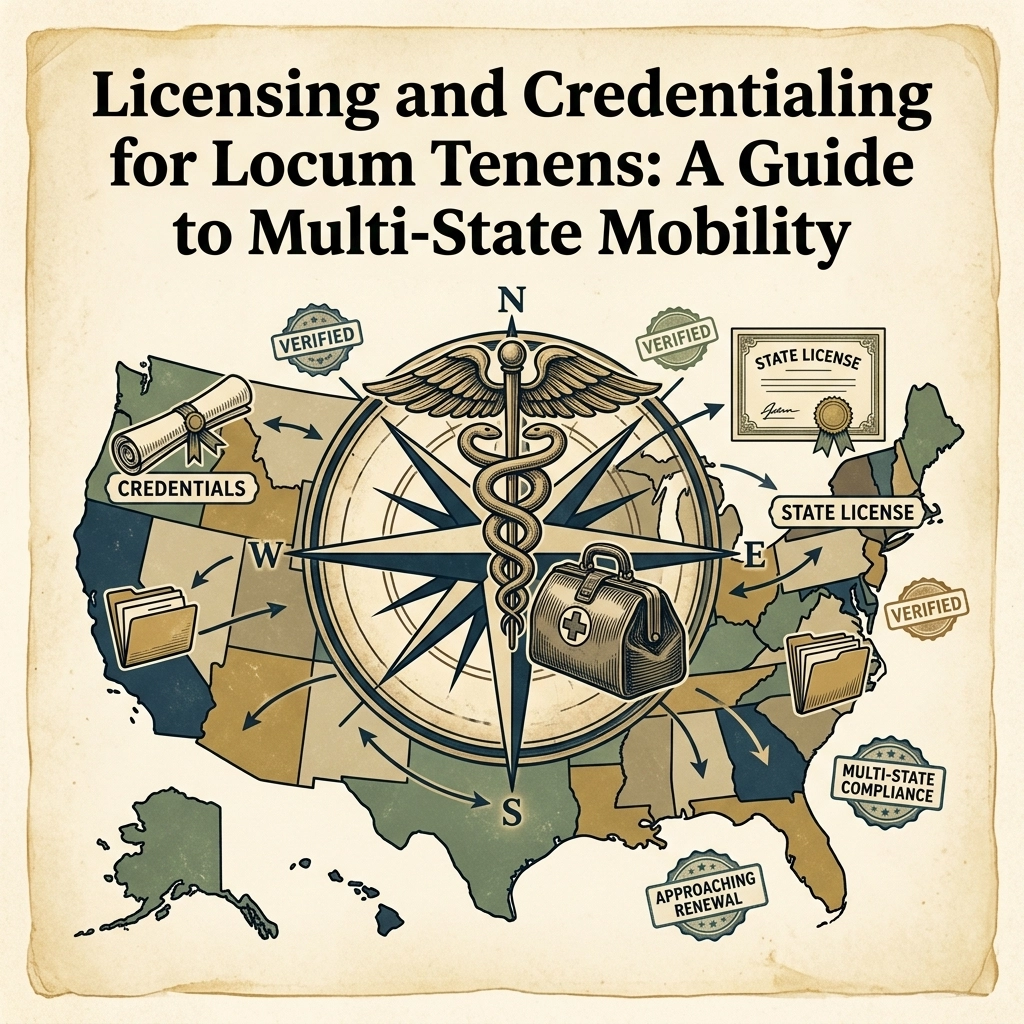
Licensing and Credentialing for Locum Tenens: A Guide to Multi-State Mobility

Locum tenens work is the lifeblood of modern healthcare flexibility, and in 2026’s booming locum tenens market, that mobility has become a direct path to high-value assignments. However, the administrative burden of securing multi-state medical licensure and navigating comprehensive provider enrollment services is often the single greatest barrier to moving fast enough to capture those opportunities. For the high-performing physician or advanced practice provider, a single missing document or a misunderstood state regulation will not just delay an assignment: it will stop revenue, stall momentum, and push a premium placement to someone else. Looking for professional provider credentialing services in the USA? 👉 Check our main service page here: veracityeg.com The High Stakes of Healthcare Mobility The healthcare industry is currently experiencing a massive shift toward "gig economy" models, where specialized talent moves across state lines to address staffing shortages and seasonal surges. In 2026, the locum tenens market is booming, and that surge in temporary staffing demand is intensifying competition for providers who are licensed, enrolled, and ready to start without delay. A provider seeking to work in California faces a vastly different set of hurdles than one heading to Wisconsin. This is exactly why rapid, multi-state licensing solutions are no longer optional. They are the operational backbone of locum success. When facilities need coverage fast, they do not wait for paperwork to catch up. They move to the next available clinician with active credentials. Failing to manage these requirements with surgical precision leads to more than just frustration. It results in revenue leakage, lost opportunities, and potential compliance risks that can shadow a provider for years. In this high-stakes environment, hope is not a strategy. You must have a rigorous framework for managing your professional credentials across multiple jurisdictions. The Power of the Interstate Medical Licensure Compact (IMLC) For physicians, the most effective tool for achieving rapid multi-state mobility is the Interstate Medical Licensure Compact (IMLC). This agreement between 42 states, the District of Columbia, and Guam simplifies the process for licensed physicians to practice in multiple states. Instead of submitting entirely new applications to every individual board, qualified physicians can use their State of Principle Licensure (SPL) to expedite the process. Eligibility is the Gatekeeper To utilize the IMLC, you must meet stringent eligibility criteria that demonstrate professional stability. You must hold a full, unrestricted medical license in an SPL that is a member of the compact. Furthermore, you must meet at least one of the following: Your primary residence is in the SPL. At least 25% of your medical practice occurs in the SPL. Your employer is located in the SPL. Your SPL is your state of residence for federal income tax purposes. Beyond location, the IMLC requires a clean disciplinary record. Any history of disciplinary action, active investigations, or criminal history will disqualify you from this expedited pathway. When you meet these standards, the IMLC acts as a "passport to success," allowing you to obtain licenses in participating states in a matter of weeks rather than the standard six-month wait. Beyond Physicians: The eNLC for Advanced Practice Nurse practitioners and travel nurses are equally vital to the locum tenens ecosystem. The Enhanced Nurse Licensure Compact (eNLC) serves a similar purpose, allowing providers to hold one multistate license with the privilege to practice in other compact states. For an NP, this mobility is the backbone of professional credibility. However, even with a compact license, the work is not finished. You must still contend with state-specific scope-of-practice laws and individual facility requirements. Navigating these nuances requires a deep understanding of provider enrollment protocols that vary by payer and facility type. The Operational Rigor: How The Veracity Group Handles the Complexity At The Veracity Group, we understand that locum tenens providers cannot afford to be bogged down by paperwork. Our approach to provider enrollment services is built on operational rigor and a refusal to accept administrative delays. We don't just "submit forms"; we manage the entire lifecycle of your professional standing. Total Data Integrity The cornerstone of multi-state mobility is a pristine CAQH profile. We treat CAQH maintenance as a mission-critical task. Our team ensures that every update, from a new DEA registration to a change in professional liability insurance, is reflected accurately and immediately. As we’ve detailed in our guide on navigating the maze of CAQH and Medicare enrollment, even a minor discrepancy in your demographic data can trigger a chain reaction of claim denials. Multi-State Medicaid Complexity One of the most significant challenges for locum providers is mastering multi-state Medicaid provider enrollment. Medicaid is notoriously fragmented. Each state has its own portal, its own set of required attachments, and its own unique timeline. The Veracity Group handles this complexity by maintaining an exhaustive database of state-specific requirements, ensuring that your enrollment in a new state's Medicaid program is handled with the same urgency as your primary medical license. The 90-Day Rule: Timing Your Multi-State Strategy In the world of locum tenens, timing is everything. In a booming 2026 market for temporary staffing, speed is not a convenience; it is a competitive advantage. While the IMLC has reduced wait times for many, the reality of state board processing and payer enrollment still necessitates a 90-day lead time. Professional boards are often understaffed and overwhelmed. A license application in California can take six months, while Wisconsin might process it in a week. If you are planning an assignment, you must work backward from your start date. If you wait until a recruiter calls with a premium opening, you are already behind. The providers who capitalize on the best assignments are the ones who have their multi-state licenses, supporting documents, and enrollment files ready before demand spikes. This timeline includes: The Discovery Phase: Identifying all state-specific requirements, including fingerprints, background checks, and primary source verification. The Documentation Phase: Gathering original transcripts, exam scores, and a full, chronological work history. Any gap longer than 30 days must be explained in detail; boards view unexplained gaps as red flags. The
State-by-State Medical Licensing Timelines: Your 2026 Guide to Planning Growth

Scaling a healthcare organization in 2026 demands more than just capital and talent; it requires a surgical approach to provider enrollment and a mastery of the medical licensing landscape. If you are eyeing expansion into new markets, the timeline for obtaining a state medical license is the "silent driver" that determines your go-live date. Ignoring these timelines will stall your revenue cycle and leave your newly hired providers sitting on the sidelines while overhead costs mount. Looking for professional provider credentialing services in the USA?👉 Check our main service page here: veracityeg.com The High Cost of Licensing Delays Time is quite literally money when it comes to physician onboarding. A delay in licensing is not just an administrative hiccup; it is a full-stop barrier to provider enrollment. Without a valid state license, you cannot initiate payer contracts or secure government reimbursement. For a high-volume surgical center or a burgeoning behavioral health group, a three-month delay in licensing can represent hundreds of thousands of dollars in lost gross charges. In 2026, the complexity of state boards has not diminished. While technology has streamlined some verification processes, the sheer volume of applicants and the rigorous standards for primary source verification remain. You must view licensing as the backbone of professional credibility and the essential first step in your growth strategy. The 2026 Landscape: IMLC vs. Traditional Pathways The most significant factor in your timeline will be whether you utilize the Interstate Medical Licensure Compact (IMLC) or follow the traditional direct application route. As of April 2026, the IMLC includes 42 states plus D.C. and Guam, providing an expedited "passport" for physicians who meet strict eligibility requirements. The IMLC Advantage If your provider qualifies, the IMLC is the gold standard for speed. Average License Approval: 19 days. Rapid Processing: Over 50% of licenses are issued within a single week once the application is submitted to the member state. High Success Rate: There is a 90% approval rate for those who qualify. However, the IMLC is not a magic wand. You must first obtain a Letter of Qualification (LOQ) from the provider's State of Primary Licensure (SPL). This is where many groups hit a wall. For example, obtaining an LOQ in Wisconsin can take 4–6 months, whereas the same process in a faster state might only take a few weeks. You can track the current list of participating states at the official IMLC website. State-by-State Breakdown: What to Expect in 2026 Timelines vary wildly based on the state’s internal resources, the time of year, and the method of application. Below is a breakdown of projected timelines for key expansion states in 2026. Category Example States Estimated Timeline (2026) Fast Track Arizona, Utah, Montana, Indiana 30–60 days Moderate Texas, Florida, New York, Georgia 60–120 days Slow and Steady California, New Jersey, Illinois 120+ days This table is an illustrative planning summary based on the broader state categories discussed below. Your actual timeline will depend on application quality, board backlog, primary source verification speed, and whether you use the IMLC or a traditional application path. The "Fast Track" States (30–60 Days) These states have optimized their digital portals and participate heavily in the IMLC, making them ideal for rapid expansion. Arizona: Known for efficient processing, often landing in the 4-6 week range for direct applications. Utah: A leader in streamlined interstate licensing. Montana: If using the IMLC, Montana can often issue a license in 1–2 weeks following the LOQ. Indiana: Continues to maintain a robust and responsive medical board. The "Moderate" States (60–120 Days) These states require meticulous documentation but generally stick to their published review cycles. Texas: While the Texas Medical Board is thorough, their process is highly structured. Expect 90 days for a clean application. Florida: High volume means you must be perfect on the first submission. Any error will reset your 30-day review clock. New York: Despite improvements, the sheer volume of providers keeps the timeline around the 3-4 month mark. Georgia: Steady, but requires proactive follow-up to ensure primary source verifications are received. The "Slow and Steady" States (120+ Days) In these jurisdictions, you must plan your recruitment at least six months in advance. California: The gold standard of scrutiny. Even with a perfect application, the backlog often pushes timelines past the 5-month mark. New Jersey: Historically longer lead times due to intensive background and verification requirements. Illinois: Timelines can be unpredictable; proactive management is mandatory. The "LOQ" Bottleneck: A Strategic Warning A common mistake is assuming that because a state is in the IMLC, the process will be fast. If your provider's State of Primary Licensure (SPL) is slow at issuing the Letter of Qualification, the IMLC route actually becomes slower than a direct application. If you are expanding into Montana and your provider’s SPL is Wisconsin, you are looking at a 4-6 month wait for the LOQ. In this specific scenario, applying directly to Montana (which takes 4-6 weeks) is the smarter strategic move. At The Veracity Group, we analyze these "pathway pivots" daily to ensure our clients don't lose months of revenue to the wrong administrative route. Understanding these nuances is critical when mastering multi-state Medicaid provider enrollment. 5 Critical Steps to Accelerate Your Timeline To prevent your growth from stalling, you must treat the application process as a high-priority project. Audit the Provider's History Early: Check for gaps in training, past disciplinary actions, or pending litigation. These are "red flags" that trigger manual reviews and add months to the process. Request Primary Source Verifications Simultaneously: Don't wait for the board to ask. Send requests to medical schools, residency programs, and hospitals the moment the application is filed. Monitor the Board’s "Deficiency Letter" Cycles: Most boards review files every 30 days. If you miss a requested document by one day, you might wait another month for the next review. Utilize Digital Fingerprinting: Where available, always opt for digital over paper cards to shave weeks off the background check phase. Assign a Dedicated Liaison: Boards do not have the
Medical License Reciprocity in 2026: What the IMLC Actually Covers

As we navigate the second quarter of 2026, the landscape of healthcare delivery is more fluid than ever. For physicians and medical group owners, expanding your footprint across state lines is no longer a luxury; it is a strategic necessity for survival and growth. However, a significant amount of confusion remains regarding provider enrollment and the actual mechanics of medical licensure when moving into new territories. Many practitioners operate under the false assumption that "reciprocity" means a single license works everywhere. Looking for professional provider credentialing services in the USA? 👉 Check our main service page here: veracityeg.com The reality is more nuanced. The Interstate Medical Licensure Compact (IMLC) is the backbone of professional credibility for modern multi-state practices, but it is not traditional reciprocity. Understanding exactly what the IMLC covers: and what it leaves behind: will determine whether your practice scales seamlessly or hits a wall of administrative delays and compliance risks. The Great Misconception: Why "Reciprocity" is a Misnomer In the traditional sense, reciprocity implies that State A recognizes State B’s license as valid within its own borders with no additional steps. In the world of U.S. healthcare, this virtually does not exist. Instead, we have the IMLC, which acts as a passport to success for physicians. It is an expedited pathway, not a universal waiver. When you utilize the IMLC, you are not getting one license that works in forty states. You are using a streamlined process to receive individual, separate licenses from each state’s medical board. Each state still retains its authority, and each state still issues its own unique license number. The "magic" of the IMLC is in the centralized verification. Once your State of Principal License (SPL) confirms your credentials, other member states accept that verification as gold, bypassing the repetitive and grueling primary source verification process that typically slows down provider enrollment. The Current Landscape of the Compact in 2026 As of April 2026, the Compact has reached a critical mass that makes it impossible to ignore. With 42 states, the District of Columbia, and Guam now active participants, the IMLC covers the vast majority of the American population. This widespread adoption is the silent driver behind the explosion of telehealth and multi-state specialty groups. Michigan’s 2026 Milestone A recent and vital update for the industry occurred just weeks ago. Michigan, which had been facing a sunset clause that threatened to pull the state out of the Compact on March 28, 2026, successfully secured its future. Governor Whitmer signed House Bill 5455 into law on March 26, 2026, ensuring that Michigan remains a permanent fixture in the IMLC. For providers in the Great Lakes region, this avoids what would have been a catastrophic disruption in care continuity and a nightmare for ongoing mastering multi-state Medicaid provider enrollment efforts. How the IMLC Streamlines Your Multi-State Strategy The data from the Interstate Medical Licensure Compact Commission is clear: the Compact works for those who know how to use it. If you are looking to scale, these statistics represent your new reality: Average licensure wait time: 19 days (compared to the 3-6 months often seen in non-compact states). Speed to practice: 51% of licenses are available within just one week of the Letter of Qualification being issued. High Approval Rate: 90% of applications through the IMLC are successful, provided the initial eligibility is met. For a growing medical group, these numbers are the difference between generating revenue in three weeks versus six months. The high cost of delays in licensure is not just administrative; it is a direct hit to your bottom line and patient access. The Gatekeeper: Understanding the State of Principal License (SPL) The IMLC process hinges entirely on your State of Principal License (SPL). You cannot simply pick any state; you must designate a state where you hold a full, unrestricted license and meet at least one of the following criteria: Your primary residence is in the SPL. At least 25% of your practice of medicine occurs in the SPL. Your employer is located in the SPL. The SPL is your state of residence for U.S. federal income tax purposes. Once your SPL verifies your qualifications and issues a Letter of Qualification (LOQ), the door opens. This letter is your "golden ticket" that is shared with all other states where you seek to practice. This centralized verification is the most efficient way to handle the complexities of our services when managing a large roster of providers. What the IMLC Doesn’t Cover: Navigating the Limitations While the IMLC is powerful, it is not a silver bullet. You must be aware of the limitations to avoid compliance pitfalls that can make or break your expansion. 1. The Cost of Doing Business The IMLC streamlines the process, but it does not necessarily lower the cost. You must still pay the individual license fees for every state you join. Some states also charge a processing fee for the IMLC application itself. When budgeting for a 10-state expansion, you must account for 10 separate state fees, which can range from $200 to over $1,000 per state. 2. State-Specific Practice Acts The Compact does not create a federal standard for medicine. You must adhere to the Medical Practice Act of the state where the patient is located. If you are a physician in Ohio treating a patient in Florida via telehealth, you are under the jurisdiction of the Florida Board of Medicine. This includes specific rules regarding controlled substance prescribing, mandatory CMEs, and scope of practice. 3. Maintenance and Renewals Each license obtained through the IMLC must be renewed independently according to that state’s specific schedule. While the Compact offers a centralized renewal process, the requirements for each state (such as specific human trafficking or implicit bias training) still apply. Failing to track these individual state requirements will lead to lapsed licenses and immediate revenue loss. Scaling Without the Stress: Why Expert Support is Non-Negotiable The technicality of the IMLC is only the first step. Once the license