Getting Your DEA Number in 2026: A Step-by-Step Guide for New Physicians

Securing your Drug Enforcement Administration (DEA) registration is not just a regulatory hurdle; it is the backbone of professional credibility for every practicing physician in the United States. In 2026, the landscape of provider enrollment and medical credentialing demands precision, as even a minor administrative error will trigger significant delays in your ability to practice medicine and serve patients. Obtaining your DEA number is the final "passport to success" that transitions you from a licensed professional to a fully operational prescriber. For new physicians, the process is often perceived as a bureaucratic maze. However, when navigated with expert precision, it is a straightforward sequence of administrative milestones. The high cost of delays: ranging from pushed-back start dates to lost revenue for your practice: makes it imperative that you execute this process correctly the first time. At The Veracity Group, we understand that your time is best spent in clinical care, which is why we specialize in making these essential provider enrollment tasks seamless. The Absolute Prerequisites: Before You Apply You must meet specific legal and professional benchmarks before the DEA will even consider your application. Attempting to apply without these prerequisites is a guaranteed way to lose your non-refundable application fee. An Active State Medical License: You must possess a full, unrestricted medical license in the state where you intend to practice. The DEA registration is tied to state authority; if your state license is pending, invalid, or inactive, your DEA application will be withdrawn without refund. State Controlled Substance Permit (If Applicable): Several states require a separate state-level controlled substance practitioner registration before you can apply for the federal DEA number. You must verify your specific state’s requirements to ensure you are in full compliance with local statutes. A Valid Practice Address: The DEA does not issue registrations to P.O. Boxes. You must have a physical location where you will be practicing and handling controlled substances. Step 1: Gathering Your Documentation Efficiency is the result of preparation. Before logging into the DEA portal, you must compile a comprehensive dossier of your professional information. Having this data ready prevents session timeouts and reduces the risk of input errors. Individual Registrations: You must provide your name, address, Social Security Number (SSN), and phone number. Business Registrations: You must provide the business name, address, Tax ID, and phone number. State Medical License Details: You will need the license number and the exact expiration date. Practice Contact Information: This includes the physical address, primary phone number, and a professional email address that you check regularly. Credit Card: The DEA accepts Visa, MasterCard, American Express, or Discover. As of 2026, the application fee for a three-year registration is a necessary investment in your career. CAQH Profile Status: While not a direct DEA requirement, ensuring your CAQH profile is current will save you immense time in the subsequent steps of your professional onboarding. Step 2: Accessing the DEA Diversion Control Division Portal The only way to apply for your registration is through the official DEA Diversion Control Division website. Once on the site, you must navigate to the "Registration" section and select "New Applications." For new physicians, you will select DEA Form 224. This form is specifically designated for "Practitioners," a category that includes Physicians (MD/DO), Dentists, Veterinarians, and other mid-level providers. Certain registrants using DEA Forms 225 and 510 must also provide the applicable drug codes or chemical codes required by the DEA. Selecting the wrong form, category, or required code will lead to an immediate denial of your application, forcing you to restart the process and pay the fee again. Step 3: Selecting Controlled Substance Schedules This is a critical section of the application where you must declare which schedules of controlled substances you are authorized: and intend: to prescribe. You must select from Schedules II through V. Schedule II: Drugs with a high potential for abuse (e.g., oxycodone, fentanyl, methylphenidate). Schedule III-V: Drugs with decreasing levels of potential for abuse (e.g., buprenorphine, benzodiazepines, cough preparations with codeine). Warning: You must only select the schedules that your state medical license allows. If you select Schedule II but your state license restricts you to Schedules III-V, your federal application will be flagged. Mid-level practitioners (MLPs) must also provide supervisory agreements that specifically grant controlled substance authority when their state requires that documentation. This level of detail is exactly why many physicians utilize professional contracting and enrollment services to oversee their paperwork. Step 4: Background Disclosure and Legal Affirmation The DEA application includes a series of "Liability Questions." These questions inquire about any past history of controlled substance violations, state license revocations, or criminal records related to controlled substances. You must be 100% transparent. Dishonesty on a federal application is a crime and will result in the permanent forfeiture of your prescribing privileges. Furnishing false or fraudulent information is subject to 21 USC 843(d), including up to 4 years of imprisonment and/or a fine of up to $250,000. If you have a history that requires explanation, it is often wise to consult with an expert before submission to ensure your narrative is accurate and professional. Step 5: Submission and the Waiting Period The final step is to review every field carefully, correct any errors, and then submit the application. Once submission is complete, you will receive a submission confirmation. In 2026, the standard processing time for a new DEA application is approximately 4 to 6 weeks, though online submissions are often processed faster if there are no red flags. After submission, you will receive a control number. Keep this number in a secure location. It is your only way to track the status of your application through the DEA’s "Check the Status of My Application" tool. You can also verify your status by calling the DEA toll-free at 800.882.9539. The Silent Driver of Success: Ongoing Maintenance Your DEA registration is not a "set it and forget it" document. It is valid for three years, and you must be proactive about its maintenance. Address Changes:
DEA Registration for Telehealth: Navigating Post-COVID Enforcement in 2026

In today’s landscape, managing provider enrollment and the intricacies of medical group enrollment requires more than just filling out forms; it demands a strategic roadmap for regulatory compliance. For telehealth practitioners, the "new normal" is defined by the DEA’s fourth temporary extension of COVID-19 telehealth flexibilities, which remains in effect through December 31, 2026. There is no official transition to a high-stakes enforcement era tied to April 6, 2026. Instead, providers should recognize that DEA and DOJ scrutiny of telehealth prescribing has been ongoing for years, even as the current temporary framework remains active. This extension is not a permanent hall pass: it is additional time for clinics to align their operations with the Ryan Haight Online Pharmacy Consumer Protection Act of 2008. Looking for professional provider credentialing services in the USA? 👉 Check our main service page here: veracityeg.com The 2026 DEA Deadline: The Clock is Ticking for Telehealth The current regulatory environment is a pressure cooker for telehealth platforms and independent practitioners alike. While the DEA has allowed for the remote prescription of Schedule II-V controlled substances without a prior in-person evaluation through the end of 2026 under its fourth temporary extension, this flexibility is a bridge to permanent regulations, not a permanent state of being. There is no DEA-designated enforcement switch flipping on April 6, 2026. If your practice is still operating under the assumption that these "temporary" rules will be renewed indefinitely, you are playing a dangerous game with your professional standing and financial stability. The Ryan Haight Act fundamentally requires at least one in-person medical evaluation before a practitioner can issue a prescription for a controlled substance. During the public health emergency, this requirement was waived. Now, the DEA is aggressively drafting permanent "Special Registrations for Telemedicine" that will require online platforms to obtain specific registrations to continue dispensing controlled medications. Failure to prepare for this transition will disrupt your patient care and trigger catastrophic revenue losses. Understanding the Ryan Haight Act in a Post-COVID World The Ryan Haight Act was designed to prevent the illegal distribution of controlled substances via the internet. In a 2026 context, the DEA is focusing on how to maintain patient access to critical medications: like those for opioid use disorder (OUD) or ADHD: without opening the floodgates to prescription drug abuse. The Special Registrations for Telemedicine rule is expected to create three new categories of provider registrations. These registrations are the backbone of professional credibility for any modern telehealth clinic. What many providers overlook is that these federal flexibilities do not override state-level mandates. Even if the DEA says you can prescribe remotely, your state medical board might have different ideas. This creates a patchwork of compliance requirements that can make or break a growing practice. Navigating this maze is why provider enrollment at the state and federal levels must be handled with surgical precision. Veracity ensures that your practice isn't just following the broad federal strokes, but is compliant with the granular details of every state in which you operate. The High Cost of Non-Compliance The consequences of failing to update your DEA registration or neglecting your medical group enrollment data are severe. Enforcement pressure did not suddenly begin on April 6, 2026; federal scrutiny of telehealth prescribing, including DOJ takedowns and related investigations, has been building for years. We are seeing an increase in OIG audits and DEA inspections targeting telehealth-heavy practices. If a provider is found to be prescribing controlled substances across state lines without the proper state-specific DEA registration or a valid special registration, the penalties include: Immediate Suspension of DEA Registration: This effectively shuts down your ability to practice medicine as a telehealth provider. Exclusion from Federal Healthcare Programs: Once you are on the OIG exclusion list, your provider enrollment with Medicare and Medicaid is terminated, often permanently. Hefty Civil Monetary Penalties: Fines for Ryan Haight Act violations can reach tens of thousands of dollars per prescription. Reputational Damage: In the age of digital transparency, a DEA enforcement action is a permanent stain that will cause patients and insurers to flee. As we discuss in our guide on mastering multi-state Medicaid provider enrollment, the complexity only increases when you add state-specific prescribing rules to the mix. Compliance Minefields: State vs. Federal Mismatch One of the most significant challenges in 2026 is the discrepancy between federal DEA guidance and state-specific regulations. For example, while the DEA currently allows audio-only telemedicine for certain OUD medications, some states strictly require synchronous audio-video technology. If your clinic’s provider enrollment records do not accurately reflect the physical locations of your practitioners or the states where your patients reside, you are inviting a compliance disaster. Ensuring that your DEA registration matches your actual practice patterns is the "silent driver" of clinical success. You must maintain updated demographic updates with all payers and regulatory bodies. A provider who is registered in Texas but is seeing patients in Florida without a Florida-specific DEA registration (where required) is a liability waiting to happen. The Veracity Take: How We Manage the Transition At The Veracity Group, we don't just watch the news; we anticipate the regulatory shifts that impact your bottom line. Our approach to our services is rooted in the reality of 2026 enforcement. We act as your compliance shield, ensuring that every provider in your group has the necessary registrations to operate legally across all jurisdictions. When the DEA finalizes the Special Registrations for Telemedicine, the influx of applications will likely cause massive bottlenecks. Those who wait until December 2026 to apply will find themselves at the back of a very long line, potentially facing months where they cannot legally prescribe. We help our clients stay ahead of the curve by: Audit-Proofing Enrollment Files: We verify that every provider’s DEA registration is correctly linked to the group’s tax ID and physical or virtual locations. State-by-State Analysis: We track the shifting landscape of state prescribing laws to ensure your multi-state telehealth operations remain bulletproof. Streamlined Group Management: For large clinics, managing medical
Understanding Controlled Substance Registrations (CSR): Do You Need One for Every State?

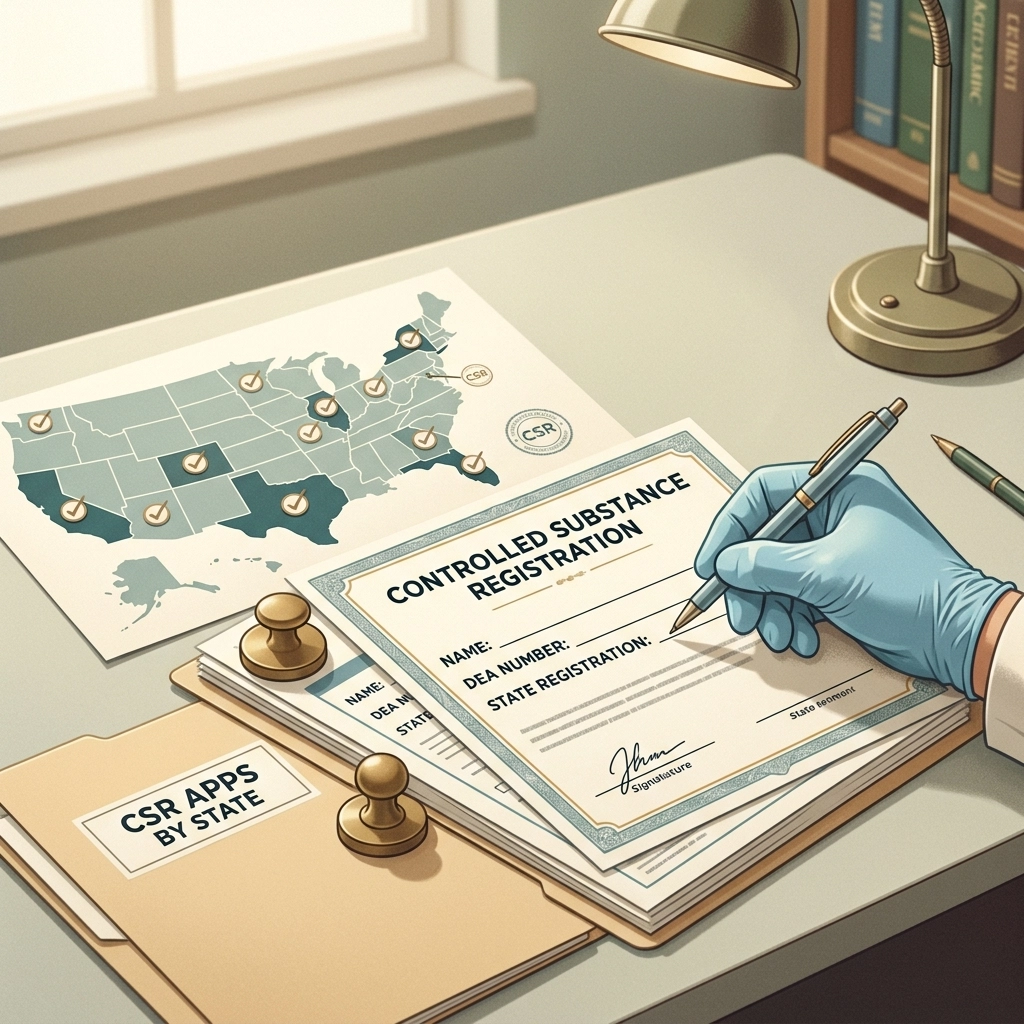
Navigating the landscape of provider enrollment services and regulatory compliance is often a logistical nightmare for expanding practices. Among the most misunderstood requirements is the Controlled Substance Registration (CSR). For any practitioner intending to prescribe, dispense, or distribute controlled substances, the CSR is not just a formality; it is the backbone of professional credibility and legal practice. As you scale your operations across state lines, the question of whether you need a separate CSR for every jurisdiction becomes a critical pivot point for your timeline and budget. Effective healthcare provider enrollment requires an uncompromising attention to detail, particularly regarding state-level mandates. Failing to secure the correct registrations will result in immediate "hard stops" for your practice, leading to delayed starts, lost revenue, and potential legal scrutiny. In this guide, we will dismantle the myths surrounding CSRs and provide the clarity you need to maintain a compliant, multi-state presence. Looking for professional provider credentialing services in the USA? 👉 Check our main service page here: veracityeg.com What Exactly is a Controlled Substance Registration? A Controlled Substance Registration (CSR): sometimes referred to as a state-level DEA license or a State Controlled Substance Certificate: is a permit issued by an individual state that allows a healthcare provider to handle controlled substances. While the Drug Enforcement Administration (DEA) handles federal oversight, individual states exercise their own police power to monitor and regulate how these substances are managed within their borders. The CSR acts as a passport to success for your prescribing authority. Without it, your federal DEA registration may be invalid or impossible to obtain in that state. It is the mechanism by which state boards track the flow of narcotics and other high-risk medications, ensuring that every pill and vial is accounted for by a registered, verified professional. The Multi-State Dilemma: Do You Need One for Every State? The short answer is: It depends entirely on the state where you are practicing. Many providers operate under the dangerous assumption that a federal DEA license is a "golden ticket" that applies everywhere. This is a misconception that can make or break your expansion. The reality is that state requirements vary significantly. 1. States with Mandatory CSRs Most states require a separate, state-issued CSR in addition to your professional medical or pharmacy license. In these jurisdictions, you must obtain the state CSR before you can even apply for a DEA registration tied to that state. States like Texas, Illinois, and Alabama have robust CSR requirements that demand individual attention. If you are practicing in multiple states that all require CSRs, you will indeed need a separate registration for every one of those states. 2. States with Single License Requirements A handful of states do not require a separate CSR. In these locations, your professional license (MD, DO, NP, PA) is sufficient to satisfy the DEA’s requirement for "state authority." However, even in these states, you must ensure your license specifically allows for the handling of controlled substances. 3. The Physical Location Rule The DEA is very clear: you must have a separate registration for each state where you practice. Furthermore, you generally need a separate registration for each physical location where you store or dispense controlled substances. If you are a telehealth provider sitting in Florida but treating patients in New York, the regulatory burden shifts based on where the "act of prescribing" or "dispensing" is legally recognized. For more information on the complexities of multi-state operations, you can review the DEA’s Diversion Control Division guidelines. Common Misunderstandings and Their Consequences Misinterpreting CSR rules is the silent driver of enrollment delays. Here are the most frequent pitfalls we see at The Veracity Group: The "One DEA" Myth: Providers often think they can use their DEA number from State A to prescribe in State B. While the DEA allows for some flexibility with "principals of practice," most state laws are more restrictive. Using a DEA number without the corresponding state CSR where required is a direct violation of state law. The Sequence Error: You cannot obtain a DEA registration for a state that requires a CSR without having the CSR first. If you apply for the DEA first, it will be rejected or held in limbo, wasting weeks of administrative time. The Facility vs. Provider Trap: Many groups assume that because the facility has a CSR, the individual provider does not need one. In many jurisdictions, the individual's authority is independent of the facility’s registration. The high cost of delays in this area cannot be overstated. A missing CSR can stall a provider’s start date by 60 to 90 days, costing a practice tens of thousands of dollars in lost patient encounters. The Strategic Importance of Professional Oversight Managing CSRs across five, ten, or fifty states is a Herculean task for any internal HR or office manager. Each state has its own application portal, fee structure, renewal cycle, and specific prerequisites (such as mandatory PMP/PDMP enrollment). When you partner with The Veracity Group, we take the guesswork out of the equation. We understand that mastering multi-state Medicaid provider enrollment and private payer contracting requires a foundation of perfect primary source verification, and that includes your CSRs. Why Multi-State Practices Choose Veracity: State-Specific Expertise: We know which states require a CSR and which don't, saving you unnecessary application fees and hours of research. Proactive Renewal Tracking: CSRs and DEA registrations often have different expiration dates. We manage the calendar so you never face a "dark period" where you cannot prescribe. Integrated Strategy: We don't just look at the CSR in a vacuum. We look at how it impacts your overall enrollment strategy, ensuring that your CAQH profile and payer applications are synchronized. Actionable Steps for Your Practice If you are planning to expand or are currently managing providers in multiple states, you must take the following steps immediately: Audit Your Current Roster: Verify that every provider has a CSR for every state in which they are seeing patients, unless that state is a "no-CSR" jurisdiction. Verify