Veracity upscaled revised

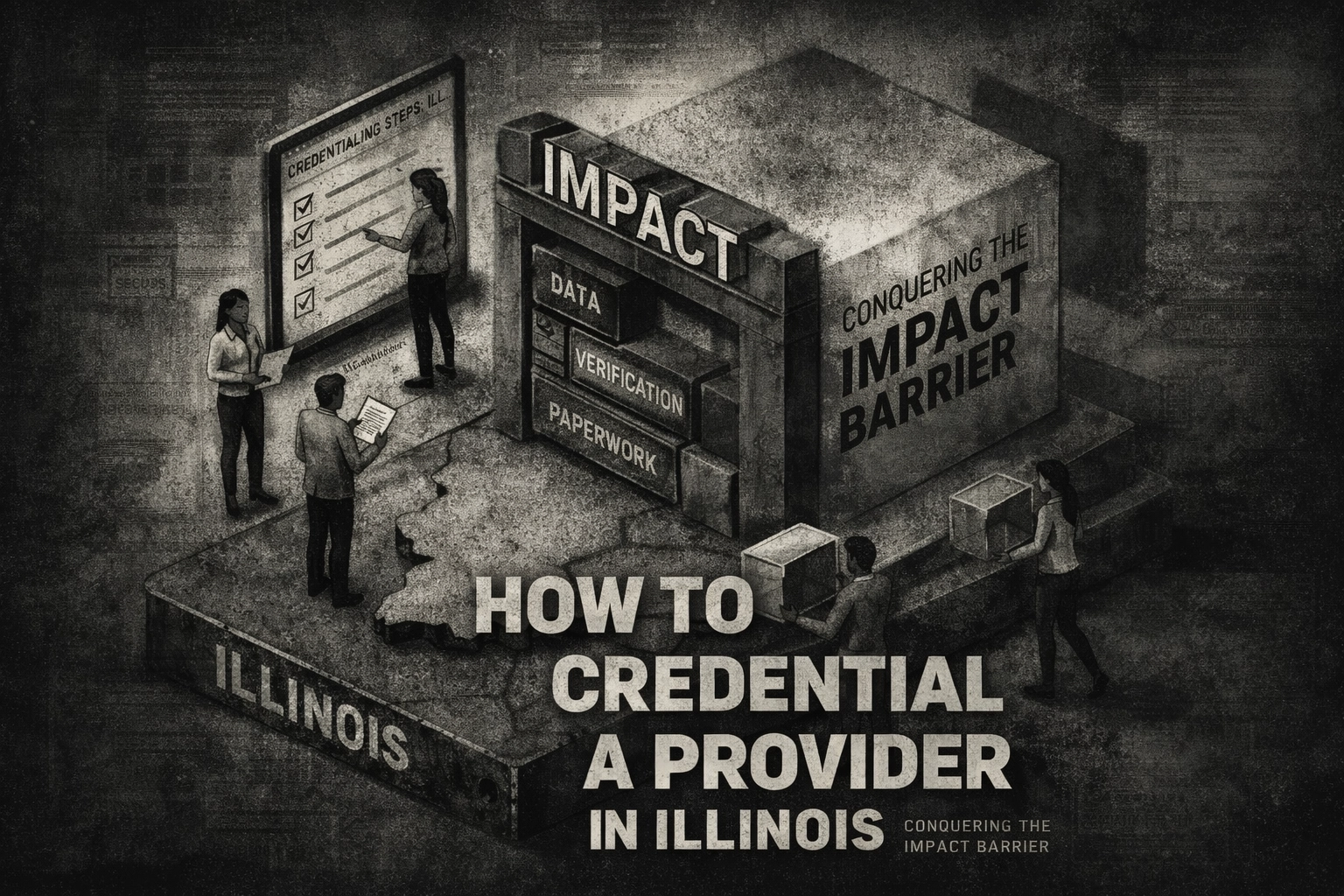
How to Credential a Provider in Illinois: Conquering the IMPACT Barrier

DpQj1599T5W

Navigating the Illinois healthcare market requires more than just clinical excellence; it demands a sharp, disciplined response to the administrative gauntlet known as the IMPACT system. For organizations trying to scale, friction in medical provider enrollment services quickly becomes a revenue choke point that slows onboarding and delays payment. Whether you manage one location or a sprawling multisite group, understanding the behavioral health provider enrollment landscape is how you keep your revenue cycle moving in the Land of Lincoln. In Illinois, the enrollment process is defined by high-stakes documentation, a state-mandated digital portal, and hard compliance deadlines that carry real consequences. If your practice is not prepared for the rigorous demands of the Illinois Medicaid Program Advanced Cloud Technology (IMPACT), you will hit avoidable delays, rejected submissions, and payment disruption. 1. The Digital Gatekeeper: Understanding HFS IMPACT The primary obstacle in Illinois is the IMPACT portal, managed by the Illinois Department of Healthcare and Family Services (HFS). This system serves as the single source of truth for Medicaid-related provider enrollment activity in the state. Under HealthChoice Illinois, a provider must be fully approved in IMPACT before participating with Medicaid managed care plans. That setup sounds clean. In practice, it is a concrete wall with a login screen. Illinois expects your information to be complete, accurate, and maintained inside IMPACT, and the state is actively enforcing revalidation requirements on the current five-year cycle. As reflected in Illinois HFS revalidation guidance, providers who miss their IMPACT revalidation deadline face immediate disenrollment, which stops participation and billing until the record is restored through the required process. That is the real Illinois risk: not just slow approval, but sudden loss of active status because a required update sat untouched in the portal. Digital glitch art displaying high-contrast kinetic typography of the words "IMPACT SYSTEM" shattering into data streams, symbolizing the complexity of the Illinois enrollment portal. 2. Mandatory Documentation: The "Yellow Paper," Revalidation Timing, and IMPACT Application Type In Illinois, missing one required item does not create a minor delay. It triggers rejection, rework, or a revalidation miss that knocks you out of active status. To move a provider through the pipeline, you must secure the following items before upload and before the revalidation clock runs out: The Application ID Number: This is the state-assigned identifier often tied to the physical notice many teams call the "yellow paper." Without it, matching the record and moving the file forward becomes far harder. Certified W-9 alignment: If a provider receives state or federal funds directly, the tax record must align with the enrollment record. A mismatch between legal name, TIN, or pay-to information and the IMPACT profile is a fast path to failure. National Provider Identifier (NPI): Your 10-digit NPI must match taxonomy, licensure, and service setup exactly. Correct IMPACT application type: Illinois places real weight on selecting the right record structure, including the Individual/Sole Proprietor pathway when that is the proper enrollment type. If your filing structure does not match how the provider is organized and billing, the rest of the application starts crooked. Operational availability for follow-up: Illinois has also been reinforcing practical support through office hours and provider assistance sessions connected to IMPACT revalidation. If your team is not monitoring those opportunities and the portal notices that drive them, you lose time you do not have. For large multisite groups, managing these documents and deadlines across dozens of providers creates a serious administrative burden. The Veracity Group uses monday.com boards to give you total transparency during this phase, ensuring every yellow paper, portal task, and follow-up item is tracked from receipt through final submission. 3. Scaling the Friction: Multisite and Behavioral Health Challenges The behavioral health enrollment landscape in Illinois is especially unforgiving because site-level accuracy matters. As the state pushes integrated care and tighter program oversight, behavioral health providers run into unique complications around service locations, affiliations, and record maintenance. Unlike markets where one approval effectively travels everywhere, Illinois often demands precise site linkage for each location where a provider renders services. For massive multisite groups, this creates an exponential increase in the number of moving parts you must control. One demographic mistake, one location mismatch, or one overlooked revalidation notice can cascade into denied claims across multiple sites. Maintaining demographic updates with precision is not optional. It is your pressure valve against payment disruption. Looking for professional provider credentialing services in the USA? 👉 Check our main service page here: veracityeg.com Upstream Preparation: Licensing and DEA Enrollment does not start with the IMPACT portal; it starts months earlier with licensing and DEA registration. The Veracity Group handles the upstream heavy lifting, ensuring that a provider’s Illinois state license and controlled substance registrations are in perfect order before the enrollment clock even starts ticking. If your provider’s DEA address does not match their primary service location in IMPACT, the system will flag the application for manual review, which can add weeks or months to your timeline. By aligning these upstream factors, we clear the path for a smoother transition into the provider enrollment phase. Kinetic typography in a high-speed digital blur showing the words "UPSTREAM LICENSING" and "DOWNSTREAM REVENUE" connecting through a series of geometric, glitched lines. 4. The 2025–2026 Revalidation Mandate: Miss the Deadline, Lose Your Status Illinois is actively operating on the standard five-year revalidation cycle in the 2025–2026 window. That cycle is not background noise. It is a live compliance trigger inside IMPACT. HFS has made clear that if you fail to complete revalidation by your assigned deadline in the portal, the consequence is immediate disenrollment. That means: Your provider record drops out of active status Your Medicaid billing ability stops Your managed care participation is disrupted Your revenue takes the hit before your operations team finishes asking what happened Illinois has also been running monthly Revalidation Town Halls throughout 2025 to help providers navigate the process, along with additional assistance resources through HFS. If your team is not attending those sessions, monitoring portal notices, and acting before

How to Credential a Provider in Georgia: Breaking Through the Payer Gridlock

TRFWlc9iiz2

Georgia is a high-volume healthcare hub with fast clinic growth and a well-earned reputation for payer bottlenecks. Navigating medical provider enrollment services in the Peach State now requires more than persistence; it requires tight control of Georgia’s evolving Medicaid rules and a working command of the behavioral health enrollment landscape. For practices looking to scale, the real bottleneck is not provider recruiting. It is the enrollment machinery that stalls activation, delays billing, and chokes cash flow across Medicaid, Medicare Advantage, and commercial plans. If you are expanding a multi-site group or launching a specialized clinic in Georgia, you are operating in one of the most administratively dense markets in the Southeast. The cost of delay is immediate. Every day a provider stays off the roster is a day of lost visits, denied claims, and revenue that does not come back. In 2026, Georgia demands closer attention than ever because Group/Billing enrollment through GAMMIS is mandatory by January 1, 2026 for organizations billing through a central group structure, and CMS continues pushing tighter digital enrollment expectations and faster turnaround standards. If you do not adapt your process, Georgia will punish the gap. Looking for professional provider credentialing services in the USA? 👉 Check our main service page here: veracityeg.com 1. The Georgia Medicaid Backbone: Centralized Review Plus GAMMIS Group/Billing Rules Georgia is unique in its Medicaid structure because the state uses a centralized review model tied to the Department of Community Health (DCH) and the GAMMIS portal as the operating backbone for enrollment activity. That centralized setup is meant to reduce duplicate work across managed Medicaid, but in practice it only works when your file is complete, current, and aligned at both the individual and organizational levels. The biggest 2026 fact-check item is not optional: Group/Billing Enrollment through GAMMIS is mandatory by January 1, 2026 for organizations billing Medicaid claims through a group or billing entity. Georgia requires organizations to link rendering NPIs to a central group NPI inside the state’s enrollment structure. If your organization still relies on a loose payee setup or inconsistent NPI relationships, you are sitting on a denial trigger. That means your Georgia playbook must include these non-negotiables: Enroll the organization correctly in GAMMIS as the billing/group entity. Link all rendering providers to the correct central group NPI. Validate that practice addresses, tax IDs, ownership details, and rosters match across GAMMIS, NPPES, and payer files. Correct mismatches before claims start flowing. However, centralized does not mean fast. Georgia still rewards precision and punishes stale documentation. If licensure, insurance, or certifications are out of date, the file stops moving. For groups handling Medicare and Medicaid enrollment for behavioral health providers, this matters even more because roster errors cascade across Georgia Families and Georgia Families 360° participation and can interrupt billing across multiple locations at once. Alt text: A clean, high-white-space Scandinavian minimal editorial photograph of a modern, organized medical office workspace with natural light. 2. Navigating GAMMIS Without Getting Buried The Georgia Medicaid Management Information System is the digital gate for enrollment, maintenance, status checks, and organizational updates. Whether you are adding a rendering provider, enrolling a new location, or cleaning up an ownership file, GAMMIS is where the battle is won or lost. In plain English: if your group file is messy, GAMMIS exposes it fast. The most common Georgia breakdowns show up in four places: Rendering NPIs not properly tied to the billing/group NPI Address mismatches between GAMMIS, NPPES, and payer records Ownership or legal-entity records that do not match Secretary of State documents Missed revalidation or maintenance updates that freeze claims This is the operational trap for large groups, behavioral health platforms, and multisite organizations. One disconnected provider record can hold up clean billing across the full entity. That is why groups expanding into Georgia need a disciplined enrollment map, not a pile of PDFs and email chains. If your organization is scaling service lines or locations, the same discipline outlined in our guide on medical group enrollment for surgery centers applies here too: the larger the roster, the harsher the consequences of one weak link. 3. The Medicare Advantage Gridlock and the New Network Pressure Georgia has heavy Medicare Advantage penetration. Payers such as Anthem Blue Cross and Blue Shield of Georgia, UnitedHealthcare, and Humana dominate major markets. Traditional Medicare follows a more standardized path, but Medicare Advantage in Georgia is where provider onboarding often hits a concrete wall. These plans routinely operate with restricted networks, especially in dense markets like Atlanta, Savannah, and Augusta. Submitting an application is not enough. You must show network value, specialty access, geographic fit, and roster readiness. That work now sits against a tougher backdrop because Georgia’s CATCH Act network reporting standards tightened in March 2025. Under updated reporting requirements issued through the Georgia Office of Commissioner of Insurance, carriers face more scrutiny around network adequacy, time-and-distance access, appointment wait times, and the completeness of provider reporting. You can review the state directive directly through the Georgia OCI CATCH Act materials. Fact Check: HB 1354 Puts a 45-Day Clock on Commercial Enrollment Here is the legal shift too many Georgia writeups miss: the Insurer Credentialing Reform Act (HB 1354) requires commercial health insurers to complete provider credentialing within 45 days after receiving a complete application. As outlined by Georgians for a Healthy Future, the law also pushes a standardized credentialing form aligned with Georgia Medicaid. In plain English, commercial plans now face the same 45-day standard that Georgia Medicaid already uses. That is not a small cleanup item. That is the state admitting the old commercial timeline was a traffic jam with a necktie on. Why this matters: Georgia lawmakers and advocates pushed this reform hard to address the behavioral health enrollment bottleneck and improve network adequacy, especially where patients wait too long because providers sit in payer limbo instead of seeing patients. If your practice operates in psychiatry, counseling, addiction medicine, or multi-site behavioral health, this is the kind of statutory change that deserves a

How to Credential a Provider in Tennessee: Solving the TennCare Puzzle

P5XLp5MIorF

Navigating the healthcare landscape in the Volunteer State requires more than clinical expertise; it demands a sharp understanding of a regulatory environment that keeps moving. For any practice seeking medical provider enrollment services, the challenge sits in the gap between growth and the administrative friction inside the behavioral health enrollment landscape. Tennessee is seeing sustained Behavioral Health (BH) demand, yet the path to becoming an in-network, billable provider still runs through TennCare rules, MCO requirements, and a compliance framework that punishes sloppy execution. In 2025 and 2026, that pressure is even more operational: TennCare has expanded TennCare III eligibility for parents and caretaker relatives to 105% of the federal poverty level, which is functionally 100% FPL plus the standard 5% income disregard and an increase from the prior 89% threshold; the provider registration process remains fully web-based; and the state continues to expect clean, digital, document-ready submissions instead of paper-chase improvisation. If you are expanding your footprint in Nashville, Memphis, or the surrounding rural areas, you must recognize that provider enrollment is the silent driver of your revenue cycle. In Tennessee, "good enough" documentation will lead to "not enough" revenue. The complexity of the state’s Medicaid program, known as TennCare, combined with a high density of Managed Care Organizations (MCOs), makes the enrollment process a high-stakes endeavor where a single missed attestation can result in months of lost billing. The Upstream Foundation: Licensing and DEA Precision Before you even glance at a TennCare application, your upstream requirements must be flawless. You cannot build a skyscraper on a swamp, and you certainly cannot enroll a provider without a pristine Tennessee professional license. The Veracity Group often sees practices rush the enrollment phase only to realize their provider’s DEA registration is still linked to an out-of-state address or their Tennessee license hasn't cleared the final board review. In Tennessee, the Board of Medical Examiners and the Board of Nursing have specific nuances regarding collaborative for mid-level providers. For Behavioral Health practitioners, such as Licensed Clinical Social Workers (LCSW) or Licensed Professional Counselors (LPC), ensuring the license is active and public-facing is the non-negotiable first step. Furthermore, your DEA registration must precisely match the location where the provider will be seeing patients. Tennessee is rigorous about its Controlled Substance Monitoring Program (CSMD). Any discrepancy between your licensing data and your DEA registration will trigger a red flag during the provider enrollment process, stalling your progress before it even begins. Alt Text: A charcoal sketch showing a hand holding a traditional fountain pen over a thick, textured stack of medical licensing documents, emphasizing the weight and importance of official paperwork. Solving the TennCare Puzzle TennCare is the primary hurdle for Tennessee providers. Unlike states with a unified Medicaid billing system, Tennessee uses a heavily managed model. To see TennCare members, you must first obtain a TennCare/Medicaid ID number. This is mandatory for contracting with the state’s MCOs. The process now runs through a web-based registration workflow. The TennCare Provider Registration portal is the operational front door for 2025 and 2026, and practices need to treat it that way. Paper-era habits will slow you down. Your CAQH data, licensure files, ownership details, practice locations, and supporting documents must be lined up before you ever hit submit. The key is the CAQH (Council for Affordable Quality Healthcare) roster. Tennessee still leans heavily on CAQH for data verification. If your provider's CAQH profile is not attested every 120 days, or if there is a gap in work history that is not clearly explained, your TennCare file will stall in digital purgatory. That urgency matters even more because TennCare’s member base is broader than it was before. Following the approved TennCare III amendment, Tennessee expanded eligibility for parents and caretaker relatives to 105% of the federal poverty level, which is 100% FPL plus a 5% income disregard. That is a real eligibility bump from the previous 89% threshold, and it matters operationally because more eligible members means more pressure on clinics to get providers active fast, keep directories accurate, and avoid enrollment lag that blocks access to care. The same amendment also added a headline-grabbing but very practical family support benefit: up to 100 diapers per month for infants under age two. That benefit does not change your enrollment workflow, but it does increase member touchpoints with TennCare-participating providers and pharmacies. In plain English: when coverage gets a little broader and benefits get a little more useful, access bottlenecks become a lot more visible if your providers are not active and billable on time. The MCO Gauntlet Once you secure your TennCare ID, the real work begins. You must then contract individually with the three primary Managed Care Organizations: BlueCare Tennessee (BlueCross BlueShield) UnitedHealthcare Community Plan Wellpoint (formerly Amerigroup) Each of these entities has its own internal credentialing committee and its own timeline. In the Tennessee behavioral health provider enrollment space, we see high provider churn, which makes the speed of this process critical. If it takes six months to get a provider in-network and that provider leaves in nine months, your practice has effectively lost the ability to generate a return on that hire. This is why many Tennessee groups are moving toward a high outsourcing rate for their enrollment needs: they simply cannot afford the internal overhead of managing these shifting timelines. Behavioral Health: The High-Growth Friction Point Tennessee is seeing a massive influx of multisite behavioral health groups. However, the behavioral health enrollment landscape is uniquely challenging because of how TennCare handles regionalization. Depending on where your clinic is located (East, Middle, or West Tennessee), the payer requirements and the regional provider relations reps you deal with will change. At the same time, your enrollment strategy must sit inside the real Tennessee coverage picture, not a fantasy map. Tennessee has not adopted full ACA Medicaid expansion, and as of 2025/2026 that remains a legislative non-starter. Yes, parents and caretaker relatives received an eligibility increase under TennCare III. No, that did not erase the state’s