How to Credential a Provider in Virginia: Fragmentation and the Commonwealth Burden

Navigating the healthcare landscape in the Old Dominion requires more than just clinical expertise; it demands a disciplined administrative strategy. Virginia presents a brutal mix of payer fragmentation and Medicaid enforcement that will stall even efficient organizations. Utilizing professional medical provider enrollment services is no longer optional for Virginia practices; it is operational defense. This is especially true within the behavioral health enrollment landscape, where regional nuances and strict oversight by the Virginia Department of Medical Assistance Services (DMAS) create serious barriers for new providers. The "Commonwealth Burden" is real, and it just got sharper. Effective July 1, 2025, Virginia DMAS eliminated the 90-day grace period for license expiration in PRSS, which means providers with expired licenses are now disenrolled immediately rather than getting a cushion. That one change turns sloppy maintenance into instant payment risk. Between Cardinal Care complexity and a dense field of mid-sized health systems, Virginia creates the kind of administrative pressure that punishes hesitation. If your organization is not proactive, you will face revenue leakage, claim disruption, and onboarding delays that drag far past acceptable limits. The Upstream Imperative: Licensure and DEA First In Virginia, your enrollment timeline begins long before you touch a payer application. The foundation of your success rests on the "upstream" elements of the provider's profile. You must ensure that the provider’s license with the Virginia Department of Health Professions (DHP) is not only active but carries the correct address and primary practice location. For many specialties, particularly in the behavioral health and surgical sectors, the DEA registration is the next critical hurdle. A common mistake we see at The Veracity Group is a provider moving from out-of-state and failing to update their DEA to a Virginia-based address before beginning the enrollment process. In Virginia’s strict regulatory climate, even a minor address mismatch between your DHP license and your DEA registration is enough to trigger an immediate rejection from major payers. This upstream bottleneck is the silent killer of practice growth. Navigating the Cardinal Care Labyrinth: Virginia Medicaid Virginia’s Medicaid program, now consolidated under the Cardinal Care banner, is notorious for its strict documentation requirements and two-tiered processing system. To successfully enroll a provider in Virginia Medicaid, you must first navigate the Provider Services Solution (PRSS). This is not a "set it and forget it" process; it requires meticulous attention to provider taxonomies, site-specific NPI data, licensure status, and ownership information. Alt text: A structured Virginia Medicaid access illustration symbolizing PRSS enrollment controls and Cardinal Care entry requirements. The Two-Tiered Medicaid Trap As reflected in DMAS provider guidance effective July 1, 2025, all providers must be enrolled in PRSS to bill DMAS or Virginia Medicaid MCOs, and MCOs are prohibited from paying claims to network providers who are not properly enrolled in PRSS. That means PRSS is not just an upstream formality. It is the front gate, the lock, and the alarm system. Once a provider is successfully registered in PRSS, the real work begins. In Virginia, state enrollment alone does not mean you can bill for services delivered to most Medicaid members. You must then separately enroll with each of the Managed Care Organizations (MCOs) that participate in Cardinal Care, such as: Anthem HealthKeepers Plus Sentara Health (formerly Optima/Virginia Premier) Molina Healthcare UnitedHealthcare Community Plan Aetna Better Health of Virginia Each of these payers has its own unique portal, its own set of readiness requirements, and its own internal timeline. For mid-sized multisite clinics, managing this across 20 or 30 providers is a logistical nightmare. If you miss one MCO application, you effectively lock your provider out of a massive segment of the Virginia patient population. If you let a license lapse, PRSS disenrollment now happens immediately, and the payment consequences hit just as fast. This is why Medicare and Medicaid enrollment for behavioral health providers is particularly taxing; the documentation required for LCSWs, LPCs, PMHNPs, psychologists, and psychiatrists in Virginia is among the most heavily scrutinized in the nation. Managing Payer Fragmentation for Multisite Clinics Virginia is a high-fragmentation state. Unlike some markets dominated by one or two "blue" plans, Virginia practitioners must deal with a balanced but disparate mix of national carriers and regional powerhouses like Sentara. For a multisite clinic, this fragmentation means that a provider working in Northern Virginia may face different network adequacy hurdles than a provider in the Tidewater region or Southwest Virginia. The administrative burden of maintaining these disparate enrollments is the primary cause of provider churn. When a provider cannot see patients because enrollment is stalled, or when an expired license triggers immediate PRSS disenrollment, the practice loses money and the provider loses patience. To combat this, you must adopt a rigorous tracking methodology. A clean application is now non-negotiable. CMS has reinforced a 30-day processing standard for clean applications in 2026, and that benchmark raises the pressure on practices to submit complete, internally consistent files the first time. If your file is missing signatures, has conflicting service locations, or carries a stale license date, you burn time you do not have. In Virginia, bad data is not a minor delay. It is a revenue shutdown in work clothes. At The Veracity Group, we advocate for a "clean file" approach. Every piece of documentation: from the CAQH profile to the malpractice face sheet: must be verified for accuracy before a single application is submitted. You can learn more about why this level of detail is necessary in our guide on navigating the maze of CAQH and Medicare enrollment. Alt text: A hand-crafted gouache illustration of a stylized clock and a map of Virginia, symbolizing the urgent need for timely enrollment in a fragmented market. The Veracity Advantage: monday.com and Extreme Transparency In an environment as volatile as Virginia, "I think we submitted that" is not an acceptable answer. The Veracity Group utilizes monday.com to provide our clients with a level of transparency that is rare in this industry. Every Virginia application is tracked with real-time status updates, including: PRSS Status Monitoring: We
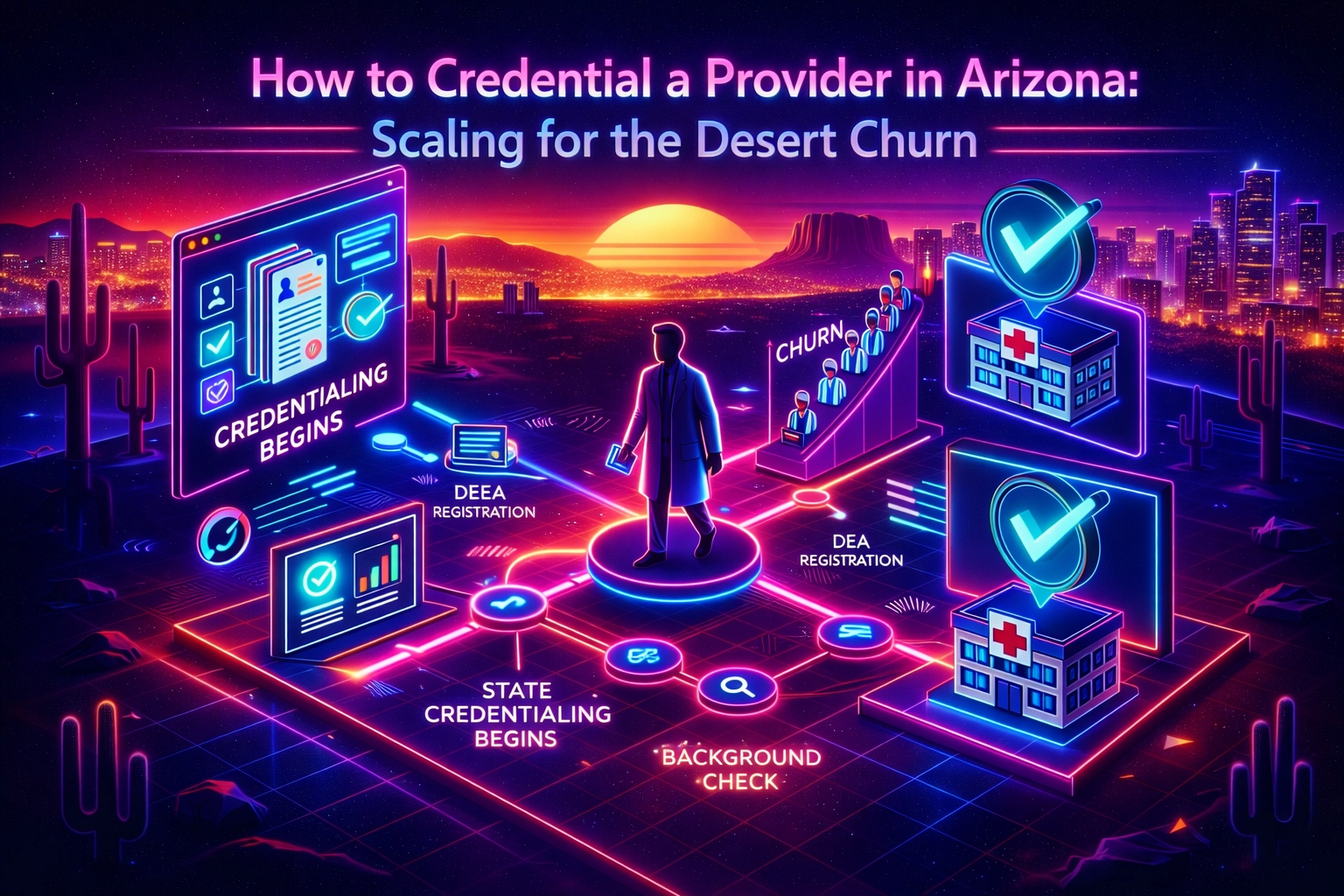
How to Credential a Provider in Arizona: Scaling for the Desert Churn

Navigating the healthcare landscape in the Grand Canyon State requires more than just a map; it requires a high-octane strategy to handle the sheer volume of growth and turnover. Whether you are expanding a primary care network in Maricopa County or scaling a specialized clinic in Pima, professional medical provider enrollment services are the engine that keeps your revenue cycle moving. In a state where behavioral health provider enrollment is surging alongside a transient workforce, your ability to onboard providers quickly is the difference between a thriving practice and a financial drought. That urgency sits inside one of the most important healthcare economies in the country: Arizona healthcare is the state’s largest sector, employing more than 410,000 people, accounting for nearly 10% of the workforce, and contributing $78 billion to state GDP. The Arizona market is unique. It is defined by "Desert Churn": a high rate of provider movement fueled by rapid population growth, a physician supply of just 2.3 physicians per 1,000 residents versus the 2.6 national average, and a payer mix that leans heavily on Medicare Advantage and AHCCCS (Arizona Health Care Cost Containment System). The pressure is not theoretical. Arizona faces a shortage of 23,300 healthcare professionals by 2030, and today it already needs 667 primary care and 228 mental health practitioners just to reach basic access ratios. Public coverage has also expanded fast: AHCCCS and Medicare enrollment has grown 110% since 2000, AHCCCS now covers 31% of the population, or roughly 2.3 million people, and Medicaid reimbursement still lands at only about 60% of private insurance rates. At the same time, Arizona ranks 4th in the nation for quality of care, outperforming states such as California and Massachusetts, with systems like Banner Health and Mayo Clinic-Phoenix helping set the pace. The payer side is becoming even more volatile in 2026. Arizona is staring down a 46.3% weighted average rate increase in the individual market, including reported jumps of 49.0% for AZ Complete Health/Ambetter, 48.7% for Blue Cross Blue Shield of Arizona, and 44.3% for UnitedHealthcare. On top of that, Banner/Aetna CVS is exiting the Arizona individual market on December 31, 2025, forcing more than 55,000 policyholders to shop for new coverage and triggering a major patient-rebalancing event across the state. That combination of growth, shortage, quality pressure, payer volatility, and reimbursement compression makes enrollment execution a board-level issue. In the 2025-2026 consolidation and sale cycle, efficient provider onboarding is not back-office housekeeping; it is a direct driver of practice valuation. In a market with 46% rate hikes and a major carrier exit, provider enrollment speed is the only reliable way for your practice to capture displaced patient demand, protect directory visibility, and maintain revenue stability. To stay ahead, you must look beyond the standard paperwork and treat enrollment as a strategic, multi-phase operation. At The Veracity Group, we run that operation through monday.com, giving you a disciplined, visible control tower to move providers into payer networks fast enough to match Arizona’s high-stakes market. The Foundation: Upstream Licensing and DEA Verification Before a single enrollment application can be submitted to a payer like Blue Cross Blue Shield of Arizona or UnitedHealthcare, the "upstream" work must be flawless. In Arizona, this begins with the Arizona Medical Board or the Arizona Board of Physician Assistants. You cannot afford to wait until a provider’s start date to realize their DEA registration is still tied to a previous out-of-state address. We see this mistake constantly: practices focus so much on the "middle" of the process that they neglect the foundation. At Veracity, our provider enrollment services include a rigorous audit of these upstream credentials. If the license is pending or the DEA isn't Arizona-compliant, the entire machine grinds to a halt. You must ensure that every box is checked: from the initial state application to the specific prescriptive authority required for behavioral health specialists: before you ever touch a payer portal. Image Alt: A polished Retro 80s Neon Arizona healthcare operations scene with enrollment documents and bright magenta-cyan accents, symbolizing fast-moving provider onboarding across the state. Navigating the AzAHP Credentialing Alliance Arizona is home to one of the most structured credentialing environments in the country: the Arizona Association of Health Plans (AzAHP) Credentialing Alliance. This is a centralized system where multiple health plans participate in a unified process managed through a Credentialing Verification Organization (CVO). For your practice, this means there is a "single source of truth," but it also means there is a single point of failure. If your CAQH profile is not perfectly aligned with the AzAHP requirements, your provider will be stuck in a loop of "information requested" statuses. Key Components of the AzAHP Process: CAQH Accuracy: Your CAQH (Council for Affordable Quality Healthcare) profile is the heartbeat of Arizona enrollment. It must be re-attested every 90 days without fail. The Data Form: AzAHP requires a specific data form that supplements the CAQH profile. Missing one signature on this form can delay a provider’s effective date by 30 to 60 days. Primary Source Verification: The CVO will verify everything: education, board certifications, and a minimum five-year work history. Any gap in that history longer than 30 days must be explained in writing. For more information on the official standards, you can visit the AzAHP Credentialing Alliance portal. Managing the "Desert Churn" with Transparency In Arizona’s fast-growing primary care and behavioral health (BH) sectors, provider churn is a constant reality. Providers move between multisite groups frequently, and the state’s below-average physician density intensifies the problem. With only 2.3 physicians per 1,000 residents, Arizona runs leaner than the national benchmark, so every delayed onboarding creates immediate access gaps, referral leakage, and scheduling bottlenecks. The pressure is now colliding with payer upheaval. Arizona’s 2026 individual market rate filings show a jaw-dropping 46.3% weighted average increase, while Banner/Aetna CVS exits the Arizona individual market on December 31, 2025, forcing more than 55,000 policyholders to find new coverage. That is not background noise. It is a massive patient-rebalancing event, and practices that
How to Credential a Provider in Colorado: Navigating the RAE Maze

Colorado is currently experiencing heavy demand for faster provider onboarding, especially as multisite groups expand across the Front Range and rural communities. Managing behavioral health provider enrollment and medical provider enrollment services in this state demands a disciplined, three-step approach built around the Colorado Medicaid process. If your practice treats the RAE Maze like a simple form-filing exercise, delays will stack up, claims will stall, and revenue will sit on the runway instead of taking off. Looking for professional provider credentialing services in the USA? 👉 Check our main service page here: veracityeg.com The High Stakes of the Colorado Behavioral Health Enrollment Landscape Colorado’s Medicaid framework is regional, layered, and unforgiving when your data is incomplete. The Department of Health Care Policy and Financing (HCPF) administers Health First Colorado, and the state relies on Regional Accountable Entities (RAEs) to manage regional operations. That means your practice must move through a defined sequence, not a shortcut. For behavioral health organizations and multispecialty groups alike, this structure creates operational friction. A provider serving patients in more than one county or location can trigger different regional workflows, different contacts, and different downstream timing. That is why the process feels like a maze. It is not random, but it absolutely punishes loose tracking. Image Alt Text: A cinematic moody photo of a healthcare executive overlooking Colorado city lights, representing the layered regional complexity of Medicaid enrollment in Colorado. The Upstream Foundation: Licensing and DEA Before you start the Colorado Medicaid sequence, your source data must be clean. At The Veracity Group, we treat licensing, identifiers, and practice demographics as the runway lights for the entire enrollment process. If those lights are off, the plane does not land. Colorado Medical Board / DORA Licensing: Your provider must hold an active, unrestricted license through the Department of Regulatory Agencies (DORA). A licensing delay immediately pushes every downstream deadline. DEA and CSR Alignment: For prescribing providers, the Colorado practice address on file must match supporting records exactly. Address mismatches, legal name issues, and incomplete ownership details create preventable rejections. Group-to-Provider Data Accuracy: Individual NPI, group NPI, Tax ID, W-9, service location data, and ownership details must line up across every application touchpoint. By addressing these provider enrollment fundamentals first, you stop the classic ping-pong cycle of corrections, resubmissions, and avoidable delays. The Colorado Medicaid Process: The 3-Step RAE Maze Colorado does not run on a vague “submit and hope” model. The process is a strict three-step sequence: Enroll with Health First Colorado (HCPF) Credential with the RAE Contract with the RAE If your practice skips the order, blurs the phases, or assumes one approval activates the next, your timeline breaks. This is where many organizations lose weeks without realizing it. Step 1: Enroll With Health First Colorado (HCPF) Every provider must first complete enrollment with Health First Colorado through the HCPF process. This is the front gate. No RAE work matters until this piece is clean and active. What happens in this phase: HCPF validates provider and organizational data Enrollment records are reviewed for completeness and accuracy Core identifiers, ownership data, licensure, and practice information are checked Average completion time: 3 days That average is fast on paper, but only when your submission is complete. Missing ownership data, NPI mismatches, or location errors will turn a three-day checkpoint into a much longer detour. According to the Colorado HCPF provider enrollment guidance, this state-level enrollment is the mandatory first move. Step 2: Credential With the RAE Once HCPF enrollment is complete, the provider moves into the RAE credentialing phase. This is where the regional maze becomes real. The RAE reviews the provider under NCQA standards, confirms eligibility for network participation, and checks the documentation package required for regional approval. Average completion time: 20–30 days This step is where stale data quietly burns time. A neglected CAQH profile is one of the most common culprits. Keeping CAQH current reduces credentialing time by 1–5 days because the RAE does not have to chase avoidable discrepancies in work history, malpractice coverage, attestation, or practice demographics. That is not a minor win. In a busy launch cycle, 1–5 days is the difference between smooth onboarding and a very awkward conversation with your revenue team. Colorado’s RAE structure also matters here. The current regional alignment includes: Region 1: Rocky Mountain Health Plans Region 2: Northeast Health Partners Regions 3 & 5: Colorado Access Region 4: Health Colorado / CareLon Regions 6 & 7: CCHA If your provider locations span multiple regions, your internal tracking must reflect the correct RAE path for each service site. Otherwise, you create directory errors, delayed approvals, and claim denials that show up after your providers have already started seeing patients. For organizations tightening their data before submission, our guidance on maintaining a clean CAQH profile is a practical place to start, and the NCQA framework remains the benchmark behind this review process. Step 3: Contract With the RAE After regional approval, your practice still must complete RAE contracting. This is the step many groups underestimate, and it is exactly where launch timelines go sideways. Average completion time: 20–120 days depending on complexity Why the wide range? Because contracting depends on factors such as: Number of providers and service locations Specialty mix and scope of services Group structure and ownership complexity Accuracy of submitted entity data Regional processing pace and follow-up responsiveness This phase is where participation terms are finalized and the provider’s path to billing becomes operational. If your team treats contracting like an afterthought, the provider will sit in limbo: approved in one sense, but not ready where it counts. Image Alt Text: A cinematic moody image of enrollment documents and a professional pen, highlighting the precision required for Colorado Medicaid and RAE processing. Managing the Multisite Surge: Scale Without Chaos For large groups, the real threat is not volume alone. The threat is losing control of which provider is in which phase. If you are onboarding 10, 20, or 50 providers across Colorado, you are