Veracity upscaled revised

5 DEA Registration Traps That Could Stop Your Practice

Ld8IAx7V8RT

For any prescribing clinician, the Drug Enforcement Administration (DEA) registration is more than just a certificate on the wall; it is the fundamental authorization that allows you to treat patients effectively. Yet, despite its importance, the DEA registration system is notoriously rigid. It is built for regulatory compliance, not for user-friendliness. At The Veracity Group, we navigate these complexities daily. We see high-performing clinics brought to a standstill because a single administrative detail was overlooked. In the world of healthcare, a lapse in DEA registration is not a minor inconvenience: it is a practice-stopping event. When your prescribing authority vanishes, your ability to generate revenue often vanishes with it. Understanding the nuances of these regulations is the only way to safeguard your operations. Here are the five most common DEA registration traps that could stop your practice in its tracks. 1. The “Silent” Expiration: Email-Only Reminders Since 2020, the DEA has transitioned to a strictly digital notification system for renewals. This shift has created a massive blind spot for providers who are accustomed to receiving physical mail or “official-looking” envelopes. The DEA sends renewal reminders by email only. If the email address associated with your registration is outdated, inactive, or buried in a junk folder, you will receive zero warning before your registration lapses. There is no courtesy phone call. There is no letter sent to your primary practice location. If you registered five years ago using a personal Gmail account or a former employer’s email address, you are at extreme risk. When that registration expires, the pharmacy will be the first to tell you: by rejecting your prescriptions. By then, the damage is done. Utilizing professional medical provider enrollment services ensures that your contact information is audited and maintained, preventing a “silent” expiration from deailing your week. Alt-tag: A laptop and phone displaying a DEA renewal alert beside a marked deadline calendar and compliance documents. 2. The Location Trap: It’s Not a State-Wide License One of the most frequent misconceptions we encounter is the belief that a DEA registration covers a provider across an entire state. This is a dangerous assumption. DEA registration is location-based, not state-based. Under federal law, a separate registration is required for every principal place of business where controlled substances are manufactured, distributed, or dispensed. Consider these scenarios: You practice at a main clinic but spend two days a week at a satellite office where you dispense or store samples. You provide locum tenens services at a different facility. You have expanded your practice to include a new surgery center location. In many of these cases, a separate DEA number is required for each site. Moving to a new office or adding a secondary location without updating your DEA profile or applying for an additional registration is a direct compliance violation. As noted in the medical group enrollment for surgery centers guide, site-specific compliance is a major hurdle that requires constant vigilance. 3. The Sequencing Error: State Permits Must Come First In the world of medical provider enrollment services, the order of operations is everything. Many providers attempt to expedite their DEA application by filing it as soon as they receive their state medical license. However, in approximately half of all U.S. states, this will result in immediate rejection or a prolonged hold. These states require a State Controlled Substance Permit (CSP) to be active and verified before the DEA will process your federal application. If you apply for the DEA first, the system will not “wait” for your state permit to arrive. It simply stalls. This sequencing mistake can cost your practice weeks of lead time. For a new provider joining your group, those weeks represent lost patient access and thousands of dollars in unrealized revenue. You must verify the specific requirements of your state’s pharmacy or medical board regarding CSPs before touching a DEA application. You can find more information on federal requirements at the DEA Diversion Control Division. 4. The 30-Day Cliff: Reinstatement vs. New Application There is a common myth that the DEA provides a generous grace period for lapsed registrations. The reality is far more punishing. While there is a 30-day reinstatement window, this is not a period of continued authority. During that 30-day gap, you cannot prescribe controlled substances. If you miss the deadline, you are effectively “down.” If you fail to reinstate within that 30-day window, your registration is deleted from the system. At that point, you are no longer eligible for “renewal” or “reinstatement.” You must file a completely new application. New applications are subject to more rigorous scrutiny and significantly longer processing times than renewals. Furthermore, you must now account for new mandates, such as the MATE Act training requirements, which require eight hours of specialized training on opioid or other substance use disorders. Failure to document this training during a new application will result in an immediate denial. 5. The “Ghost” Address: Mismatched Records and Audit Risks Your DEA registration does not automatically update when you move. It does not sync with your NPI record, your CAQH profile, or your state medical board. It is a standalone system that requires manual updates. When providers relocate or join a new medical group, they often forget to update their DEA “Principal Place of Business.” This creates “ghost” records where your DEA registration is tied to a location where you no longer practice. This causes two major issues: Pharmacy Rejections: When a pharmacy runs a check and sees your registered address doesn’t match your current practice address, they may refuse to fill the script. Audit Red Flags: In the event of an inspection, mismatched records are considered a serious compliance failure. The DEA expects your registration to reflect exactly where you are seeing patients and prescribing. Keeping these records in sync is a full-time job. This is where The Veracity Group excels. We manage the administrative burden of demographic updates and ensure that your DEA registration is always an accurate reflection of your current practice reality. Conclusion:

Provider Enrollment in New York: PNDS + Dual Eligible Unwind

Dvs1cCTAPmF

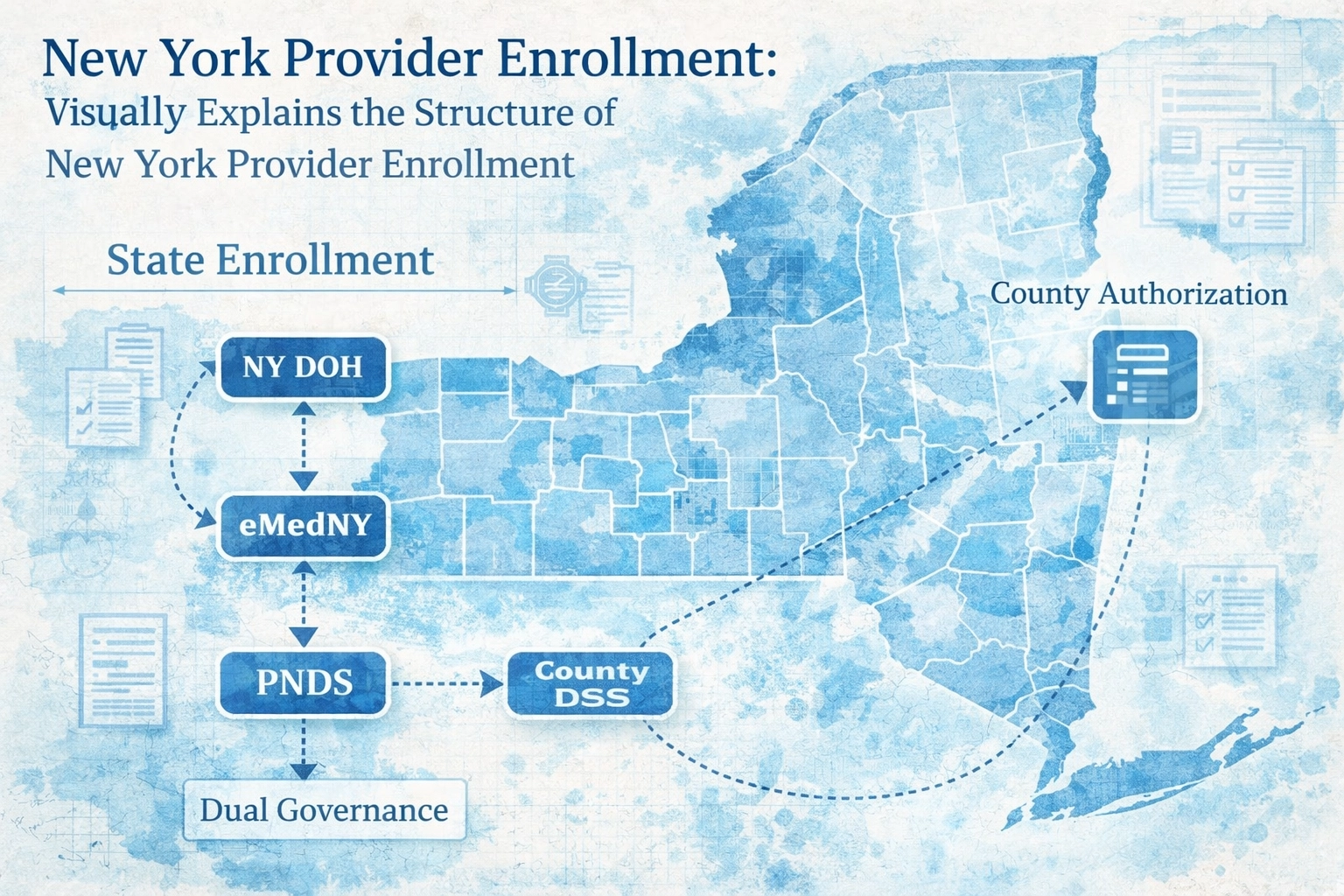
New York provider enrollment isn’t just complicated: it’s layered with administrative tripwires that derail even experienced practice managers. While most administrators focus on state-level Department of Health requirements, they miss how managed care network reporting, ongoing Provider Network Data System (PNDS) expectations, and NPI linking failures create a perfect storm of delays that cost your practice thousands in lost revenue. If you’re managing a multi-location clinic or expanding into New York for the first time, you’re walking into one of the most complex enrollment landscapes in the country. New York is uniquely challenging, but every state brings its own set of hurdles. See how it compares to other regions in our guide on Three States, Three Realities: Medicaid Enrollment in Texas, Indiana, and California. Here’s what most practice managers don’t know: and what will cost you if you don’t address it. 1) The Real New York Trap: Enrollment + Network Participation Drift New York Medicaid enrollment succeeds or fails based on clean, consistent provider data and plan-facing participation rules. Your eMedNY enrollment, your NPPES record, and the way Managed Care Organizations (MCOs) list you in their networks must align under the broader managed care oversight framework described on Medicaid.gov. This creates the operational trap: your practice can be enrolled but still not paid when your network participation data, provider directory listing, or plan configuration does not match what the MCO reports. What “Participation Drift” Looks Like in Real Life When your practice expands locations, adds providers, or changes tax details, you must keep every system synchronized. Drift shows up as: Rendering providers missing from a plan’s active roster even though your clinic treats members Incorrect service locations in plan directories that block referrals and generate grievances Tax ID / pay-to mismatches that trigger claim denials or payment holds Role configuration errors (billing vs. rendering vs. servicing) that reject claims at intake For high‑Medicaid specialties (behavioral health, pediatrics, family medicine, urgent care), these gaps create immediate revenue disruption because volume is high and denials compound fast. 2) eMedNY Enrollment vs. PNDS: Know What Each System Actually Does New York’s eMedNY remains the backbone of Medicaid claims processing and provider enrollment workflow. PNDS is different. PNDS is a managed care provider network reporting tool used for oversight of MCO networks—plans submit provider network data and the state evaluates network adequacy. New York DOH describes PNDS as a managed care provider network data system (see NYSDOH PNDS overview). In federal context, Medicaid managed care oversight relies on accurate network reporting as part of monitoring and access expectations (see Medicaid.gov managed care monitoring tools guidance). Why PNDS Accuracy Still Impacts Your Payments Because MCOs use provider network data to build rosters and directories, bad data turns into operational denial triggers. When your information is wrong in a plan’s network file, you see: Claims pended or denied due to provider/location not recognized for the member’s plan Referral leakage because patients can’t find you in directories Credentialing/contracting rework inside the plan (even when you already treat members) Network participation gaps that stall new site launches The Data Fields That Trip Up Most Practices During PNDS transition, these specific data elements cause the most enrollment failures: Service location addresses that don’t exactly match IRS tax documents Taxonomy codes that don’t align with actually rendered services Group NPI versus individual NPI designation errors Doing Business As (DBA) names that differ from legal entity names Supervising provider relationships for behavioral health services Even a minor discrepancy: like using “Street” instead of “St.” in your address: can trigger a validation failure that delays your enrollment by 45-60 days. NPI Linking: The Silent Enrollment Killer NPI linking failures represent the single most common reason for New York provider enrollment delays. The state requires precise relationships between individual provider NPIs, group NPIs, and service location NPIs: and if these relationships aren’t established correctly in both NPPES and eMedNY, your entire enrollment grinds to a halt. How NPI Linking Actually Works (And Where It Breaks) When you enroll in New York Medicaid, you must establish clear hierarchical relationships: Individual providers must be linked to the group NPI under which they practice Service locations must be associated with the correct group NPI Rendering providers must have active individual NPIs properly linked to billing entities Supervising providers must be explicitly linked to supervised staff for behavioral health services The problem? These relationships must be established in NPPES first, then replicated exactly in eMedNY, and now again in PNDS. Any mismatch creates a validation error that prevents enrollment completion. For practices offering medical provider enrollment services across multiple specialties, NPI linking becomes exponentially more complex. You’re managing multiple provider types, various supervision structures, and different taxonomy codes: all of which must align perfectly across three separate systems. The 30-Day NPPES Update Window Here’s a trap most practice managers fall into: they update NPI information in NPPES but immediately attempt to complete their eMedNY enrollment. NPPES changes take 7-10 business days to propagate to state Medicaid systems. If you submit your New York enrollment before NPPES updates are visible to eMedNY, your application will be rejected for data inconsistencies: even though your NPPES data is technically correct. You must wait for full NPPES propagation before proceeding with state enrollment. 4) The Real Consequences of eMedNY + Network Reporting Failures These aren’t theoretical problems: they create immediate revenue disruptions for practices that underestimate New York’s enrollment and managed care participation requirements: 1) Lost Revenue During Delays: Every week of enrollment delay costs practices an average of $8,000-$15,000 in unbillable Medicaid services, depending on patient volume. For behavioral health practices with high Medicaid patient populations, a 90-day delay means $50,000+ in lost revenue. 2) Directory and Roster Breakage: When your practice location, taxonomy, or provider affiliation is wrong in an MCO’s network data, patients search directories and never find you—even while your front desk schedules them. 3) Retroactive Billing Limits: New York allows limited retroactive billing (typically 60-90 days from enrollment approval), but services delivered during prolonged enrollment