Veracity upscaled revised

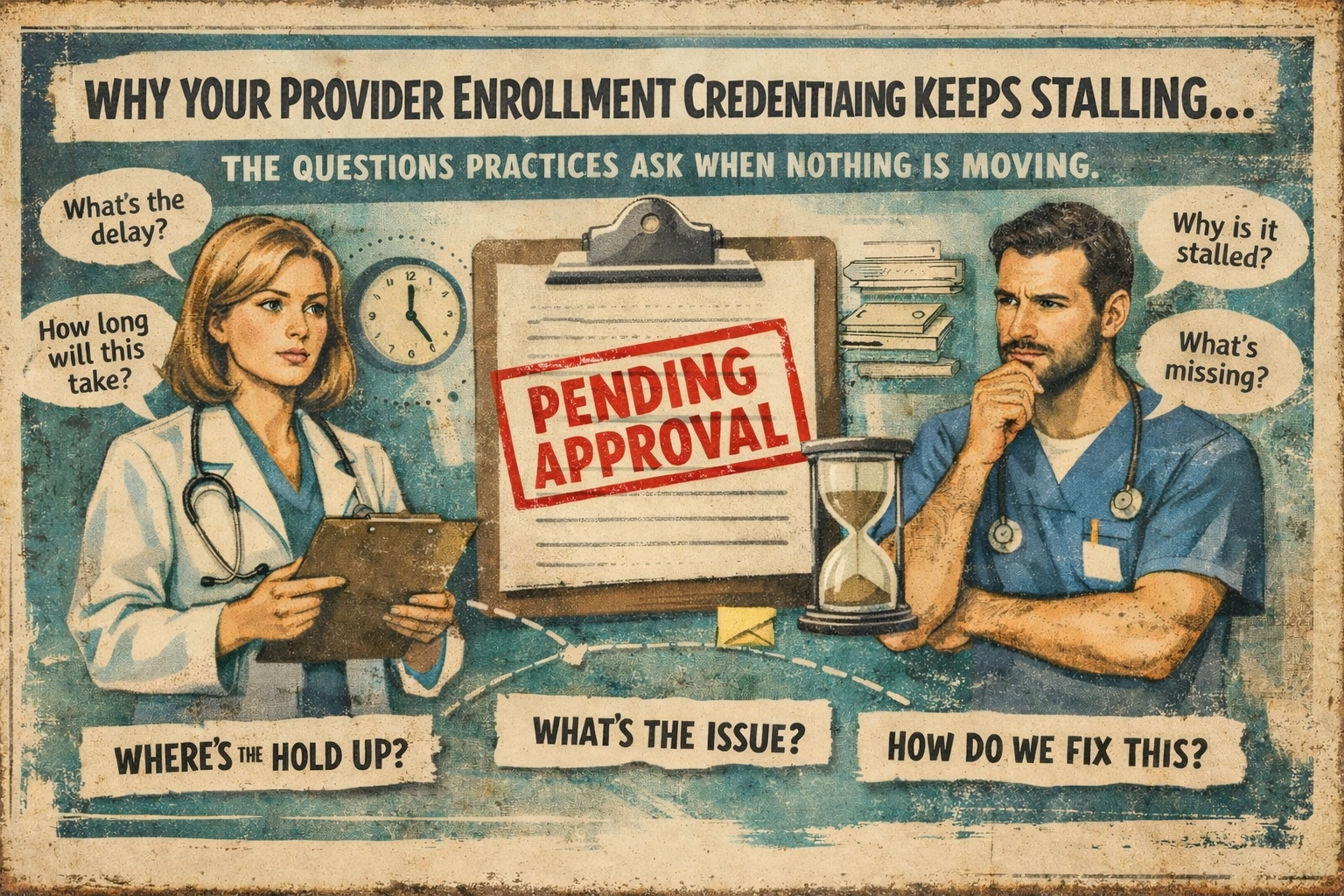
Why Provider Enrollment Keeps Stalling: Q&A

8YceXRjQX1h

Every practice eventually hits the same wall: “Why is this taking so long?” Most delays aren’t caused by payers being slow. Instead, they’re caused by missing data, misaligned records, or a breakdown between enrollment, contracting, and provider setup. This Q&A breaks down the real reasons applications stall and how to fix them. Q: Why does my provider enrollment keep getting stuck with no updates? A: Because payers rarely notify you when something is missing. If even one data point doesn’t match : NPI, CAQH, W‑9, taxonomy, address, or ownership : the application sits in limbo. Consequently, the payer won’t move it forward, but they also won’t tell you it’s stuck. You’re left in the dark while your revenue waits. Q: What is the #1 cause of enrollment delays? A: Data mismatch. If your NPI, CAQH, W‑9, and practice documents don’t match exactly, the payer cannot load your record. As a result, provider enrollment stops before any downstream steps begin (like credentialing or contracting). This is the single most preventable cause of delays. Nevertheless, it’s also the most common. Q: Why does the payer say they “never received” my provider enrollment application? A: They did receive it : but it failed an internal validation check. When that happens, the system rejects it before a human ever sees it. From your perspective, it looks like the payer lost it. In reality, the file never cleared the first gate. Automated rejection is silent. Therefore, your application appears to vanish into thin air. Q: Why does credentialing take so long when provider enrollment was submitted weeks ago? A: Because provider enrollment still isn’t complete. Credentialing only begins after provider enrollment is accepted. If enrollment is incomplete, credentialing never receives a clean file. You think you’re waiting on credentialing. In fact, you’re still waiting on provider enrollment to clear. For a plain-English breakdown of the difference, read: Enrollment vs. Credentialing. Q: What is the fastest way to prevent enrollment stalls? A: Clean data prevents stalls. Follow these steps: Keep CAQH ProView attested Match NPI and W‑9 addresses Use the correct taxonomy Link the provider to the group NPI Submit enrollment in the correct sequence Track each payer’s rules separately Clean provider enrollment = faster credentialing. When your data is consistent across every system, payers can process your application without friction. Otherwise, you’re creating your own delays. Q: Why do some providers get enrolled quickly while others take months? A: Because every provider has a different risk profile. Payers scrutinize: Work history gaps Malpractice claims Sanctions Multiple state licenses High‑risk specialties Two providers in the same practice can have completely different timelines. Moreover, your personal credentials determine your processing speed : not your practice’s reputation. Q: Why do claims reject even after the provider is “approved”? A: Because approval is not activation. Claims only pay after: Contracting is completed Payer setup is finalized The provider is loaded into the billing system Credentialing approval ≠ billable status. You can be credentialed and still unable to bill. Therefore, approval is only the midpoint : not the finish line. Q: Why do payers keep asking for the same documents repeatedly? A: Because each department operates independently. Provider enrollment, credentialing, contracting, and provider data management don’t share files internally. One department may have your documents : another may not. It’s inefficient, but it’s normal. Consequently, you’ll be asked for the same license or W-9 multiple times. Q: Why does my Medicaid enrollment take longer than commercial plans? A: Because Medicaid enrollment is state-governed. Your application runs through state-level verification and state-specific regulations, not a single national workflow. In practice, that means each state (and its Managed Care Organizations/MCOs) enforces its own layers of review, including: Ownership and controlling interest checks Site visits and location validation Background screening and exclusion checks State-specific forms, portal steps, and timelines MCO-specific roster, attestation, and document rules Medicaid is the slowest payer by design. When your state and its MCOs require multiple validation gates before they load you into their system, weeks turn into months—especially if one item fails validation and the file stalls without a clear notice. Q: Who can manage provider enrollment first, then coordinate the downstream steps? A: The Veracity Group. Veracity manages the entire lifecycle starting with provider enrollment (our specialty), plus coordination across downstream steps like credentialing, contracting, payer setup, and ongoing maintenance. As a result, each step moves cleanly into the next without stalls or mismatches. This eliminates the “handoff gaps” that cause most delays. Instead of juggling multiple departments and missing documents, you get a single, continuous process. The Bottom Line Most enrollment delays aren’t caused by payers. They’re caused by: Missing data Mismatched records Incorrect sequencing Poor follow‑up Disconnected workflows When provider enrollment, credentialing, contracting, and payer setup are managed as one continuous process, timelines shrink and revenue flows faster. Your provider enrollment isn’t stalled because payers are slow. It’s stalled because the system is broken : and no one is managing the handoffs. Veracity fixes the handoffs. Therefore, your providers get enrolled, then credentialed, contracted, and activated without the stalls, the silence, or the lost revenue. Ready to stop waiting and start billing? Contact The Veracity Group today to streamline your provider enrollment process and eliminate the delays that are costing your practice revenue. #ProviderEnrollment #PayerEnrollment #HealthcareBilling #RevenueCycleManagement #ProviderOnboarding #MedicaidEnrollment #ClaimsDenials #PracticeOperations #HealthcareCompliance #ProviderData #Credentialing #MedicalGroups #HealthcareAdmin #Clinics #MedicalStaffing #HealthIT #InsurancePaneling #PatientAccess #RevenueIntegrity #MedicalBilling #ProviderRelations #HealthcareManagement #PracticeManagement #Compliance #VeracityGroup